The Texas Child Power of Attorney form is a vital legal tool that allows parents or guardians to delegate specific decision-making authority regarding their child to another trusted adult. This form is particularly useful in situations where parents may be temporarily unavailable, such as during travel or medical emergencies. By completing this document, parents can ensure that their child receives necessary care and support without delays. The form covers various aspects, including the scope of authority granted, the duration of the power of attorney, and any limitations on the powers given. It is essential to provide clear instructions to avoid confusion and ensure the child's best interests are prioritized. Understanding how to properly execute this form can help families navigate challenging circumstances with confidence and peace of mind.
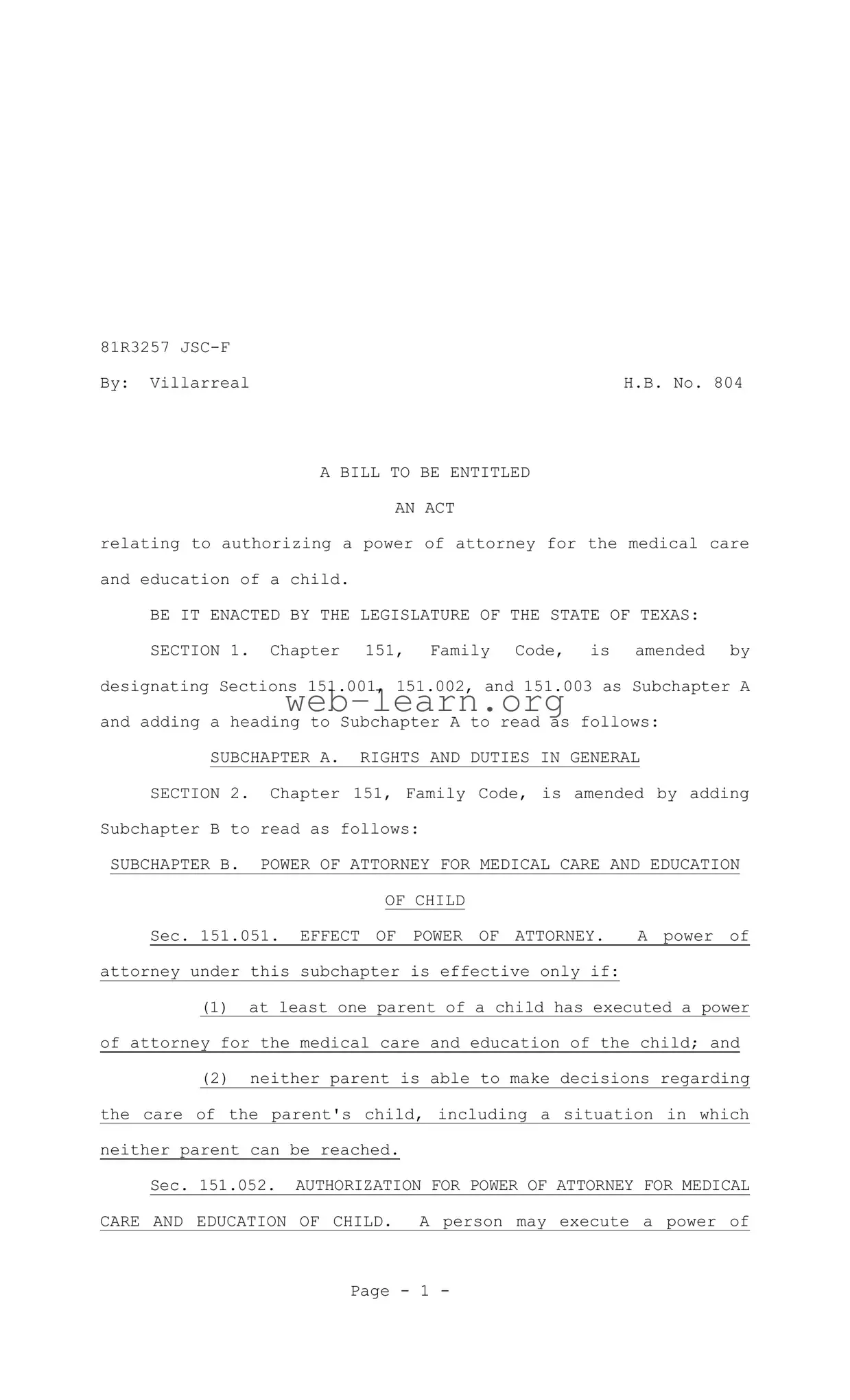
81R3257 |
|
By: Villarreal |
H.B. No. 804 |
A BILL TO BE ENTITLED
AN ACT
relating to authorizing a power of attorney for the medical care and education of a child.
BE IT ENACTED BY THE LEGISLATURE OF THE STATE OF TEXAS: SECTION 1. Chapter 151, Family Code, is amended by
designating Sections 151.001, 151.002, and 151.003 as Subchapter A and adding a heading to Subchapter A to read as follows:
SUBCHAPTER A. RIGHTS AND DUTIES IN GENERAL
SECTION 2. Chapter 151, Family Code, is amended by adding Subchapter B to read as follows:
SUBCHAPTER B. POWER OF ATTORNEY FOR MEDICAL CARE AND EDUCATION
OF CHILD
Sec. 151.051. EFFECT OF POWER OF ATTORNEY. A power of attorney under this subchapter is effective only if:
(1)at least one parent of a child has executed a power of attorney for the medical care and education of the child; and
(2)neither parent is able to make decisions regarding the care of the parent's child, including a situation in which neither parent can be reached.
Sec. 151.052. AUTHORIZATION FOR POWER OF ATTORNEY FOR MEDICAL CARE AND EDUCATION OF CHILD. A person may execute a power of
Page - 1 -
H.B. No. 804 attorney appointing another person as the person's agent to make
decisions regarding the medical care and education of the person's child.
Sec. 151.053. FORM. (a) A power of attorney for the medical care and education of a child must be in substantially the following form:
POWER OF ATTORNEY FOR THE MEDICAL CARE AND EDUCATION OF A CHILD
Part I: To be filled out and/or initialed by parent(s). Minor Child's Name_________________________________
Mother/Legal Guardian's Name & Address
______________________________
______________________________
______________________________
Father/Legal Guardian's Name & Address
______________________________
______________________________
______________________________
Caregiver's Name & Address
______________________________
______________________________
______________________________
(check one of the following)
(____) Both parents are living and have signed this
document;
(____) One parent is deceased;
Page

H.B. No. 804 (____) The
for one of the parents;
(____) The
been limited by a court order;
(____) One parent is the sole managing conservator of the
minor child and has sent a copy of this document, by certified mail, return receipt requested, to the other parent at that
parent's last known address; or
(____) The other parent has not consented to the
appointment or consent cannot be obtained because
______________________________.
Temporary
(____) the serious illness or incarceration of a parent
or legal guardian;
(____) the physical or mental condition of the parent or
legal guardian or the child is such that care and supervision of
the child cannot be provided;
(____) the need for medical or mental health treatment
(including substance abuse treatment) by |
the parent or legal |
||
guardian; |
|
|
|
|
(____) the military deployment of the parent or legal |
||
guardian; or |
|
|
|
|
(____) other |
(please |
describe) |
Page
H.B. No. 804
__________________________________________________, at a time when
the other parent or legal guardian, if applicable, is unable to care for the child.
(____) I/We the undersigned, authorize the named caregiver to
do one or more of the following (check as appropriate):
(_____) enroll the child in school and extracurricular
activities;
(_____) obtain medical, dental, and mental health
treatment for the child; and
(_____) provide for the child's food, lodging, housing,
recreation, and travel.
(____) I/We grant the following additional powers to the named
caregiver:___________________________________________.
(____) I/We understand that this document does not provide
legal custody to the caregiver. If at any time I/we disagree with a decision of the named caregiver or choose to make any health care or educational decisions for my/our child, I/we must revoke the power of attorney, in writing, and provide written documentation to the health care provider and the local education agency (i.e., school).
(____) I/We understand that this document may be terminated by
another written document signed by either parent with legal authority or by any order of a court with competent jurisdiction.
Part II: To be initialed by caregiver as applicable.
(____) I understand that this document, properly executed,
Page
H.B. No. 804 gives me the right to enroll the minor child in the local education
agency serving the area where I reside.
(____) I understand that this document does not provide me
with legal custody of the minor child.
(____) I understand that, prior to enrollment, the local
education agency may require documentation of the minor child's residence with a caregiver and/or documentation or other verification of the validity of the stated hardship.
(____) I understand that, except to the extent limited by
federal law, I shall be assigned the rights, duties, and responsibilities that would otherwise be assigned to the parent, legal guardian, or legal custodian of the minor child.
(____) I understand that if the minor child ceases to reside
with me, I am required by law to notify any person, school, or health care provider to whom I have given this document.
I/We declare under penalty of perjury under the laws of the State of Texas that the foregoing is true and correct.
Signed this ___ day of __________, 20__.
______________________________
Mother/Legal Guardian
The Mother/Legal Guardian, ______________________, personally
appeared before me this _____ day of ____________, 20__.
______________________________
Notary Public in and for the State of Texas
My commission expires: ___________________
Page
H.B. No. 804
Signed this ___ day of __________, 20__.
______________________________
Father/Legal Guardian
The Father/Legal Guardian, ______________________, personally
appeared before me this _____ day of ____________, 20__.
______________________________
Notary Public in and for the State of Texas
My commission expires: ___________________
Signed this ___ day of __________, 20__.
______________________________
Caregiver
The Caregiver, ______________________, personally appeared
before me this _____ day of ____________, 20__.
______________________________
Notary Public in and for the State of Texas
My commission expires: ___________________
NOTICE TO THE LOCAL EDUCATION AGENCY AND/OR HEALTH CARE PROVIDER: No person, school official, or health care provider who acts in good faith reliance on a power of attorney for care of a minor child to enroll the child in school or to provide medical, dental, or mental health care, without actual knowledge of facts contrary to those authorized, is subject to criminal or civil liability to any person, or is subject to professional disciplinary action for such reliance. This immunity applies even if medical, dental, or mental health care is provided to a minor child or the
Page
H.B. No. 804 child is enrolled in a school in contravention of the wishes of the
child's parent, if the person, school official, or health care provider has been provided a copy of an appropriately executed power of attorney for care of the minor child and has not been provided written documentation that the parent has revoked the power of attorney for care of the minor child. Nothing in this document relieves any individual from liability for a violation of any other law.
(b)A power of attorney for the medical care and education of a child is legally sufficient under this chapter if the wording of the form complies substantially with Subsection (a), the form is properly completed, and the signatures of the parent or parents, as applicable, and the caregiver are acknowledged.
Sec. 151.054. TERMINATION OF AGENT'S AUTHORITY. (a) The authority of an agent appointed in a power of attorney for the medical care and education of a child executed by the child's parent or parents terminates:
(1)on the appointment and qualification of a guardian of the person appointed for the child under Chapter XIII, Texas Probate Code; or
(2)on revocation of the power of attorney by either parent who executed the power of attorney.
(b)An agent's authority with regard to a child under a power of attorney is terminated if a parent of the child who did not execute the power of attorney presents to the court evidence that
Page
H.B. No. 804 the parent is able to make decisions regarding the care of the
child.
Sec. 151.055. USE OF POWER OF ATTORNEY IN APPOINTING GUARDIAN OF THE PERSON FOR CHILD. (a) A power of attorney for the medical care and education of a child executed under this subchapter is not considered a written declaration of appointment of a guardian authorized by Section 676(d), Texas Probate Code.
(b)If a person who executes a power of attorney for the medical care and education of a child under this subchapter does not execute a written declaration of appointment of a guardian authorized by Section 676(d), Texas Probate Code, and an application for the appointment of a guardian of the person for the child is pending under Chapter XIII, Texas Probate Code, the court may consider the person appointed as the agent under the power of attorney for the medical care and education of a child in appointing a qualified person to serve as guardian of the person for the child under Section 676(c), Texas Probate Code.
SECTION 3. This Act takes effect September 1, 2009.
Page
| Fact Name | Details |
|---|---|
| Purpose | The Texas Child Power of Attorney form allows a parent or legal guardian to designate another adult to make decisions for their child. |
| Governing Law | This form is governed by Texas Family Code Section 751. |
| Duration | The authority granted by this form can last up to six months unless specified otherwise. |
| Eligibility | Only a parent or legal guardian can execute this form to appoint an agent. |
| Agent's Authority | The appointed agent can make decisions regarding the child's education, health care, and welfare. |
| Revocation | A parent or guardian can revoke the Power of Attorney at any time in writing. |
| Notarization | The form must be signed in the presence of a notary public to be valid. |
| Limitations | This form does not grant the agent the authority to consent to marriage or adoption of the child. |
| Use in Emergencies | This form can be particularly useful in emergency situations where a parent is unavailable. |
Filling out the Texas Child Power of Attorney form is a straightforward process that allows you to designate someone to make decisions on behalf of your child. After completing the form, you'll need to ensure it is properly signed and notarized before it can be used.
After completing these steps, keep a copy of the signed and notarized form for your records. Provide the original to the designated agent, so they can act on your behalf when necessary.
The Texas Child Power of Attorney form is a legal document that allows a parent or legal guardian to grant another person the authority to make decisions on behalf of their child. This authority can include making educational, medical, and other important decisions when the parent or guardian is unavailable.
Any responsible adult can be appointed as an agent. This could be a relative, family friend, or anyone the parent trusts to act in the best interest of the child. It is important to choose someone who is reliable and understands the child's needs.
The agent can make a variety of decisions, including:
The document is typically valid for up to six months, unless specified otherwise. However, it can be revoked or amended by the parent or guardian at any time, as long as they provide proper notice to the agent.
Yes, the form must be signed in the presence of a notary public to be considered valid. This adds an extra layer of authenticity and ensures that the document is legally recognized.
Yes, a single form can be used to appoint an agent for multiple children. However, it is advisable to clearly indicate the names and details of each child to avoid any confusion regarding the authority granted.
If the appointed agent is unable to fulfill their responsibilities, the parent or guardian can designate a new agent or revoke the existing power of attorney. It is essential to communicate any changes promptly to ensure the child's needs are always met.
Yes, the form can be revoked at any time by the parent or guardian. To revoke, a written notice should be provided to the agent and any relevant institutions, such as schools or medical facilities, to prevent any confusion.
The form can typically be obtained from legal websites, local government offices, or family law attorneys. Ensure that you are using the most current version of the form to comply with Texas laws.
When filling out the Texas Child Power of Attorney form, individuals often make critical mistakes that can lead to complications. One common error is failing to provide accurate information about the child. This includes the child's full name, date of birth, and address. Omitting or misspelling this information can create confusion and may invalidate the document.
Another frequent mistake is not specifying the duration of the power of attorney. The form should clearly state how long the authority is granted. Without this detail, the document may be considered ambiguous, leading to potential disputes later on.
Many people overlook the need for signatures. Both the parent or guardian granting the power and the agent receiving it must sign the form. Neglecting to obtain the necessary signatures can render the document ineffective.
Additionally, individuals often forget to have the document notarized. In Texas, notarization is a crucial step for the power of attorney to be legally binding. Skipping this step can result in the form being challenged or deemed invalid.
Another mistake is failing to outline the specific powers granted to the agent. The form should detail what decisions the agent can make regarding the child's care. Vague language can lead to misunderstandings and conflicts over authority.
Some people mistakenly believe that the power of attorney is permanent. However, it is essential to indicate if the authority is temporary or if it will end upon a certain event, such as the return of the child to the parent. Clarity on this point is vital.
Another common oversight is not updating the form when circumstances change. If the agent’s contact information changes or if the relationship between the parties alters, the form should be revised to reflect these changes. Failing to do so can lead to confusion and potential legal issues.
Moreover, individuals sometimes neglect to discuss the arrangement with the agent beforehand. It's crucial for the person granting the power to ensure that the agent is willing and prepared to take on this responsibility. Lack of communication can lead to unexpected challenges.
People also often underestimate the importance of reviewing the form before submission. Errors can easily slip through, so taking the time to double-check all information is essential. A thorough review can prevent many issues down the line.
Finally, individuals may not seek legal advice when necessary. While the Texas Child Power of Attorney form is designed to be user-friendly, consulting with a legal professional can help avoid pitfalls and ensure that the document meets all legal requirements.
The Texas Child Power of Attorney form allows a parent or legal guardian to designate another individual to make decisions on behalf of their child. This form is particularly useful in situations where the parent is temporarily unable to care for the child, such as during travel or extended absences. Along with this form, several other documents may be needed to ensure comprehensive legal authority and clarity in various situations.
These documents, when used alongside the Texas Child Power of Attorney form, create a comprehensive framework for ensuring the child's well-being and safety during the parent's absence. Proper preparation can help avoid misunderstandings and provide peace of mind for both the parent and the caregiver.
When filling out the Texas Child Power of Attorney form, it’s essential to approach the task with care. Here are some important dos and don’ts to keep in mind:
The Texas Child Power of Attorney form is a crucial document for parents who need to grant temporary authority to another individual regarding their child. However, several misconceptions surround this form. Below is a list of ten common misunderstandings, along with clarifications for each.
Understanding these misconceptions can help parents make informed decisions about the Texas Child Power of Attorney form and its appropriate use.
The Texas Child Power of Attorney form allows a parent or guardian to designate another adult to make decisions on behalf of their child. Here are some key takeaways regarding its use: