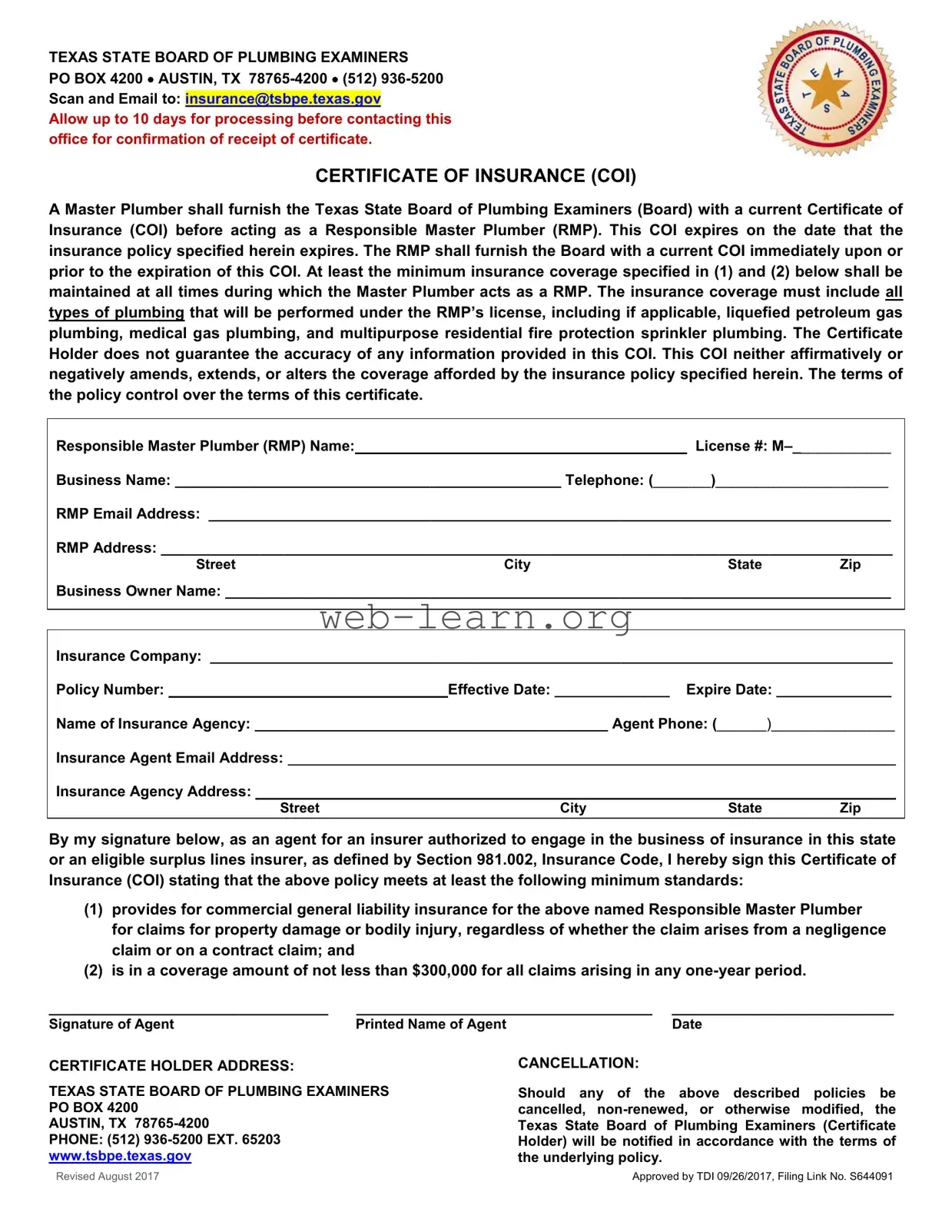
The Texas Certificate of Insurance (COI) form plays a crucial role for Master Plumbers in Texas, especially those designated as Responsible Master Plumbers (RMPs). Before assuming their responsibilities, RMPs must submit a current COI to the Texas State Board of Plumbing Examiners. This form is not just a piece of paper; it signifies that the plumber has the necessary insurance coverage to operate legally and safely. The COI must detail specific insurance coverage, including commercial general liability insurance, with a minimum coverage amount of $300,000 for any claims within a year. It's important to note that the insurance must cover all plumbing activities under the RMP's license, which may include specialized services like medical gas plumbing or fire protection sprinkler systems. The validity of the COI aligns with the insurance policy's expiration date, and RMPs are responsible for providing an updated COI as soon as the previous one expires. Additionally, the form includes essential contact information for both the RMP and their insurance provider, ensuring that the Board can easily verify coverage. While the Certificate Holder does not guarantee the accuracy of the information provided, it serves as a formal acknowledgment that the necessary insurance standards have been met. Understanding these aspects of the Texas COI form is vital for maintaining compliance and ensuring the safety of plumbing operations across the state.

TEXAS STATE BOARD OF PLUMBING EXAMINERS
PO BOX 4200 • AUSTIN, TX
Allow up to 10 days for processing before contacting this office for confirmation of receipt of certificate.
CERTIFICATE OF INSURANCE (COI)
A Master Plumber shall furnish the Texas State Board of Plumbing Examiners (Board) with a current Certificate of Insurance (COI) before acting as a Responsible Master Plumber (RMP). This COI expires on the date that the insurance policy specified herein expires. The RMP shall furnish the Board with a current COI immediately upon or prior to the expiration of this COI. At least the minimum insurance coverage specified in (1) and (2) below shall be maintained at all times during which the Master Plumber acts as a RMP. The insurance coverage must include all types of plumbing that will be performed under the RMP’s license, including if applicable, liquefied petroleum gas plumbing, medical gas plumbing, and multipurpose residential fire protection sprinkler plumbing. The Certificate Holder does not guarantee the accuracy of any information provided in this COI. This COI neither affirmatively or negatively amends, extends, or alters the coverage afforded by the insurance policy specified herein. The terms of the policy control over the terms of this certificate.
Responsible Master Plumber (RMP) Name:License #: M‒____________
Business Name: _______________________________________________ Telephone: (_______)_____________________
RMP Email Address: ___________________________________________________________________________________
RMP Address: _________________________________________________________________________________________
StreetCityState Zip
Business Owner Name: _________________________________________________________________________________
Insurance Company: ___________________________________________________________________________________
Policy Number:Effective Date: ______________ Expire Date: ______________
Name of Insurance Agency: ___________________________________________ Agent Phone: (______)_______________
Insurance Agent Email Address:
Insurance Agency Address:
Street |
City |
State |
Zip |
By my signature below, as an agent for an insurer authorized to engage in the business of insurance in this state or an eligible surplus lines insurer, as defined by Section 981.002, Insurance Code, I hereby sign this Certificate of Insurance (COI) stating that the above policy meets at least the following minimum standards:
(1)provides for commercial general liability insurance for the above named Responsible Master Plumber for claims for property damage or bodily injury, regardless of whether the claim arises from a negligence claim or on a contract claim; and
(2)is in a coverage amount of not less than $300,000 for all claims arising in any
__________________________________ |
____________________________________ |
___________________________ |
Signature of Agent |
Printed Name of Agent |
Date |
CERTIFICATE HOLDER ADDRESS:
TEXAS STATE BOARD OF PLUMBING EXAMINERS PO BOX 4200
AUSTIN, TX
PHONE: (512)
Revised August 2017
CANCELLATION:
Should any of the above described policies be cancelled,
Approved by TDI 09/26/2017, Filing Link No. S644091
| Fact Name | Description |
|---|---|
| Issuing Authority | The Texas Certificate of Insurance (COI) is issued by the Texas State Board of Plumbing Examiners. |
| Processing Time | After submission, allow up to 10 days for processing before confirming receipt. |
| Expiration | The COI expires on the same date as the insurance policy it references. |
| Minimum Coverage Requirements | The policy must provide at least $300,000 in coverage for claims arising in any one-year period. |
| Governing Law | This form is governed by Section 981.002 of the Texas Insurance Code. |
Filling out the Texas Certificate of Insurance form is a straightforward process. It’s essential to provide accurate information to ensure compliance with state regulations. Once completed, you will need to submit the form to the Texas State Board of Plumbing Examiners for processing. Allow up to 10 days for them to confirm receipt of your certificate.
What is the Texas Certificate of Insurance (COI)?
The Texas Certificate of Insurance (COI) is a document that must be provided by a Master Plumber to the Texas State Board of Plumbing Examiners. This certificate verifies that the plumber has the necessary insurance coverage to operate as a Responsible Master Plumber (RMP). It must be current and submitted before the plumber can act in this capacity.
Who is required to submit a COI?
A Master Plumber must furnish a current COI to the Texas State Board of Plumbing Examiners before they can act as a Responsible Master Plumber. This requirement ensures that the plumber has adequate insurance coverage while performing plumbing services.
What are the minimum insurance requirements for the COI?
The COI must meet at least two minimum standards:
How long is the COI valid?
The COI remains valid until the expiration date of the insurance policy specified in the document. It is the responsibility of the RMP to provide a current COI immediately before or upon the expiration of the existing COI.
What types of plumbing services must be covered by the insurance?
The insurance coverage must include all types of plumbing that the RMP will perform under their license. This includes, but is not limited to, liquefied petroleum gas plumbing, medical gas plumbing, and multipurpose residential fire protection sprinkler plumbing.
What should I do if my insurance policy is canceled or modified?
If any described policies are canceled, non-renewed, or modified, the Texas State Board of Plumbing Examiners will be notified according to the terms of the underlying insurance policy. It is important to ensure that coverage remains active to avoid lapses in compliance.
How can I submit the COI to the Board?
The COI can be submitted by scanning and emailing it to [email protected]. It is advisable to allow up to 10 days for processing before following up with the Board for confirmation of receipt.
What happens if I do not provide a COI?
Without a valid COI, a Master Plumber cannot legally act as a Responsible Master Plumber. This could lead to penalties, including fines or suspension of the plumbing license.
Where can I find more information about the COI?
For additional details, you can visit the Texas State Board of Plumbing Examiners website at www.tsbpe.texas.gov or contact their office directly at (512) 936-5200.
Filling out the Texas Certificate of Insurance (COI) form can seem straightforward, but many people make common mistakes that can lead to delays or issues with their application. One frequent error is failing to provide complete information. Every field must be filled out accurately, including the Responsible Master Plumber's name, license number, and contact details. Leaving any section blank can result in the form being returned or rejected.
Another mistake is not checking the expiration dates of the insurance policy. The COI is only valid as long as the insurance policy remains active. If the policy expires before the COI is submitted, it could create complications. Always verify that the effective date and expiration date are current and match the policy.
People often overlook the requirement for minimum coverage amounts. The COI must meet the specified minimum standards, which include commercial general liability insurance for at least $300,000. Not adhering to these requirements can lead to rejection, so it’s essential to double-check that the coverage meets these criteria.
Inaccurate contact information for the insurance agent is another common pitfall. The agent's name, phone number, and email must be correct and up-to-date. If the Board cannot reach the agent for verification, it may delay the processing of the COI.
Some individuals mistakenly think that the Certificate Holder guarantees the accuracy of the information provided. This is not the case. The Certificate Holder does not verify the details, so it’s crucial to ensure that all information is accurate before submission.
Another frequent oversight is not signing the form. The signature of the insurance agent is mandatory. Without it, the form is incomplete and cannot be processed. Always remember to include this crucial step.
People sometimes fail to submit the COI via the correct channels. The instructions specify that the form should be scanned and emailed to the provided address. Not following these instructions can lead to delays in processing.
Lastly, many applicants do not allow enough time for processing. It’s recommended to allow up to 10 days for the Board to confirm receipt of the certificate. Waiting until the last minute can lead to stress and potential lapses in compliance.
When dealing with the Texas Certificate of Insurance form, several other documents may come into play. Each serves a specific purpose in ensuring compliance and maintaining proper records. Here’s a list of commonly used forms and documents that often accompany the Certificate of Insurance.
Understanding these documents can help streamline the process and ensure that all necessary paperwork is in order. This proactive approach can save time and prevent potential issues down the line.
The Texas Certificate of Insurance (COI) serves a specific purpose in the realm of plumbing licensing. However, it shares similarities with several other important documents in the insurance and regulatory landscape. Here are six documents that are comparable to the Texas COI, along with explanations of their similarities:
Understanding these documents can help individuals navigate the insurance requirements necessary for compliance in various professional fields, including plumbing.
Filling out the Texas Certificate of Insurance form can be straightforward if you keep a few important points in mind. Here’s a list of what you should and shouldn’t do to ensure a smooth process.
By following these guidelines, you can help ensure that your submission goes smoothly and meets all necessary requirements. Good luck!
There are several misconceptions surrounding the Texas Certificate of Insurance (COI) form that can lead to confusion. Understanding these misconceptions can help ensure compliance and clarity for all parties involved. Below are some common misunderstandings:
By addressing these misconceptions, Master Plumbers can better navigate the requirements of the Texas Certificate of Insurance form and ensure compliance with state regulations.
Filling out the Texas Certificate of Insurance (COI) form is an essential step for Master Plumbers acting as Responsible Master Plumbers (RMPs). Here are some key takeaways to keep in mind:
By following these guidelines, you can ensure that your COI is completed correctly and that you remain compliant with Texas regulations. Taking the time to understand this process can save you from potential issues down the line.