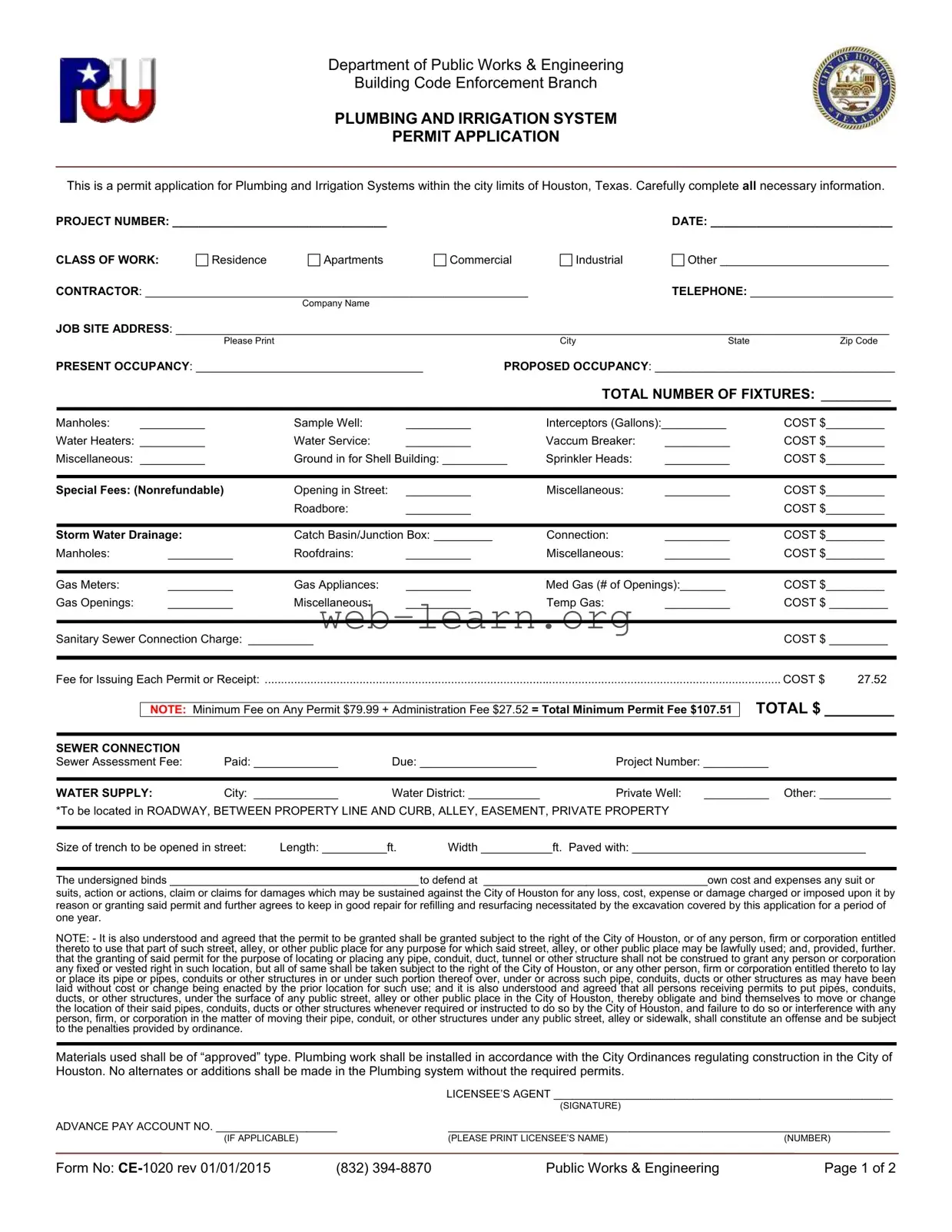
The Texas CE 1020 form serves as a crucial application for obtaining permits related to plumbing and irrigation systems within Houston's city limits. This document is designed to ensure that all necessary information is collected to facilitate compliance with local regulations. Applicants are required to provide details such as the project number, date, class of work, and contractor information, including the company name and contact number. The form also prompts users to specify the job site address and the current and proposed occupancy types. Additionally, it outlines various plumbing fixtures and services, requiring applicants to indicate the total number of fixtures, manholes, gas meters, and other relevant components, along with associated costs. Notably, the CE 1020 form details the fee structure, including minimum fees and charges for different types of installations and inspections. It emphasizes the responsibilities of permit holders, including the need to maintain and repair any excavations for a year following the permit's issuance. Understanding the implications of this form is essential for anyone looking to navigate the permitting process effectively while adhering to the city’s building codes.

Department of Public Works & Engineering
Building Code Enforcement Branch
PLUMBING AND IRRIGATION SYSTEM
PERMIT APPLICATION
This is a permit application for Plumbing and Irrigation Systems within the city limits of Houston, Texas. Carefully complete all necessary information.
PROJECT NUMBER: _________________________________ |
|
|
DATE: ____________________________ |
||
CLASS OF WORK: |
Residence |
Apartments |
Commercial |
Industrial |
Other __________________________ |
CONTRACTOR: ___________________________________________________________ |
|
TELEPHONE: ______________________ |
|||
Company Name
JOB SITE ADDRESS: ______________________________________________________________________________________________________________
|
Please Print |
|
|
|
City |
State |
|
Zip Code |
PRESENT OCCUPANCY: ___________________________________ |
PROPOSED OCCUPANCY: _____________________________________ |
|||||||
|
|
|
|
|
TOTAL NUMBER OF FIXTURES: _________ |
|||
|
|
|
|
|
|
|
|
|
Manholes: |
__________ |
Sample Well: |
__________ |
|
Interceptors (Gallons):__________ |
COST $ |
_________ |
|
Water Heaters: __________ |
Water Service: |
__________ |
|
Vaccum Breaker: |
__________ |
COST $ |
_________ |
|
Miscellaneous: __________ |
Ground in for Shell Building: __________ |
Sprinkler Heads: |
__________ |
COST $ |
_________ |
|||
|
|
|
|
|
|
|
|
|
Special Fees: (Nonrefundable) |
Opening in Street: |
__________ |
|
Miscellaneous: |
__________ |
COST $ |
_________ |
|
|
|
Roadbore: |
__________ |
|
|
|
COST $ |
_________ |
|
|
|
|
|
|
|
||
Storm Water Drainage: |
Catch Basin/Junction Box: _________ |
|
Connection: |
__________ |
COST $ |
_________ |
||
Manholes: |
__________ |
Roofdrains: |
__________ |
|
Miscellaneous: |
__________ |
COST $ |
_________ |
|
|
|
|
|
|
|
|
|
Gas Meters: |
__________ |
Gas Appliances: |
__________ |
|
Med Gas (# of Openings):_______ |
COST $ |
_________ |
|
Gas Openings: |
__________ |
Miscellaneous: |
__________ |
|
Temp Gas: |
__________ |
COST $ |
_________ |
|
|
|
|
|
|
|
||
Sanitary Sewer Connection Charge: __________ |
|
|
|
|
COST $ |
_________ |
||
|
|
|
|
|
|
|
|
|
Fee for Issuing Each Permit or Receipt: |
|
|
|
|
COST $ |
27.52 |
||
NOTE: Minimum Fee on Any Permit $79.99 + Administration Fee $27.52 = Total Minimum Permit Fee $107.51
TOTAL $ ________
SEWER CONNECTION |
|
|
|
|
|
Sewer Assessment Fee: |
Paid: _____________ |
Due: __________________ |
Project Number: __________ |
||
|
|
|
|
||
WATER SUPPLY: |
City: _____________ |
Water District: ___________ |
Private Well: __________ Other: ___________ |
||
*To be located in ROADWAY, BETWEEN PROPERTY LINE AND CURB, ALLEY, EASEMENT, PRIVATE PROPERTY |
|||||
|
|
|
|||
Size of trench to be opened in street: |
Length: __________ft. |
Width ___________ft. Paved with: ____________________________________ |
|||
The undersigned binds _________________________________________to defend at _____________________________________own cost and expenses any suit or
suits, action or actions, claim or claims for damages which may be sustained against the City of Houston for any loss, cost, expense or damage charged or imposed upon it by reason or granting said permit and further agrees to keep in good repair for refilling and resurfacing necessitated by the excavation covered by this application for a period of one year.
NOTE: - It is also understood and agreed that the permit to be granted shall be granted subject to the right of the City of Houston, or of any person, firm or corporation entitled thereto to use that part of such street, alley, or other public place for any purpose for which said street, alley, or other public place may be lawfully used; and, provided, further. that the granting of said permit for the purpose of locating or placing any pipe, conduit, duct, tunnel or other structure shall not be construed to grant any person or corporation any fixed or vested right in such location, but all of same shall be taken subject to the right of the City of Houston, or any other person, firm or corporation entitled thereto to lay or place its pipe or pipes, conduits or other structures in or under such portion thereof over, under or across such pipe, conduits, ducts or other structures as may have been laid without cost or change being enacted by the prior location for such use; and it is also understood and agreed that all persons receiving permits to put pipes, conduits, ducts, or other structures, under the surface of any public street, alley or other public place in the City of Houston, thereby obligate and bind themselves to move or change the location of their said pipes, conduits, ducts or other structures whenever required or instructed to do so by the City of Houston, and failure to do so or interference with any person, firm, or corporation in the matter of moving their pipe, conduit, or other structures under any public street, alley or sidewalk, shall constitute an offense and be subject to the penalties provided by ordinance.
Materials used shall be of “approved” type. Plumbing work shall be installed in accordance with the City Ordinances regulating construction in the City of Houston. No alternates or additions shall be made in the Plumbing system without the required permits.
LICENSEE’S AGENT ________________________________________________________
(SIGNATURE)
ADVANCE PAY ACCOUNT NO. ____________________ |
_________________________________________________________________________ |
|
(IF APPLICABLE) |
(PLEASE PRINT LICENSEE’S NAME) |
(NUMBER) |
Form No: |
(832) |
Public Works & Engineering |
Page 1 of 2 |

MINIMUM FEES: |
(a) Following is a schedule of fees required for permits issued under Sec. 117 of the Building |
|
|
|
........................................................................................................................................................................................................................... |
$ |
27.52 |
|
Minimum Fee (Any Permit) |
$ |
79.99 |
|
$ |
77.06 |
|
FIXTURES: |
Plumbing Fixture, first three |
$ |
28.07 |
|
Each Additional to be installed under same permit |
$ |
9.35 |
|
Ground in plumbing for Shell Building, 3000 sq.ft. floor area or less |
$ |
38.53 |
|
Thereafter, per 1000 sq. ft |
$ |
17.61 |
GAS PERMIT: |
Gas Permit and Inspection Fee (1 to 4 openings) |
$ |
37.33 |
|
Additional Gas Openings (each) |
$ |
6.40 |
|
Temporary Gas Inspection |
$ |
74.65 |
MEDICAL GAS PERMIT: |
First 10 openings |
$ |
33.01 |
|
Each Gas Opening |
$ |
5.50 |
CENTRAL HEATING |
|
|
|
GAS APPLIANCES: |
Furnace (non duct type) |
$ |
28.07 |
|
Each additional furnace to be installed in same building under the same permit |
$ |
9.35 |
|
Floor Furnace (not duct type) |
$ |
38.53 |
|
Incinerators (gas fired) (complete with 3 burners or more) |
$ |
66.05 |
|
$ |
28.07 |
|
|
Each additional |
$ |
9.35 |
|
Yard lights or barbecue grills |
|
|
|
One (1) |
$ |
28.07 |
|
Each additional to be installed under same permit |
$ |
9.35 |
PERMANENT |
|
|
|
APPLIANCES |
Wall Heaters (bathroom heaters exempt) |
$ |
28.07 |
|
Each additional to be installed under same permit |
$ |
9.35 |
|
Gas Steam Radiators |
$ |
38.53 |
|
Each additional to be installed under same permit |
$ |
9.35 |
|
Commercial Ovens |
$ |
44.03 |
|
Commercial Dryers |
$ |
38.53 |
|
Warm Air Circulators, first three |
$ |
38.53 |
|
Each additional to be installed under same permit |
$ |
9.35 |
SANITARY SEWER |
Sewer Connection |
$ |
44.03 |
|
Investigation Fee |
$273.36 or |
|
MISCELLANEOUS |
|
double fee whichever is greater |
|
|
Inspections outside regular working hours |
|
|
|
Minimum four (4) hours |
$ |
264.22 |
|
Each hour exceeding four (4) hours |
$ |
68.80 |
DISCONNECT |
Sanitary Sewer (disconnect and plug main sewer connection) |
$ |
77.06 |
|
Septic System (disconnect and fill septic tank, grease trap) |
$ |
77.06 |
STORM SEWER |
Tie to curb |
$ |
71.55 |
|
Manholes |
$ |
71.55 |
|
Catch basin, outside area drain or junction box (first two) |
$ |
28.07 |
|
Each additional to be installed under same permit |
$ |
9.35 |
|
Roof drain or outside downspout connection to drainage system (first two) |
$ |
28.07 |
|
Each additional roof drain or downspout to be installed under same permit |
$ |
9.35 |
TANKS |
Tanks (not septic tanks) a permit separate from a permit for other plumbing work required |
|
|
|
Tanks through 1,000 gallon capacity (including mechanical interceptors) |
$ |
77.06 |
|
1,001 thru 6,000 gallons |
$ |
93.57 |
|
6,001 thru 15,000 gallons |
$ |
115.60 |
|
15,001 thru 30,000 gallons |
$ |
165.13 |
|
Over 30,000 gallons |
$ |
187.16 |
IRRIGATION SYSTEM |
1 to 200 heads, per head |
$ |
1.60 |
|
Each additional head |
$ |
1.07 |
Form No: |
(832) |
Public Works & Engineering |
Page 2 of 2 |
| Fact Name | Details |
|---|---|
| Form Purpose | The Texas CE 1020 form is used to apply for permits related to plumbing and irrigation systems in Houston, Texas. |
| Governing Law | This form is governed by the City of Houston's Building Code and related ordinances. |
| Minimum Fees | The minimum fee for any permit is $79.99, plus an administration fee of $27.52, totaling $107.51. |
| Project Number | Each application must include a unique project number for tracking purposes. |
| Occupancy Types | The form allows applicants to specify the type of occupancy: residence, apartments, commercial, industrial, or other. |
| Fixture Costs | Costs for various plumbing fixtures are detailed within the form, including specific fees for water heaters and gas appliances. |
| Inspection Fees | Inspection fees may vary based on the type of work being performed and can include additional charges for after-hours inspections. |
| Gas Permits | Separate fees apply for gas permits, which include charges for the number of openings and inspections. |
| Sanitary Sewer Connection | There is a specific fee for sanitary sewer connections, which is $44.03. |
| Application Signature | The application must be signed by the licensee's agent to validate the permit request. |
Completing the Texas CE 1020 form requires attention to detail and accuracy. This form is essential for obtaining a permit for plumbing and irrigation systems within the city limits of Houston, Texas. Follow the steps below to ensure that the application is filled out correctly.
What is the Texas CE 1020 form?
The Texas CE 1020 form is a permit application for plumbing and irrigation systems within the city limits of Houston, Texas. It is essential for anyone planning to install or modify plumbing or irrigation systems in this area.
Who needs to fill out this form?
Contractors or property owners intending to undertake plumbing or irrigation work must complete the CE 1020 form. This includes work on residential, commercial, industrial, or other types of properties.
What information is required on the form?
Applicants must provide details such as:
What are the fees associated with the CE 1020 form?
The minimum fee for any permit is $79.99, plus an administration fee of $27.52, totaling a minimum of $107.51. Additional costs may apply based on the specifics of the plumbing or irrigation work being performed.
How long does it take to process the application?
Processing times can vary. It is advisable to submit the application well in advance of the planned work to avoid delays. Contact the Building Code Enforcement Branch for more specific timelines.
What happens if I do not obtain a permit?
Failure to obtain a permit can lead to penalties, including fines and the requirement to undo any work completed without authorization. It is crucial to comply with local regulations to avoid these consequences.
Can I make changes to my plumbing system after obtaining a permit?
No alterations or additions can be made to the plumbing system without the required permits. If changes are necessary, a new permit application must be submitted.
What is the responsibility of the permit holder regarding repairs?
The permit holder is responsible for maintaining and repairing any excavation work for a period of one year. This includes refilling and resurfacing any areas disturbed during the project.
Who do I contact for questions about the CE 1020 form?
For any inquiries regarding the CE 1020 form, you can contact the Public Works & Engineering Department at (832) 394-8870. They can provide guidance and answer any specific questions you may have.
Filling out the Texas CE 1020 form can be a straightforward process, but many people make common mistakes that can lead to delays or complications. One frequent error is neglecting to provide complete contact information for the contractor. It's essential to include the contractor's name and phone number clearly. Missing this information can result in communication issues, which may slow down the permit approval process.
Another mistake often seen is failing to specify the class of work. Applicants should check the appropriate box for residence, commercial, or industrial work. Omitting this detail can lead to confusion and potentially the rejection of the application, as it is vital for categorizing the type of permit being requested.
Many applicants also overlook the importance of accurately detailing the job site address. Providing a complete address, including city, state, and zip code, is crucial. Incomplete or incorrect addresses can lead to delays in processing or even misrouting of the permit to the wrong location.
Additionally, not filling in the total number of fixtures can be a significant oversight. This information is critical for assessing the scope of the project and calculating the appropriate fees. Without this detail, the permit may be delayed as the reviewing authority seeks clarification.
Another common error is miscalculating the cost of the project. Applicants should ensure that all costs are accurately summed and reflected on the form. This includes costs associated with fixtures, special fees, and other related expenses. An incorrect total can lead to complications in the payment process and may result in additional fees or penalties.
Some applicants also forget to sign the form, which is a critical step. The signature binds the applicant to the terms of the permit and confirms their understanding of the responsibilities involved. A missing signature can halt the entire application process, causing unnecessary delays.
Moreover, failing to provide information about the water supply can be a significant oversight. Whether it’s a city supply, water district, or private well, this information is necessary for the city to evaluate the project’s impact on local resources. Without it, the application may be incomplete.
Lastly, applicants often neglect to review the minimum fees associated with the permit. Understanding the fee structure is vital to avoid surprises later in the process. Not accounting for these fees can lead to payment delays and further complications in obtaining the permit.
The Texas CE 1020 form is essential for obtaining plumbing and irrigation system permits in Houston. However, several other documents are often required or recommended to ensure compliance with local regulations. Below is a list of these forms and documents, each serving a specific purpose in the permitting process.
Gathering these documents alongside the Texas CE 1020 form can streamline the permitting process and help avoid delays. Being thorough and prepared is key to ensuring a successful application and project execution.
When filling out the Texas CE 1020 form, it’s important to ensure accuracy and completeness. Here are some essential dos and don’ts to guide you through the process:
By following these guidelines, you can help ensure that your application is processed smoothly and efficiently. Take your time, and don’t hesitate to seek assistance if needed. Your attention to detail will make a significant difference.
Understanding the Texas CE 1020 form can be challenging, especially with the various misconceptions that surround it. Here’s a list of common misunderstandings that may help clarify the purpose and requirements of this important permit application.
In reality, this form is applicable to a variety of projects, including commercial and industrial plumbing, as well as irrigation systems.
Completing the form accurately is crucial. Missing information can delay the processing of your application.
Fees are required for processing this permit. The minimum fee is $107.51, which includes both the administration fee and the minimum permit fee.
Permits can be revoked if conditions are not met or if there are violations of city ordinances. Compliance is essential.
Even minor plumbing tasks may require a permit. It’s always best to check before proceeding with any work.
This form is specific to the City of Houston. Other cities may have different forms and requirements.
These fees are mandatory and can add significant costs if you need inspections at non-standard times.
Any alterations or additions require separate permits. It’s vital to follow the regulations to avoid penalties.
This form is also necessary for repairs and modifications to existing plumbing systems, ensuring all work is compliant with city standards.
By addressing these misconceptions, you can better navigate the requirements of the Texas CE 1020 form and ensure that your plumbing or irrigation project proceeds smoothly and legally.
When filling out the Texas CE 1020 form for plumbing and irrigation systems, it's essential to pay attention to detail. Here are some key takeaways to keep in mind:
By keeping these points in mind, you can navigate the application process more smoothly and help ensure that your project proceeds without unnecessary delays.