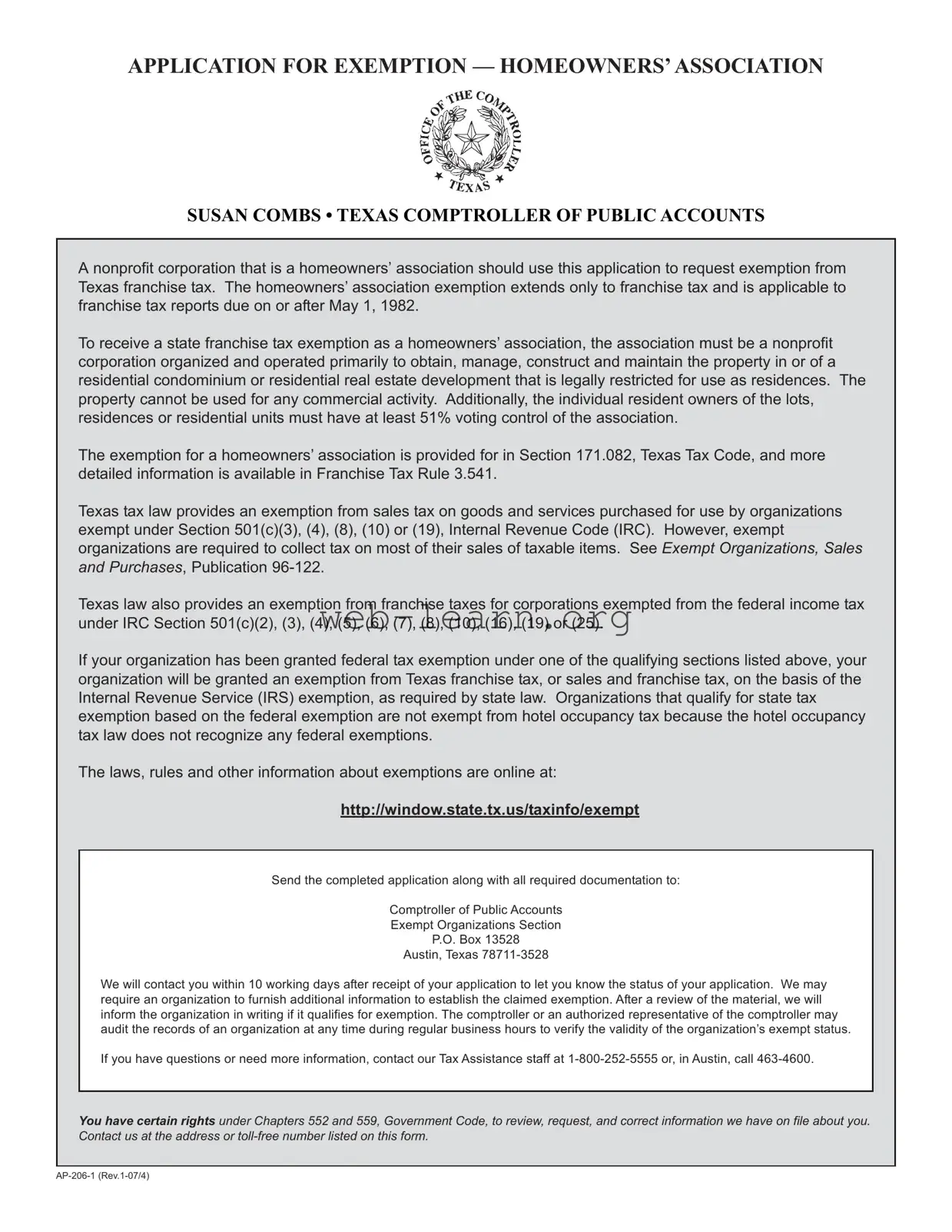
The Texas AP 206 form is an essential application for homeowners’ associations seeking exemption from the Texas franchise tax. This form is specifically designed for nonprofit corporations that manage residential properties, such as condominiums or real estate developments, which are legally restricted for residential use only. To qualify for this exemption, the homeowners’ association must ensure that at least 51% of the voting control is held by individual resident owners. This form requires detailed information about the association's structure, including the number of residential units, voting rights, and ownership distribution among members. It's important to note that the exemption applies solely to franchise taxes and does not extend to other taxes, such as hotel occupancy tax. The application process involves submitting the completed form along with necessary documentation to the Comptroller of Public Accounts, who will review the submission and notify the association of its exemption status within ten working days. By understanding the requirements and properly completing the Texas AP 206 form, homeowners’ associations can secure significant tax benefits, allowing them to focus on maintaining their communities.

APPLICATION FOR EXEMPTION — HOMEOWNERS’ASSOCIATION
SUSAN COMBS • TEXAS COMPTROLLER OF PUBLIC ACCOUNTS
A nonprofit corporation that is a homeowners’ association should use this application to request exemption from Texas franchise tax. The homeowners’ association exemption extends only to franchise tax and is applicable to franchise tax reports due on or after May 1, 1982.
To receive a state franchise tax exemption as a homeowners’ association, the association must be a nonprofit corporation organized and operated primarily to obtain, manage, construct and maintain the property in or of a residential condominium or residential real estate development that is legally restricted for use as residences. The property cannot be used for any commercial activity. Additionally, the individual resident owners of the lots, residences or residential units must have at least 51% voting control of the association.
The exemption for a homeowners’ association is provided for in Section 171.082, Texas Tax Code, and more detailed information is available in Franchise Tax Rule 3.541.
Texas tax law provides an exemption from sales tax on goods and services purchased for use by organizations exempt under Section 501(c)(3), (4), (8), (10) or (19), Internal Revenue Code (IRC). However, exempt organizations are required to collect tax on most of their sales of taxable items. See Exempt Organizations, Sales and Purchases, Publication
Texas law also provides an exemption from franchise taxes for corporations exempted from the federal income tax under IRC Section 501(c)(2), (3), (4), (5), (6), (7), (8), (10), (16), (19) or (25).
If your organization has been granted federal tax exemption under one of the qualifying sections listed above, your organization will be granted an exemption from Texas franchise tax, or sales and franchise tax, on the basis of the Internal Revenue Service (IRS) exemption, as required by state law. Organizations that qualify for state tax exemption based on the federal exemption are not exempt from hotel occupancy tax because the hotel occupancy tax law does not recognize any federal exemptions.
The laws, rules and other information about exemptions are online at:
http://window.state.tx.us/taxinfo/exempt
Send the completed application along with all required documentation to:
Comptroller of Public Accounts
Exempt Organizations Section
P.O. Box 13528
Austin, Texas
We will contact you within 10 working days after receipt of your application to let you know the status of your application. We may require an organization to furnish additional information to establish the claimed exemption. After a review of the material, we will inform the organization in writing if it qualifies for exemption. The comptroller or an authorized representative of the comptroller may audit the records of an organization at any time during regular business hours to verify the validity of the organization’s exempt status.
If you have questions or need more information, contact our Tax Assistance staff at
You have certain rights under Chapters 552 and 559, Government Code, to review, request, and correct information we have on file about you. Contact us at the address or

SPECIFIC INSTRUCTIONS
Item 1. The filed document of record, and any subsequent amendments, that establishes the purpose of the property usually provides the qualifications for association membership, owners’ voting rights and whether the property is held exclusively for residential use. This document and the plat map are filed with the local county clerk’s office, and may be referred to as the:
•Declaration;
•Deed Restrictions;
•Covenants, Conditions and Restrictions, or similar titles.
To complete Item 1, take the language directly from the appropriate controlling document, which is normally the Articles of Incorporation but may be the association’s Declaration or Bylaws. Also, specify in Item 1 the title of the document and the specific citation from which the language was taken.
Item 2. To be eligible for exemption as a homeowners’ association, the property must be residential and have no commercial property within the real estate development. A condominium project or real estate development is considered residential if the property is legally restricted for use as residences, with no commercial use allowed.
To complete Item 2, enter the total number of lots/units as shown on the plat map for the real estate development. The plat map should be on file with the local county clerk’s office.
Item 3. To complete Item 3, enter the total number of lots/units owned by the individual resident owners. Do not include any lots/units owned by the declarants, developers, builders, banks, investors or similar parties. Do not include
Item 4. To complete Item 4, enter the total number of lots not included in Item 3. Include multiple- owned lots by an individual owner, and all lots/units owned by parties other than the individual resident owners. Attach a list identifying these owners and the number of lots owned.
In order to qualify for exemption as a homeowners’ association, these parties cannot control more than 49% of the association’s total votes. Majority control cannot be held by a single individual or family, or by one or more developers, declarants, banks, investors or similar parties.
Item 5. If the answer to number 5 is yes, also complete Items 5a and 5c. If the answer to number 5 is no, also complete Items 5b and 5c. For 5a, 5b and 5c, take the language directly from the controlling documents. If the language is not found in the declaration, then look for it in the Articles of Incorporation or bylaws. Also, provide the title of the document from which the language was taken.

|
|
|
|
|
|
|
|
TEXAS APPLICATION FOR STATE TAX EXEMPTION |
|
• TYPE OR PRINT |
|
|
|
||
FOR HOMEOWNERS’ ASSOCIATIONS |
|
• Do NOT write in shaded areas. |
Page 1 |
PLEASE COMPLETE THE FOLLOWING INFORMATION
1.SEE INSTRUCTIONS The primary purpose of the corporation as quoted directly from the association's Articles of Incorporation, Declaration, or Bylaws, including any subsequent amendments, is
as found in
(Title of document and cite from which the language was taken)
2. SEE INSTRUCTIONS Number of lots/units shown on the plat map for the real estate development ..........
3. SEE INSTRUCTIONS Number of residential lots/units owned by individual owner .....................................
4.SEE INSTRUCTIONS Number of lots/units units owned by declarant, developers, builders,
banks, investors, or other similar parties .....................................................................................................
Items 3 and 4 must equal the total reported in Item 2.
....................................5. SEE INSTRUCTIONS Does the Declaration provide for different classes of votes? |
YES |
|
|
|
If YES, must complete 5a and 5c. If NO, must complete 5b and 5c.
5a. Enter the voting rights for each class of member, as found in:
NO
(Title of document and cite from which the language was taken)
CLASS A:
CLASS B:
(List additional classes if necessary)
5b. Enter the language that identifies the number of votes each member is entitled to, including the declarant’s voting rights.
Title of document and cite from which 5b was taken:
5c. List conditions that determine when the Declarant’s voting rights ceased, or converted to other conditions allowing the individual owners to gain voting control of the association.
Title of document and cite from which 5c was taken:
6. Based on the information provided above, the date the individual resident owners |
Month Day Year |
||||||||||||
|
|
|
|
|
|
|
|
|
|
|
|
|
|
collectively gained voting control (at least 51 percent) of the association was: |
|
|
|
|
|
|
|
|
|
|
|
|
|
7.Corporation name (For Texas corporations, name must match the official corporate name as on file with the Texas Secretary of State. For
(CONTINUED ON BACK SIDE)

TEXAS APPLICATION FOR STATE TAX EXEMPTION
FOR HOMEOWNERS’ ASSOCIATIONS
• TYPE OR PRINT |
|
• Do NOT write in shaded areas. |
Page 2 |
8. |
Name, address and daytime phone number of person submitting this application |
|
|
|
|
|
|
|
|
|
|
|
|
|
|||||||||||||||||||
|
|
Name |
|
|
|
Title |
|
|
|
|
|
|
|
|
|
|
|
|
|
||||||||||||||
|
|
|
|
|
|
|
|
|
|
|
|
|
|
|
|
|
|
|
|
|
|||||||||||||
|
|
|
|
|
|
|
|
|
|
|
|
|
|
|
|
|
|
|
|
|
|
|
|
|
|
|
|
|
|
|
|
|
|
|
|
Firm or Company Name |
|
|
|
|
|
Daytime Phone (Area code and number) |
|
Extension |
|||||||||||||||||||||||
|
|
|
|
|
|
|
|
|
|
|
|
|
|
|
|
|
|
|
|
|
|
|
|
|
|
|
|
|
|
|
|
|
|
|
|
Address |
|
City |
|
|
|
|
|
|
|
State |
|
Zip |
|||||||||||||||||||
|
|
|
|
|
|
|
|
|
|
|
|
|
|
|
|
|
|
|
|
|
|
|
|
|
|
|
|
|
|
|
|
|
|
9. |
Texas taxpayer number |
|
|
|
|
|
|
|
|
|
|
|
|
|
|
|
|
|
|
|
|
|
|
|
|
|
|
|
|
|
|
|
|
|
|
|
|
|
|
|
|
|
|
|
|
|
|
|
|
|
|
|
|
|
|
|
|
|
|
|
|
|
|
||||
10. |
Federal employers identification number (if applicable) |
|
|
|
|
|
|
|
|
|
|
|
|
|
|
|
|
|
|
|
|
|
|
|
|
|
|
|
|
|
|||
|
|
|
|
|
|
|
|
|
|
|
|
|
|
|
|
|
|
|
|
|
|
|
|
|
|
|
|
|
|||||
11.For TEXAS corporations, filing information issued by the Secretary of State:
Month Day Year
File Number ............................................
File Date ...................................
12. For
Month Day Year
Certificate of Authority File Number ..........
File Date ...................................
Home State |
|
Date of |
Month Day Year |
||||||||||||
|
|
|
|
|
|
|
|
|
|
|
|
|
|
||
of Incorporation |
|
Incorporation |
|
|
|
|
|
|
|
|
|
|
|
|
|
|
|
|
|
|
|
|
|
|
|
|
|
|
|
||
Home State Filing
or Registration Number
I, _____________________________________________ , ________________________________________________
(Name)(Title)
of ________________________________________________________________________________________ , affirm
(Corporation Name)
the homeowner's association is a nonprofit corporation.
I further state that the corporation is organized and operated primarily to obtain, manage, construct, and maintain property in or of a residential condominium or residential real estate development.
The corporation will maintain proof that the condominium project or real estate development is legally restricted for use as residences, with no commercial use allowed, and will also maintain proof that the collective resident owners of individual lots, residences, or units control at least 51 percent of the votes of the corporation.
___________________________________________________ DATE _________________________________
| Fact Name | Details |
|---|---|
| Purpose of Form | The Texas AP 206 form is used by nonprofit homeowners' associations to request an exemption from the Texas franchise tax. |
| Eligibility Criteria | To qualify for the exemption, the homeowners' association must be organized primarily for managing residential properties and must not engage in any commercial activities. |
| Voting Control Requirement | At least 51% of the voting control of the association must be held by individual resident owners of the lots or units. |
| Governing Law | The exemption is governed by Section 171.082 of the Texas Tax Code and detailed in Franchise Tax Rule 3.541. |
| Application Process | Completed applications must be sent to the Comptroller of Public Accounts, and organizations can expect a response within 10 working days regarding their exemption status. |
Filling out the Texas AP 206 form is a straightforward process. This form is essential for homeowners’ associations seeking exemption from Texas franchise tax. To ensure accuracy, follow the steps carefully and provide all necessary information.
After completing the form, send it along with any required documentation to the Comptroller of Public Accounts. Expect a response within 10 working days regarding the status of your application.
The Texas AP 206 form is an application that homeowners’ associations use to request an exemption from the Texas franchise tax. This exemption is applicable to nonprofit corporations organized and operated primarily to manage residential properties, such as condominiums or residential real estate developments. The form is essential for associations that wish to confirm their status as tax-exempt entities under Texas law.
To qualify for the exemption, the homeowners’ association must be a nonprofit corporation that operates primarily to manage residential properties. The properties must be legally restricted for residential use only, with no commercial activities allowed. Additionally, at least 51% of the voting control must be held by individual resident owners of the properties. This structure ensures that the association is genuinely serving the interests of its residents.
When completing the Texas AP 206 form, several key documents are necessary:
These documents help verify the eligibility of the association for the tax exemption.
After submitting the completed AP 206 form along with all required documentation, the Texas Comptroller's office will contact the association within 10 working days to inform them of the application status. If additional information is needed, the office may request it to establish the claimed exemption.
If the application for exemption is approved, the homeowners’ association will be exempt from paying the Texas franchise tax. However, it is important to note that this exemption does not extend to hotel occupancy taxes, as those are not recognized under federal exemptions. The association must maintain its nonprofit status and adhere to the regulations governing such exemptions to retain its tax-exempt status.
Filling out the Texas AP 206 form can be a straightforward process, but there are common mistakes that can lead to delays or denials of exemption. One frequent error is failing to provide the correct documentation. It's essential to include the appropriate controlling documents, such as the Articles of Incorporation or Bylaws. Without these documents, the application may be deemed incomplete, causing unnecessary setbacks.
Another mistake is inaccurately reporting the number of lots or units. In Item 2, applicants must enter the total number of lots/units as shown on the plat map. Miscounting or failing to reference the correct plat map can lead to discrepancies that may jeopardize the application.
Many applicants also overlook the importance of detailing ownership accurately. When completing Item 3, it is crucial to report only the lots/units owned by individual resident owners. Including properties owned by developers, banks, or other parties can invalidate the application. This oversight can easily occur if applicants do not double-check their ownership records.
Additionally, failing to specify the voting rights in Item 5 can create complications. If the Declaration provides for different classes of votes, applicants must complete Items 5a and 5c. Omitting this information can raise questions about the association's governance structure, resulting in further inquiries from the comptroller's office.
Another common error is not adhering to the required format for citing documents. When referencing the title and citation of controlling documents, clarity is essential. Ambiguous or incomplete citations can lead to confusion and may require additional follow-up.
Moreover, applicants sometimes neglect to ensure that the corporation name matches the official name on file with the Texas Secretary of State. This inconsistency can lead to rejection of the application, so it is vital to verify this detail before submission.
Lastly, failing to sign and date the application can halt the process entirely. The affirmation of the applicant is a crucial part of the application. Without a signature and date, the form is incomplete and will not be processed.
The Texas AP 206 form is an important document for homeowners’ associations seeking exemption from franchise tax. However, several other forms and documents are often used in conjunction with it to ensure compliance with state regulations and to provide necessary information about the association's structure and operations. Below is a list of commonly associated documents.
Understanding these documents can help homeowners’ associations navigate the complexities of tax exemption and maintain compliance with state laws. Each document plays a vital role in demonstrating the association's nonprofit status and its commitment to serving its members effectively.
When filling out the Texas AP 206 form for homeowners’ associations, it's important to follow certain guidelines to ensure your application is processed smoothly. Here are nine things to keep in mind:
By adhering to these guidelines, you can help ensure a smoother application process for your homeowners’ association exemption. If you have any questions, don’t hesitate to reach out for assistance.
Understanding the Texas AP 206 form can be challenging, especially with the various misconceptions that exist. Here’s a list of common misunderstandings to clarify the facts:
Being informed about these misconceptions can help homeowners' associations navigate the application process more effectively and ensure compliance with Texas tax laws.
When filling out and using the Texas AP 206 form for homeowners' associations, it is essential to keep the following key points in mind: