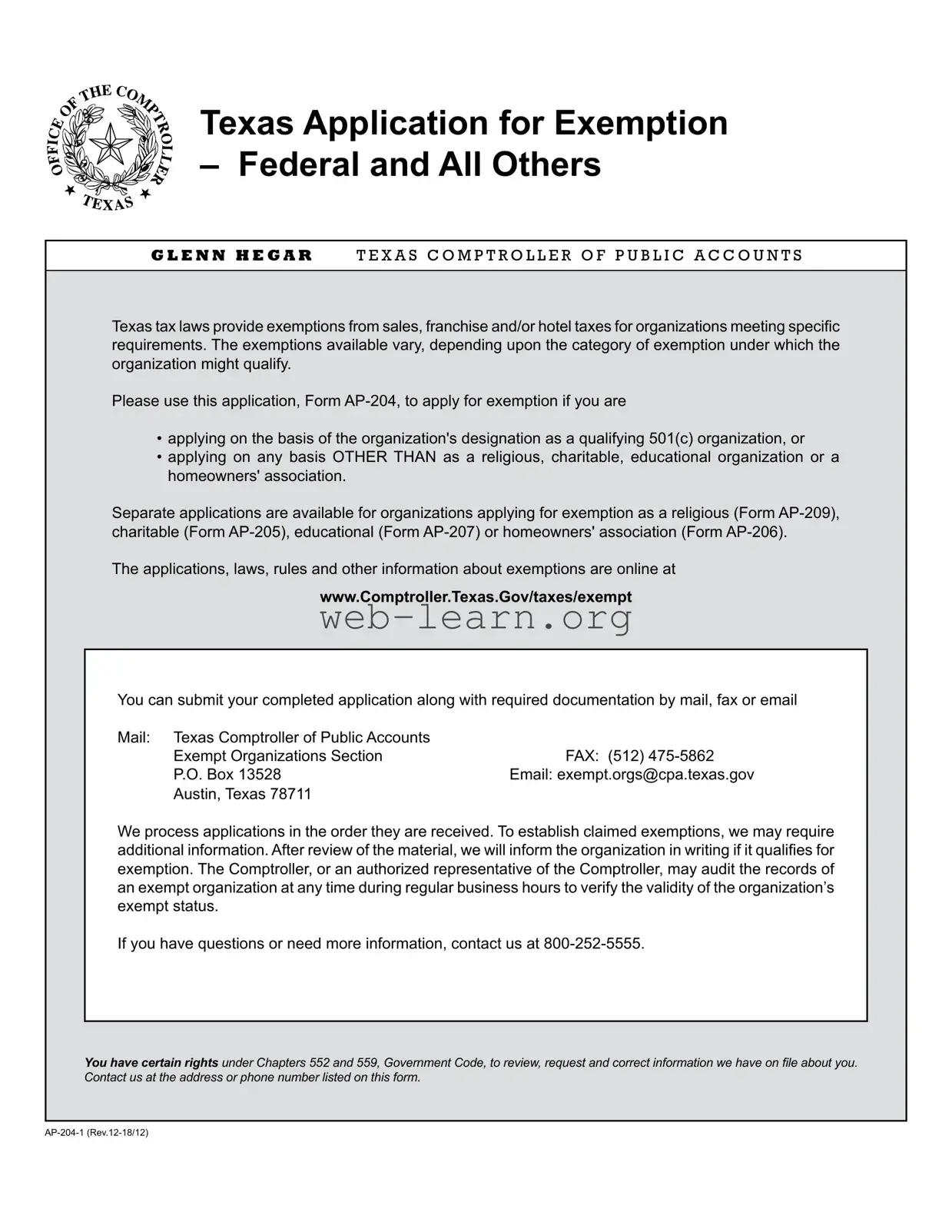
The Texas Application for Exemption, known as Form AP-204, serves as a vital tool for organizations seeking relief from various state taxes, including sales, franchise, and hotel taxes. This form is specifically designed for entities that do not qualify as religious, charitable, or educational organizations, as those categories have separate application processes. By utilizing AP-204, qualifying organizations can establish their status under the Internal Revenue Code Section 501(c) or other specified categories, such as chambers of commerce, cooperative associations, and volunteer fire departments, among others. The application requires accurate completion and submission of supporting documentation to ensure processing efficiency. Organizations must be aware that incomplete applications will be returned, prompting delays in obtaining tax-exempt status. Once submitted, the Texas Comptroller's office processes these applications in the order they are received, and may request additional information to confirm eligibility. Furthermore, organizations should understand their rights to review and correct any information held by the Comptroller's office, ensuring transparency throughout the process. For those navigating the complexities of tax exemptions in Texas, Form AP-204 is an essential starting point.

Texas Application for Exemption
– Federal and All Others
G L E N N H E G A R T E X A S C O M P T RO L L E R O F P U B L I C AC C O U N T S
Texas tax laws provide exemptions from sales, franchise and/or hotel taxes for organizations meeting specific requirements. The exemptions available vary, depending upon the category of exemption under which the organization might qualify.
Please use this application, Form
•applying on the basis of the organization's designation as a qualifying 501(c) organization, or
•applying on any basis OTHER THAN as a religious, charitable, educational organization or a homeowners' association.
Separate applications are available for organizations applying for exemption as a religious (Form
The applications, laws, rules and other information about exemptions are online at
www.Comptroller.Texas.Gov/taxes/exempt
You can submit your completed application along with required documentation by mail, fax or email
Mail: Texas Comptroller of Public Accounts |
|
Exempt Organizations Section |
FAX: (512) |
P.O. Box 13528 |
Email: [email protected] |
Austin, Texas 78711 |
|
We process applications in the order they are received. To establish claimed exemptions, we may require additional information. After review of the material, we will inform the organization in writing if it qualifies for
exemption. The Comptroller, or an authorized representative of the Comptroller, may audit the records of an exempt organization at any time during regular business hours to verify the validity of the organization’s exempt status.
If you have questions or need more information, contact us at
You have certain rights under Chapters 552 and 559, Government Code, to review, request and correct information we have on file about you. Contact us at the address or phone number listed on this form.

Texas Application for Exemption
– Federal and All Others
*AP20420W121812*
*AP20420W121812*
* A P 2 0 4 2 0 W 1 2 1 8 1 2 *
• Remove All Staples • TYPE OR PRINT • Do NOT write in shaded areas.
1.Organizations applying for exemption under one of the categories listed below should check the appropriate box and complete this application.
Our publication, Guidelines to Texas Tax Exemptions
exemption. For the category you select, be sure to read the requirements listed in the publication. If you send in an application without including the documentation described in the publication, we will return the application to you with a request for additional information. We are unable to process incomplete applications.
Federal Exemption under qualifying Internal Revenue Code (IRC) Section 501(c). Attach IRS Determination Letter.
Cemetery Corporations
Certain Insurance Corporations for Farm Mutuals, Local Mutual Aid
Associations and Burial Associations
Certain Insurance Corporations Licensed as Title Insurance Companies and Title Insurance Agents
Certain Corporations Subject to the Insurance Code
Chambers of Commerce
Convention and Tourist Promotional Agencies
Cooperative Associations
Cooperative Credit Associations
Corporations Exempted by Another Law
Corporations with Business Interest In Solar Energy Devices
Corporations Organized for Agricultural Purposes
Corporations Organized for Conservation Purposes
Corporations Involved with City Natural Gas Facility
Corporations Organized to Provide Cooperative Housing Corporations Organized to Provide Convalescent Homes for
Elderly
Corporations Organized for Student Loan Funds or Student Scholarship Purposes
2. ORGANIZATION NAME
(Legal name as provided on Articles of Incorporation, or if unincorporated, the governing document.)
Credit Unions - Federal
Credit Unions - State
Development Corporations
Electric Cooperatives
Emergency Medical Service Corporations
Farmers' Cooperative Societies or cooperatives whose single member is a farmers' cooperative described in Section 521(b)(1), IRC, that has at least 500
Health Facility Development Corporations
Hospital Laundry Cooperative Associations
Housing Finance Corporations
Local Organizing Committees
Lodges
Marketing Associations
Nonprofit Water Supply Corporations
Corporations Organized to Promote County, City or Another Area
(Public Interest Organizations)
Railway Terminal Corporations
Recycling Operations
Telephone Cooperatives
Volunteer Fire Departments
Youth Athletic Organizations
3. ORGANIZATION MAILING ADDRESS
Street number, P.O. Box or rural route and box number
CityState/ProvinceZIP CodeCounty (or country, if outside the U.S.)
4. Texas taxpayer number (if applicable) |
|
|
5. Federal Employer Identification Number (EIN) (Required if applying for exemption on the basis of a federal exemption) |
|
|
6. a) Enter filing information issued by the Texas Secretary of State: |
Month Day |
Year |
|
||
File Number |
File Date |
|
OR
b) Check this box if this organization is not registered with the Texas Secretary of State.
Special note to
7. Contact information of the person submitting this application
Name |
|
|
|
Email Address |
|
|
||||||||||||||||||||||||||||
|
|
|
|
|
|
|
|
|
|
|
|
|
|
|
|
|
|
|
|
|
|
|
|
|
|
|
|
|
|
|
|
|
|
|
Firm or Company Name |
|
|
|
|
Daytime Phone (Area code and number) |
|
Extension |
|||||||||||||||||||||||||||
|
|
|
|
|
|
|
|
|
|
|
|
|
|
|
|
|
|
|
|
|
|
|
|
|
|
|
|
|
|
|
|
|
|
|
|
|
|
|
|
|
|
|
|
|
|
|
|
|
|
|
|
|
|
|
|
|
|
|
|
|
|
|
|
|
|
|
|
|
|
Address |
|
City |
|
|
|
|
|
|
|
|
|
|
|
State |
|
ZIP Code |
||||||||||||||||||
|
|
|
|
|
|
|
|
|
|
|
|
|
|
|
|
|
|
|
|
|
|
|
|
|
|
|
|
|
|
|
|
|
|
|
We will notify you by email when the exemption has been added to let you know where the exemption can be verified online. If an email address is not
provided, indicate where our response should be mailed: |
|
organization's mailing address or |
|
mailing address of the submitter. |
| Fact Name | Description |
|---|---|
| Purpose | The Texas AP-204 form is used to apply for exemptions from sales, franchise, and hotel taxes for specific organizations. |
| Eligibility | Organizations must qualify under certain categories, such as 501(c) organizations, to use this form. |
| Exemption Categories | Exemptions vary based on the organization type, including chambers of commerce, cooperative associations, and more. |
| Separate Forms | Different forms exist for religious (AP-209), charitable (AP-205), educational (AP-207), and homeowners' associations (AP-206). |
| Submission Methods | Applications can be submitted via mail, fax, or email to the Texas Comptroller of Public Accounts. |
| Processing Order | Applications are processed in the order they are received, and additional information may be required. |
| Audit Rights | The Comptroller may audit the records of an exempt organization during regular business hours to verify exempt status. |
| Contact Information | For inquiries, organizations can contact the Texas Comptroller at 800-252-5555 or through the provided email address. |
| Governing Laws | This form operates under Texas tax laws and is governed by the Texas Government Code, Chapters 552 and 559. |
| Documentation Requirement | Applicants must include all required documentation as outlined in the Guidelines to Texas Tax Exemptions publication. |
Completing the Texas Application for Exemption – Federal and All Others (Form AP-204-2) is an important step for organizations seeking tax exemptions. This form is essential for those applying based on specific qualifications, and it helps ensure that all necessary information is provided for a smooth review process. Here’s how to fill it out correctly.
Once submitted, the application will be processed in the order it is received. Be prepared to provide additional information if requested. After review, you will receive written notification regarding your exemption status. If you have questions during the process, don’t hesitate to reach out for assistance.
The Texas Application for Exemption, Form AP-204, is used by organizations to apply for exemptions from sales, franchise, and hotel taxes. This form is specifically for organizations that do not qualify as religious, charitable, educational, or homeowners' associations. It allows qualifying organizations, such as those designated under Section 501(c) of the Internal Revenue Code, to seek tax exemptions based on their status.
This form is intended for organizations applying for exemption based on a variety of categories, including:
Organizations that fall under the categories of religious, charitable, educational, or homeowners' associations should use separate forms designed for those specific exemptions.
Once the application is completed, it can be submitted in one of three ways:
Make sure to include all required documentation to avoid delays in processing.
After submission, the Texas Comptroller's office will process the application in the order it was received. If additional information is needed to establish the claimed exemptions, the office may request it. Once the review is complete, the organization will receive written notification regarding its exemption status. The Comptroller or an authorized representative may also audit the records of the organization to verify its exempt status at any time during regular business hours.
Filling out the Texas Application for Exemption – Federal and All Others (Form AP-204-2) can be a straightforward process, but many applicants make common mistakes that can lead to delays or even rejection. One frequent error is neglecting to provide the required documentation. Each category of exemption has specific documentation requirements, and failing to include these can result in the application being returned for additional information.
Another common mistake is using the wrong form. Applicants sometimes mistakenly use forms designated for other types of organizations, such as religious or charitable groups. It’s crucial to ensure that you are using Form AP-204-2 if your organization does not fall under those categories.
Many applicants also overlook the importance of accurately entering the organization’s legal name. This name should match exactly as it appears on the Articles of Incorporation or governing document. Any discrepancies can create confusion and may lead to processing delays.
In addition, applicants often forget to fill in all required fields. Missing information, such as the Texas taxpayer number or the Federal Employer Identification Number (EIN), can halt the processing of the application. Double-checking each section before submission can help avoid this pitfall.
Another mistake involves the contact information provided. Some applicants fail to include a valid email address or daytime phone number, which can hinder communication regarding the application status. Providing accurate contact details ensures that any follow-up questions can be addressed promptly.
Inaccurate filing information is also a common issue. When entering information issued by the Texas Secretary of State, applicants may mistakenly input the wrong file number or date. This can lead to complications in verifying the organization’s status.
Many applicants do not properly format the mailing address. Omitting the street number, P.O. Box, or ZIP code can result in delays in receiving important correspondence. Ensuring that the mailing address is complete and correctly formatted is essential.
Some applicants neglect to remove staples from the application before submission. While this may seem minor, it can disrupt the processing of the document. Following all submission guidelines, including removing staples, is important for smooth processing.
Lastly, applicants sometimes fail to read the guidelines provided in the publication, “Guidelines to Texas Tax Exemptions.” This document outlines additional documentation requirements and other essential information. Ignoring these guidelines can lead to incomplete applications and unnecessary delays.
By being aware of these common mistakes and taking the time to review the application thoroughly, organizations can improve their chances of a successful exemption application process.
When applying for tax exemptions in Texas, several forms and documents may accompany the Texas Application for Exemption, Form AP-204-2. Each of these documents serves a specific purpose in establishing eligibility for various exemptions. Below is a list of commonly used forms and documents that can enhance your application process.
Including the appropriate forms and documentation with your Texas Application for Exemption can significantly streamline the review process. Ensure that all materials are complete and accurate to avoid delays in obtaining your tax exemption.
The Texas Application for Exemption – Federal and All Others (Form AP-204-2) is similar to several other exemption forms. Each serves a specific purpose for organizations seeking tax exemptions in Texas. Here are four forms that share similarities:
When filling out the Texas Application for Exemption (Form AP-204-2), it is essential to follow specific guidelines to ensure a smooth process. Below is a list of things you should and shouldn't do.
This form is designed for various organizations seeking tax exemptions, not just those classified as religious. It applies to a wide range of entities, including nonprofit organizations and certain corporations.
Submitting the AP-204 form requires additional documentation specific to the exemption category you are applying for. Incomplete applications will be returned for more information.
The processing of applications occurs in the order they are received. There may be delays, and organizations should expect to wait for a written response regarding their exemption status.
While the form is for Texas exemptions, non-Texas organizations can also apply. They must provide specific documentation, such as a Certificate of Existence from their home state.
Applicants will receive an email notification once their exemption has been added. If an email is not provided, the response will be mailed to the indicated address.
The Texas Comptroller may audit the records of exempt organizations at any time during regular business hours to ensure compliance and verify the validity of their exempt status.
Different categories of exemptions require separate forms. For example, organizations seeking exemptions as charitable, educational, or homeowners' associations must use Forms AP-205, AP-207, or AP-206, respectively.
Understanding the Texas AP-204-2 Form is essential for organizations seeking tax exemptions. Here are four key takeaways regarding the completion and use of this form: