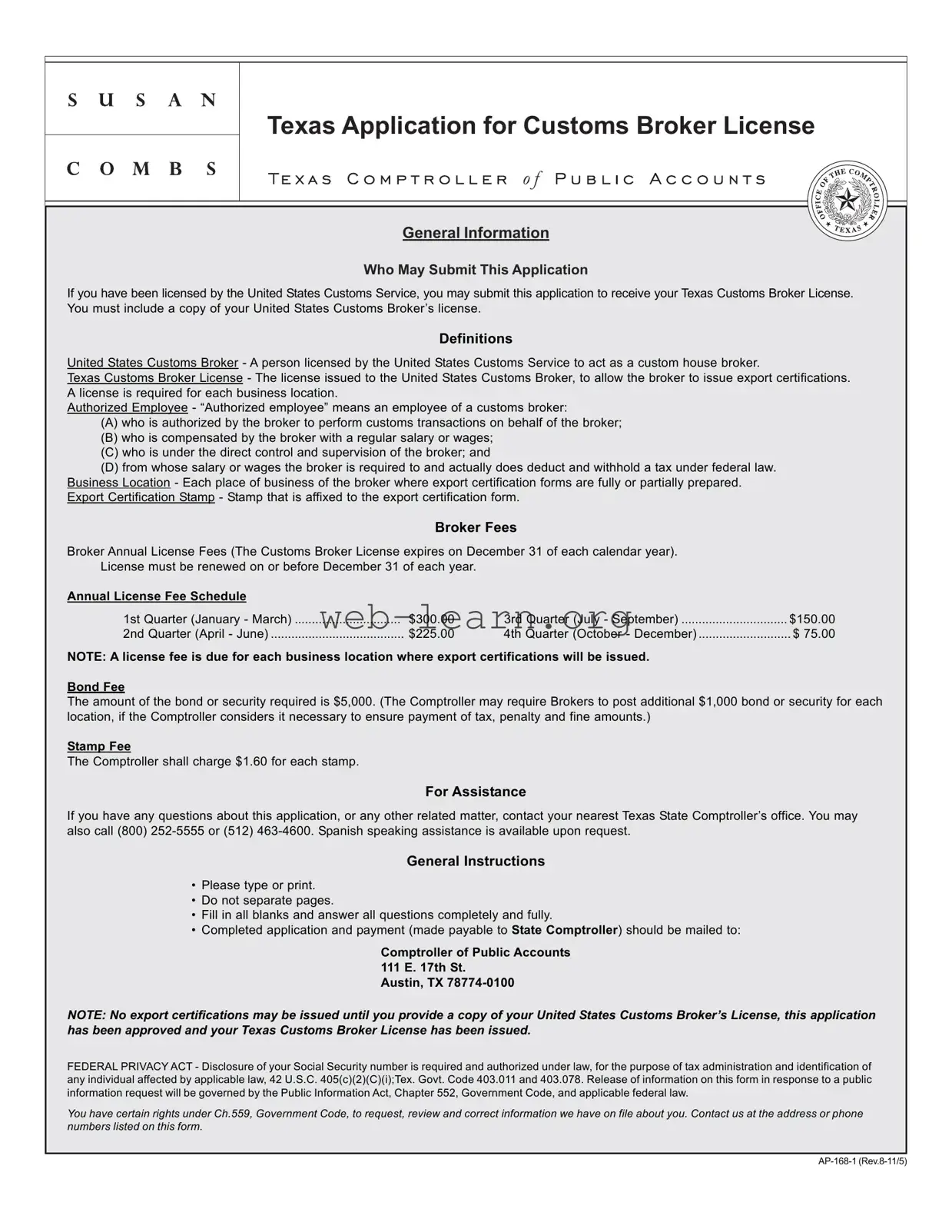
The Texas Application for Customs Broker License, known as Form AP 168, serves as a critical step for individuals seeking to operate as customs brokers in Texas. This application is specifically designed for those who already hold a United States Customs Broker license and wish to obtain the corresponding Texas license. To complete the application, you must provide a copy of your U.S. Customs Broker license along with various details about your business and authorized employees. Each business location where export certifications will be issued requires its own license, and the application process includes submitting necessary fees and documentation. The form outlines the responsibilities of the licensed customs broker, including compliance with state tax regulations and proper documentation practices. Additionally, applicants must be aware of the annual renewal process and the associated fees, which vary depending on the time of year. Understanding these requirements is essential for anyone looking to navigate the licensing process effectively and maintain compliance with state regulations.

Texas Application for Customs Broker License
General Information
Who May Submit This Application
If you have been licensed by the United States Customs Service, you may submit this application to receive your Texas Customs Broker License. You must include a copy of your United States Customs Broker’s license.
Definitions
United States Customs Broker - A person licensed by the United States Customs Service to act as a custom house broker.
Texas Customs Broker License - The license issued to the United States Customs Broker, to allow the broker to issue export certifications. A license is required for each business location.
Authorized Employee - “Authorized employee” means an employee of a customs broker:
(A)who is authorized by the broker to perform customs transactions on behalf of the broker;
(B)who is compensated by the broker with a regular salary or wages;
(C)who is under the direct control and supervision of the broker; and
(D)from whose salary or wages the broker is required to and actually does deduct and withhold a tax under federal law. Business Location - Each place of business of the broker where export certification forms are fully or partially prepared. Export Certification Stamp - Stamp that is affixed to the export certification form.
Broker Fees
Broker Annual License Fees (The Customs Broker License expires on December 31 of each calendar year).
License must be renewed on or before December 31 of each year.
Annual License Fee Schedule |
|
|
|
1st Quarter (January - March) |
$300.00 |
3rd Quarter (July - September) |
$150.00 |
2nd Quarter (April - June) |
$225.00 |
4th Quarter (October - December) |
$ 75.00 |
NOTE: A license fee is due for each business location where export certifications will be issued.
Bond Fee
The amount of the bond or security required is $5,000. (The Comptroller may require Brokers to post additional $1,000 bond or security for each location, if the Comptroller considers it necessary to ensure payment of tax, penalty and fine amounts.)
Stamp Fee
The Comptroller shall charge $1.60 for each stamp.
For Assistance
If you have any questions about this application, or any other related matter, contact your nearest Texas State Comptroller’s office. You may also call (800)
General Instructions
•Please type or print.
•Do not separate pages.
•Fill in all blanks and answer all questions completely and fully.
•Completed application and payment (made payable to State Comptroller) should be mailed to:
Comptroller of Public Accounts
111 E. 17th St.
Austin, TX
NOTE: No export certifications may be issued until you provide a copy of your United States Customs Broker’s License, this application has been approved and your Texas Customs Broker License has been issued.
FEDERAL PRIVACY ACT - Disclosure of your Social Security number is required and authorized under law, for the purpose of tax administration and identification of any individual affected by applicable law, 42 U.S.C. 405(c)(2)(C)(i);Tex. Govt. Code 403.011 and 403.078. Release of information on this form in response to a public information request will be governed by the Public Information Act, Chapter 552, Government Code, and applicable federal law.
You have certain rights under Ch.559, Government Code, to request, review and correct information we have on file about you. Contact us at the address or phone numbers listed on this form.
| Fact Name | Fact Description |
|---|---|
| Who Can Apply | Only individuals licensed by the United States Customs Service may submit the Texas Application for Customs Broker License. |
| License Requirement | A Texas Customs Broker License is mandatory for each business location where export certifications are issued. |
| Annual License Fees | The annual license fee varies based on the quarter, ranging from $75 to $300, and must be renewed by December 31 each year. |
| Bond Fee | A bond or security of $5,000 is required, with the possibility of an additional $1,000 for each business location if deemed necessary by the Comptroller. |
| Stamp Fee | The Comptroller charges a fee of $1.60 for each export certification stamp. |
| Governing Laws | The application is governed by the Texas Government Code, specifically sections 403.011 and 403.078, as well as federal privacy laws. |
| Assistance Contact | For questions, applicants can contact the Texas State Comptroller's office at (800) 252-5555 or (512) 463-4600, with Spanish assistance available upon request. |
Completing the Texas Application for Customs Broker License (Form AP-168) is essential for those seeking to operate as customs brokers in Texas. The following steps will guide you through the process of filling out the form correctly. Be sure to gather all necessary information and documents before you begin.
After submitting your application, wait for approval. No export certifications can be issued until your Texas Customs Broker License is granted. If you have any questions during the process, reach out to the Texas State Comptroller’s office for assistance.
What is the Texas Application for Customs Broker License (AP-168)?
The Texas Application for Customs Broker License (AP-168) is a form that individuals who are already licensed by the United States Customs Service must complete to obtain a Texas Customs Broker License. This license is essential for brokers who want to issue export certifications within Texas. It is important to note that a separate license is required for each business location where these certifications will be issued.
Who is eligible to submit the AP-168 application?
Only individuals who have already been licensed by the United States Customs Service can submit this application. Along with the completed form, applicants must provide a copy of their United States Customs Broker’s license. This ensures that all applicants are qualified to perform customs transactions on behalf of their businesses.
What are the fees associated with obtaining a Texas Customs Broker License?
There are several fees involved in obtaining a Texas Customs Broker License:
It is crucial to remember that these fees are due for each business location where export certifications will be issued.
What should I do if I have questions about the application process?
If you have any questions regarding the AP-168 application or related matters, you can reach out to your nearest Texas State Comptroller’s office. They are available to assist you and can be contacted at (800) 252-5555 or (512) 463-4600. Spanish-speaking assistance is also available upon request. Don't hesitate to ask for help; it’s important to ensure that your application is completed accurately.
Filling out the Texas Application for Customs Broker License, known as Form AP-168, can be a straightforward process if done correctly. However, many applicants make common mistakes that can delay their application or lead to rejection. Here are ten mistakes to avoid when completing this form.
One frequent error is neglecting to include a copy of the United States Customs Broker’s license. This document is essential for the application to be considered. Without it, the form may be deemed incomplete, and processing will halt until the necessary documentation is provided.
Another mistake is failing to fill in all required fields. Each blank must be completed, and applicants often overlook minor details. Incomplete applications can lead to delays, so it’s crucial to double-check that every question has been answered.
Some applicants mistakenly write in shaded areas of the form, which are designated for Comptroller use only. This can result in confusion and may require the applicant to resubmit the form, wasting time and effort.
Additionally, many people forget to sign the application. A signature is not just a formality; it confirms that the information provided is accurate and that the applicant agrees to the terms outlined in the agreement section.
Incorrectly entering the Social Security number or Federal Employer Identification Number (FEIN) is another common issue. These numbers must be accurate, as they are used for identification and tax purposes. Errors can lead to complications in processing the application.
Many applicants also overlook the importance of including a daytime phone number. Providing a reliable contact number ensures that the Comptroller’s office can reach the applicant if there are any questions or issues with the application.
Some individuals fail to attach the required powers of attorney for employees authorized to issue certifications. Each employee listed must have this documentation, and missing it can delay the approval process.
Another mistake is submitting payment without verifying the correct fee amount. The application fee varies depending on when it is submitted, and applicants should ensure they are paying the appropriate amount to avoid delays.
Lastly, not checking the mailing address can lead to significant setbacks. Applications should be sent to the correct address, as outlined in the instructions. Sending it to the wrong location can result in lost applications and further delays.
By avoiding these common mistakes, applicants can streamline the process of obtaining their Texas Customs Broker License and ensure a smoother experience overall.
The Texas Application for Customs Broker License (AP-168) is an essential document for individuals seeking to operate as customs brokers in Texas. Alongside this form, there are several other important documents and forms that may be required to ensure compliance with state and federal regulations. Below is a list of commonly used forms and documents associated with the AP-168.
Understanding and preparing these documents can facilitate a smoother application process for obtaining the Texas Customs Broker License. Ensuring all paperwork is complete and accurate helps in maintaining compliance and avoiding potential issues down the line.
The Texas Application for Customs Broker License (Form AP-168) shares similarities with several other documents related to business licensing and regulatory compliance. Below is a list of seven documents that resemble the AP-168 form, along with a brief explanation of how they are similar.
When filling out the Texas Application for Customs Broker License (Form AP-168), it’s important to follow certain guidelines to ensure your application is processed smoothly. Here are six things you should and shouldn’t do:
By adhering to these guidelines, you can help ensure a more efficient application process for your Texas Customs Broker License.
Here are four common misconceptions about the Texas AP 168 form:
This is not true. Any individual who holds a valid United States Customs Broker License can apply, regardless of their state of residence.
In reality, the license must be renewed annually. Each year, brokers need to submit their renewal application and pay the appropriate fee before December 31.
This is incorrect. Each business location where export certifications will be issued requires its own Texas Customs Broker License.
Actually, the bond fee of $5,000 is an ongoing requirement. Additional fees may apply for each location if deemed necessary by the Comptroller.
When filling out and using the Texas Application for Customs Broker License (Form AP-168), it is important to keep the following key points in mind: