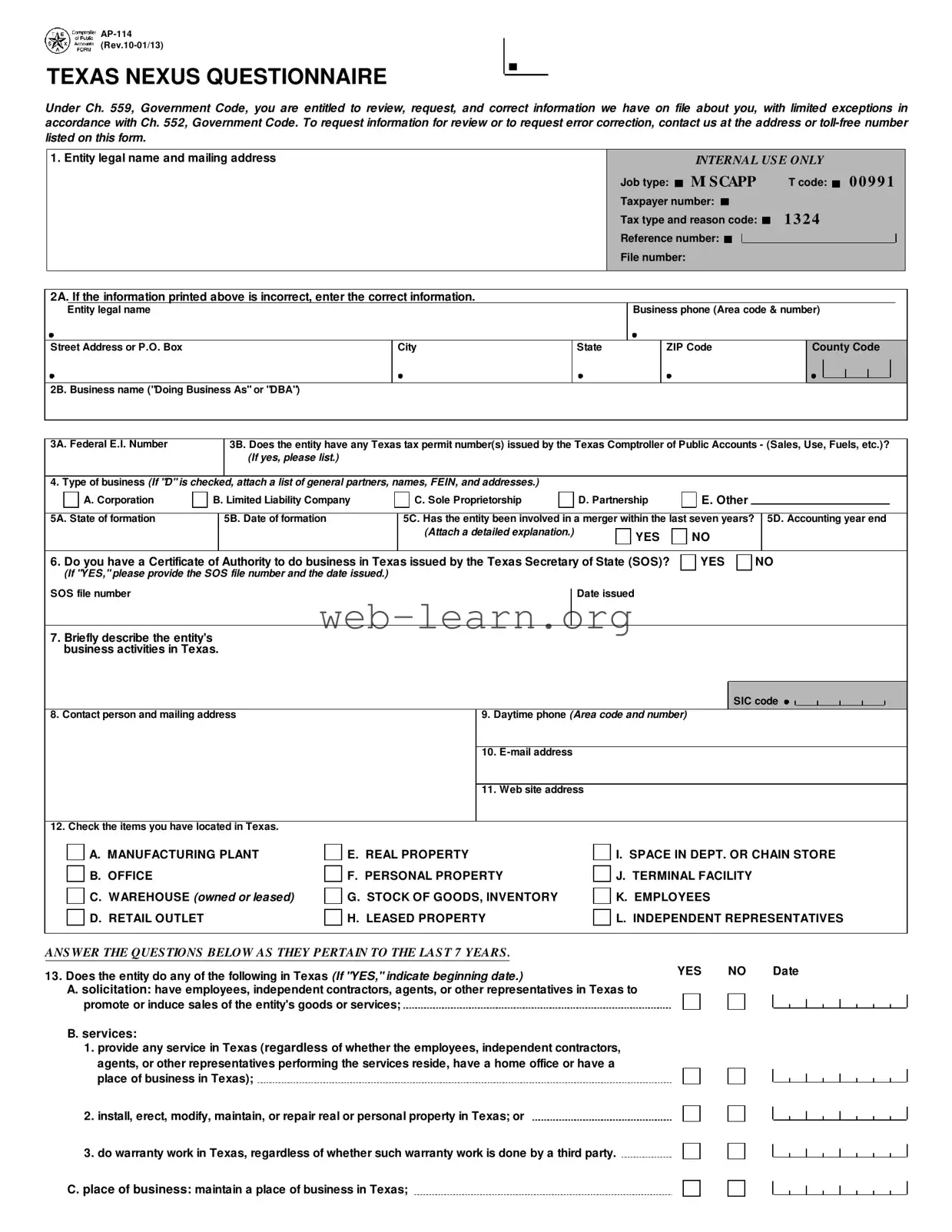
The Texas AP-114 form, also known as the Texas Nexus Questionnaire, serves as a crucial document for businesses operating within the state. It collects essential information regarding a company's legal identity, including its name, mailing address, and business type. This form also inquires about the entity's activities in Texas, such as whether it maintains a physical presence or conducts business transactions within the state. Key sections of the form require details about the entity's formation, any mergers, and whether it holds a Certificate of Authority from the Texas Secretary of State. Additionally, the AP-114 prompts businesses to disclose their Texas tax permits and specific operational activities that may establish a nexus in the state. By providing a comprehensive overview of a business's operations and compliance with Texas regulations, the AP-114 plays a vital role in ensuring that entities fulfill their tax obligations and maintain accurate records with the Texas Comptroller of Public Accounts.
TEXAS NEXUS QUESTIONNAIRE
Under Ch. 559, Government Code, you are entitled to review, request, and correct information we have on file about you, with limited exceptions in accordance with Ch. 552, Government Code. To request information for review or to request error correction, contact us at the address or
|
1. Entity legal name and mailing address |
|
INTERNAL US E ONLY |
|||
|
|
Job type: |
MI SCAPP |
T code: 0 0 9 9 1 |
||
|
|
Taxpayer number: |
|
|
||
|
|
Tax type and reason code: |
1 3 2 4 |
|
||
|
|
|
|
|
||
|
|
Reference number: |
|
|
|
|
|
|
File number: |
|
|
|
|
|
|
|
|
|
|
|
|
|
|
|
|
|
|
|
2A. If the information printed above is incorrect, enter the correct information. |
|
|
|
|
|
Entity legal name
Business phone (Area code & number)
Street Address or P.O. Box
City
State
ZIP Code
County Code
2B. Business name ("Doing Business As" or "DBA")
3A. Federal E.I. Number
3B. Does the entity have any Texas tax permit number(s) issued by the Texas Comptroller of Public Accounts - (Sales, Use, Fuels, etc.)? (If yes, please list.)
4. Type of business (If "D" is checked, attach a list of general partners, names, FEIN, and addresses.)
|
|
A. Corporation |
|
B. Limited Liability Company |
|
C. Sole Proprietorship |
|
D. Partnership |
|
|
|
E. Other |
|
|
||||
|
|
|
|
|
|
|
|
|
|
|
|
|
|
|
|
|
|
|
|
|
|
|
|
|
|
|
|||||||||||
5A. State of formation |
|
|
5B. Date of formation |
5C. Has the entity been involved in a merger within the last seven years? |
5D. Accounting year end |
|||||||||||||
|
|
|
|
|
|
|
(Attach a detailed explanation.) |
|
|
YES |
|
|
NO |
|
|
|||
|
|
|
|
|
|
|
|
|
|
|
|
|
||||||
|
|
|
|
|
|
|
|
|
|
|
|
|
|
|
||||
|
|
|
|
|
|
|
|
|
|
|
|
|
|
|
|
|
|
|
6.Do you have a Certificate of Authority to do business in Texas issued by the Texas Secretary of State (SOS)?
(If "YES," please provide the SOS file number and the date issued.)
SOS file number |
Date issued |
|
|
YES
NO
7. Briefly describe the entity's business activities in Texas.
SIC code
8. Contact person and mailing address |
9. Daytime phone (Area code and number) |
|
|
|
|
|
10. |
|
|
|
|
|
11. |
Web site address |
|
|
|
12. Check the items you have located in Texas. |
|
|
A.MANUFACTURING PLANT
B.OFFICE
C.WAREHOUSE (owned or leased)
D.RETAIL OUTLET
E.REAL PROPERTY
F.PERSONAL PROPERTY
G.STOCK OF GOODS, INVENTORY
H.LEASED PROPERTY
I.SPACE IN DEPT. OR CHAIN STORE
J.TERMINAL FACILITY
K.EMPLOYEES
L.INDEPENDENT REPRESENTATIVES
ANS WER THE QUES TIONS BELOW AS THEY PERTAIN TO THE LAS T 7 YEARS .
13. Does the entity do any of the following in Texas (If "YES," indicate beginning date.) |
YES |
NO |
Date |
|||||
|
|
|
|
|
|
|
|
|
A. solicitation: have employees, independent contractors, agents, or other representatives in Texas to |
|
|
|
|
|
|
|
|
promote or induce sales of the entity's goods or services; |
|
|
|
|
|
|
|
|
B.services:
1.provide any service in Texas (regardless of whether the employees, independent contractors,
agents, or other representatives performing the services reside, have a home office or have a place of business in Texas);
2. install, erect, modify, maintain, or repair real or personal property in Texas; or
3. do warranty work in Texas, regardless of whether such warranty work is done by a third party.
C. place of business: maintain a place of business in Texas;

Form
YES NO Date
13.(Continued)
D. partners: act as a general partner in a general or limited partnership which is doing business in Texas;
E. contracting: perform a contract in Texas regardless of whether the entity brings its own employees into the state, hires local labor, or subcontracts with another;
F. inventory: have inventory in Texas;
G. real estate: hold, acquire, lease, or dispose of any property located in Texas;
H. shows: the staging of shows or other events in Texas;
I.transportation:
1. carry passengers or property in Texas if both pickup and delivery occur within Texas; or
2.have facilities and/or employees, independent contractors, agents, or other representatives in Texas for storage, delivery, or shipment of goods; for servicing, maintaining, or repairing of vehicles or other
equipment; for coordinating and directing the transportation of passengers or property; or for doing other business of the corporation/LLC;
J. franchisers: enter into one or more contracts with persons or other business entities located in Texas, by which:
1. the franchisee is granted the right to engage in the business of offering, selling, or distributing goods or services under a marketing plan or system prescribed in substantial part by the franchiser; and
2.the operation of a franchisee's business pursuant to such plan is substantially associated with the franchiser's trademark, service mark, trade name, logotype, advertising, or other commercial symbol
designating the franchiser or its affiliate;
K. processing: assemble, process, manufacture, or store goods in Texas;
L. advertising: enter Texas to purchase, place, or display advertising when the advertising is for the benefit of another;
M. processing and shipment: send materials to a Texas manufacturer, processor, repairer, or printer to be processed and stored in completed form awaiting orders for their shipment;
N. loan production activities: solicit sales contracts or loans, gather financial data, make credit checks, or perform other financial activities in Texas through employees, independent contractors, agents, or other representatives;
O. holding companies: maintain a place of business in Texas or manage direct, and/or perform services in Texas for subsidiaries or investee corporations/LLCs;
P. federal enclaves: do business in any area within Texas, even if the area is leased by, owned by, ceded to, or under the control of the federal government;
Q. consignments: have consigned goods in Texas;
R. delivering: deliver into Texas items it has sold, in company vehicles;
S. leasing: lease tangible personal property that is used in Texas.
Remarks:
I declare that the information in this document and any attachments is true and correct to the best of my knowledge and belief.
Authorized signature (Officer, director, authorized agent)
Date
Type or print name
Title
PROVIDING COMPLETE AND ACCURATE BUSINESS INFORMATION WILL EXPEDITE
THE PROCESSING OF YOUR QUESTIONNAIRE.
Please return the questionnaire to: Texas Comptroller of Public Accounts 111 E. 17th Street
Austin, TX
For assistance, call
(TDD), the toll free number is
| Fact Name | Description |
|---|---|
| Form Title | The form is officially titled "Texas Nexus Questionnaire" and is designated as AP-114. |
| Governing Law | This form is governed by Chapter 559 of the Texas Government Code. |
| Purpose | The questionnaire collects information to determine nexus for tax purposes in Texas. |
| Entity Information | It requires the entity's legal name, mailing address, and taxpayer number. |
| Business Type | Entities must indicate their type, such as Corporation, LLC, or Sole Proprietorship. |
| Certificate of Authority | The form asks if the entity has a Certificate of Authority issued by the Texas Secretary of State. |
| Business Activities | Entities must describe their business activities in Texas and provide an SIC code. |
| Contact Information | It collects details for a contact person, including phone number and email address. |
| Items in Texas | Entities check off items they have located in Texas, like offices or warehouses. |
| Signature Requirement | An authorized signature is required to validate the information provided in the questionnaire. |
Filling out the Texas AP-114 form requires careful attention to detail. Ensure that all information is accurate and complete to avoid delays in processing. After completing the form, submit it to the Texas Comptroller of Public Accounts as instructed.
After completing all sections, review the form for accuracy. Submit the form to the Texas Comptroller of Public Accounts at the address provided. For any questions, contact the provided phone numbers for assistance.
What is the Texas AP-114 form?
The Texas AP-114 form, also known as the Texas Nexus Questionnaire, is a document used by businesses to provide information regarding their activities in Texas. This form helps the Texas Comptroller of Public Accounts determine whether a business has a tax obligation in the state. It collects details such as the entity's legal name, business type, formation date, and specific business activities conducted in Texas.
Who needs to fill out the Texas AP-114 form?
Any business entity that operates in Texas or has a significant presence in the state may need to complete the AP-114 form. This includes corporations, limited liability companies, partnerships, and sole proprietorships. If your business engages in activities such as selling goods, providing services, or maintaining a physical location in Texas, you are likely required to submit this form.
What information is required on the AP-114 form?
The form requests various details, including:
Providing accurate and complete information will help expedite the processing of your questionnaire.
How do I submit the AP-114 form?
You can submit the completed AP-114 form by mailing it to the Texas Comptroller of Public Accounts at the address provided on the form: 111 E. 17th Street, Austin, TX 78774-0100. Ensure that you retain a copy for your records. If you need assistance while filling out the form, you can call the toll-free number provided for support.
What happens if I provide incorrect information on the form?
If you realize that the information submitted on the AP-114 form is incorrect, you have the right to request a correction. You can do this by contacting the Texas Comptroller's office using the contact information provided on the form. It is essential to ensure that all details are accurate to avoid potential issues with tax compliance.
Can I review the information on file about my business?
Yes, under Chapter 559 of the Government Code, you are entitled to review, request, and correct information that the Texas Comptroller has on file about your business. If you wish to review this information, reach out to the Comptroller’s office using the contact details listed on the AP-114 form.
Filling out the Texas AP-114 form can seem straightforward, but many individuals and businesses make common mistakes that can lead to delays or issues. One frequent error is not providing the correct entity legal name and mailing address. This section is crucial because it identifies your business. If the name or address is incorrect, it can cause confusion and miscommunication with the Texas Comptroller's office.
Another common mistake involves skipping the section about the Texas tax permit numbers. If your entity has any permits issued by the Texas Comptroller, failing to list them can raise red flags. It’s essential to provide this information accurately to avoid complications in processing your questionnaire.
Some people also overlook the type of business question. Selecting the wrong type, whether it’s a corporation, partnership, or sole proprietorship, can lead to significant issues. Each business type has different legal implications and requirements, so it’s important to choose the one that accurately reflects your business structure.
In addition, many applicants forget to include the contact person’s information. This section is vital for communication. Without a designated contact, the Comptroller's office may struggle to reach you for any follow-up questions or clarifications, potentially delaying the process.
Providing incomplete or unclear descriptions of the business activities in Texas is another mistake that can hinder the application. The form asks for a brief description, and vague or generic responses may not provide enough context for the reviewers. Be specific about what your business does to ensure it’s understood correctly.
Finally, neglecting to sign and date the form is a simple yet critical error. An unsigned form is not valid, and it will be returned for correction. Make sure to include an authorized signature along with the date to confirm that the information provided is accurate and complete.
The Texas AP-114 form, also known as the Texas Nexus Questionnaire, is essential for businesses to disclose their activities in Texas. When completing this form, you may also need to submit other documents that provide additional information about your business operations. Here are five forms and documents commonly used alongside the Texas AP-114:
Gathering these documents can help ensure a smooth process when filing the Texas AP-114 form. Having all necessary information readily available will facilitate compliance with Texas regulations and support your business operations.
The Texas AP 114 form is similar to several other documents used for business registration and compliance. Here are four documents that share similarities:
When filling out the Texas AP-114 form, it’s essential to approach the task with care and attention to detail. Here are five things you should and shouldn't do to ensure your submission is accurate and complete.
Understanding the Texas AP-114 form is essential for businesses operating in the state. However, several misconceptions can lead to confusion. Here are seven common misconceptions about the Texas AP-114 form:
Being aware of these misconceptions can help ensure compliance and streamline the process of doing business in Texas.
Filling out the Texas AP-114 form requires attention to detail and accuracy. Here are key takeaways to consider when completing and using this form:
Completing the Texas AP-114 form thoroughly and accurately will facilitate the processing of your questionnaire. If you have questions or need assistance, do not hesitate to contact the Texas Comptroller of Public Accounts.