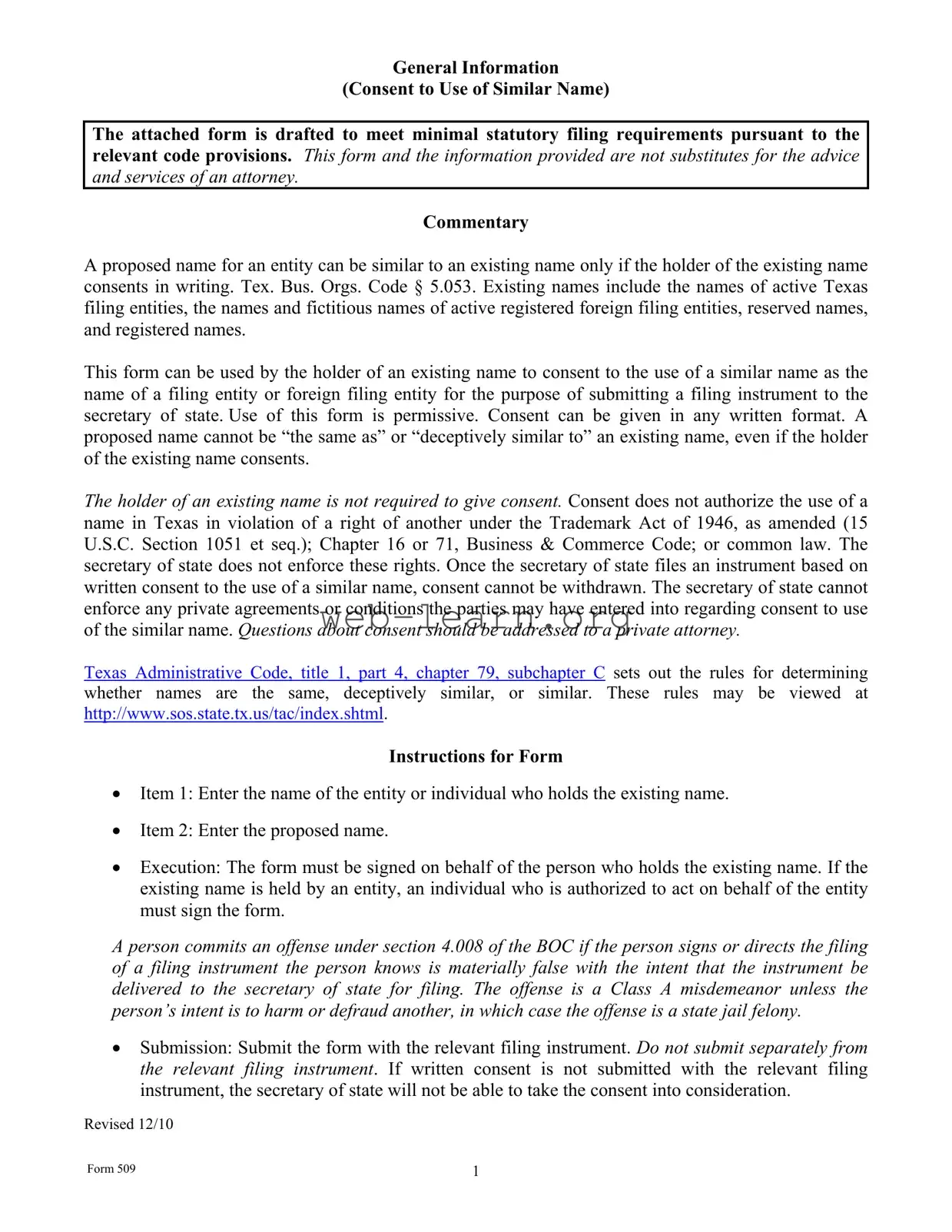
In the world of business in Texas, ensuring that your entity's name is unique and compliant with state regulations is crucial. The Texas 509 form plays a vital role in this process by allowing the holder of an existing name to consent to the use of a similar name by another entity. This form is designed to meet the minimum statutory filing requirements, ensuring that all parties involved are protected under the law. It is important to note that while the form facilitates the naming process, it does not replace the need for professional legal advice. Consent to use a similar name must be obtained in writing from the holder of the existing name, and this consent cannot be withdrawn once the form is filed. However, it is essential to understand that the proposed name cannot be identical or deceptively similar to the existing name, even with consent. The Texas Secretary of State does not enforce trademark rights, so individuals must remain vigilant in protecting their interests. This form, which must be submitted alongside the relevant filing instrument, is a simple yet significant step in establishing a business identity in Texas.

General Information
(Consent to Use of Similar Name)
The attached form is drafted to meet minimal statutory filing requirements pursuant to the relevant code provisions. This form and the information provided are not substitutes for the advice and services of an attorney.
Commentary
A proposed name for an entity can be similar to an existing name only if the holder of the existing name consents in writing. Tex. Bus. Orgs. Code § 5.053. Existing names include the names of active Texas filing entities, the names and fictitious names of active registered foreign filing entities, reserved names, and registered names.
This form can be used by the holder of an existing name to consent to the use of a similar name as the name of a filing entity or foreign filing entity for the purpose of submitting a filing instrument to the secretary of state. Use of this form is permissive. Consent can be given in any written format. A proposed name cannot be “the same as” or “deceptively similar to” an existing name, even if the holder of the existing name consents.
The holder of an existing name is not required to give consent. Consent does not authorize the use of a name in Texas in violation of a right of another under the Trademark Act of 1946, as amended (15 U.S.C. Section 1051 et seq.); Chapter 16 or 71, Business & Commerce Code; or common law. The secretary of state does not enforce these rights. Once the secretary of state files an instrument based on written consent to the use of a similar name, consent cannot be withdrawn. The secretary of state cannot enforce any private agreements or conditions the parties may have entered into regarding consent to use of the similar name. Questions about consent should be addressed to a private attorney.
Texas Administrative Code, title 1, part 4, chapter 79, subchapter C sets out the rules for determining whether names are the same, deceptively similar, or similar. These rules may be viewed at http://www.sos.state.tx.us/tac/index.shtml.
Instructions for Form
クItem 1: Enter the name of the entity or individual who holds the existing name.
クItem 2: Enter the proposed name.
クExecution: The form must be signed on behalf of the person who holds the existing name. If the existing name is held by an entity, an individual who is authorized to act on behalf of the entity must sign the form.
A person commits an offense under section 4.008 of the BOC if the person signs or directs the filing of a filing instrument the person knows is materially false with the intent that the instrument be delivered to the secretary of state for filing. The offense is a Class A misdemeanor unless the person’s intent is to harm or defraud another, in which case the offense is a state jail felony.
クSubmission: Submit the form with the relevant filing instrument. Do not submit separately from the relevant filing instrument. If written consent is not submitted with the relevant filing instrument, the secretary of state will not be able to take the consent into consideration.
Revised 12/10
Form 509 |
1 |

Form 509 (Revised 12/10)
Submit with relevant filing instrument.
Filing Fee: None
Consent to Use of Similar Name
(1)
Name of the entity or individual who holds the existing name on file with the secretary of state
consents to the use of
(2)
Proposed name
as the name of a filing entity or foreign filing entity in Texas for the purpose of submitting a filing instrument to the secretary of state. This consent does not authorize the use of the similar name in violation of a right of another under the Trademark Act of 1946, as amended (15 U.S.C. Section 1051 et seq.); Chapter 16 or 71, Business & Commerce Code; or common law.
(3)The undersigned certifies to being authorized by the holder of the existing name to give this consent. The undersigned signs this document subject to the penalties imposed by law for the submission of a materially false or fraudulent instrument.
Date:
By:
Name of existing entity, if any (type or print)
File number of existing entity, if any
Signature of Authorized Person
Name of Authorized Person (type or print)
Title of Authorized Person, if any (type or print)
Form 509 |
2 |
| Fact Name | Fact Description |
|---|---|
| Purpose | The Texas 509 form allows the holder of an existing name to consent to the use of a similar name for a filing entity or foreign filing entity. |
| Governing Law | This form is governed by Tex. Bus. Orgs. Code § 5.053 and related provisions. |
| Submission Requirement | Submit the form with the relevant filing instrument. Do not submit it separately. |
| Consent Limitations | Consent does not allow the use of a name that is identical or deceptively similar to an existing name, even with consent. |
Filling out the Texas 509 form is a straightforward process that requires careful attention to detail. This form is essential for obtaining consent to use a name similar to an existing one. After completing the form, it must be submitted along with the relevant filing instrument to the Secretary of State. Here’s how to fill it out step-by-step:
After completing these steps, ensure that the form is submitted together with the relevant filing instrument. It’s important to remember that the Secretary of State will not consider the consent if the form is submitted separately. Double-check for accuracy before submission to avoid any potential issues.
What is the purpose of the Texas 509 form?
The Texas 509 form is used to obtain consent from the holder of an existing name for the use of a similar name by a filing entity or foreign filing entity. This consent is necessary to comply with Texas law, which requires that a proposed name cannot be the same as or deceptively similar to an existing name without written consent.
Who needs to sign the Texas 509 form?
The form must be signed by the person who holds the existing name. If the existing name is associated with an entity, an individual authorized to act on behalf of that entity must sign the form. This ensures that the consent is valid and legally binding.
Is there a fee associated with filing the Texas 509 form?
No, there is no filing fee required for submitting the Texas 509 form. However, it must be submitted along with the relevant filing instrument to the Secretary of State for it to be considered valid.
Can consent given through the Texas 509 form be withdrawn?
Once the Secretary of State files an instrument based on the written consent provided in the Texas 509 form, that consent cannot be withdrawn. It is important to understand that the consent is final once filed, and any private agreements regarding the use of the name are not enforced by the Secretary of State.
What happens if the Texas 509 form is not submitted correctly?
If the Texas 509 form is not submitted with the relevant filing instrument, the Secretary of State will not consider the consent. This could result in the rejection of the filing, delaying the process of establishing the new entity name.
Where can I find more information about name similarity rules in Texas?
For more details on how names are evaluated for similarity, you can refer to the Texas Administrative Code, title 1, part 4, chapter 79, subchapter C. This resource outlines the specific criteria used to determine whether names are the same, deceptively similar, or simply similar.
Filling out the Texas 509 form requires careful attention to detail. One common mistake is failing to provide the correct name of the entity or individual holding the existing name. This information is crucial, as it must match exactly what is on file with the Secretary of State. A simple typo can lead to delays or rejection of the filing.
Another frequent error involves the proposed name. Some individuals mistakenly believe that they can use a name that is merely similar to an existing name without proper consent. It is essential to remember that consent must be obtained in writing from the holder of the existing name. Without this consent, the proposed name cannot be used.
People often overlook the execution section of the form. The form must be signed by someone authorized to act on behalf of the entity holding the existing name. If this step is ignored, the submission may be deemed invalid. Furthermore, if the existing name is held by an entity, the signature must come from an individual with the appropriate authority.
Another mistake is submitting the form separately from the relevant filing instrument. The Texas 509 form must accompany the filing instrument. If it is submitted alone, the Secretary of State will not consider the consent, potentially resulting in a failed application.
Some individuals fail to understand the implications of providing false information. Signing the form while knowing that the information is materially false can lead to serious legal consequences, including misdemeanor or felony charges. It is crucial to ensure that all information provided is accurate and truthful.
Additionally, many people neglect to check the rules regarding what constitutes a "deceptively similar" name. This can lead to confusion and potential issues with the filing. Reviewing the Texas Administrative Code can provide clarity on this matter.
Lastly, individuals may not realize that once consent is given and the Secretary of State files the instrument, that consent cannot be withdrawn. This emphasizes the importance of being certain about the decision to grant consent before signing the form.
The Texas 509 form is essential for obtaining consent to use a similar name for a business entity. However, there are several other documents that often accompany this form to ensure compliance with state regulations. Below is a list of these documents, each serving a unique purpose in the filing process.
Understanding these documents can help streamline the process of forming and registering a business in Texas. Each plays a vital role in ensuring that your business complies with state laws and operates smoothly. Always consider seeking professional advice if you have questions about specific requirements or processes.
The Texas 509 form is primarily used for granting consent to use a name that is similar to an existing name. Several other documents serve similar purposes in different contexts. Here are four documents that share similarities with the Texas 509 form:
When filling out the Texas 509 form, there are several important considerations to keep in mind to ensure a smooth process. Below is a list of things you should and shouldn't do while completing this form.
By following these guidelines, you can navigate the Texas 509 form more effectively and reduce the likelihood of complications during the filing process.
Understanding the Texas 509 form is essential for anyone looking to navigate the complexities of business naming in Texas. Unfortunately, several misconceptions can lead to confusion. Here’s a detailed look at nine common misunderstandings about this form:
Being aware of these misconceptions can help individuals and businesses navigate the naming process in Texas more effectively. Always consider seeking professional legal advice for specific situations.
When it comes to the Texas 509 form, understanding its purpose and proper usage is essential. Here are some key takeaways to keep in mind:
By keeping these points in mind, you can navigate the process of using the Texas 509 form with greater ease and confidence.