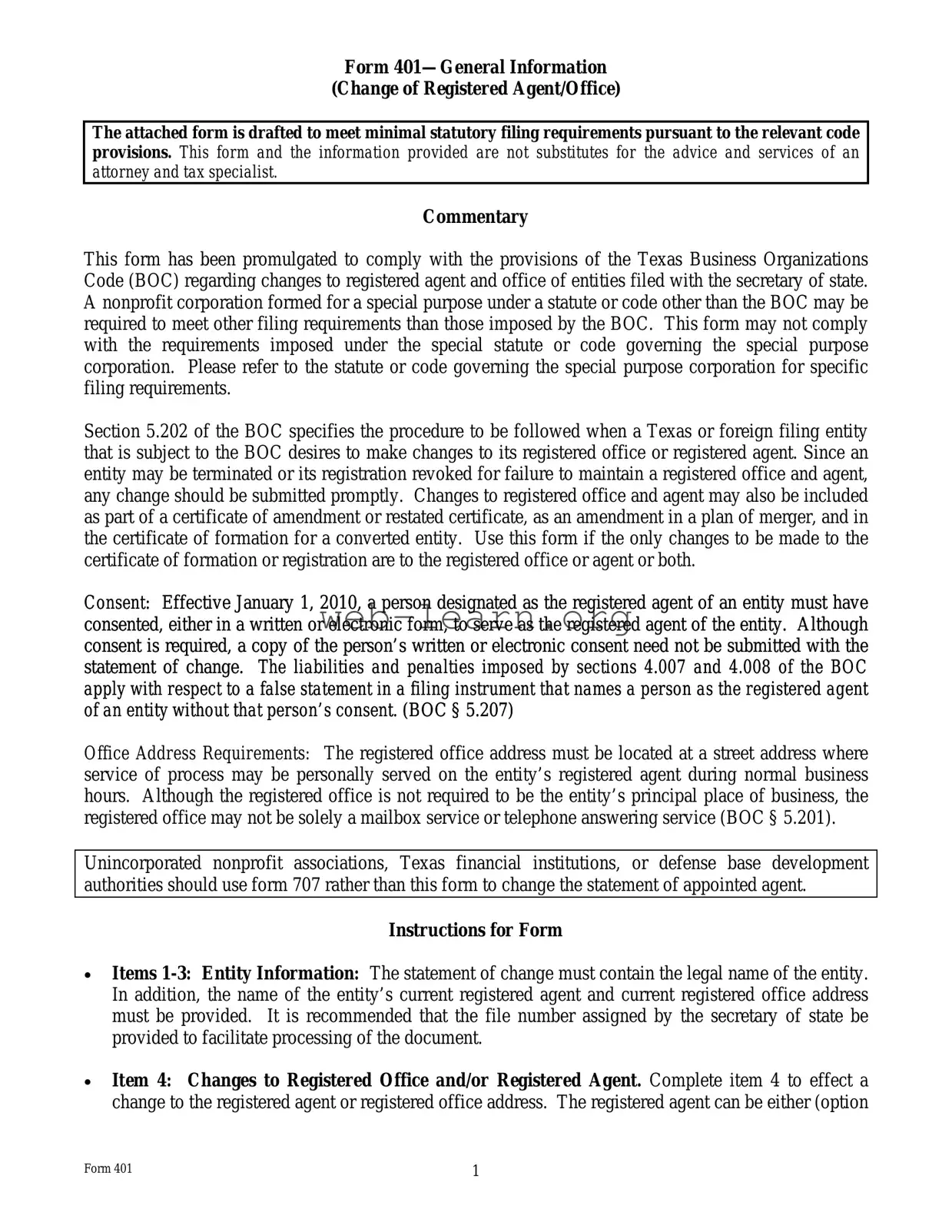
The Texas 401 form is essential for entities that need to change their registered agent or registered office. This form helps ensure compliance with the Texas Business Organizations Code (BOC) and serves as a formal notification to the Secretary of State. It is important to note that while this form meets basic statutory requirements, it may not address all the specific needs of nonprofit corporations formed under different statutes. The form requires basic information about the entity, including its legal name and current registered agent details. Changes to the registered office or agent must be submitted promptly to avoid potential termination or revocation of registration. Additionally, the form emphasizes that the registered agent must consent to their designation, and it outlines specific address requirements to ensure proper service of process. Filing fees vary depending on the entity type, and the completed form can be submitted via mail, fax, or in person. Understanding the nuances of the Texas 401 form can help entities maintain compliance and avoid unnecessary complications.

Form
The attached form is drafted to meet minimal statutory filing requirements pursuant to the relevant code provisions. This form and the information provided are not substitutes for the advice and services of an attorney and tax specialist.
Commentary
This form has been promulgated to comply with the provisions of the Texas Business Organizations Code (BOC) regarding changes to registered agent and office of entities filed with the secretary of state. A nonprofit corporation formed for a special purpose under a statute or code other than the BOC may be required to meet other filing requirements than those imposed by the BOC. This form may not comply with the requirements imposed under the special statute or code governing the special purpose corporation. Please refer to the statute or code governing the special purpose corporation for specific filing requirements.
Section 5.202 of the BOC specifies the procedure to be followed when a Texas or foreign filing entity that is subject to the BOC desires to make changes to its registered office or registered agent. Since an entity may be terminated or its registration revoked for failure to maintain a registered office and agent, any change should be submitted promptly. Changes to registered office and agent may also be included as part of a certificate of amendment or restated certificate, as an amendment in a plan of merger, and in the certificate of formation for a converted entity. Use this form if the only changes to be made to the certificate of formation or registration are to the registered office or agent or both.
Consent: Effective January 1, 2010, a person designated as the registered agent of an entity must have consented, either in a written or electronic form, to serve as the registered agent of the entity. Although consent is required, a copy of the person’s written or electronic consent need not be submitted with the statement of change. The liabilities and penalties imposed by sections 4.007 and 4.008 of the BOC apply with respect to a false statement in a filing instrument that names a person as the registered agent of an entity without that person’s consent. (BOC § 5.207)
Office Address Requirements: The registered office address must be located at a street address where service of process may be personally served on the entity’s registered agent during normal business hours. Although the registered office is not required to be the entity’s principal place of business, the registered office may not be solely a mailbox service or telephone answering service (BOC § 5.201).
Unincorporated nonprofit associations, Texas financial institutions, or defense base development authorities should use form 707 rather than this form to change the statement of appointed agent.
Instructions for Form
Items
Item 4: Changes to Registered Office and/or Registered Agent. Complete item 4 to effect a change to the registered agent or registered office address. The registered agent can be either (option
Form 401 |
1 |
A)a domestic entity or a foreign entity that is registered to do business in Texas or (option B) an individual resident of the state. The filing entity cannot act as its own registered agent.
If the registered office is changed, complete section C. The registered office must be located at a street address where service of process may be personally served on the entity’s registered agent during normal business hours. Although the registered office address is not required to be the entity’s principal place of business, the registered office may not be solely a mailbox service or a telephone answering service (BOC § 5.201).
The statement of change must recite that the street address of the registered office is the same as the registered agent’s business address.
Statement of Approval: As required by section 5.202(b)(6) of the BOC, the form includes a recitation that the change specified in the statement is authorized by the entity. While the statement of change has the effect of amending the entity’s certificate of formation or registration, the BOC does not provide that the procedures to amend the certificate of formation are applicable. In general, the statement of change should be adopted and approved by the governing persons or by a person authorized to act on behalf of the entity.
Effectiveness of Filing: A statement of change becomes effective when filed by the secretary of state (option A). However, pursuant to sections 4.052 and 4.053 of the BOC the effectiveness of the instrument may be delayed to a date not more than ninety (90) days from the date the instrument is signed (option B). The effectiveness of the instrument also may be delayed on the occurrence of a future event or fact, other than the passage of time (option C). If option C is selected, you must state the manner in which the event or fact will cause the instrument to take effect and the date of the 90th day after the date the instrument is signed. In order for the instrument to take effect under option C, the entity must, within ninety (90) days of the filing of the instrument, file a statement with the secretary of state regarding the event or fact pursuant to section 4.055 of the BOC.
On the filing of a document with a delayed effective date or condition, the computer records of the secretary of state will be changed to show the filing of the document, the date of the filing, and the future date on which the document will be effective or evidence that the effectiveness was conditioned on the occurrence of a future event or fact.
On acceptance of the statement of change by the secretary of state, the statement is effective as an amendment to the appropriate provision of the entity’s certificate of formation or the foreign filing entity’s registration.
Execution: Pursuant to section 4.001 of the BOC, the statement of change must be signed by a person authorized by the BOC to act on behalf of the entity in regard to the filing instrument. Generally, a governing person or managerial official of the entity signs a filing instrument.
The statement of change need not be notarized. However, before signing, please read the statements on this form carefully. The designation or appointment of a person as the registered agent by a managerial official is an affirmation by that official that the person named in the instrument has consented to serve as registered agent. (BOC § 5.2011, effective January 1, 2010)
A person commits an offense under section 4.008 of the BOC if the person signs or directs the filing of a filing instrument the person knows is materially false with the intent that the instrument be
Form 401 |
2 |
delivered to the secretary of state for filing. The offense is a Class A misdemeanor unless the person’s intent is to harm or defraud another, in which case the offense is a state jail felony.
Payment and Delivery Instructions: The filing fee for a change of registered office/agent is $15, unless the filing entity is a nonprofit corporation or a cooperative association. The filing fee for a nonprofit corporation or a cooperative association is $5. Fees may be paid by personal checks, money orders, LegalEase debit cards, or American Express, Discover, MasterCard, and Visa credit cards. Checks or money orders must be payable through a U.S. bank or financial institution and made payable to the secretary of state. Fees paid by credit card are subject to a statutorily authorized convenience fee of 2.7 percent of the total fees.
Submit the completed form in duplicate along with the filing fee. The form may be mailed to P.O. Box 13697, Austin, Texas
Revised 05/11
Form 401 |
3 |

Form 401 (Revised 05/11)
Submit in duplicate to: Secretary of State P.O. Box 13697 Austin, TX
512
Filing Fee: See instructions
This space reserved for office use.
Statement of Change of
Registered Office/Agent
Entity Information
1. The name of the entity is:
State the name of the entity as currently shown in the records of the secretary of state.
2.The file number issued to the filing entity by the secretary of state is:
3.The name of the registered agent as currently shown on the records of the secretary of state is:
Registered Agent Name
The address of the registered office as currently shown on the records of the secretary of state is:
TX
Street Address |
City |
State Zip Code |
Change to Registered Agent/Registered Office
4.The certificate of formation or registration is modified to change the registered agent and/or office of the filing entity as follows:
Registered Agent Change
(Complete either A or B, but not both. Also complete C if the address has changed.)
A. The new registered agent is an organization (cannot be entity named above) by the name of:
OR
B. The new registered agent is an individual resident of the state whose name is:
First Name |
M.I. |
Last Name |
Suffix |
Registered Office Change
C. The business address of the registered agent and the registered office address is changed to:
TX
Street Address (No P.O. Box) |
City |
State Zip Code |
The street address of the registered office as stated in this instrument is the same as the registered agent’s business address.
Form 401 |
4 |

Statement of Approval
The change specified in this statement has been authorized by the entity in the manner required by the BOC or in the manner required by the law governing the filing entity, as applicable.
Effectiveness of Filing (Select either A, B, or C.)
A. This document becomes effective when the document is filed by the secretary of state.
B. This document becomes effective at a later date, which is not more than ninety (90) days from the date of signing. The delayed effective date is:
C. This document takes effect upon the occurrence of a future event or fact, other than the passage of time. The 90th day after the date of signing is:
The following event or fact will cause the document to take effect in the manner described below:
Execution
The undersigned affirms that the person designated as registered agent has consented to the appointment. The undersigned signs this document subject to the penalties imposed by law for the submission of a materially false or fraudulent instrument and certifies under penalty of perjury that the undersigned is authorized to execute the filing instrument.
Date:
Signature of authorized person
Printed or typed name of authorized person (see instructions)
Reset
Form 401 |
5 |
| Fact Name | Details |
|---|---|
| Form Purpose | This form is used to change the registered agent or office for entities registered in Texas. |
| Governing Law | The Texas Business Organizations Code (BOC) governs the use of this form. |
| Filing Fee | The fee for filing this form is $15, or $5 for nonprofit corporations and cooperative associations. |
| Consent Requirement | The designated registered agent must consent to serve, but their consent does not need to be submitted with the form. |
| Office Address | The registered office must be a physical address, not just a mailbox or answering service. |
| Effectiveness of Filing | The filing becomes effective upon acceptance by the Secretary of State, unless a delayed effective date is specified. |
| Signature Requirement | The form must be signed by an authorized person; notarization is not required. |
| Submission Methods | Forms can be mailed, faxed, or delivered in person to the Secretary of State. |
Completing the Texas 401 form involves a series of clear steps to ensure that the necessary changes regarding a registered agent or office are properly documented. Following these steps will help facilitate a smooth filing process with the Secretary of State.
What is the purpose of the Texas 401 form?
The Texas 401 form is used to officially change the registered agent or registered office of a business entity in Texas. It ensures compliance with the Texas Business Organizations Code (BOC) and helps maintain accurate records with the Secretary of State.
Who needs to file the Texas 401 form?
Any Texas or foreign filing entity that needs to change its registered agent or registered office must file this form. This includes corporations, limited liability companies, and partnerships. Nonprofit corporations formed under special statutes may have different requirements and should consult the relevant code.
What are the requirements for a registered office address?
The registered office must be a physical street address where the registered agent can be served with legal documents during normal business hours. It cannot be a P.O. Box, mailbox service, or telephone answering service. The registered office address must also be the same as the business address of the registered agent.
What is the consent requirement for a registered agent?
As of January 1, 2010, a registered agent must consent to serve in that capacity. This consent can be in written or electronic form. However, the actual consent does not need to be submitted with the Texas 401 form; it is sufficient to affirm that consent has been obtained.
What is the filing fee for the Texas 401 form?
The filing fee is $15 for most entities. However, if the filing entity is a nonprofit corporation or a cooperative association, the fee is reduced to $5. Payments can be made via check, money order, or credit card, with specific instructions for each payment method.
How does the effectiveness of the filing work?
The statement of change becomes effective when filed by the Secretary of State. However, it can also be set to take effect at a later date or upon the occurrence of a specific event, as indicated in the form. If a delayed effective date is chosen, it cannot exceed ninety days from the signing date.
Who is authorized to sign the Texas 401 form?
The form must be signed by an individual authorized to act on behalf of the entity, typically a governing person or managerial official. The signature affirms that the registered agent has consented to serve and that the information provided is accurate.
How should the Texas 401 form be submitted?
The completed form should be submitted in duplicate, along with the filing fee. It can be mailed, faxed, or delivered in person to the Secretary of State's office in Austin, Texas. If faxing, include credit card information for payment.
What happens after filing the Texas 401 form?
Upon acceptance of the form, the Secretary of State will return a stamped copy of the document as evidence of filing. This serves as confirmation that the registered agent or office change has been officially recorded.
Filling out the Texas 401 form can seem straightforward, but many people make common mistakes that can lead to delays or complications. Understanding these pitfalls can help ensure a smoother filing process.
One frequent mistake is failing to provide complete entity information. The form requires the legal name of the entity, along with the current registered agent's name and office address. Omitting any of these details can result in rejection of the form. Always double-check that all required fields are filled out accurately.
Another common error involves the registered agent's consent. Since a registered agent must consent to their appointment, individuals often forget to confirm this before submitting the form. While you don’t need to include the consent document with your submission, ensuring that the agent is aware and agrees to serve is crucial.
Additionally, some individuals mistakenly believe that a P.O. Box is an acceptable registered office address. The Texas Business Organizations Code specifies that the registered office must be a physical street address where service of process can occur. Relying on a mailbox service can lead to complications, including the potential for the entity to be terminated.
Another issue arises when people select the wrong option for the type of registered agent. The form allows for either a domestic or foreign entity or an individual resident of Texas. However, the filing entity cannot serve as its own registered agent. Confusion in this area can lead to incorrect submissions.
People often overlook the statement of approval section, which certifies that the change has been authorized by the entity. This section must be completed properly to validate the changes being made. Failing to include this affirmation can cause the filing to be considered incomplete.
Moreover, some filers forget to include the correct payment. The filing fee varies depending on the type of entity, and submitting the wrong amount can delay processing. It’s essential to verify the fee structure and include the appropriate payment method, whether it be a check or credit card.
Another mistake is neglecting to indicate the effectiveness of the filing. The form provides options for when the changes will take effect, and failing to select one can lead to confusion about the timing of the changes. Make sure to choose the option that best fits your needs.
Finally, some individuals do not sign the form correctly. The Texas Business Organizations Code requires that the form be signed by an authorized person. This signature serves as an affirmation of the accuracy of the information provided. Not adhering to this requirement can result in the form being rejected.
By being aware of these common mistakes, individuals can navigate the Texas 401 form process more effectively. Taking the time to review the form and ensuring all details are accurate can save time and prevent unnecessary complications.
The Texas 401 form serves as a critical document for entities wishing to change their registered agent or office. However, it is often accompanied by several other forms and documents that facilitate various aspects of corporate governance and compliance. Understanding these additional documents can help ensure that all necessary legal requirements are met when making changes to an entity's structure or registration.
In summary, while the Texas 401 form is essential for changing a registered agent or office, several other forms and documents play significant roles in maintaining compliance and facilitating corporate governance. Entities should ensure they understand the requirements associated with each document to navigate the complexities of Texas business law effectively.
The Texas 401 form, which is used for changing the registered agent or office of an entity, shares similarities with several other important documents in business and corporate governance. Here are five documents that are comparable to the Texas 401 form, along with their similarities:
When filling out the Texas 401 form, it’s crucial to follow specific guidelines to ensure your submission is valid. Here are five important dos and don'ts to keep in mind:
By adhering to these guidelines, you can help prevent delays or issues with your filing. Make sure to review the form carefully before submission to ensure accuracy and compliance.
This form is applicable to various entities, including nonprofits and foreign filing entities, not just corporations.
While consent is required, you do not need to attach a copy of it to the form when filing.
The registered office must be a physical street address and cannot be solely a mailbox or answering service.
The form becomes effective upon filing, but you can also choose a delayed effective date of up to 90 days.
Notarization is not a requirement for the Texas 401 form; it only needs to be signed by an authorized person.
The fee varies; it is $15 for most entities but only $5 for nonprofit corporations and cooperative associations.
Entities cannot serve as their own registered agent; they must designate an individual or another entity.
Failure to maintain a registered office and agent can lead to termination or revocation of the entity’s registration, so changes should be submitted promptly.
This form does not replace the need for professional legal or tax advice; it meets only minimal statutory requirements.
While you can mail or fax the form, it must be sent to specific addresses provided by the Secretary of State.
Key Takeaways on Filling Out and Using the Texas 401 Form: