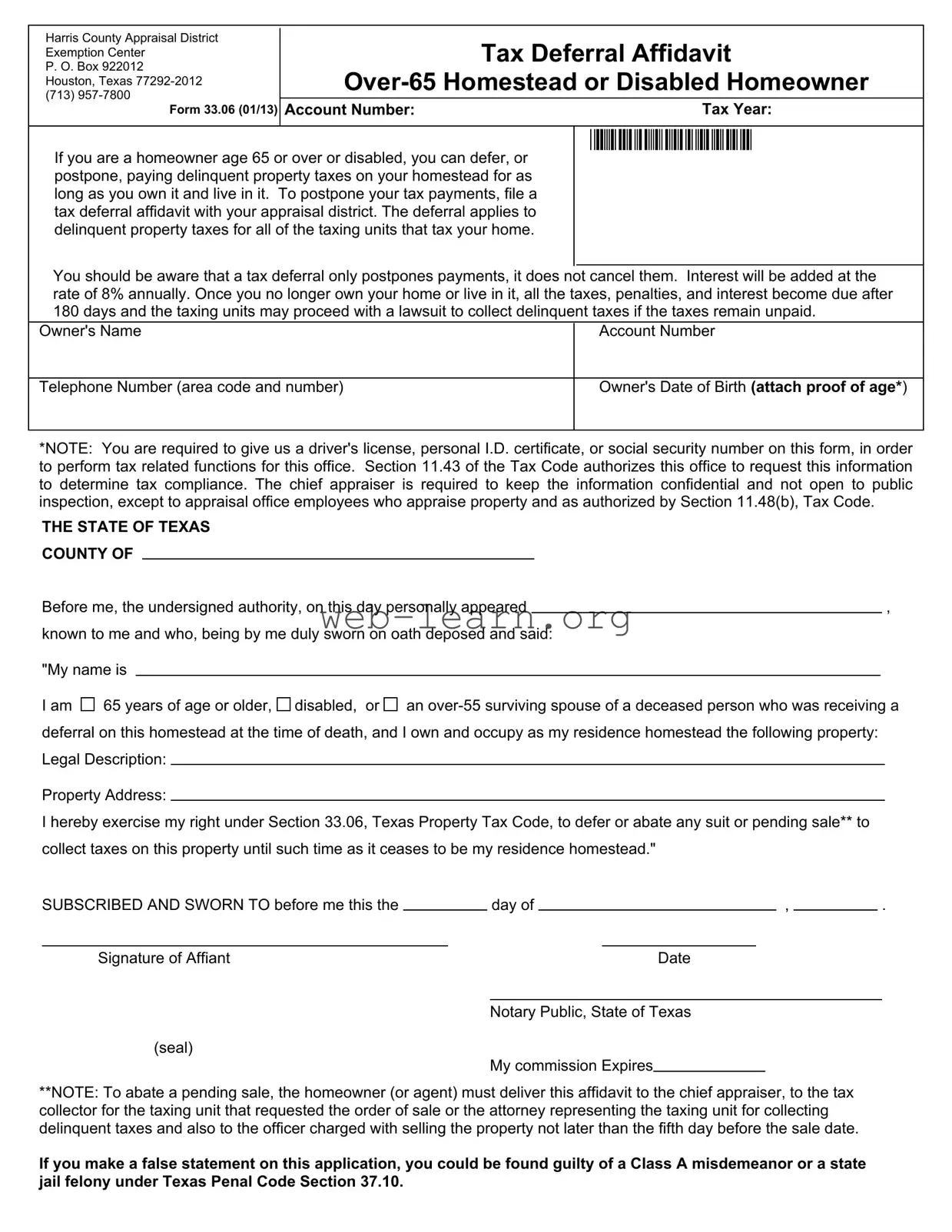
The Texas 33.06 form is an important tool for homeowners aged 65 and over, as well as disabled individuals, who wish to manage their property tax obligations. This form allows eligible homeowners to defer, or postpone, the payment of delinquent property taxes on their homestead. By filing a tax deferral affidavit with the local appraisal district, homeowners can ensure that they do not have to pay these taxes immediately. However, it’s crucial to understand that deferring taxes does not eliminate them. Instead, interest will accumulate at a rate of 8% annually until the homeowner no longer owns or resides in the property. At that point, all deferred taxes, penalties, and interest must be paid within 180 days. The form requires personal information, such as the homeowner's name, account number, and date of birth, and mandates the submission of proof of age. Confidentiality is maintained regarding this information, ensuring it is protected under Texas law. Additionally, homeowners should be aware of the legal implications of making false statements on the application, which could lead to serious penalties. Overall, the Texas 33.06 form serves as a vital resource for eligible homeowners seeking financial relief from property taxes while navigating their responsibilities effectively.
Harris County Appraisal District Exemption Center
P. O. Box 922012
Houston, Texas
Form 33.06 (01/13)
Tax Deferral Affidavit
Account Number: |
Tax Year: |
If you are a homeowner age 65 or over or disabled, you can defer, or postpone, paying delinquent property taxes on your homestead for as long as you own it and live in it. To postpone your tax payments, file a tax deferral affidavit with your appraisal district. The deferral applies to delinquent property taxes for all of the taxing units that tax your home.
*NEWHS124*
You should be aware that a tax deferral only postpones payments, it does not cancel them. Interest will be added at the rate of 8% annually. Once you no longer own your home or live in it, all the taxes, penalties, and interest become due after 180 days and the taxing units may proceed with a lawsuit to collect delinquent taxes if the taxes remain unpaid.
Owner's Name |
Account Number |
Telephone Number (area code and number)
Owner's Date of Birth (attach proof of age*)
*NOTE: You are required to give us a driver's license, personal I.D. certificate, or social security number on this form, in order to perform tax related functions for this office. Section 11.43 of the Tax Code authorizes this office to request this information to determine tax compliance. The chief appraiser is required to keep the information confidential and not open to public inspection, except to appraisal office employees who appraise property and as authorized by Section 11.48(b), Tax Code.
THE STATE OF TEXAS
COUNTY OF
Before me, the undersigned authority, on this day personally appeared |
|
, |
known to me and who, being by me duly sworn on oath deposed and said:
"My name is
I am 65 years of age or older, disabled, or an
deferral on this homestead at the time of death, and I own and occupy as my residence homestead the following property:
Legal Description:
Property Address:
I hereby exercise my right under Section 33.06, Texas Property Tax Code, to defer or abate any suit or pending sale** to
collect taxes on this property until such time as it ceases to be my residence homestead."
SUBSCRIBED AND SWORN TO before me this the |
|
|
|
day of |
|
|
|
, |
|
. |
|
|
|
|
|
|
|
|
|
|
|
|
|
Signature of Affiant |
|
|
|
|
|
Date |
|
|
|
|
|
|
|
|
|
|
|
|
|
|
|||
|
|
|
|
Notary Public, State of Texas |
|
|
|
|
|||
(seal)
My commission Expires
**NOTE: To abate a pending sale, the homeowner (or agent) must deliver this affidavit to the chief appraiser, to the tax collector for the taxing unit that requested the order of sale or the attorney representing the taxing unit for collecting delinquent taxes and also to the officer charged with selling the property not later than the fifth day before the sale date.
If you make a false statement on this application, you could be found guilty of a Class A misdemeanor or a state jail felony under Texas Penal Code Section 37.10.
| Fact Name | Description |
|---|---|
| Eligibility | Homeowners aged 65 or older, disabled individuals, or surviving spouses of deceased homeowners can apply for tax deferral. |
| Filing Requirement | A tax deferral affidavit must be filed with the local appraisal district to postpone delinquent property tax payments. |
| Interest Rate | Deferred taxes will accrue interest at a rate of 8% annually. |
| Tax Payment Postponement | The deferral only postpones tax payments; it does not cancel them. All taxes become due after 180 days if the homeowner no longer occupies the property. |
| Confidentiality | Information provided in the affidavit is kept confidential, as mandated by Section 11.43 of the Texas Tax Code. |
| Legal Authority | The deferral is authorized under Section 33.06 of the Texas Property Tax Code. |
| Consequences of False Statements | Providing false information on the application may lead to criminal charges, including a Class A misdemeanor or state jail felony. |
Filling out the Texas 33.06 form is a straightforward process. This form allows homeowners who are 65 years or older or disabled to defer paying delinquent property taxes on their homestead. It is important to complete the form accurately to ensure that your request for tax deferral is processed smoothly. Below are the steps to fill out the form correctly.
After completing the form, it will be processed by the appraisal district. If everything is in order, you will receive confirmation of your tax deferral. Remember, this deferral postpones payments but does not eliminate them, so it’s important to stay informed about your tax obligations moving forward.
What is the Texas 33.06 form?
The Texas 33.06 form is a Tax Deferral Affidavit designed for homeowners who are either 65 years of age or older or disabled. By completing this form and submitting it to your local appraisal district, you can defer paying delinquent property taxes on your homestead. This deferral allows you to postpone tax payments as long as you continue to own and reside in the property.
Who is eligible to file the Texas 33.06 form?
Eligibility for filing this form includes homeowners who are:
What happens when I file the Texas 33.06 form?
Filing the Texas 33.06 form allows you to defer the payment of delinquent property taxes on your homestead. However, it is important to note that this deferral only postpones the payments; it does not cancel them. Interest will accrue at a rate of 8% annually on the deferred amount.
What is the process for submitting the form?
To submit the Texas 33.06 form, you must complete it with accurate information and then send it to your local appraisal district. Make sure to include proof of age, such as a driver's license or social security number. It’s also essential to submit the form before any pending sale to avoid further legal complications.
What happens if I sell my home or move out?
If you sell your home or no longer live in it, all deferred taxes, penalties, and interest become due within 180 days. At this point, the taxing units may initiate legal action to collect any unpaid taxes. Therefore, it’s crucial to keep track of your status regarding the property.
Is there a deadline for filing the Texas 33.06 form?
While there is no specific deadline for filing the form to defer taxes, it is recommended to submit it as soon as you become eligible. If there is a pending sale of your property, you must deliver the affidavit at least five days before the sale date to prevent the sale from proceeding.
What are the consequences of providing false information?
Providing false information on the Texas 33.06 form can lead to serious legal consequences. You could be charged with a Class A misdemeanor or a state jail felony under Texas Penal Code Section 37.10. It is crucial to ensure that all information is accurate and truthful.
Can I get assistance with the Texas 33.06 form?
Yes, assistance is available for completing the Texas 33.06 form. You can contact your local appraisal district or seek help from legal aid organizations that specialize in property tax issues. They can guide you through the process and ensure that your application is completed correctly.
What information do I need to provide on the form?
You will need to provide several pieces of information, including:
Make sure to complete all sections accurately to avoid delays.
Where do I send the completed Texas 33.06 form?
The completed Texas 33.06 form should be sent to your local appraisal district. For residents of Harris County, you can mail it to the Harris County Appraisal District Exemption Center at P.O. Box 922012, Houston, Texas 77292-2012. You may also contact them at (713) 957-7800 for further assistance.
Completing the Texas 33.06 form requires careful attention to detail. One common mistake is failing to provide accurate personal information. Homeowners must ensure that their name, account number, and contact information are correct. Errors in this section can lead to delays in processing the application.
Another frequent oversight involves the omission of proof of age or disability. The form requires homeowners to attach documentation, such as a driver's license or personal identification certificate. Neglecting this step can result in the rejection of the application.
Inaccurate legal descriptions of the property are also a significant issue. Homeowners should confirm that the legal description matches what is on their property deed. This mistake can complicate the tax deferral process and lead to potential legal challenges.
Many applicants mistakenly believe that the tax deferral cancels their tax obligations. It is essential to understand that the deferral only postpones payments. Homeowners must be aware that interest will accrue at an annual rate of 8%, and all taxes become due if they no longer occupy the home.
Another error involves the failure to submit the affidavit in a timely manner. Homeowners must deliver the completed form to the appropriate authorities before the deadline. Missing this deadline can result in losing the opportunity for tax deferral.
Some individuals do not realize that the affidavit must be notarized. A signature without notarization renders the document invalid. Homeowners should ensure that they sign the form in the presence of a notary public to avoid this pitfall.
Lastly, providing false information on the application can have serious consequences. Homeowners should be aware that making a false statement could lead to criminal charges. It is crucial to fill out the form honestly and accurately to avoid legal repercussions.
When dealing with property tax matters in Texas, especially for homeowners who are 65 or older or disabled, several forms and documents may be needed alongside the Texas 33.06 form. Understanding these documents can help ensure a smoother process in managing property tax deferrals and exemptions.
Being aware of these forms and documents can empower homeowners to navigate the complexities of property taxes effectively. Proper preparation and understanding of the requirements can lead to better management of tax obligations and peace of mind.
The Texas 33 06 form is primarily a tax deferral affidavit designed for homeowners aged 65 or older or disabled individuals. Several other documents serve similar purposes in terms of tax relief, deferral, or exemptions. Below is a list of ten documents that share similarities with the Texas 33 06 form:
Each of these forms serves to alleviate the financial burden of property taxes for specific groups, much like the Texas 33 06 form does for eligible homeowners.
When filling out the Texas 33.06 form, there are important dos and don’ts to keep in mind. Following these guidelines can help ensure your application is processed smoothly.
Understanding the Texas 33.06 form can be challenging, and several misconceptions often arise. Here’s a breakdown of some common misunderstandings surrounding this important tax deferral affidavit.
Many believe that submitting the Texas 33.06 form eliminates their property tax obligations. In reality, the form only postpones the payment of delinquent property taxes. The taxes remain due, and interest will accumulate at a rate of 8% annually.
Some homeowners think they can defer their taxes forever. However, the deferral lasts only as long as you own and live in your home. If you move or sell the property, all deferred taxes, penalties, and interest become due within 180 days.
While homeowners aged 65 or older can apply, disabled homeowners and surviving spouses of deceased homeowners who were receiving a deferral also qualify. Age is not the only criterion.
There is a belief that only those with limited income can file the Texas 33.06 form. In fact, the deferral is available to any eligible homeowner, regardless of income level, as long as they meet the age or disability requirements.
Some homeowners think they can completely ignore their tax obligations once they file the form. This is misleading. While payments are postponed, they are still owed, and ignoring them can lead to serious consequences.
It's a common misconception that moving out of the home doesn’t require any action. If you move, you must notify the appraisal district, as the deferral will no longer apply, and all taxes become due.
Many people feel overwhelmed by the paperwork. However, the Texas 33.06 form is designed to be straightforward. With the right information at hand, completing the form can be a manageable task.
Some homeowners underestimate the impact of the interest rate on deferred taxes. At 8% annually, the interest can accumulate quickly, leading to a larger amount owed when payment is finally required.
Filing the form is just the first step. Homeowners must remain vigilant about their tax status and be aware of any changes in their living situation that could affect their eligibility for the deferral.
When dealing with the Texas 33.06 form, it's crucial to understand its implications and requirements. Here are key takeaways to keep in mind:
Take these points seriously to ensure compliance and protect your rights as a homeowner. Act promptly and gather all necessary documents to complete the form accurately.