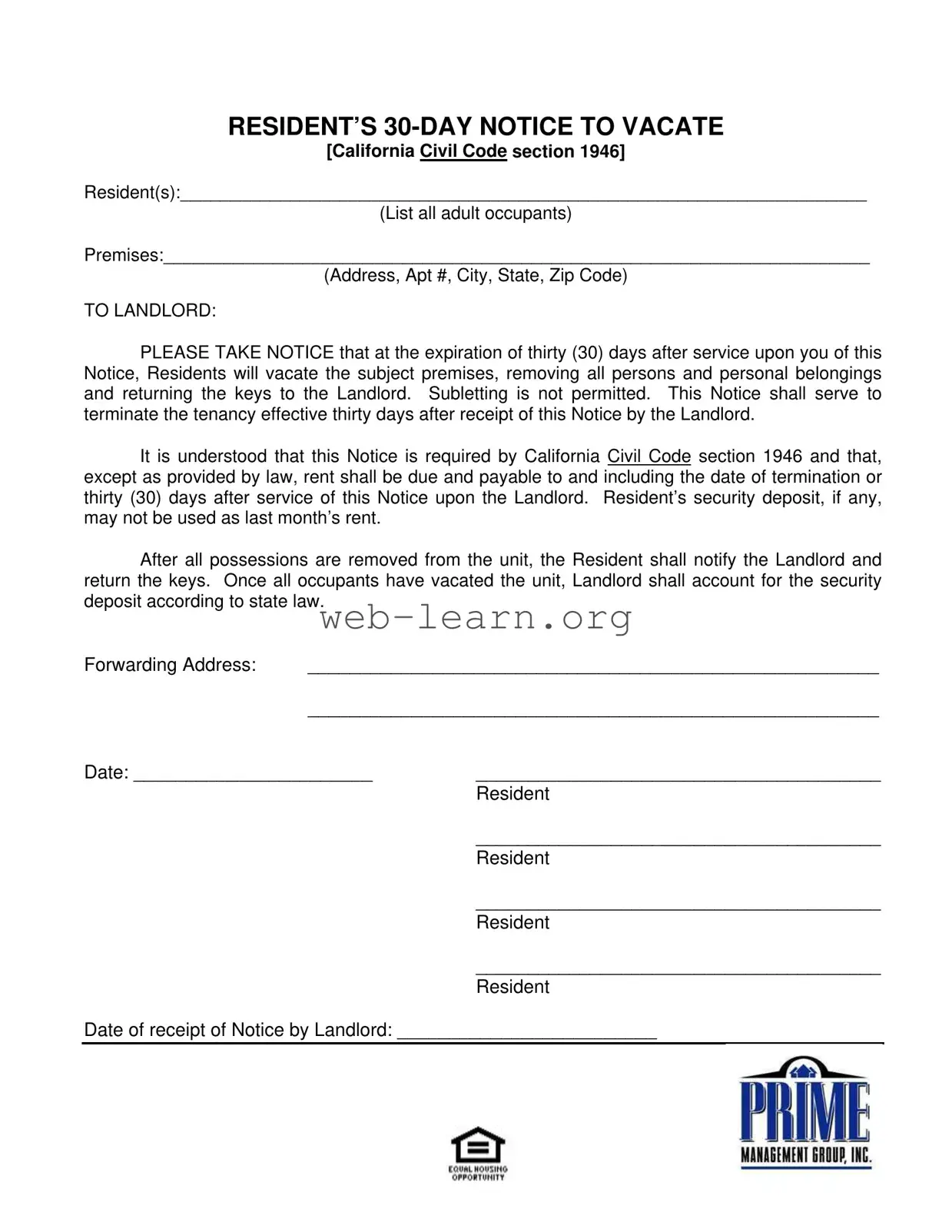
The Texas 30 Day Notice To Vacate form is a crucial document for residents planning to end their tenancy. This form outlines the necessary steps residents must take to notify their landlord of their intention to vacate the premises. It specifies that residents must provide a written notice at least thirty days before they leave, allowing both parties to prepare for the transition. The form requires the names of all adult occupants and the complete address of the rental property. It emphasizes that subletting is not allowed and that all personal belongings must be removed by the end of the notice period. Additionally, it clarifies that rent is due until the termination date, and a resident’s security deposit cannot be used as the last month’s rent. After vacating, residents are responsible for returning the keys and informing the landlord of their new forwarding address. The landlord, in turn, must account for the security deposit according to state law once the unit is vacated. Understanding this form is essential for a smooth and compliant move-out process.

RESIDENT’S
[CALIFORNIA CIVIL CODE SECTION 1946]
Resident(s):_____________________________________________________________________
(List all adult occupants)
Premises:_______________________________________________________________________
(Address, Apt #, City, State, Zip Code)
TO LANDLORD:
PLEASE TAKE NOTICE that at the expiration of thirty (30) days after service upon you of this Notice, Residents will vacate the subject premises, removing all persons and personal belongings and returning the keys to the Landlord. Subletting is not permitted. This Notice shall serve to terminate the tenancy effective thirty days after receipt of this Notice by the Landlord.
It is understood that this Notice is required by California Civil Code section 1946 and that, except as provided by law, rent shall be due and payable to and including the date of termination or thirty (30) days after service of this Notice upon the Landlord. Resident’s security deposit, if any, may not be used as last month’s rent.
After all possessions are removed from the unit, the Resident shall notify the Landlord and return the keys. Once all occupants have vacated the unit, Landlord shall account for the security deposit according to state law.
Forwarding Address: |
_______________________________________________________ |
|
|
_______________________________________________________ |
|
Date: _______________________ |
_______________________________________ |
|
|
|
Resident |
_______________________________________
Resident
_______________________________________
Resident
_______________________________________
Resident
Date of receipt of Notice by Landlord: _________________________
| Fact Name | Description |
|---|---|
| Purpose | The Texas 30 Day Notice To Vacate form is used by residents to inform their landlord of their intent to vacate the rental property. |
| Notice Period | Residents must provide a minimum of thirty (30) days' notice before vacating the premises. |
| Governing Law | This notice is governed by Texas Property Code Section 24.005. |
| Delivery Method | The notice can be delivered in person, by mail, or through electronic means, depending on the lease agreement. |
| Subletting Restrictions | Subletting the rental unit is not permitted under this notice. |
| Security Deposit | Residents cannot use their security deposit as the last month’s rent; it must be returned after the property is vacated. |
| Return of Keys | Residents are required to return all keys to the landlord upon vacating the premises. |
| Forwarding Address | Residents should provide a forwarding address for the return of the security deposit and any other correspondence. |
Completing the Texas 30 Day Notice To Vacate form is an essential step for residents planning to end their tenancy. After filling out this form, it will be important to deliver it to the landlord and ensure that all necessary actions are taken to finalize the move-out process. Here are the steps to properly fill out the form:
What is the Texas 30 Day Notice to Vacate form?
The Texas 30 Day Notice to Vacate form is a legal document that a tenant provides to their landlord to formally notify them of their intention to vacate the rental property. This notice must be given at least 30 days before the intended move-out date. It serves to terminate the tenancy and outlines the responsibilities of both the tenant and landlord during the notice period.
Who needs to sign the Texas 30 Day Notice to Vacate?
All adult occupants listed on the lease agreement must sign the notice. This ensures that everyone who is part of the tenancy is aware of the decision to vacate. It is important to include all residents to avoid any confusion or disputes regarding the move-out process.
What happens after the notice is served?
Once the notice is served, the landlord is expected to acknowledge receipt. The tenant must then prepare to vacate the premises within the 30-day period. This includes removing all personal belongings, cleaning the unit, and returning the keys to the landlord. Rent is due until the end of the notice period, and the security deposit will be handled according to state law after the tenant has vacated.
Can a tenant use their security deposit as last month's rent?
No, tenants are not allowed to use their security deposit as last month's rent. The security deposit is meant to cover any potential damages or unpaid rent. Tenants should pay their final month's rent in full, and the landlord will return the security deposit after ensuring the property is in good condition, as per state regulations.
Completing the Texas 30 Day Notice To Vacate form requires attention to detail. One common mistake is failing to list all adult occupants. It is crucial to include the names of everyone living in the unit. Omitting a name can lead to confusion and potential disputes regarding the notice.
Another frequent error involves not providing the correct address of the premises. The form asks for a complete address, including the apartment number, city, state, and zip code. Inaccurate or incomplete information can delay the process and complicate communication with the landlord.
Many residents overlook the importance of clearly stating the date of the notice. The notice must specify the date it is served to the landlord. Without this date, it becomes difficult to determine the effective date of the termination of the tenancy, which could lead to misunderstandings about the timeline for vacating the property.
Additionally, some individuals mistakenly believe they can use their security deposit as last month's rent. The form explicitly states that the security deposit cannot be applied in this manner. This misunderstanding can create financial issues and complicate the return of the deposit after vacating.
Finally, failing to provide a forwarding address is a critical mistake. Residents should include a forwarding address to ensure that the landlord can return the security deposit and send any necessary correspondence after the move. Without this information, residents may miss important communications or the return of their deposit.
When preparing to vacate a rental property in Texas, several additional forms and documents may be necessary to ensure a smooth transition. Below is a list of commonly used documents that complement the Texas 30 Day Notice to Vacate form. Each document serves a specific purpose in the moving process.
Having these documents ready can facilitate a smoother transition when vacating a rental property. They help clarify responsibilities and protect the rights of both tenants and landlords. Being organized and informed can ease the stress of moving.
The Texas 30 Day Notice To Vacate form shares similarities with several other documents used in rental agreements and tenant-landlord communications. Each document serves a specific purpose in notifying parties about tenancy issues. Below are four documents that are comparable to the Texas 30 Day Notice To Vacate:
When filling out the Texas 30 Day Notice To Vacate form, it is essential to approach the task with care. Here’s a list of things you should and shouldn’t do to ensure the process goes smoothly.
The Texas 30 Day Notice To Vacate form is often misunderstood. Here are five common misconceptions that can lead to confusion for both tenants and landlords.
Many people believe that a 30-day notice can be issued at any point in the month. However, the notice must be given at least 30 days before the intended move-out date. If a tenant wishes to vacate by the end of the month, they should provide the notice on or before the last day of the previous month.
Some tenants think that once they submit a notice to vacate, they are no longer responsible for rent. This is incorrect. Rent is still due up until the end of the notice period, meaning that tenants must continue to pay rent through the 30 days following the notice.
There is a belief that a notice to vacate is merely a suggestion and not a legal requirement. In reality, this notice is a formal declaration that initiates the end of the tenancy. Both parties are expected to adhere to the terms outlined in the notice.
Some tenants mistakenly think they can use their security deposit to cover their last month’s rent. This is not allowed. The security deposit is meant to cover any damages or unpaid rent and should not be used as a substitute for the final month’s payment.
Many believe that a simple verbal notice to the landlord is enough to terminate the lease. However, a written notice is required to ensure clarity and protect the rights of both the tenant and landlord. A written notice provides a record of the intent to vacate and the timeline involved.
When filling out and using the Texas 30 Day Notice To Vacate form, keep the following key takeaways in mind:
By following these guidelines, residents can ensure a smooth transition when vacating the premises.