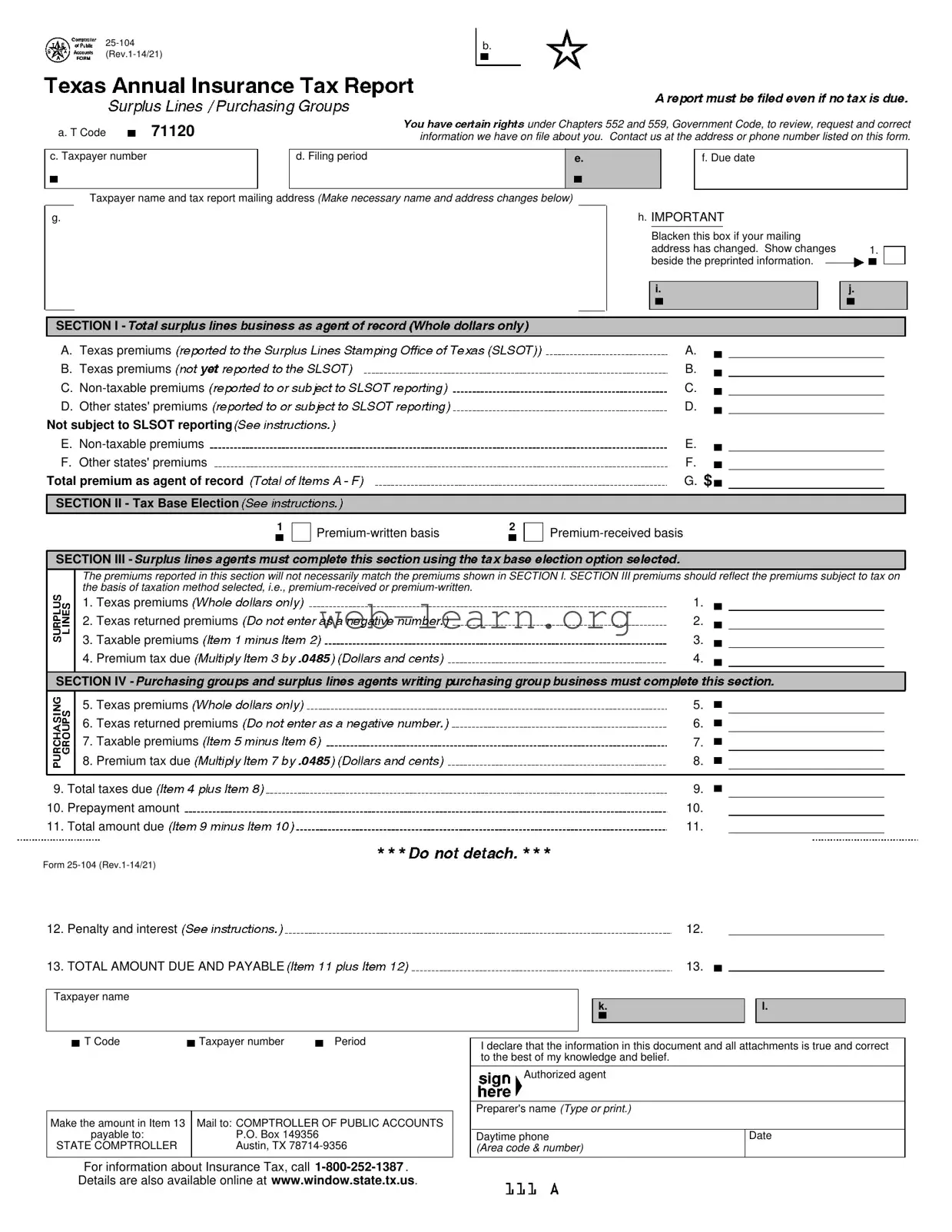
The Texas 25-104 form plays a crucial role in the annual reporting of insurance premiums for surplus lines agents and purchasing groups registered in Texas. This form requires detailed information about premiums, including Texas premiums, non-taxable premiums, and premiums from other states. It is essential for agents to accurately report both taxable and non-taxable amounts, as well as any returned premiums due to policy cancellations or adjustments. The form is divided into several sections, each addressing specific reporting requirements, such as the method of taxation—premium-written or premium-received. Completing the 25-104 form correctly is vital, as it helps ensure compliance with state regulations and avoids penalties. Agents must also note any changes in mailing addresses and are encouraged to reach out to the Comptroller’s office for any clarifications. Filing is due by March 1 of the year following the tax year, even if no tax is owed, making it important for agents to stay organized and proactive in their reporting efforts.
a. T Code |
71120 |
c. Taxpayer number
b.
under Chapters 552 and 559, Government Code, to review, request and correct inf rmati n we have on file about you. Contact us at the address or phone number listed on this form.
d. Fili peri d |
e. |
|
f. Due date |
|
|
|
|
Taxpayer name and tax |
mailing addr (Make neces ary name and address chang s b low) |
g.
h. IMPORTANT
Blacken this ox if your mailing |
|
|
address has changed. Show changes |
1. |
|
esi e the preprinted information. |
|
|
|
|
|
i.
j.
SECTION I -
A. Texas premiums |
A. |
|
|
B. Texas premiums |
B. |
|
|
C. |
C. |
|
|
D. Other states' premiums |
D. |
||
Not subject to LSOT repor ing |
|
|
|
E. |
E. |
|
|
F. Other states' premiums |
F. |
|
|
Total premium as ag nt of record |
G. $ |
||
|
|
|
|
SECTION II - Tax Ba Elect on |
|
|
|
|
|
|
|
Pr |
2 |
|
SECTION III - |
|
|
|
|
|
|
||
|
The premiums eported |
his se |
will |
ot nece rily m ch the premiums shown SECTION I. SECTION III premiums should refl the premiums subject to tax on |
||||
|
the basis of taxation method |
d, .e., |
||||||
|
1. |
Texas premiu |
s |
|
|
1. |
|
|
|
2. |
Texas return |
d pr |
m s |
|
2. |
|
|
|
3. |
Taxable p emiums |
|
|
3. |
|
|
|
|
4. |
Premium tax due |
|
|
4. |
|
|
|
|
|
|
|
|
|
|
|
|
SECTION IV - |
|
|
|
|
|
|
||
|
5. |
Texas premiu |
s |
|
|
5. |
|
|
|
6. |
Texas return |
d pr |
|
|
6. |
|
|
|
7. |
Taxable premiums |
|
|
7. |
|
|
|
|
8. |
Premium tax due |
|
|
8. |
|
|
|
|
|
|
|
|
|
|
|
|
9. Total taxes due |
|
|
|
9. |
|
|
||
10. Prepayment amount |
|
|
10. |
|
|
|||
11. Total amount due |
|
|
|
11. |
|
|
||
Form
12.Penalty and interest
13.TOTAL AMOUNT DUE AND PAYABLE
Taxpayer name
12.
13.
k.
l.
T Code |
Taxpayer number |
Period |
Make the amount in Item 13 |
Mail to: COMPTROLLER OF PUBLIC ACCOUNTS |
payable to: |
P.O. Box 149356 |
STATE COMPTROLLER |
Austin, TX |
|
|
I declare that the information in this document and all attachments is true and correct to the best of my knowledge and belief.
Authorized agent
Preparer's name (Type or print.)
Daytime phone |
Date |
(Area code & number) |
|
|
|
For information about Insurance Tax, call

Form
Inst uctio |
f r Completing the Texas Annual Insurance T x Report |
Who Must File |
|
All surpl lines ag ts licen ed Texas and a |
purchasi gr ups registered in Texas must file this report, even if no tax is due. |
When to File
he report and payment are d on March 1 of the year following the tax year.
Section I
he
Item A - Texas Pr miums - Enter the total Texas premiums for policies that were effective prior to July 21, 2011 (net of return premiums) that were reported to the SLSOT during the tax year. Enter the total amount of premiums for policies that were effective on or after July 21, 2011 (net of return premiums) that have been reported to the SLSOT where Texas is the home tate of the insured.
Item - Texas Pr miums - Enter the total Texas premiums for policies that were effective prior to July 21, 2011 (net of return premiums) that have NOT YET been reported to the SLSOT during the tax year. Ent r he total amount of premiums for policies that were effective on or after July 21, 2011 (net of return premiums) that have NOT YET been reported to the SLSOT where Texas is the home state of the insured.
Item C -
entirely Texas and the
the premiums are exem t from taxation or are preempted from taxation.
Item D - Oth r States' Premi ms - Enter the total premiums for policies that were effective prior to July 21, 2011 (net of return premiums) allocated to all other states from a
100% of the policy premium, but also allows the monitoring of the amount of
enter the premiums (net of return premium ) that are 100% exempt or
Item F - Oth r States' Premi ms - This category does not apply to policies that are effective on or after July 21, 2011. For policies that are effective prior to July 21, 2011, enter the to al taxable premiums (net of return premiums) allocated to other states for policies that exclusively cover states other than Texas.
Section II
lines agents who received a license during the reporting year must elect one of the tax base options shown.
Rle 34 TAC, Sec. 3.822, provides specific information on the requirements for reporting surplus lines tax. Agents have the option of reporting tax using a
Section III
These premiums will not necessarily match the premiums shown in Section I, because they are based on the reporting method chosen. The term "premium" includes all
premiums, premi m deposits, membership fees, registration fees, assessments, dues and any other consideration for surplus lines insurance. Texas premiums include: premiums written or received for policies that are effective prior to July 21, 2011 that cover risks in this state;
premiums written or received for new or renewal Texas or
Exempt premiums are premiums for a surplus lines policy that covers risks or exposures that are properly allocated to federal waters, international waters, or risks or exposures that are under the jurisdiction of a foreign government. Effective Jan. 1, 2014, premiums on risks or exposures under ocean marine insurance coverage of sto ed or
Feder l preemptions to state taxation for surplus lines insurance include premiums for policies that are issued to the following entities:
the Federal Deposit Insurance Corporation (FDIC), when it acts as the receiver of a failed financial institution that holds the property being insured; the National Credit Union Administration;
a federally chartered credit union; and
Indian Tribal Nations (see Publication
Texas returned premiums - Report the unearned portion of the premium that is credited or refunded to a policyholder as a result of cancellation or premium adjustment prior to the policy expiration. An age t reporting on the premium received basis will not have returned premiums.
Endorsements and audits on surplus lines insurance policies must be reported based on the date of the endorsement or audit, not the date of the original policy. The tax for endorsements and audits that generate return premiums due a policyholder must be calculated using the tax rate that was originally charged.
Section IV
Purchasing groups obtaining coverage from insurers licensed in Texas or surplus lines agents licensed in Texas do NOT owe tax on this report, but must a zero report. Purchasing groups obtaining coverage independently through negotiations and procurement occurring outside Texas are subject to tax on the premiums paid for coverage of their members located in Texas.
Check this box if insurance was obtained from a licensed insurance company or a licensed or registered risk retention group.
Check this box if insurance was obtained from a surplus lines agent licensed in Texas.
Specific Instructions
Item 12 - Penalty and interest
If tax is paid
If tax is paid
If tax is paid over 60 days late: Enter penalty of 10% (.10) of Item 11 plus interest. Calculate interest at the rate published online at www.window.state.tx.us or call the Comptroller at
Electronic reporting nd payment options are available 24 hours day, 7 days a week. Have this form available when you log on.
| Fact Name | Description |
|---|---|
| Governing Law | The Texas 25-104 form is governed by Chapters 552 and 559 of the Texas Government Code. |
| Who Must File | All surplus lines agents licensed in Texas and purchasing groups registered in Texas must file this report, even if no tax is due. |
| Filing Deadline | The report and payment are due on March 1 of the year following the tax year. |
| Penalty for Late Payment | If tax is paid late, penalties range from 5% to 10% of the total amount due, depending on how late the payment is. |
Completing the Texas 25-104 form requires careful attention to detail. Ensure that all information is accurate and reflects your tax obligations. Follow these steps to fill out the form correctly.
After completing the form, mail it to the address provided, ensuring that the payment is made out to the Comptroller of Public Accounts. For any questions or clarifications, you may contact the Comptroller's office or visit their website for further assistance.
What is the Texas 25 104 form used for?
The Texas 25 104 form is primarily used for reporting surplus lines insurance premiums. It is required for all surplus lines agents licensed in Texas and purchasing groups registered in Texas. This form helps ensure that the appropriate taxes are reported and paid for the insurance premiums collected during the tax year.
When is the Texas 25 104 form due?
The report and payment for the Texas 25 104 form are due on March 1 of the year following the tax year. This means that if you are reporting for the tax year 2023, your form and payment would be due on March 1, 2024.
Who must file the Texas 25 104 form?
All surplus lines agents licensed in Texas and purchasing groups registered in Texas are required to file this report. This requirement stands even if no tax is due. It is essential to comply with this filing to avoid potential penalties.
What happens if I file the Texas 25 104 form late?
If you file the Texas 25 104 form late, you may incur penalties and interest. For example:
To avoid these penalties, it is crucial to submit your form and payment on time.
Filling out the Texas 25-104 form can be straightforward, but mistakes can lead to delays and complications. One common error is neglecting to update the taxpayer's mailing address. If your address has changed, it is crucial to blacken the box indicating this change. Failing to do so may result in important communications being sent to the wrong address, which could lead to missed deadlines and penalties.
Another frequent mistake involves incorrectly reporting premium amounts. Section I requires accurate reporting of Texas premiums, non-taxable premiums, and other states' premiums. Many filers mistakenly mix up the amounts for policies effective before and after July 21, 2011. This confusion can result in inaccurate tax calculations, which may trigger audits or additional tax liabilities.
Additionally, some individuals overlook the importance of selecting the correct tax base option in Section II. New agents must choose between a premium-written or premium-received basis. Failing to make this election means the agent will automatically be taxed on a premium-written basis, which might not be the most beneficial option for their specific situation. This decision can have significant financial implications.
Lastly, many filers forget to include penalties and interest in Section IV if they are submitting their form late. If the tax payment is delayed, penalties apply based on how late the payment is. It is essential to calculate these amounts accurately to avoid further complications. Being diligent about these details can save time and money in the long run.
The Texas 25-104 form is essential for surplus lines agents and purchasing groups in Texas to report their insurance premiums and related taxes. When filing this form, several other documents may also be required to ensure compliance with state regulations. Below is a list of commonly used forms that complement the Texas 25-104.
These documents are integral to the filing process and help ensure compliance with Texas insurance tax regulations. Properly completing and submitting all required forms will facilitate a smoother reporting experience and minimize the risk of penalties.
The Texas 25-104 form is similar to several other documents used for tax reporting and compliance. Below are five documents that share similarities with the Texas 25-104 form:
When filling out the Texas 25-104 form, it is important to follow specific guidelines to ensure accuracy and compliance. Here are nine things to keep in mind:
Following these guidelines will help ensure that your submission is processed smoothly and efficiently.
Misconceptions about the Texas 25-104 form can lead to confusion and potential issues for those required to file it. Here are eight common misunderstandings, along with clarifications to help you navigate the process more effectively.
This is incorrect. All surplus lines agents licensed in Texas must file the Texas 25-104 form, even if no tax is due. This requirement ensures compliance with state regulations.
The deadline for submitting the form and any associated payments is March 1 of the year following the tax year. Missing this deadline can result in penalties.
Not all premiums are subject to tax. The form distinguishes between taxable and non-taxable premiums, so it is essential to categorize them correctly when reporting.
The Texas 25-104 form may undergo revisions. Always ensure you are using the most current version to avoid discrepancies in your filing.
Once you select a tax base option (premium-written or premium-received), you can only change it every four years. Planning ahead is crucial to avoid unexpected tax liabilities.
Penalties can accumulate quickly. If tax is paid late, penalties range from 5% to 10% of the total amount due, depending on how late the payment is. Interest may also apply.
Policies from other states that cover risks in Texas must also be reported. This includes multi-state policies where Texas is the home state of the insured.
When reporting endorsements and audits, you must use the date of the endorsement or audit, not the original policy date. This detail is important for accurate tax calculations.
Understanding these misconceptions can help ensure that you complete the Texas 25-104 form accurately and on time. Staying informed about the requirements will help you avoid unnecessary penalties and maintain compliance.
Key Takeaways for Using the Texas 25-104 Form: