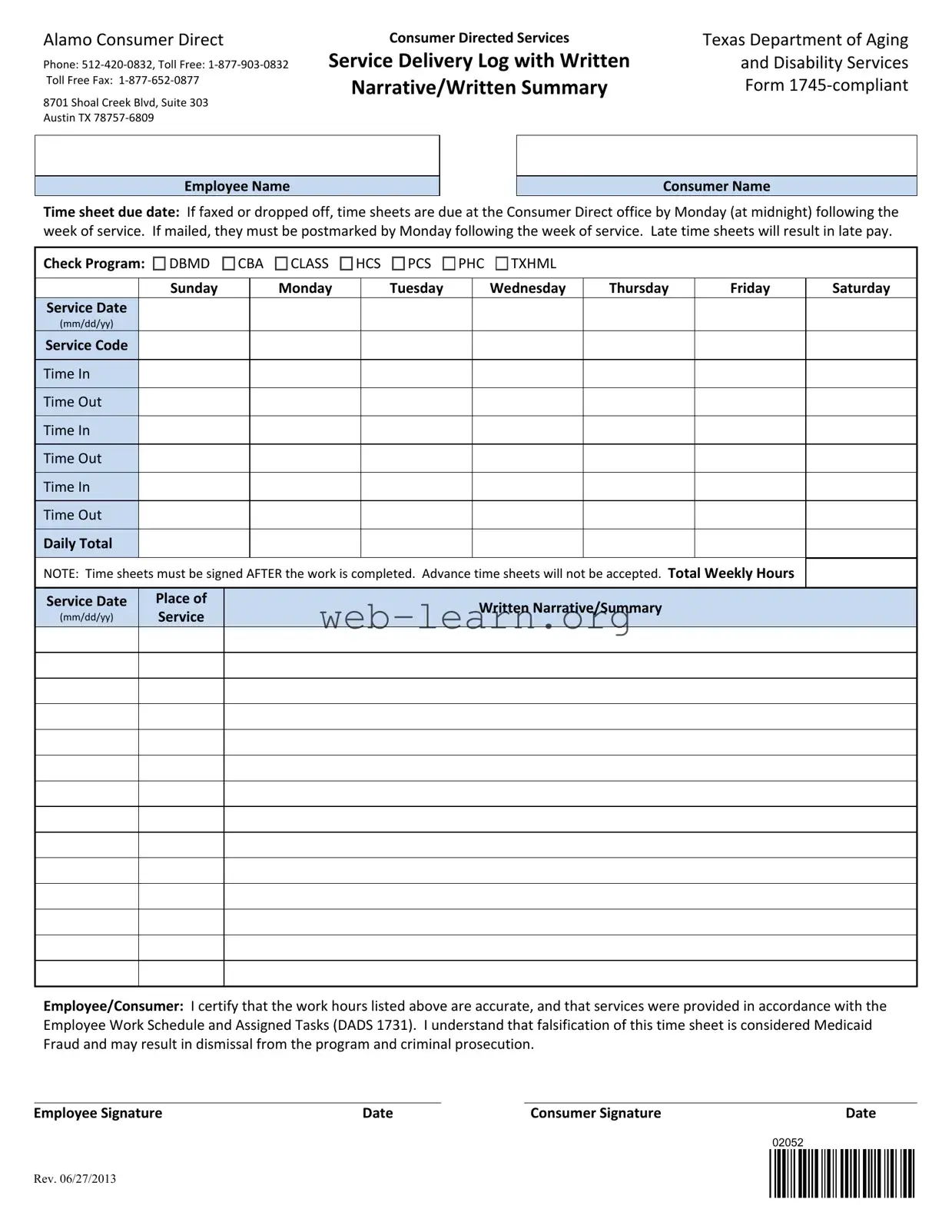
The Texas 1745 form plays a crucial role in the management of consumer-directed services provided to individuals with disabilities. This form, also known as the Service Delivery Log and Written Narrative/Summary, is essential for documenting the hours worked by employees who assist consumers in their daily activities. It ensures that services are rendered in compliance with state regulations. The form includes sections for recording service dates, codes, and the total hours worked each day. Timeliness is critical; employees must submit their time sheets by specific deadlines to avoid delays in payment. The Texas Department of Aging oversees this process, providing a toll-free number for inquiries and support. Employees and consumers must sign the form after services are completed, affirming the accuracy of the reported hours. Failure to adhere to these guidelines can lead to serious consequences, including potential allegations of Medicaid fraud. Overall, the Texas 1745 form is a vital tool for ensuring accountability and transparency in the delivery of essential services.
Alamo Consumer Direct |
Consumer Directed Services |
Texas Department of Aging |
|
Phone: 512‐420‐0832, Toll Free: 1‐877‐903‐0832 |
Service Delivery Log with Written |
and Disability Services |
|
Toll Free Fax: 1‐877‐652‐0877 |
Narrative/Written Summary |
Form 1745‐compliant |
|
8701 Shoal Creek Blvd, Suite 303 |
|||
|
|
||
Austin TX 78757‐6809 |
|
|
Employee Name
Consumer Name
Time sheet due date: If faxed or dropped off, time sheets are due at the Consumer Direct office by Monday (at midnight) following the week of service. If mailed, they must be postmarked by Monday following the week of service. Late time sheets will result in late pay.
Check Program: DBMD CBA CLASS HCS PCS PHC TXHML
Sunday |
Monday |
Tuesday |
Wednesday |
Thursday |
Friday |
Saturday |
Service Date
(mm/dd/yy)
Service Code
Time In
Time Out
Time In
Time Out
Time In
Time Out
Daily Total
NOTE: Time sheets must be signed AFTER the work is completed. Advance time sheets will not be accepted. Total Weekly Hours
Service Date
(mm/dd/yy)
Place of Service
Written Narrative/Summary
Employee/Consumer: I certify that the work hours listed above are accurate, and that services were provided in accordance with the Employee Work Schedule and Assigned Tasks (DADS 1731). I understand that falsification of this time sheet is considered Medicaid Fraud and may result in dismissal from the program and criminal prosecution.
Employee Signature |
Date |
Consumer Signature |
Date |
02052
REV. 06/27/2013
| Fact Name | Details |
|---|---|
| Form Title | Texas 1745 - Service Delivery Log with Written Narrative/Written Summary |
| Governing Body | Texas Department of Aging and Disability Services (DADS) |
| Submission Deadlines | Time sheets are due by Monday at midnight if faxed or dropped off. If mailed, they must be postmarked by Monday following the week of service. |
| Consequences of Late Submission | Late time sheets will result in late pay for the employee. |
| Signature Requirement | Time sheets must be signed after the work is completed; advance time sheets are not accepted. |
| Fraud Warning | Falsification of the time sheet is considered Medicaid Fraud and may lead to dismissal and criminal prosecution. |
| Contact Information | Phone: 512-420-0832, Toll Free: 1-877-903-0832, Toll Free Fax: 1-877-652-0877 |
Completing the Texas 1745 form is a crucial step in ensuring that service hours are accurately recorded and submitted. This form must be filled out carefully to avoid any issues with payment or compliance. Follow these steps to ensure that the form is completed correctly.
Once the form is filled out, review it carefully for any errors or omissions. Submit the completed Texas 1745 form according to the guidelines provided for timely processing and payment. Be mindful of the deadlines to avoid any delays in compensation.
What is the Texas 1745 form?
The Texas 1745 form, also known as the Service Delivery Log with Written Narrative/Written Summary Form, is used for documenting services provided under various consumer-directed programs. It ensures that services are recorded accurately and comply with state regulations.
Who needs to fill out the Texas 1745 form?
Both employees providing services and consumers receiving those services must fill out the form. Employees document the hours worked, while consumers verify the accuracy of the reported hours and services.
When are time sheets due?
Time sheets are due at the Consumer Direct office by midnight on the Monday following the week of service if faxed or dropped off. If mailed, they must be postmarked by that same Monday. Late submissions can result in delayed payments.
What happens if I submit a late time sheet?
Submitting a late time sheet will result in late pay. It is crucial to adhere to the submission deadlines to ensure timely compensation for services rendered.
Can I submit time sheets in advance?
No, advance time sheets are not accepted. The form must be signed only after the work is completed to ensure accuracy and compliance with regulations.
What should I do if I notice an error on the time sheet?
If you notice an error, it is important to correct it before submitting the time sheet. Both the employee and consumer must agree on the accuracy of the hours worked and services provided.
What is the significance of the signatures on the Texas 1745 form?
The signatures from both the employee and the consumer confirm that the reported hours and services are accurate. Falsifying information can lead to serious consequences, including Medicaid fraud charges.
What information is required on the Texas 1745 form?
The form requires details such as the employee's name, consumer's name, service dates, service codes, time in and out, daily totals, and a written narrative summary of the services provided.
How can I contact the Texas Department of Aging for assistance?
You can reach the Texas Department of Aging by phone at 512-420-0832 or toll-free at 1-877-903-0832. For fax inquiries, use the toll-free fax number 1-877-652-0877.
What are the consequences of falsifying information on the form?
Falsification of the Texas 1745 form is considered Medicaid fraud. This can lead to dismissal from the program and potential criminal prosecution. It is essential to maintain integrity when completing the form.
Filling out the Texas 1745 form can be straightforward, but many people make mistakes that can lead to delays or issues with payments. One common error is not signing the time sheet after the work is completed. It’s essential to remember that time sheets must be signed only after services have been rendered. Submitting an unsigned or pre-signed sheet can result in rejection of the form.
Another frequent mistake involves the service dates. People often forget to fill in the service dates correctly. Each date should be in the format of mm/dd/yy. If the dates are missing or incorrect, it can cause confusion and delays in processing. Always double-check that the dates align with the days services were provided.
Many individuals also overlook the importance of the service codes. Each service performed must have a corresponding code, and failing to include these codes can lead to payment issues. Ensure that you select the correct service code for each day worked. This detail is crucial for accurate billing and payment.
In addition, some users fail to calculate the total weekly hours correctly. It’s vital to sum up the daily totals accurately. A simple miscalculation can affect the overall payment and may lead to disputes. Take the time to verify your math before submitting the form.
Lastly, mailing the time sheets can pose a problem if deadlines are not met. If you are mailing the form, remember that it must be postmarked by Monday following the week of service. Late submissions will result in late pay. To avoid this, consider faxing or dropping off the form directly at the Consumer Direct office.
The Texas 1745 form is essential for documenting service hours in consumer-directed services. Alongside this form, several other documents play a crucial role in ensuring compliance and proper management of services. Below is a list of forms commonly used in conjunction with the Texas 1745.
These forms collectively enhance the transparency and accountability of consumer-directed services. They ensure that both employees and consumers are aligned in their expectations and responsibilities, ultimately promoting a smoother service delivery process.
When filling out the Texas 1745 form, attention to detail is crucial. The following list outlines key actions to take and avoid during this process.
Misconceptions about the Texas 1745 form can lead to confusion and potential issues in service delivery. Understanding the truth behind these misconceptions is essential for both employees and consumers. Below are four common misconceptions:
This is not accurate. Time sheets must be signed only after the work has been completed. Submitting them in advance is not permitted and can lead to complications.
In reality, late time sheets will result in delayed payment. It is crucial to adhere to the submission deadlines to ensure timely compensation.
This is misleading. Time sheets must be faxed, dropped off, or mailed according to specific guidelines. Each method has its own deadlines that must be followed to avoid penalties.
This is a serious misunderstanding. Falsification is considered Medicaid Fraud and can lead to severe consequences, including dismissal from the program and potential criminal prosecution.
When filling out and using the Texas 1745 form, it is essential to understand the following key points: