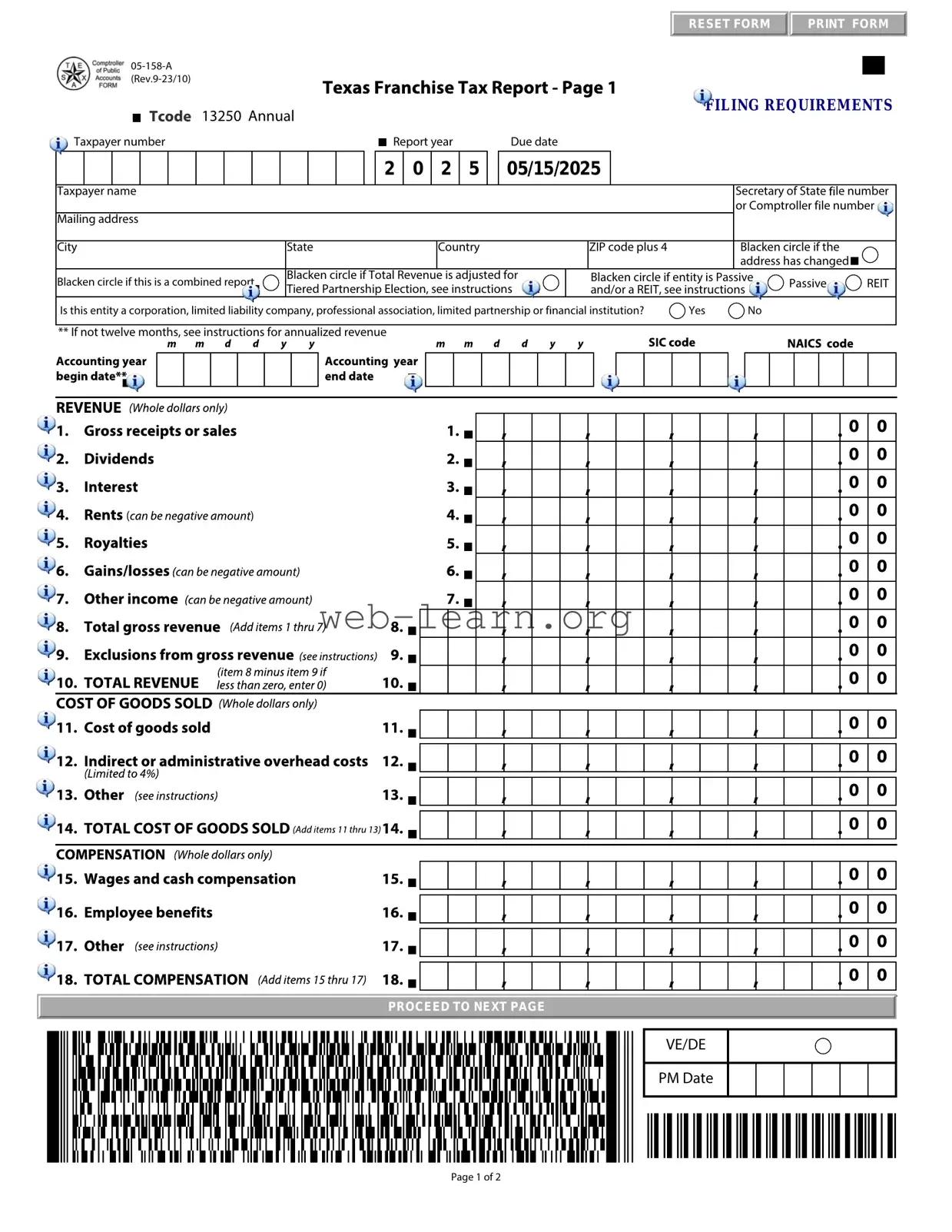
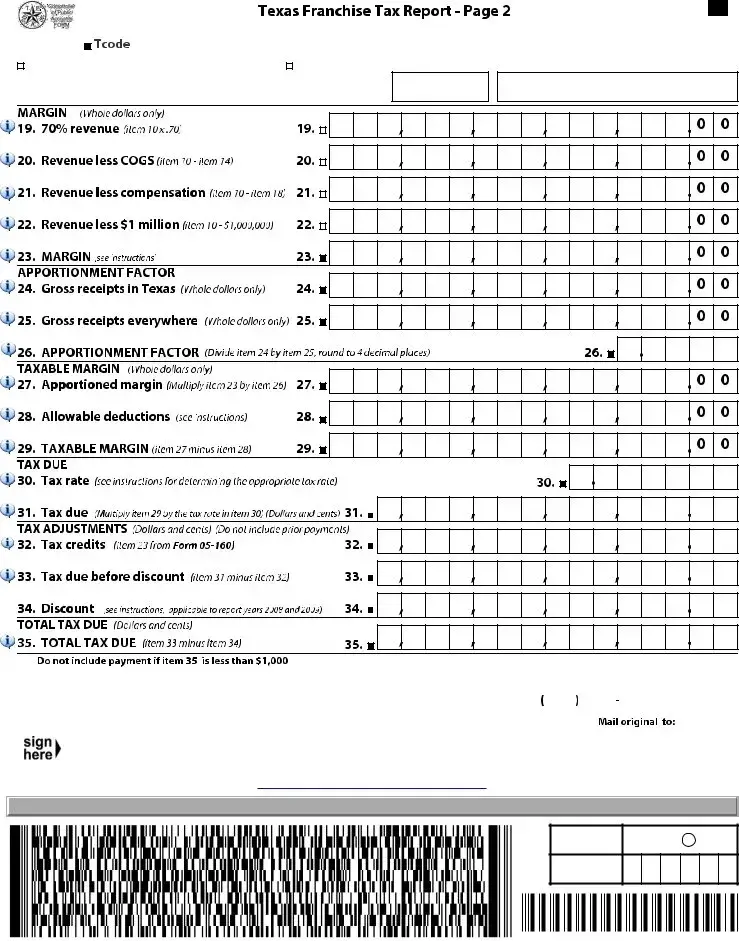
The Texas 05 158 A form is an essential document for businesses operating within the state, specifically designed for the Texas Franchise Tax Report. This form must be completed annually and submitted by various types of entities, including corporations, limited liability companies, and financial institutions. Key information required includes the taxpayer number, report year, and due date. The form captures gross revenue through multiple categories, such as sales, dividends, and rents, and allows for the deduction of exclusions from total revenue. Additionally, businesses must report their cost of goods sold and compensation expenses, which are critical for calculating the taxable margin. The form includes sections for determining the apportionment factor, which reflects the business's gross receipts within Texas compared to total gross receipts. Finally, the document outlines the tax due based on the calculated taxable margin, with provisions for tax adjustments and credits. Completing this form accurately is crucial for compliance with Texas tax regulations and for ensuring that businesses meet their financial obligations.
RESET FORM |
PRINT FORM |
|
|
13250 Annual
Taxpayer number
FILING REQUIREMENTS
Report year |
Due date |
|
|
|
|
|
|
|
|
|
|
|
|
|
|
|
|
|
|
|
|
|
|
|
2 |
0 |
|
2 |
|
5 |
|
|
05/15/2025 |
|
|
|
|
|
|
|
|
|
|
|
|
|
|
|
|
|
|
|
|
|||||||||
|
|
|
|
|
|
|
|
|
|
|
|
|
|
|
|
|
|
|
|
|
|
|
|
|
|
|
|
|
|
|
|
|
|
|
|
|
|
|
|
|
|
|
|
|
|
|
|
|
|
|
|
|
|
|
|
|
|
|
|
|
Taxpayer name |
|
|
|
|
|
|
|
|
|
|
|
|
|
|
|
|
|
|
|
|
|
|
|
|
|
|
|
|
|
|
|
|
Secretary of State |
le number |
||||||||||||||||||||||||||
|
|
|
|
|
|
|
|
|
|
|
|
|
|
|
|
|
|
|
|
|
|
|
|
|
|
|
|
|
|
|
|
|
|
|
|
|
|
|
|
|
|
|
|
|
|
|
|
or Comptroller f le number |
||||||||||||
Mailing address |
|
|
|
|
|
|
|
|
|
|
|
|
|
|
|
|
|
|
|
|
|
|
|
|
|
|
|
|
|
|
|
|
|
|
|
|
|
|
|
|
|
|
|
|
|
|||||||||||||||
|
|
|
|
|
|
|
|
|
|
|
|
|
|
|
|
|
|
|
|
|
|
|
|
|
|
|
|
|
|
|
|
|
|
|
|
|
|
|
|
|
|
|
|
|
|
|
|
|||||||||||||
City |
|
State |
|
|
|
|
|
Country |
|
|
|
|
|
|
ZIP code plus 4 |
|
|
|
Blacken circle if the |
|||||||||||||||||||||||||||||||||||||||||
|
|
|
|
|
|
|
|
|
|
|
|
|
|
|
|
|
|
|
|
|
|
|
|
|
|
|
|
|
|
|
|
|
|
|
|
|
|
|
|
|
|
|
|
|
|
|
|
address has changed |
|
|
|
|||||||||
|
|
|
|
|
|
|
|
|
|
|
|
|
|
|
|
|
|
|
|
|
|
|
|
|
|
|
|
|
|
|
|
|
|
|
|
|
|
|
|
|
|
|
|
|
|
|
|
|
||||||||||||
|
|
|
|
|
|
|
|
|
|
|
|
|
|
|
|
|
|
|
|
|
|
|
|
|
|
|
|
|
|
|
|
|
|
|
|
|
|
|
|
|
|
|
|
|
|
|
|
|
||||||||||||
Blacken circle if this is a combined report |
|
|
|
|
Blacken circle if Total Revenue |
is adjusted for |
|
Blacken circle if entity is Passive |
|
Passive |
|
|
|
REIT |
||||||||||||||||||||||||||||||||||||||||||||||
|
|
|
|
Tiered Partnership Election, see instructions |
|
|
|
and/or a REIT, see instructions |
|
|
|
|
|
|||||||||||||||||||||||||||||||||||||||||||||||
|
|
|
|
|
|
|
|
|
|
|
||||||||||||||||||||||||||||||||||||||||||||||||||
|
|
|
|
|
|
|
|
|
|
|
|
|
|
|
|
|
|
|
|
|
|
|
|
|
|
|
|
|
|
|||||||||||||||||||||||||||||||
Is this entity a corporation, limited liability company, professional association, limited partnership or f nancial institution? |
Yes |
|
|
No |
|
|
|
|
|
|
|
|
|
|||||||||||||||||||||||||||||||||||||||||||||||
|
|
|
|
|
|
|
|
|
|
|
|
|
|
|
|
|
|
|
|
|
|
|
|
|
|
|
|
|
|
|
|
|
|
|
|
|
|
|
|
|
|
|
|
|
|
|
||||||||||||||
** If not twelve months, see instructions for annualized revenue |
|
|
|
|
|
|
|
|
|
|
|
|
|
|
|
|
|
|
|
|
|
|
|
|
|
|
|
|
|
|
|
|
|
|
|
|
|
|||||||||||||||||||||||
|
|
|
|
|
|
|
|
|
|
|
|
|
|
|
|
|
|
|
|
|
|
|
|
|
|
|
|
|
|
|
|
|
|
|
|
|
|
|
|
|
|
|
|
|
|
|
|
|
|
|
|
|
|
|
|
|
|
|
|
|
|
|
|
|
|
|
|
|
|
|
|
|
|
|
|
|
|
|
|
|
|
|
|
|
|
|
|
|
|
|
|
|
|
|
|
|
|
|
|
|
|
|
|
|
|
|
|
|
|
|
|
|
|
|
|
|
|
|
|
|
|
|
|
|
|
|
|
|
|
|
|
|
|
|
|
|
|
|
|
|
|
|
|
|
|
|
|
|
|
|
|
|
|
|
|
|
|
|
|
|
|
|
|
|
|
|
|
|
|
|
|
|
|
|
|
|
|
|
|
|
|
|
( |
) |
PROCEED TO NEXT PAGE
VE/DE
PM Date
Page 1 of 2
13251 Annual
|
Taxpayer number |
|
|
Report year |
|
||||||||||||||
|
|
|
|
||||||||||||||||
|
|
|
|
||||||||||||||||
|
|
|
|
|
|
|
|
|
|
|
|
|
2 |
0 |
2 |
5 |
|||
|
|
|
|
|
|
|
|
|
|
|
|
|
|
|
|
|
|
|
|
|
|
|
|
|
|
|
|
|
|
|
|
|
|
|
|
|
|
|
|
|
|
|
|
|
|
|
|
|
|
|
|
|
|
|
|
|
|
|
|
|
|
|
|
|
|
|
|
|
|
|
|
|
|
|
|
|
|
|
|
|
|
|
|
|
|
|
|
|
|
|
|
|
|
|
|
|
|
|
|
|
|
|
|
|
|
|
|
|
|
|
|
|
|
|
|
|
|
|
|
|
|
|
|
|
|
|
|
|
|
|
|
|
|
|
|
|
|
|
|
|
|
|
|
|
|
|
|
|
|
|
|
|
|
|
|
|
|
|
|
|
|
|
|
|
|
|
|
|
|
|
|
|
|
|
|
|
|
|
|
Due date |
Taxpayer name |
05/15/2025
X X X
or if annualized total revenue is less than the no tax due threshold (see instructions). If the entity makes a tiered partnership election, ANY amount in item 35 is due. Complete Form
Print or type name |
Area code and phone number |
|
|
|
|
I declare that the information in this document and any attachments is true and correct to the best of my knowledge and belief. |
|
|
|
|
Texas Comptroller of Public Accounts |
|
Date |
|
|
P.O. Box 149348 |
|
|
|
|
|
|
Austin, TX |
|
|
|
Instructions for each report year are online at www.comptroller.texas.gov/taxes/franchise/forms/. If you have any questions, call
RETURN TO PAGE 1
VE/DE
PM Date
Page 2 of 2
| Fact Name | Details |
|---|---|
| Form Number | 05-158-A |
| Purpose | This form is used for filing the Texas Franchise Tax Report. |
| Governing Law | Texas Tax Code, Title 2, Chapter 171 |
| Filing Frequency | Annual filing is required for most entities. |
| Due Date | The report is due on May 15 of each year, or the next business day if it falls on a weekend or holiday. |
| Taxpayer Identification | Requires taxpayer number and name of the entity. |
| Revenue Reporting | Entities must report total gross revenue and exclusions. |
| Cost of Goods Sold | Entities can deduct cost of goods sold from total revenue. |
| Margin Calculation | Margin is calculated by subtracting costs from total revenue. |
| Contact Information | Questions can be directed to the Texas Comptroller at 1-800-252-1381. |
Filling out the Texas 05 158 A form is an essential step for businesses to meet their franchise tax obligations. Ensuring accuracy and completeness is crucial, as any errors can lead to delays or penalties. Follow these steps carefully to complete the form efficiently.
What is the Texas 05 158 A form?
The Texas 05 158 A form is the Texas Franchise Tax Report. It is required for entities such as corporations, limited liability companies, and other business organizations operating in Texas. This form is used to report revenue, calculate taxes owed, and ensure compliance with state tax regulations.
Who needs to file this form?
Any entity classified as a corporation, limited liability company, professional association, limited partnership, or financial institution must file the Texas 05 158 A form. If your business is not one of these entities, you may not be required to submit this form.
What information is required on the form?
The form requires various details, including:
Accurate reporting of this information is essential to determine your tax liability.
When is the form due?
The Texas 05 158 A form is typically due on June 15 of the year following the report year. For example, for the 2021 report year, the form was due on June 15, 2021. It's crucial to file on time to avoid penalties.
What happens if I miss the filing deadline?
If the filing deadline is missed, your business may incur penalties and interest on any taxes owed. It's advisable to file as soon as possible, even if you are late, to minimize potential penalties.
How do I calculate my taxable margin?
To calculate your taxable margin, you need to determine your total revenue, subtract the cost of goods sold and allowable deductions, and then apply the appropriate apportionment factor. The instructions on the form provide detailed steps for this calculation.
Can I amend my Texas 05 158 A form?
Yes, if you discover an error after filing, you can amend your Texas 05 158 A form. It is important to file an amendment as soon as possible to correct any inaccuracies and ensure compliance with state tax laws.
Where do I send the completed form?
The completed Texas 05 158 A form should be mailed to:
Texas Comptroller of Public Accounts
P.O. Box 149348
Austin, TX 78714-9348
Make sure to send the original form and keep a copy for your records.
What if my business has no tax due?
If your business's annualized total revenue is less than the no tax due threshold, you should still file the form. However, do not include payment if the total tax due is less than $1,000.
Where can I find more information or assistance?
For additional information, you can visit the Texas Comptroller's website at www.comptroller.texas.gov/taxes/franchise/forms/. If you have questions, you can also call the Comptroller's office at 1-800-252-1381 for assistance.
Filling out the Texas 05-158 A form can be straightforward, but many make common mistakes that can lead to delays or complications. Here are eight common errors to avoid.
First, many individuals forget to include their taxpayer number. This number is essential for identifying your business. Omitting it can result in processing delays. Always double-check that this number is filled in accurately.
Second, people often fail to blacken the correct circles. If your address has changed or if you are filing a combined report, make sure to mark those options. Neglecting to do so can lead to confusion about your filing status.
Another frequent mistake is incorrect reporting of revenue. Ensure that all revenue entries, including gross receipts and other income, are reported in whole dollars only. Rounding or using decimal points can cause discrepancies that may trigger audits.
Fourth, individuals sometimes miscalculate the total gross revenue. This total should be the sum of all income items listed. A simple addition error can lead to significant issues down the line, so take your time to verify your calculations.
Fifth, some filers overlook exclusions from gross revenue. Be sure to consult the instructions for what can be excluded. Missing this step can inflate your taxable margin and lead to a higher tax bill.
Another common error involves the cost of goods sold. Ensure that you accurately report all related costs. If you include indirect or administrative overhead costs, remember that they are limited to 4%. Failing to adhere to this rule can skew your margins.
Seventh, people often forget to include the correct tax rate when calculating tax due. Refer to the instructions to determine the appropriate rate for your report year. Using the wrong rate can result in underpayment or overpayment of taxes.
Lastly, many individuals neglect to sign and date the form. This step is crucial. Without your signature, the form is not valid, and it may be returned for correction. Always ensure that you complete this final step before submission.
By avoiding these common mistakes, you can help ensure a smoother filing process for your Texas 05-158 A form. Take your time, review your entries, and consult the instructions if you're unsure about any part of the process.
The Texas 05 158 A form is an essential document for entities required to file a franchise tax report in Texas. It collects vital information about a business's revenue, expenses, and tax liabilities. In addition to this form, several other documents are often utilized in conjunction with it to ensure compliance with state regulations. Below are some of the key forms that may accompany the Texas 05 158 A form.
These forms and documents work together to provide a comprehensive overview of a business's financial status and tax obligations. Properly completing and submitting them is crucial for compliance with Texas tax laws.
The Texas 05 158 A form is a critical document for businesses operating in Texas, specifically for franchise tax reporting. Understanding similar documents can provide clarity on the various requirements and processes involved in business taxation. Here are ten documents that share similarities with the Texas 05 158 A form:
Each of these documents plays a vital role in ensuring compliance with tax regulations. Understanding their similarities can help business owners navigate their responsibilities more effectively.
When filling out the Texas 05 158 A form, there are important considerations to keep in mind. Here are four things you should do and four things you should avoid.
Understanding the Texas 05 158 A form is essential for accurate tax reporting. However, several misconceptions can lead to confusion. Here are seven common misunderstandings:
Clarifying these misconceptions can help ensure compliance and reduce the risk of errors in tax reporting.
Filling out the Texas 05 158 A form is an important task for businesses operating in Texas. Here are key takeaways to keep in mind: