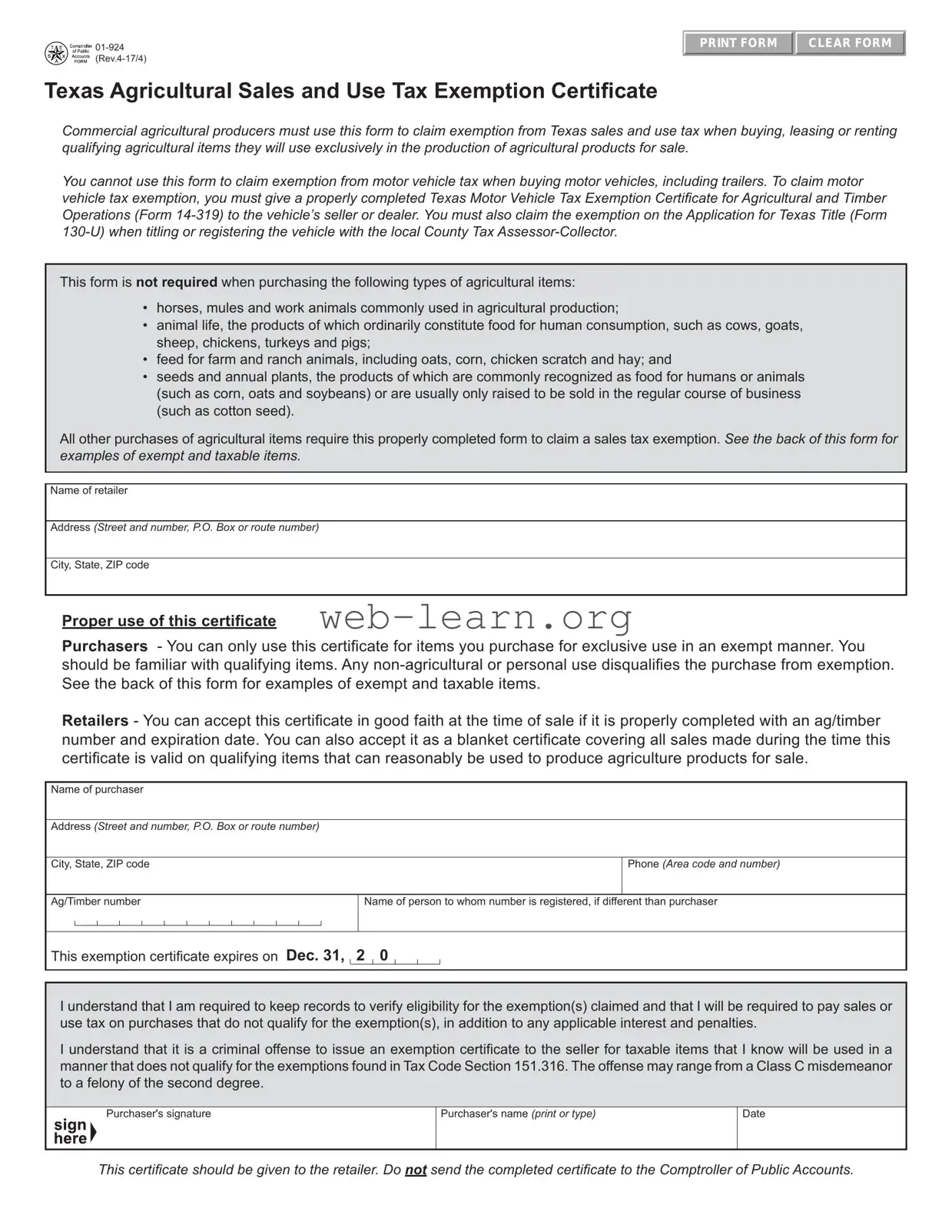
The Texas 01-924 form serves as a vital tool for commercial agricultural producers in Texas seeking to navigate the complexities of sales and use tax exemptions. This form allows eligible buyers to claim exemption from state taxes when purchasing, leasing, or renting qualifying agricultural items intended solely for the production of agricultural products for sale. However, it’s important to note that this exemption does not extend to motor vehicles, including trailers, which require a different form for tax exemption. Certain agricultural items, such as horses, livestock, and feed, are exempt by default and do not necessitate the use of the 01-924 form. The form outlines specific guidelines for both purchasers and retailers, emphasizing the importance of proper completion to ensure compliance. Purchasers must be aware that any personal or non-agricultural use will disqualify the exemption, while retailers can accept the form in good faith if it is filled out correctly. Understanding the nuances of this form is crucial for anyone involved in agricultural production in Texas, as it helps ensure that they can take advantage of available tax benefits while adhering to state regulations.
PRINT FORM |
CLEAR FORM |
|
|
Texas Agricultural Sales and Use Tax Exemption Certificate
Commercial agricultural producers must use this form to claim exemption from Texas sales and use tax when buying, leasing or renting qualifying agricultural items they will use exclusively in the production of agricultural products for sale.
You cannot use this form to claim exemption from motor vehicle tax when buying motor vehicles, including trailers. To claim motor vehicle tax exemption, you must give a properly completed Texas Motor Vehicle Tax Exemption Certificate for Agricultural and Timber Operations (Form
This form is not required when purchasing the following types of agricultural items:
•horses, mules and work animals commonly used in agricultural production;
•animal life, the products of which ordinarily constitute food for human consumption, such as cows, goats, sheep, chickens, turkeys and pigs;
•feed for farm and ranch animals, including oats, corn, chicken scratch and hay; and
•seeds and annual plants, the products of which are commonly recognized as food for humans or animals (such as corn, oats and soybeans) or are usually only raised to be sold in the regular course of business (such as cotton seed).
All other purchases of agricultural items require this properly completed form to claim a sales tax exemption. See the back of this form for examples of exempt and taxable items.
Name of retailer
Address (Street and number, P.O. Box or route number)
City, State, ZIP code
Proper use of this certificate
Purchasers - You can only use this certificate for items you purchase for exclusive use in an exempt manner. You should be familiar with qualifying items. Any
Retailers - You can accept this certificate in good faith at the time of sale if it is properly completed with an ag/timber number and expiration date. You can also accept it as a blanket certificate covering all sales made during the time this certificate is valid on qualifying items that can reasonably be used to produce agriculture products for sale.
Name of purchaser
Address (Street and number, P.O. Box or route number)
City, State, ZIP code
Phone (Area code and number)
Ag/Timber number
Name of person to whom number is registered, if different than purchaser
This exemption certificate expires on Dec. 31, 2 0
I understand that I am required to keep records to verify eligibility for the exemption(s) claimed and that I will be required to pay sales or use tax on purchases that do not qualify for the exemption(s), in addition to any applicable interest and penalties.
I understand that it is a criminal offense to issue an exemption certificate to the seller for taxable items that I know will be used in a manner that does not qualify for the exemptions found in Tax Code Section 151.316. The offense may range from a Class C misdemeanor to a felony of the second degree.
Purchaser's signature
Purchaser's name (print or type)
Date
This certificate should be given to the retailer. Do not send the completed certificate to the Comptroller of Public Accounts.

Form
Always Exempt
These items are always exempt and do not require an exemption certificate or an ag/timber number.
•Horses, mules and work animals commonly used in agricultural production;
•Animal life, the products of which ordinarily constitute food for human consumption, such as cattle, goats, sheep, chickens, turkeys and hogs;
•Feed such as oats, hay, chicken scratch, wild bird seed and deer corn for livestock and wild game (pet food is not exempt); and
•Seeds and annual plants, the products of which are commonly recognized as food for humans or animals, such as corn, oats and soybeans or for fiber, such as cotton seed.
Exempt
Here are examples of items that are exempt from sales tax when used exclusively on a farm or ranch to produce agricultural products for sale and pur- chased by a person with a current ag/timber number.
Air tanks
Augers
Bale transportation equipment
Baler twine
Baler wrap
Balers
Binders
Branding irons
Brush hogs Bulk milk coolers Bulk milk tanks
Calf weaners and feeders
Cattle currying and oiling machines
Cattle feeders
Chain saws used for clearing fence lines or pruning orchards
Choppers
Combines
Conveyors
Corn pickers
Corral panels
Cotton pickers, strippers
Crawlers – tractors
Crushers
Cultipackers
Discs
Drags
Dryers
Dusters
Egg handling equipment
Ensilage cutters
Farm machinery and repair or replacement parts
Farm tractors Farm wagons
Farrowing houses (portable and crates)
Feed carts
Feed grinders
Feeders
Fertilizer
Fertilizer distributors
Floats for water troughs
Foggers
Forage boxes
Forage harvesters
Fruit graters
Fruit harvesters
Grain binders
Grain bins
Grain drills
Grain handling equipment
Greases, lubricants and oils for qualifying farm machinery and equipment
Harrows
Head gates
Hoists
Husking machines
Hydraulic fluid
Irrigation equipment
Manure handling equipment Manure spreaders Milking equipment
Mowers (hay and rotary blade)
Pesticides
Pickers
Planters Poultry feeders
Poultry house equipment
Pruning equipment
Rollbar equipment Rollers
Root vegetable harvesters
Rotary hoes
Salt stands
Seed cleaners
Shellers
Silo unloaders
Soilmovers used to grade farmland
Sorters
Sowers
Sprayers
Spreaders
Squeeze chutes
Stalls
Stanchions
Subsoilers
Telecommunications services used to navigate farm machinery and equipment*
Threshing machines Tillers
Tires for exempt equipment Troughs, feed and water
Vacuum coolers
Vegetable graders
Vegetable washers
Vegetable waxers
* As of Sept. 1, 2015, telecommunications services used to navigate farm machinery and equipment are exempt.
Taxable
These items DO NOT qualify for sales and use tax exemption for agricultural production.
•Automotive parts, such as tires, for vehicles licensed for highway use, even if the vehicle has farm plates
•Clothing, including work clothing, safety apparel and shoes
•Computers and computer software used for any purposes other than agricultural production
•Furniture, home furnishings and housewares
•Golf carts, dirt bikes, dune buggies and
•Guns, ammunition, traps and similar items
*See
•Materials used to construct roads or buildings used for shelter, housing, storage or work space (examples include general storage barns, sheds or shelters)
•Motor vehicles and trailers*
•Pet food
•Taxable services such as nonresidential real property repairs or remodeling, security services, and waste removal
Tax Help: www.comptroller.texas.gov/taxes/ = Window on State Government: www.comptroller.texas.gov
Tax Assistance:
Sign up to receive email updates on the Comptroller topics of your choice at www.comptroller.texas.gov/subscribe.
| Fact Name | Description |
|---|---|
| Purpose | The Texas 01-924 form is used by commercial agricultural producers to claim exemption from sales and use tax on qualifying agricultural items exclusively used in production. |
| Exclusions | This form cannot be used for motor vehicle tax exemptions; a separate form (14-319) is required for vehicles. |
| Expiration | The exemption certificate expires on December 31 of the year issued, requiring renewal for continued use. |
| Governing Law | This form is governed by Texas Tax Code Section 151.316, which outlines the eligibility for sales tax exemptions in agricultural contexts. |
Filling out the Texas 01-924 form is a straightforward process, but it requires attention to detail to ensure accuracy. This form allows agricultural producers to claim an exemption from sales and use tax for qualifying items used exclusively in agricultural production. After completing the form, it should be provided to the retailer at the time of purchase, rather than sent to the state. Here are the steps to complete the form.
Once the form is filled out, it is ready to be presented to the retailer. Ensure that all information is accurate and complete to avoid any issues during the purchase process. Keep a copy for your records, as it may be needed for future reference or verification of the exemption claimed.
What is the Texas 01-924 form?
The Texas 01-924 form, also known as the Agricultural Sales and Use Tax Exemption Certificate, is a document that allows commercial agricultural producers to claim exemption from Texas sales and use tax. This exemption applies when purchasing, leasing, or renting qualifying agricultural items that will be used exclusively in the production of agricultural products for sale. It's important to note that this form cannot be used for motor vehicle tax exemptions.
Who is eligible to use the Texas 01-924 form?
Eligibility for using the Texas 01-924 form is limited to commercial agricultural producers. These individuals or businesses must be engaged in the production of agricultural products for sale. Additionally, the items purchased must be used exclusively for agricultural purposes. Any personal or non-agricultural use of these items will disqualify the purchase from receiving the tax exemption.
What items are exempt from sales tax under this certificate?
Many agricultural items qualify for exemption under the Texas 01-924 form. Examples include:
However, certain items, such as horses, mules, and specific agricultural products, are always exempt and do not require this certificate.
What should I do if I use the exemption certificate incorrectly?
If you issue the Texas 01-924 form for items that do not qualify for the exemption, you may face serious consequences. The law considers this a criminal offense, which can range from a Class C misdemeanor to a felony of the second degree. It is crucial to keep accurate records to verify eligibility for any exemptions claimed. If in doubt, consult with a tax professional or legal expert.
How do retailers handle the Texas 01-924 form?
Retailers can accept the Texas 01-924 form in good faith if it is properly completed with the purchaser's ag/timber number and expiration date. Retailers may also accept it as a blanket certificate, covering all qualifying sales made during the certificate's validity period. However, they must ensure that the items sold are indeed used for agricultural production to avoid liability for unpaid sales tax.
Filling out the Texas 01-924 form can be straightforward, but many people make mistakes that can lead to complications. One common error is not providing the correct Ag/Timber number. This number is essential for claiming the exemption. Without it, the form is incomplete, and the retailer may refuse to accept it. Always double-check that this number is accurate and current.
Another frequent mistake is using the form for items that do not qualify for exemption. Purchasers sometimes assume that all agricultural purchases are exempt. However, items like motor vehicles and certain types of equipment are not eligible. Familiarizing oneself with the list of exempt and taxable items is crucial to avoid unnecessary tax payments.
Many people also forget to include their signature on the form. This step is vital. A missing signature can render the certificate invalid, and the retailer may still charge sales tax. Ensure that you sign and date the form before submitting it to the retailer.
Inaccurate information about the purchaser can lead to issues as well. Individuals often fill in the name or address incorrectly, which can cause confusion during the transaction. Always verify that all details are correct and match the information associated with the Ag/Timber number.
Some purchasers neglect to understand the requirement for exclusive use. If the items purchased are used for non-agricultural purposes, the exemption does not apply. This misunderstanding can lead to tax liabilities that could have been avoided. Be clear on how the items will be used before claiming the exemption.
Lastly, many individuals fail to keep proper records. The form states that purchasers must maintain records to verify eligibility for the exemptions claimed. Without adequate documentation, individuals may face penalties if audited. Keeping receipts and records organized can save time and trouble in the long run.
When dealing with the Texas Agricultural Sales and Use Tax Exemption Certificate (Form 01-924), several other forms and documents may also be required. These documents ensure that agricultural producers can properly claim exemptions and comply with state regulations. Below is a list of important forms that are commonly used alongside the 01-924 form.
Having these forms and documents ready can streamline the process of claiming tax exemptions and ensure compliance with Texas state laws. It's essential to familiarize yourself with each form's requirements to avoid any potential issues during transactions.
When filling out the Texas 01-924 form, it is essential to follow certain guidelines to ensure that your application is processed correctly. Below is a list of things you should and shouldn’t do:
By adhering to these guidelines, you can help ensure a smooth process in claiming your sales and use tax exemption. It is important to take these steps seriously, as any errors could lead to complications or potential penalties. If you have any questions, consider reaching out to the appropriate tax assistance resources for further clarification.
Misconceptions about the Texas 01 924 form can lead to confusion regarding agricultural tax exemptions. Here are five common misconceptions:
Filling out the Texas 01-924 form correctly is essential for agricultural producers seeking sales tax exemptions. Here are some key takeaways to help you navigate the process:
Understanding these points will help ensure you use the Texas 01-924 form effectively and maintain compliance with tax regulations.