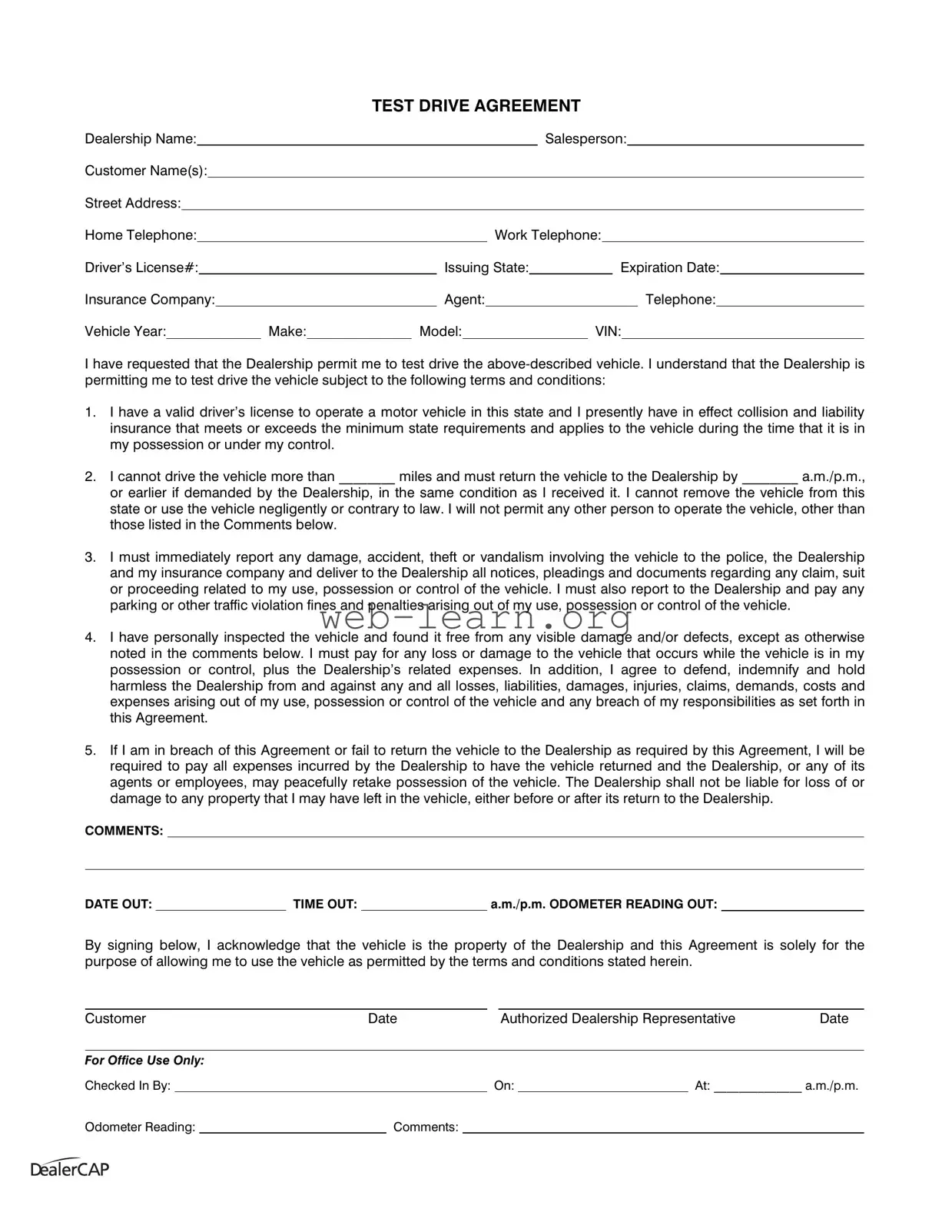
The Test Drive form serves as a crucial document that outlines the terms and conditions under which a potential buyer can operate a vehicle from a dealership. This agreement is not merely a formality; it establishes a clear understanding between the dealership and the customer, ensuring that both parties are aware of their responsibilities. Key components of the form include the dealership's name, the salesperson's contact information, and the customer's personal details, such as their address and phone numbers. Additionally, it requires the customer to provide their driver’s license information and insurance details, affirming their eligibility to test drive the vehicle. The form explicitly states the distance limitations for the test drive, the time by which the vehicle must be returned, and the necessity for the customer to maintain the vehicle in its original condition. It also addresses the protocols for reporting any incidents or damages that may occur during the test drive. Furthermore, it emphasizes the customer's obligation to indemnify the dealership against any claims arising from their use of the vehicle. This comprehensive approach not only protects the dealership's interests but also enhances the customer's awareness of their obligations during the test drive experience.
TEST DRIVE AGREEMENT
Dealership Name: |
|
|
|
|
|
|
|
|
|
|
Salesperson: |
|
||||||||||||
Customer Name(s): |
|
|
|
|
|
|
|
|
|
|
|
|
|
|
|
|
|
|
|
|||||
Street Address: |
|
|
|
|
|
|
|
|
|
|
|
|
|
|
|
|
|
|
|
|||||
Home Telephone: |
|
|
|
|
|
|
|
|
Work Telephone: |
|
||||||||||||||
Driver’s License#: |
|
|
|
|
|
Issuing State: |
|
|
|
|
Expiration Date: |
|
||||||||||||
Insurance Company: |
|
|
|
|
Agent: |
|
|
|
|
|
|
|
Telephone: |
|
||||||||||
Vehicle Year: |
|
|
Make: |
|
Model: |
|
|
VIN: |
|
|||||||||||||||
I have requested that the Dealership permit me to test drive the
1.I have a valid driver’s license to operate a motor vehicle in this state and I presently have in effect collision and liability insurance that meets or exceeds the minimum state requirements and applies to the vehicle during the time that it is in my possession or under my control.
2.I cannot drive the vehicle more than ________ miles and must return the vehicle to the Dealership by ________ a.m./p.m., or earlier if demanded by the Dealership, in the same condition as I received it. I cannot remove the vehicle from this state or use the vehicle negligently or contrary to law. I will not permit any other person to operate the vehicle, other than those listed in the Comments below.
3.I must immediately report any damage, accident, theft or vandalism involving the vehicle to the police, the Dealership and my insurance company and deliver to the Dealership all notices, pleadings and documents regarding any claim, suit or proceeding related to my use, possession or control of the vehicle. I must also report to the Dealership and pay any parking or other traffic violation fines and penalties arising out of my use, possession or control of the vehicle.
4.I have personally inspected the vehicle and found it free from any visible damage and/or defects, except as otherwise noted in the comments below. I must pay for any loss or damage to the vehicle that occurs while the vehicle is in my possession or control, plus the Dealership’s related expenses. In addition, I agree to defend, indemnify and hold harmless the Dealership from and against any and all losses, liabilities, damages, injuries, claims, demands, costs and expenses arising out of my use, possession or control of the vehicle and any breach of my responsibilities as set forth in this Agreement.
5.If I am in breach of this Agreement or fail to return the vehicle to the Dealership as required by this Agreement, I will be required to pay all expenses incurred by the Dealership to have the vehicle returned and the Dealership, or any of its agents or employees, may peacefully retake possession of the vehicle. The Dealership shall not be liable for loss of or damage to any property that I may have left in the vehicle, either before or after its return to the Dealership.
COMMENTS:
DATE OUT: |
|
TIME OUT: |
|
a.m./p.m. ODOMETER READING OUT: |
By signing below, I acknowledge that the vehicle is the property of the Dealership and this Agreement is solely for the purpose of allowing me to use the vehicle as permitted by the terms and conditions stated herein.
Customer |
Date |
Authorized Dealership Representative |
Date |
|||
|
|
|
|
|
|
|
For Office Use Only: |
|
|
|
|
|
|
Checked In By: |
|
|
On: |
|
At: ______________ a.m./p.m. |
|
Odometer Reading: |
|
Comments: |
| Fact Name | Description |
|---|---|
| Valid Driver's License Requirement | The customer must possess a valid driver's license for the state in which the test drive occurs, ensuring they are legally allowed to operate the vehicle. |
| Insurance Coverage | Customers are required to have collision and liability insurance that meets or exceeds the state's minimum requirements, applicable during the test drive. |
| Vehicle Return Conditions | The vehicle must be returned to the dealership by a specified time and in the same condition as received, with a maximum mileage limit for the test drive. |
| Liability for Damage | The customer is responsible for any damage or loss to the vehicle during the test drive and agrees to indemnify the dealership against any related claims. |
Filling out the Test Drive form is a straightforward process. Once completed, you will be able to proceed with your test drive. Follow these steps to ensure all necessary information is accurately provided.
The Test Drive form is a legal agreement between the customer and the dealership. It outlines the terms and conditions under which a customer can test drive a vehicle. By signing this form, customers acknowledge their responsibilities while using the vehicle.
Customers must provide personal information, including their name, address, telephone numbers, driver's license number, and insurance details. Additionally, vehicle specifics such as year, make, model, and VIN should be included.
Customers must ensure they have a valid driver's license and appropriate insurance coverage. They should not exceed the mileage limit set on the form and must return the vehicle in the same condition as received. The vehicle cannot be driven out of state or used in any negligent manner.
In the event of an accident, customers must immediately report it to the police, the dealership, and their insurance company. It is also necessary to provide the dealership with any related documents or notices.
Yes, customers are responsible for any loss or damage that occurs while the vehicle is in their possession. This includes covering the dealership's expenses related to the damage.
Only individuals listed in the comments section of the form may operate the vehicle. Customers should not allow anyone else to drive it.
If a customer fails to return the vehicle as required, they may incur additional expenses. The dealership reserves the right to retake possession of the vehicle peacefully.
No, the dealership is not liable for any loss or damage to personal property left in the vehicle, whether before or after its return.
Customers should note any visible damage or defects in the comments section of the form. If no issues are reported, it is assumed the vehicle is free from damage.
Fill out all required fields accurately, including personal information and vehicle details. Ensure to read the terms and conditions carefully before signing the form. Both the customer and an authorized dealership representative must sign and date the agreement.
Filling out the Test Drive form can seem straightforward, but many people make common mistakes that can lead to complications. One frequent error is failing to provide complete contact information. Customers often skip filling in their home or work telephone numbers. This information is crucial for the dealership to reach you in case of any issues regarding the test drive.
Another mistake involves the driver's license section. Some individuals neglect to include their driver’s license number or provide an expired license. Ensure that your license is valid and that you enter the correct number. This is a legal requirement and a critical part of the agreement.
Additionally, many customers overlook the importance of the comments section. Not specifying any pre-existing damage or defects can lead to disputes later. It is essential to document any visible issues with the vehicle before you take it out. This protects you from being held responsible for damages that were not caused during your test drive.
Lastly, not adhering to the mileage and return time can create significant problems. Some individuals fail to fill in the maximum mileage or return time, which can result in misunderstandings. Clearly state these details to avoid any potential breaches of the agreement. Remember, clear communication is key to a smooth experience.
When engaging in a test drive, several other documents may accompany the Test Drive Agreement to ensure a smooth and transparent process. Each document serves a specific purpose, enhancing the overall experience for both the dealership and the customer.
These documents collectively enhance the accountability and safety of the test drive process, ensuring that both the customer and dealership are well-informed and protected throughout the experience.
The Test Drive form serves as a crucial document in the vehicle rental and sales process. It shares similarities with several other documents that also outline responsibilities, liabilities, and terms of use. Below is a list of seven documents that are comparable to the Test Drive form, detailing how they align in purpose and content.
Understanding these similarities can help ensure that all parties are aware of their rights and responsibilities when engaging in vehicle use agreements.
When filling out the Test Drive form, keep the following guidelines in mind:
Following these guidelines will help ensure a smooth test drive experience.
When it comes to the Test Drive form, there are several misconceptions that can lead to confusion. Understanding these can help ensure a smoother experience when test driving a vehicle. Here are seven common misconceptions:
By clarifying these misconceptions, potential drivers can approach their test drive with a better understanding of their responsibilities and the dealership's expectations. This knowledge can lead to a more enjoyable and stress-free experience.
When filling out the Test Drive form, keep these key takeaways in mind:
Following these guidelines will help ensure a smooth and responsible test drive experience.