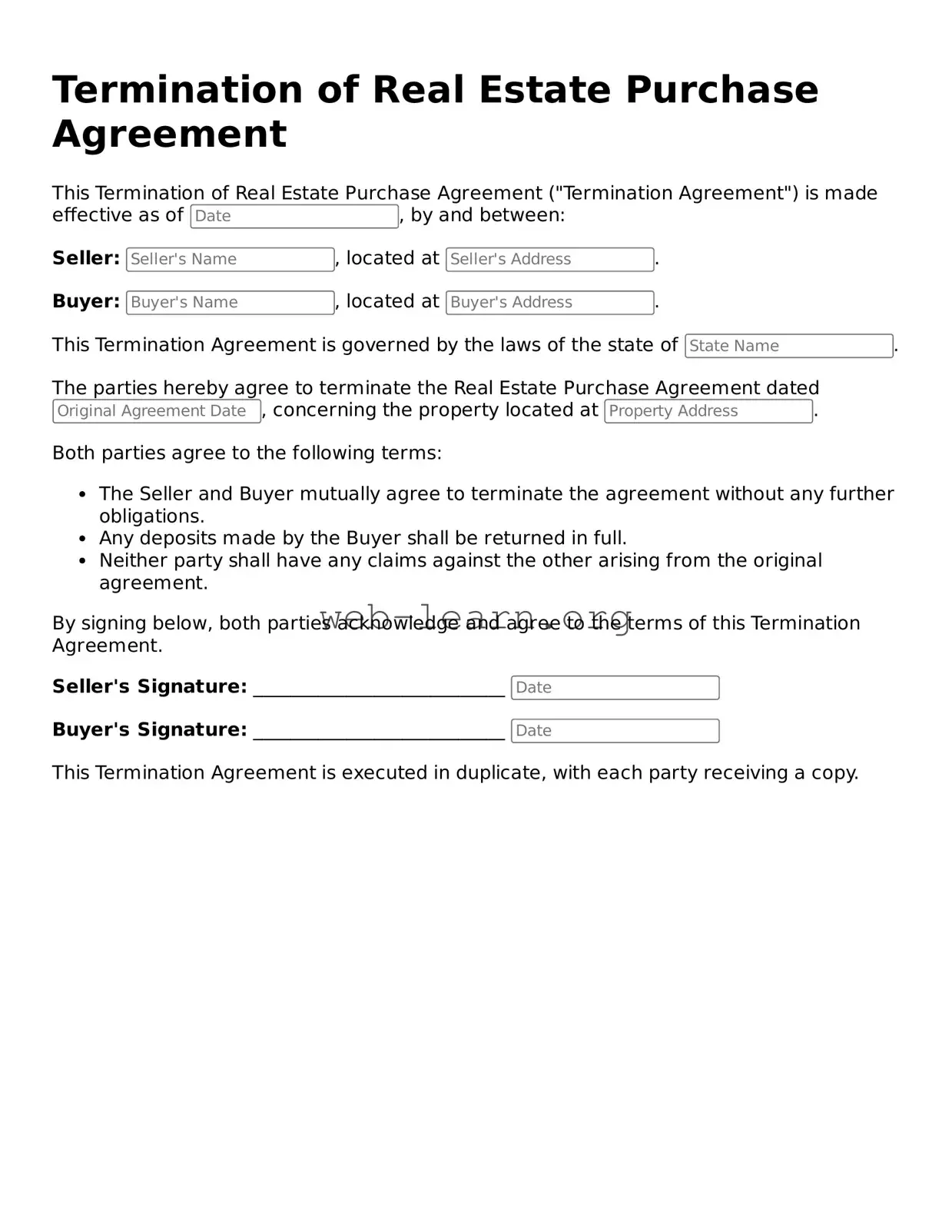
When navigating the complexities of real estate transactions, the Termination of Real Estate Purchase Agreement form serves as a crucial document for both buyers and sellers. This form is designed to formally end a purchase agreement, providing a structured approach for parties wishing to withdraw from a transaction. Key aspects of the form include the identification of the parties involved, the property in question, and the specific reasons for termination. It often requires signatures from both parties to ensure mutual consent, thereby protecting the interests of each side. Additionally, the form may address any financial implications, such as the return of earnest money deposits or the handling of other costs incurred during the process. Understanding how to properly utilize this form can help mitigate potential disputes and clarify the responsibilities of each party as they move forward.
Termination of Real Estate Purchase Agreement
This Termination of Real Estate Purchase Agreement ("Termination Agreement") is made effective as of , by and between:
Seller: , located at .
Buyer: , located at .
This Termination Agreement is governed by the laws of the state of .
The parties hereby agree to terminate the Real Estate Purchase Agreement dated , concerning the property located at .
Both parties agree to the following terms:
By signing below, both parties acknowledge and agree to the terms of this Termination Agreement.
Seller's Signature: ___________________________
Buyer's Signature: ___________________________
This Termination Agreement is executed in duplicate, with each party receiving a copy.
| Fact Name | Description |
|---|---|
| Purpose | The Termination of Real Estate Purchase Agreement form is used to officially end a real estate purchase agreement between parties. |
| Parties Involved | This form typically involves the buyer and the seller, both of whom must agree to the termination. |
| Governing Law | The laws governing the termination process may vary by state. For example, in California, it is governed by the California Civil Code. |
| Signature Requirement | Both parties must sign the form to validate the termination of the agreement. |
| Notice Period | Some states may require a notice period before the termination takes effect. Always check local regulations. |
| Consequences | Terminating the agreement may have financial implications, such as forfeiture of deposits or other penalties. |
| Record Keeping | It is advisable for both parties to keep a copy of the signed termination form for their records. |
After completing the Termination of Real Estate Purchase Agreement form, it will need to be submitted to the appropriate parties involved in the transaction. Ensure that all necessary signatures are obtained to finalize the termination process.
What is a Termination of Real Estate Purchase Agreement form?
This form is used to officially end a real estate purchase agreement between a buyer and a seller. It outlines the reasons for termination and ensures that both parties acknowledge the cancellation of the agreement. By using this form, you create a clear record that the contract is no longer in effect.
When should I use this form?
You should use the Termination of Real Estate Purchase Agreement form when either the buyer or the seller decides to withdraw from the agreement. Common reasons for termination include financing issues, inspection problems, or simply a change of mind. It’s important to document the termination to avoid any misunderstandings later.
Do I need a lawyer to fill out this form?
While it’s not mandatory to have a lawyer, consulting one can be beneficial, especially if the situation is complex. A legal professional can help ensure that all necessary details are included and that your rights are protected. However, many people successfully complete the form on their own.
What information do I need to provide?
Typically, you will need to include:
Make sure all information is accurate to avoid any potential disputes.
What happens after I submit the form?
Once the Termination of Real Estate Purchase Agreement form is completed and signed, it should be distributed to all parties involved. This includes the buyer, the seller, and any real estate agents. After this, the agreement is officially terminated, and neither party has further obligations under the original contract.
Is there a fee associated with terminating a real estate purchase agreement?
Generally, there is no fee specifically for using the Termination of Real Estate Purchase Agreement form itself. However, if you have engaged a real estate agent or attorney, there may be fees associated with their services. Always check your original agreement for any clauses regarding termination that may involve costs.
When individuals decide to terminate a real estate purchase agreement, filling out the associated form accurately is crucial. However, many people make common mistakes that can lead to complications. One frequent error is failing to provide all required information. Each section of the form typically needs to be filled out completely, including details about both parties and the property in question. Omitting even a small piece of information can delay the process.
Another mistake often seen is the incorrect dating of the form. The date on which the termination is signed is important, as it establishes when the termination takes effect. If the date is missing or incorrect, it may lead to disputes about the timing of the termination.
People sometimes forget to sign the form. A signature is usually required from all parties involved to validate the termination. Without the necessary signatures, the form may not be considered legally binding, which can result in ongoing obligations under the original agreement.
In addition to signatures, individuals may neglect to provide their contact information. This detail is essential for any follow-up communications regarding the termination. Without accurate contact information, parties may struggle to reach each other, complicating the termination process.
Another common oversight is failing to include a clear reason for the termination. While not always required, stating the reason can help clarify intentions and provide context. This can be particularly helpful if there are disputes later on regarding the termination.
Some people may also overlook the importance of reviewing the entire form before submission. Errors can easily go unnoticed, and a thorough review can catch mistakes that might otherwise lead to issues down the line. It is advisable to double-check all entries for accuracy.
In certain cases, individuals may not be aware of any specific state requirements that could affect the termination process. Each state may have its own rules regarding real estate transactions, including terminations. Ignoring these can lead to non-compliance and potential legal challenges.
Lastly, individuals may fail to retain a copy of the completed form for their records. Keeping a copy is important for reference and can provide proof of the termination if questions arise in the future. Without a copy, individuals may find it challenging to demonstrate that the agreement was properly terminated.
When terminating a real estate purchase agreement, several other forms and documents may be necessary to ensure a smooth process. Understanding these documents can help you navigate the situation effectively and protect your interests. Below is a list of commonly used forms that often accompany the Termination of Real Estate Purchase Agreement form.
Being aware of these documents can help you manage the termination process more effectively. Each form plays a crucial role in ensuring that all parties are informed and protected throughout this transition.
When filling out the Termination of Real Estate Purchase Agreement form, it is important to approach the task with care. Below are some guidelines to consider.
Understanding the Termination of Real Estate Purchase Agreement form is crucial for anyone involved in real estate transactions. Here are ten common misconceptions about this form:
Many believe the form can be submitted at any stage. However, it is typically only valid under specific circumstances, such as when both parties agree to terminate or if certain conditions are unmet.
Submitting the form does not automatically cancel the agreement. Both parties must acknowledge and agree to the termination for it to be effective.
Terminating a real estate purchase agreement can lead to financial repercussions, such as forfeiting earnest money or facing legal action if the termination is not justified.
Withdrawal implies a decision to step back, while termination is a formal process that requires documentation and agreement from both parties.
Either party, the buyer or the seller, can initiate the termination process if the terms of the agreement allow for it.
While the form may appear straightforward, it often requires detailed information and careful consideration of the circumstances surrounding the termination.
Although some may feel confident handling the process independently, consulting with a legal professional can provide essential guidance and protect interests.
Not all agreements are the same. Some may have specific clauses that allow for termination without needing this form.
In some cases, parties may negotiate to reinstate the agreement after termination. This depends on mutual consent and the specific terms of the original contract.
After filing, both parties must ensure that all terms of the termination are met and documented to finalize the process.
When dealing with the Termination of Real Estate Purchase Agreement form, it's essential to understand the key elements that ensure a smooth process. Here are some important takeaways:
Transaction Finalization Extension Addendum - Ensures that all necessary parties agree to the new closing date.