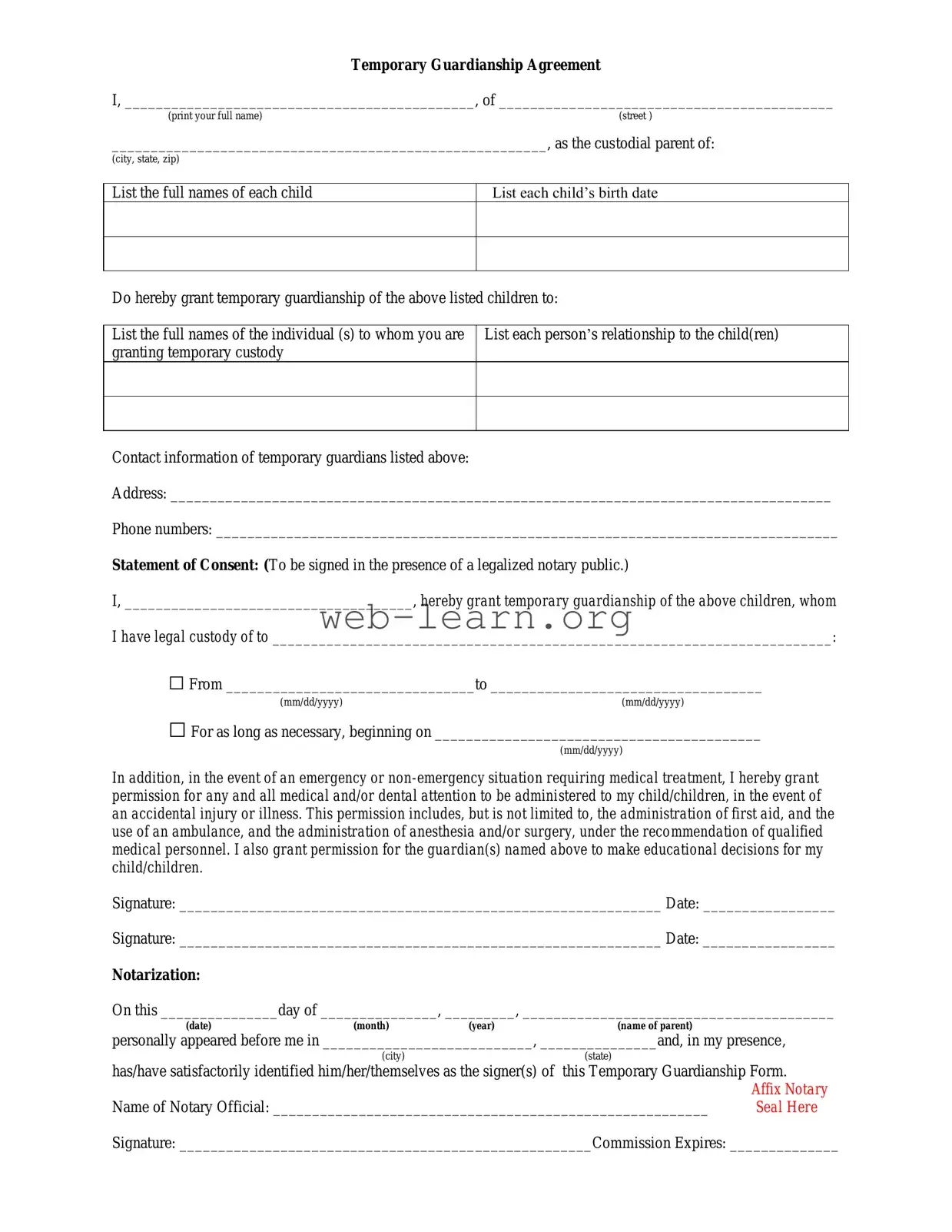
When navigating the complexities of child custody arrangements, understanding the Temporary Custody form can be a crucial step for parents and guardians. This form is designed to establish a temporary custody agreement that outlines who will care for a child for a specified period, often during transitions such as divorce, separation, or other significant life changes. It details the rights and responsibilities of the custodial and non-custodial parents, ensuring that the child’s best interests remain at the forefront. The form typically requires information about the child, the parents, and any relevant circumstances that led to the need for temporary custody. Additionally, it may include provisions for visitation rights and other important considerations that help maintain stability for the child. By completing this form accurately, parents can create a clear and enforceable agreement that addresses their child's immediate needs while paving the way for future arrangements.

Temporary Guardianship Agreement
I, _____________________________________________, of ___________________________________________
(print your full name)(street )
________________________________________________________, as the custodial parent of:
(city, state, zip)
List the full names of each child
List each child’s birth date
Do hereby grant temporary guardianship of the above listed children to:
List the full names of the individual (s) to whom you are List each person’s relationship to the child(ren) granting temporary custody
Contact information of temporary guardians listed above:
Address: _____________________________________________________________________________________
Phone numbers: ________________________________________________________________________________
Statement of Consent: (To be signed in the presence of a legalized notary public.)
I, _____________________________________, hereby grant temporary guardianship of the above children, whom
I have legal custody of to ________________________________________________________________________:
□From ________________________________to ___________________________________
(mm/dd/yyyy) |
(mm/dd/yyyy) |
□For as long as necessary, beginning on __________________________________________
(mm/dd/yyyy)
In addition, in the event of an emergency or
Signature: ______________________________________________________________ Date: _________________
Signature: ______________________________________________________________ Date: _________________
Notarization:
On this _______________day of _______________, _________, ________________________________________
(date) |
(month) |
(year) |
(name of parent) |
|
personally appeared before me in ___________________________, _______________and, in my presence, |
||||
|
(city) |
|
(state) |
|
has/have satisfactorily identified him/her/themselves as the signer(s) of |
this Temporary Guardianship Form. |
|||
|
|
|
|
Affix Notary |
Name of Notary Official: ________________________________________________________ |
Seal Here |
|||
Signature: _____________________________________________________Commission Expires: ______________
| Fact Name | Details |
|---|---|
| Definition | The Temporary Custody form is a legal document used to establish temporary guardianship of a child, allowing a designated individual to care for the child for a limited period. |
| Governing Law | In many states, the governing laws for temporary custody are found in the family law statutes, which vary by state. For example, in California, it falls under the California Family Code Section 3040. |
| Purpose | This form is often utilized in situations where parents are unable to care for their child due to various circumstances, such as illness or temporary relocation. |
| Filing Process | The completed Temporary Custody form must be filed with the appropriate family court, and a hearing may be scheduled to finalize the temporary custody arrangement. |
Filling out a Temporary Custody form can seem daunting, but with a clear understanding of the steps involved, it becomes much more manageable. Once the form is completed, it will need to be submitted to the appropriate court or agency, where it will be reviewed as part of the custody process.
After filling out the form, ensure that you follow the specific submission guidelines set by the court or agency. This may include filing fees or additional documentation. Being thorough and organized will help facilitate the process.
A Temporary Custody form is a legal document used to request temporary custody of a child. This form is typically filed in situations where immediate custody is needed, such as during a divorce, separation, or in cases of emergency. The form outlines the reasons for seeking temporary custody and provides details about the child's current living situation.
Generally, a parent or legal guardian can file for Temporary Custody. In some cases, other relatives or individuals with a close relationship to the child may also be eligible to file. It is important to demonstrate a valid reason for seeking custody, such as concerns for the child's safety or well-being.
The form typically requires the following information:
After filing the form, the court will schedule a hearing. During this hearing, both parties can present their case. The judge will consider the best interests of the child before making a decision. It is essential to provide clear and compelling evidence to support your request.
If the court grants Temporary Custody, the order will specify the terms and duration of custody. The custodial parent or guardian will be responsible for the child's care during this period. The order may also include visitation rights for the other parent or guardian.
Yes, Temporary Custody orders can be modified if there are significant changes in circumstances. Either party can request a modification by filing the appropriate paperwork with the court. It is crucial to provide justification for the requested changes.
When filling out the Temporary Custody form, individuals often overlook critical details that can lead to complications. One common mistake is failing to provide accurate information about the child’s current living situation. The form requires specific details regarding where the child resides, including the names and addresses of all individuals currently involved in the child's care. Omitting or misrepresenting this information can delay the process and may even impact the court’s decision.
Another frequent error is neglecting to include all necessary signatures. The Temporary Custody form typically requires signatures from both parents or guardians, as well as any other relevant parties. If one signature is missing, the court may reject the application. It’s essential to ensure that every required signature is present before submission to avoid unnecessary delays.
People also sometimes fail to provide adequate supporting documentation. The form may request additional paperwork, such as proof of residency, medical records, or school information. Not attaching these documents can result in the court needing more time to process the request, which can be frustrating for all parties involved.
Lastly, individuals may misinterpret the instructions on the form. Each section of the Temporary Custody form has specific requirements and guidelines. Misunderstanding these can lead to incomplete or incorrect responses. Taking the time to read the instructions carefully and seeking clarification when needed can help ensure that the form is filled out correctly.
When navigating the temporary custody process, several other forms and documents may be required to ensure a smooth experience. Each of these documents plays a crucial role in establishing the necessary legal framework for custody arrangements. Here’s a look at some of the key forms that often accompany the Temporary Custody form.
Understanding these documents can significantly ease the process of obtaining temporary custody. Each form contributes to creating a comprehensive picture for the court, ultimately leading to a decision that prioritizes the child's well-being.
The Temporary Custody form shares similarities with several other legal documents, each serving a specific purpose in custody and guardianship contexts. Below is a list of ten documents that are comparable to the Temporary Custody form, along with explanations of their similarities.
When filling out the Temporary Custody form, it's important to approach the process carefully. Here are some things to keep in mind:
Understanding the Temporary Custody form can be challenging, and there are several misconceptions that people often have. Here’s a list to clarify these misunderstandings:
By clearing up these misconceptions, individuals can better navigate the process of seeking temporary custody and understand their rights and responsibilities.
When dealing with the Temporary Custody form, it's essential to understand the process thoroughly. Here are six key takeaways to keep in mind:
By keeping these takeaways in mind, you can navigate the Temporary Custody process more effectively and ensure the best outcome for the child involved.