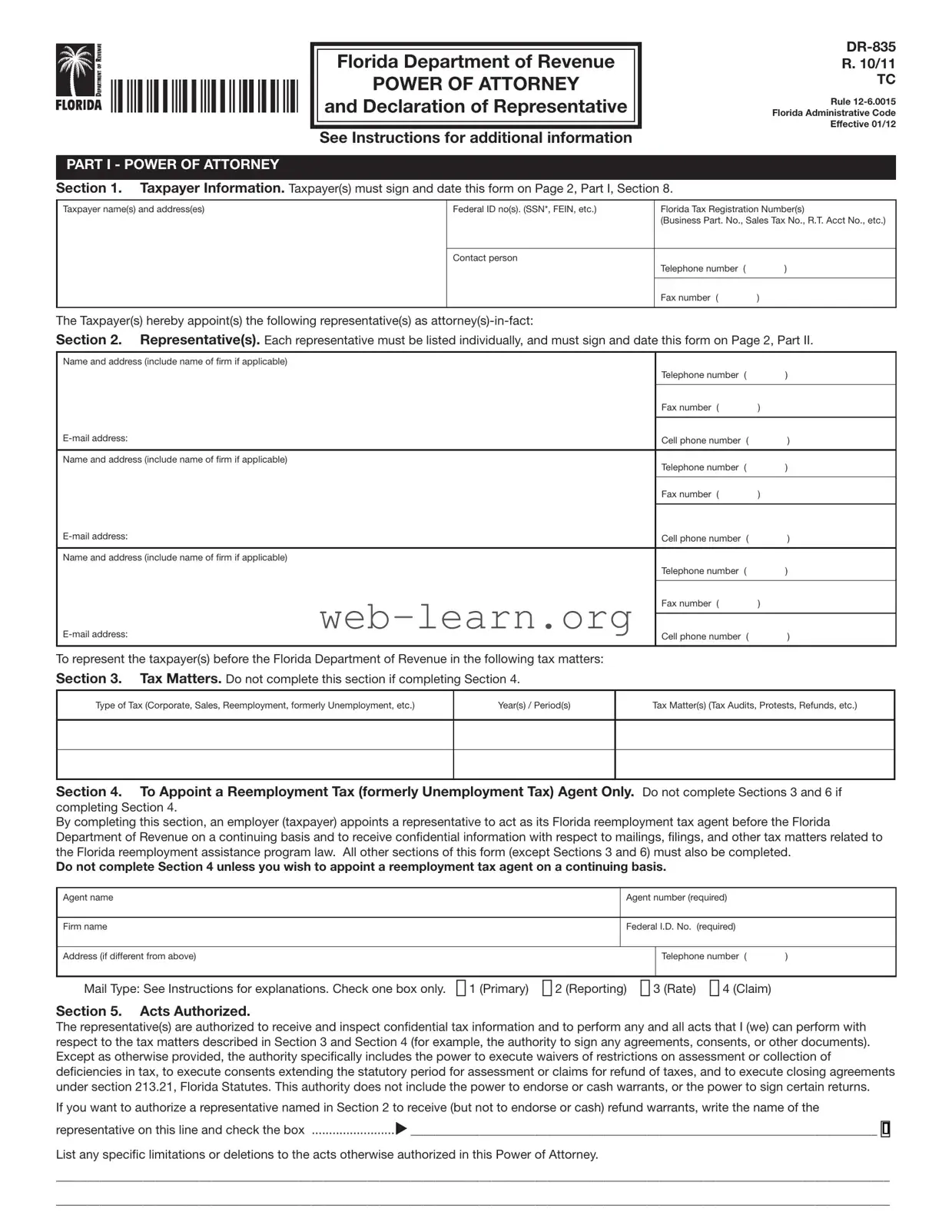
The Tax POA DR 835 form serves as an essential tool for individuals and businesses seeking to authorize a representative to act on their behalf in tax matters. This form enables taxpayers to grant permission for someone else, such as a tax professional or attorney, to communicate with the tax authorities regarding their tax liabilities, filings, and other related issues. By completing the Tax POA DR 835, taxpayers can ensure that their chosen representative has the authority to receive confidential information and make decisions concerning their tax affairs. This form is particularly useful during audits, disputes, or when navigating complex tax situations. Additionally, it streamlines communication between the taxpayer and tax agencies, allowing for a more efficient resolution of any outstanding issues. Understanding the nuances of the Tax POA DR 835 form can significantly ease the burden of tax compliance and representation.
I |
|
|
|
|
|
|
||
|
|
Florida Department of Revenue |
|
|
|
|||
1111111111111111111111111111111111 |
|
|
|
Florida |
R. 10/11 |
|||
|
I iiiiiiiiiiiiiiiiiiiiiiiiiiiiii~I |
|
|
Effective 01/12 |
||||
|
|
|
|
POWER OF ATTORNEY |
|
|
|
TC |
|
|
|
|
and Declaration of Representative |
|
|
|
Administrative Code |
|
|
|
|
L!;;;;;;;;;;;;;l |
|
|
|
Rule |
|
|
|
|
|
|
|
|
|
|
|
|
|
|
|
|
|
|
|
|
|
|
|
|
|
|
|
|
|
|
|
See Instructions for additional information |
|
|
|
|
PART I - POWER OF ATTORNEY
Section 1. Taxpayer Information. Taxpayer(s) must sign and date this form on Page 2, Part I, Section 8.
Taxpayer name(s) and address(es) |
Federal ID no(s). (SSN*, FEIN, etc.) |
Florida Tax Registration Number(s) |
|
|
|
(Business Part. No., Sales Tax No., R.T. Acct No., etc.) |
|
|
|
|
|
|
Contact person |
Telephone number ( |
) |
|
|
||
|
|
|
|
|
|
Fax number ( |
) |
|
|
|
|
The Taxpayer(s) hereby appoint(s) the following representative(s) as
Section 2. Representative(s). Each representative must be listed individually, and must sign and date this form on Page 2, Part II.
Name and address (include name of frm if applicable) |
|
|
|
|
Telephone number |
( |
) |
|
|
|
|
|
Fax number ( |
|
) |
|
|
|
|
Cell phone number |
( |
) |
|
|
|
|
|
Name and address (include name of frm if applicable) |
Telephone number |
( |
) |
|
|||
|
|
|
|
|
Fax number ( |
|
) |
|
|
|
|
Cell phone number |
( |
) |
|
|
|
|
|
Name and address (include name of frm if applicable) |
|
|
|
|
Telephone number |
( |
) |
|
|
|
|
|
Fax number ( |
|
) |
|
|
|
|
Cell phone number |
( |
) |
|
|
|
|
|
To represent the taxpayer(s) before the Florida Department of Revenue in the following tax matters:
Section 3. Tax Matters. Do not complete this section if completing Section 4.
Type of Tax (Corporate, Sales, Reemployment, formerly Unemployment, etc.)
Year(s) / Period(s)
Tax Matter(s) (Tax Audits, Protests, Refunds, etc.)
Section 4. To Appoint a Reemployment Tax (formerly Unemployment Tax) Agent Only. Do not complete Sections 3 and 6 if completing Section 4.
By completing this section, an employer (taxpayer) appoints a representative to act as its Florida reemployment tax agent before the Florida Department of Revenue on a continuing basis and to receive confdential information with respect to mailings, flings, and other tax matters related to the Florida reemployment assistance program law. All other sections of this form (except Sections 3 and 6) must also be completed.
Do not complete Section 4 unless you wish to appoint a reemployment tax agent on a continuing basis.
Agent name |
Agent number (required) |
|
|
|
|
|
|
Firm name |
Federal I.D. No. (required) |
|
|
|
|
|
|
Address (if different from above) |
|
Telephone number ( |
) |
|
|
|
|
Mail Type: See Instructions for explanations. Check one box only. ❑ 1 (Primary) ❑ 2 (Reporting) ❑ 3 (Rate) ❑ 4 (Claim)
Section 5. Acts Authorized.
The representative(s) are authorized to receive and inspect confdential tax information and to perform any and all acts that I (we) can perform with respect to the tax matters described in Section 3 and Section 4 (for example, the authority to sign any agreements, consents, or other documents). Except as otherwise provided, the authority specifcally includes the power to execute waivers of restrictions on assessment or collection of defciencies in tax, to execute consents extending the statutory period for assessment or claims for refund of taxes, and to execute closing agreements under section 213.21, Florida Statutes. This authority does not include the power to endorse or cash warrants, or the power to sign certain returns.
If you want to authorize a representative named in Section 2 to receive (but not to endorse or cash) refund warrants, write the name of the
representative on this line and check the box |
u___________________________________________________________________________ ❑ |
List any specifc limitations or deletions to the acts otherwise authorized in this Power of Attorney.
______________________________________________________________________________________________________________________________________
______________________________________________________________________________________________________________________________________

I |
|
|
|
|
111111111111111111111111111111111111111 |
R. 10/11 |
|
|
|||
|
Page 2 |
||
|
|
|
Florida Tax Registration Number: |
Taxpayer Name(s): |
Federal Identifcation Number: |
||
•Taxpayer(s) must complete Page 1 of this Power of Attorney or it will not be processed.
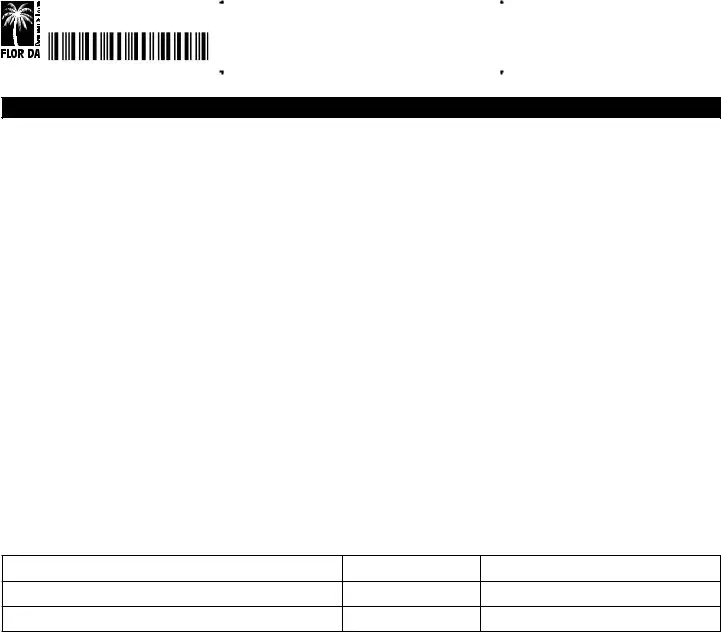
Section 6. Notices and Communication. Do not complete Section 6 if completing Section 4.
•Notices and other written communications will be sent to the first representative listed in Part I, Section 2, unless the taxpayer selects one of the options below. Receipt by either the representative or the taxpayer will be considered receipt by both.
a. |
If you want notices and communications sent to both you and your representative, check this box |
u |
❑ |
b. |
If you want notices or communications sent to you and not your representative, check this box |
u |
❑ |
Certain
Section 7. Retention / Nonrevocation of Prior Power(s) of Attorney.
The fling of this Power of Attorney will not revoke earlier Power(s) of Attorney on fle with the Florida Department of Revenue, even for the same tax matters and years or periods covered by this document. If you want to revoke a prior Power of
Attorney, check this box |
u ❑ |
You must attach a copy of any Power of Attorney you wish to revoke.
Section 8. Signature of Taxpayer(s).
If a tax matter concerns a joint return, both husband and wife must sign if joint representation is requested. If signed by a corporate offcer, partner, member/managing member, guardian, tax matters partner/person, executor, receiver, administrator, trustee, or fduciary on behalf of the taxpayer, I declare under penalties of perjury that I have the authority to execute this form on behalf of the taxpayer.
Under penalties of perjury, I (we) declare that I (we) have read the foregoing document, and the facts stated in it are true.
If this Power of Attorney is not signed and dated, it will be returned.
_______________________________________________________________________________________ |
________________________________________ |
_________________________________________ |
Signature |
Date |
Title (if applicable) |
_______________________________________________________________________________________ |
|
|
Print name |
|
|
_______________________________________________________________________________________ |
________________________________________ |
_________________________________________ |
Signature |
Date |
Title (if applicable) |
_______________________________________________________________________________________ |
|
|
Print name |
|
|
PART II - DECLARATION OF REPRESENTATIVE
Under penalties of perjury, I declare that:
•I am familiar with the mandatory standards of conduct governing representation before the Department of Revenue, including Rules
•I am familiar with the law and facts related to this matter and am qualified to represent the taxpayer(s) in this matter.
•I am authorized to represent the taxpayer(s) identified in Part I for the tax matter(s) specified therein, and to receive and inspect confidential taxpayer information.
•I am one of the following:
a.Attorney - a member in good standing of the bar of the highest court of the jurisdiction shown below.
b.Certifed Public Accountant - duly qualifed to practice as a certifed public accountant in the jurisdiction shown below.
c.Enrolled Agent – enrolled as an agent pursuant to the requirements of Treasury Department Circular Number 230.
d.Former Department of Revenue Employee. As a representative, I cannot accept representation in a matter upon which I had direct involvement while I was a public employee.
e.Reemployment Tax Agent authorized in Section 4 of this form.
f.Other Qualifed Representative
•I have read the foregoing Declaration of Representative and the facts stated in it are true.
If this Declaration of Representative is not signed and dated, it will not be processed.
Designation – Insert |
Jurisdiction (State) and |
Signature |
Letter from Above (a |
Enrollment Card No. (if any) |
|
|
|
|
Date
Made fillable by FormsPal.
POWER OF ATTORNEY INSTRUCTIONS
R.10/11 Page 3
Purpose of this form
A Power of Attorney (Form
to an attorney, certifed public accountant, enrolled agent, former Department employee, reemployment tax agent, or any other qualifed individual. A Power of Attorney is a legal document authorizing someone other than yourself to act as your representative.
You may use this form for any matters affecting any tax administered by the Department of Revenue. This includes both the audit and collection processes. A Power of Attorney will remain in effect until you revoke it. If you provide more than one Power of Attorney with respect to a tax and tax period, the Department employee handling your case will address notices and correspondence relative to that issue to the frst person listed on the latest Power of Attorney.
A Power of Attorney Form is generally not required, if the representative is, or is accompanied by: a trustee, a receiver, an administrator, an executor of an estate, a corporate offcer, or an authorized employee of the taxpayer.
Photocopies and fax copies of Form
How to Complete Form
PART I POWER OF ATTORNEY
Section 1 – Taxpayer Information
•For individuals and sole proprietorships: Enter your name, address, social security number, and telephone number(s) in the spaces provided. Enter your federal employer identifcation number (FEIN), if you have one. If a joint return is involved, and you and your spouse are designating the same
•For a corporation, limited liability company, or partnership: Enter the name, business address, FEIN, a contact person familiar with this matter, and telephone number(s).
•For a trust: Enter the name, title, address, and telephone number(s) of the fduciary, and name and FEIN of the trust.
•For an estate: Enter the name, title, address, and telephone number(s) of the decedent’s personal representative, and the name and identifcation number of the estate. The identifcation number for an estate includes both the FEIN if the estate has one and the decedent’s social security number.
•For any other entity: Enter the name, business address, FEIN, and telephone number(s), as well as the name of a contact person familiar with this matter.
•Identifcation Number: The Department may have assigned you a Florida tax registration number such as a sales tax number, a reemployment tax account number, or a business partner number. These numbers further assist the Department in identifying your particular tax matter, and you should enter them in the appropriate box. If you do not provide this information, the Department may not be able to process the Power of Attorney.
Section 2 – Representative(s)
Enter the individual name, frm name (if applicable), address, telephone number(s), and fax number of each individual appointed as
Section 3 – Tax Matters
Enter the type(s) of tax this Power of Attorney authorization applies to and the years or periods for which the Power of Attorney is granted. The word “All” is not specifc enough. If your tax situation does not ft into a tax type or period (for example, a specifc administrative appeal, audit, or collection matter), describe it in the blank space provided for “Tax Matters.” The Power of Attorney can be limited to specifc reporting period(s) that can be stated in year(s), quarter(s), month(s), etc., or can be granted for an indefnite period. You must indicate the tax types, periods, and/or matters for which you are authorizing representation by your
Examples: |
|
|
Sales and Use Tax |
First and second quarter 2008 |
|
Corporate Income Tax |
|
7/1/07 – 6/30/08 |
Communications Services Tax |
|
2006 thru 2008 |
Insurance Premium Tax |
|
1/1/06 – 12/31/08 |
Technical Assistance Advisement Request |
dated 8/6/08 |
|
Claim for Refund |
|
3/7/07 |
Section 4 – To Appoint a Reemployment Tax Agent Complete this section only if you wish to appoint an agent for reemployment taxes on a continuing basis. You should not complete Section 3 or Section 6, but you must complete the remaining sections of Form
Enter the agent’s name. It must be the same name as found in Section 2. Enter the frm name and address. You do not need to complete the address line if you reported that information in Section 2.
1.Enter the agent number. The agent number is a
2.Enter the federal employer identifcation number. The FEIN is a
3.Select the mail type.
Primary Mail. If you select primary mail, the agent will receive all documents from the Department of Revenue related to this reemployment tax account, and will be authorized to receive confdential information and discuss matters related to the tax and wage report, beneft information, claims, and the employer’s rate.
Reporting Mail. If you select reporting mail, the agent will receive the Employer’s Quarterly Report (Form
Rate Mail. If you select rate mail, the agent will receive tax rate notices and correspondence related to the rate and will be authorized to receive confdential information and discuss the employer’s rate notices and rate with the Department.
Claims Mail. If you select claims mail, the agent will receive the notice of benefts paid, and will be authorized to receive confdential information and discuss matters related to benefts.
Note: Duplicate copies of certain
Note: If you wish to appoint a representative to act on your behalf in a specifc and
Section 5 – Acts Authorized
Your signature on the back of the Power of Attorney authorizes the individual(s) you designate (your representative or
Section 6 – Mailing of Notices and Communications
If you do not check a box, the Department will send notices and other written communications to the frst representative listed in Section 2, unless you select another option. If you wish to have no documents sent to your representative, or documents sent to both you and your representative, you should check the appropriate box in Section 6. Check the second box if you wish to have notices and other written communications sent to you and not to your representative. In certain instances, the Department can only send documents to the taxpayer. Therefore, the taxpayer has the responsibility of keeping the representative informed of tax matters.
Note: Taxpayers completing Section 4 (To Appoint a Reemployment Tax Agent Only) should not complete Section 6. See Section 4 of these instructions for information regarding notices and communications sent to a reemployment tax agent.
Section 7 – Retention/Nonrevocation of Prior Power(s) of Attorney The most recent Power of Attorney will take precedence over, but will not revoke, prior Powers of Attorney. If you wish to revoke a prior Power of Attorney, you must check the box on the form and attach a copy of the old Power of Attorney.
Section 8 – Signature of Taxpayer(s)
The Power of Attorney is not valid until signed and dated by the taxpayer. The individual signing the Power of Attorney is representing, under penalties of perjury, that he or she is the taxpayer or authorized to execute the Power of Attorney on behalf of the taxpayer.
•For a corporation, trust, estate, or any other entity: A corporate offcer or person having authority to bind the entity must sign.
•For partnerships: All partners must sign unless one partner is authorized to act in the name of the partnership.
•For a sole proprietorship: The owner of the sole proprietorship must sign.
•For a joint return: Both husband and wife must sign if the representative represents both. If the representative only represents one spouse, then only that spouse should sign.
PART II – DECLARATION OF REPRESENTATIVE
Any party who appears before the Department of Revenue has the right, at his or her own expense, to be represented by counsel or by a qualifed representative. The representative(s) you name must declare, under penalties of perjury, that he or she is qualifed to represent you in this matter and will comply with the mandatory standards of conduct
R. 10/11
Page 4
governing representation before the Department of Revenue. The representative(s) must also declare, under penalties of perjury, that he or she has been authorized to represent the taxpayer(s) in this matter and authorized by the taxpayer(s) to receive confdential taxpayer information.
The representative(s) you name must sign and date this declaration and enter the designation (i.e., items
a.Attorney – Enter the
b.Certifed Public Accountant – Enter the
c.Enrolled Agent – Enter the enrollment card number issued by the Internal Revenue Service.
d.Former Department of Revenue Employee – Former employees may not accept representation in matters in which they were directly involved, and in certain cases, on any matter for a period of two years following termination of employment. If a former Department of Revenue employee is also an attorney or CPA, then the additional designation, jurisdiction, and enrollment card should also be entered.
e.Reemployment Tax Agent – A person(s) appointed under Section 4 of the Power of Attorney to handle reemployment tax matters on a continuing basis. A separate Power of Attorney form must be completed in order for a reemployment tax agent to handle a specifc and
f.Other Qualifed Representative – An individual may represent a taxpayer before the Department of Revenue if training and experience qualifes that person to handle a specifc matter.
Rule
(a)Engage in conduct involving dishonesty, fraud, deceit, or misrepresentation.
(b)Engage in conduct that is prejudicial to the administration of justice.
(c)Handle a matter that the representative knows or should know that he or she is not competent to handle.
(d)Handle a legal or factual matter without adequate preparation.
*Social security numbers (SSNs) are used by the Florida Department of Revenue as unique identifers for the administration of Florida’s taxes. SSNs obtained for tax administration purposes are confidential under sections 213.053 and 119.071, Florida Statutes, and not subject to disclosure as public records. Collection of your SSN is authorized under state and federal law. Visit our Internet site at www.foridarevenue.com and select “Privacy Notice” for more information regarding the state and federal law governing the collection, use, or release of SSNs, including authorized exceptions.
Where to Mail Form
If Form
If Form
| Fact Name | Description |
|---|---|
| Purpose | The Tax POA DR 835 form is used to authorize an individual to represent a taxpayer before the IRS or state tax authorities. |
| Eligibility | Any individual or business entity can use this form to designate a representative for tax matters. |
| Governing Law | The form is governed by the Internal Revenue Code and applicable state tax laws, which may vary by state. |
| Filing Method | The form can be filed electronically or submitted via mail, depending on the requirements of the tax authority. |
| Duration of Authority | Once filed, the authority granted remains in effect until revoked by the taxpayer or until the matter is resolved. |
| Revocation | A taxpayer can revoke the authority at any time by submitting a written notice to the tax authority. |
Filling out the Tax POA DR 835 form is a straightforward process that allows you to designate someone to represent you regarding your tax matters. Once you have completed the form, it will need to be submitted to the appropriate tax authority to ensure your representative can act on your behalf.
The Tax POA DR 835 form is a Power of Attorney document that allows an individual to authorize another person to represent them in tax matters before the Colorado Department of Revenue. This form is essential for taxpayers who want someone else to handle their tax affairs, ensuring that the appointed representative can communicate with the tax authority on their behalf.
Taxpayers can designate various individuals as their representatives, including attorneys, accountants, or any person they trust. It's crucial to choose someone knowledgeable about tax matters and who can effectively advocate for your interests.
To complete the form, start by providing your personal information, including your name, address, and taxpayer identification number. Next, fill in the details of the representative you are appointing, including their name and contact information. Finally, sign and date the form to validate it.
Once completed, the Tax POA DR 835 form should be submitted to the Colorado Department of Revenue. You can send it via mail or, in some cases, submit it electronically, depending on the department's guidelines.
Generally, there is no fee for submitting the Tax POA DR 835 form. However, it's always a good idea to check the latest guidelines from the Colorado Department of Revenue to confirm that there are no changes or additional requirements.
The Tax POA DR 835 form remains valid until you revoke it or until the representative withdraws from their role. It’s important to monitor the status of your Power of Attorney and make updates as necessary, especially if your financial situation or representation needs change.
Yes, you can revoke the Tax POA DR 835 form at any time. To do this, you must submit a written notice to the Colorado Department of Revenue stating your intent to revoke the Power of Attorney. Ensure that you also inform your representative of the revocation.
If you need help completing the form, consider reaching out to a tax professional or an attorney who specializes in tax law. They can provide guidance and ensure that the form is filled out correctly to avoid any potential issues.
The Tax POA DR 835 form is especially beneficial in situations where a taxpayer is unable to manage their tax affairs due to health issues, travel, or lack of understanding of tax regulations. It allows a trusted representative to handle important matters, such as responding to audits or negotiating payment plans, providing peace of mind for the taxpayer.
Filling out the Tax Power of Attorney (POA) Form DR 835 can be a straightforward process, but mistakes can lead to delays or complications. One common error is failing to provide all required information. Individuals often overlook sections that ask for specific details about the taxpayer or the representative. Missing information can result in the form being returned or rejected, causing unnecessary delays in processing.
Another frequent mistake involves the selection of the appropriate representative. Taxpayers sometimes choose individuals who are not authorized to represent them before the IRS or state tax authority. It is crucial to ensure that the selected representative holds the necessary credentials, such as being a licensed attorney, certified public accountant, or enrolled agent. Selecting an unqualified representative can lead to complications in tax matters.
Inaccurate signatures also pose a significant issue. The form requires signatures from both the taxpayer and the representative. If the taxpayer's signature does not match the name as it appears on the tax return, this inconsistency can cause problems. Additionally, if the representative signs on behalf of the taxpayer without proper authorization, the form may be deemed invalid.
Finally, individuals often neglect to keep a copy of the completed form for their records. Retaining a copy is essential for future reference and for confirming that the form was submitted. Without this documentation, taxpayers may find it difficult to resolve any disputes or issues that arise later. By avoiding these common mistakes, individuals can ensure a smoother process when submitting the Tax POA DR 835 form.
The Tax Power of Attorney (POA) DR 835 form is a crucial document that allows an individual to authorize another person to represent them in tax matters. When dealing with tax issues, several other forms and documents may be necessary to ensure a smooth process. Below is a list of commonly used forms that often accompany the Tax POA DR 835 form.
Understanding these forms can greatly assist in navigating tax-related issues. Each document serves a specific purpose and can facilitate communication and representation in various tax matters. Being prepared with the right forms can help ensure compliance and streamline the process of managing tax obligations.
The Tax Power of Attorney (POA) DR 835 form allows individuals to authorize someone to act on their behalf regarding tax matters. Several other documents serve similar purposes, enabling representation or authorization in various contexts. Below is a list of nine documents that are similar to the Tax POA DR 835 form:
When filling out the Tax POA DR 835 form, there are important guidelines to follow. Here are four things you should and shouldn't do:
Understanding the Tax Power of Attorney (POA) Form DR 835 is crucial for anyone dealing with tax matters. However, several misconceptions can lead to confusion. Here are eight common misconceptions explained:
This form is specifically designed for tax-related matters in certain jurisdictions. Not all states or situations allow for its use, so it's important to verify eligibility before proceeding.
This form can be used by both individuals and entities, such as corporations or partnerships, to designate a representative for tax matters.
While this form allows a representative to act on your behalf, it does not guarantee a favorable outcome. The resolution still depends on the specifics of your case.
This is not true. You can revoke the authority granted by the form at any time by submitting a written notice to the tax authority.
Even for simple tax matters, having a representative can provide peace of mind and ensure that everything is handled correctly.
The authority granted can vary. It's essential to specify what powers the representative will have on the form.
This is a misconception. You can authorize someone else to submit the form on your behalf, as long as you have filled it out correctly.
These forms serve different purposes. A general power of attorney covers a wide range of legal matters, while the Tax POA DR 835 is specifically for tax-related issues.
Being aware of these misconceptions can help you navigate your tax responsibilities more effectively. If you have further questions, consider seeking professional advice tailored to your specific situation.
When considering the Tax POA DR 835 form, it is important to understand its purpose and how to effectively complete and utilize it. Here are key takeaways to guide you through the process:
Understanding these key points will help you navigate the process of filling out and using the Tax POA DR 835 form with confidence.