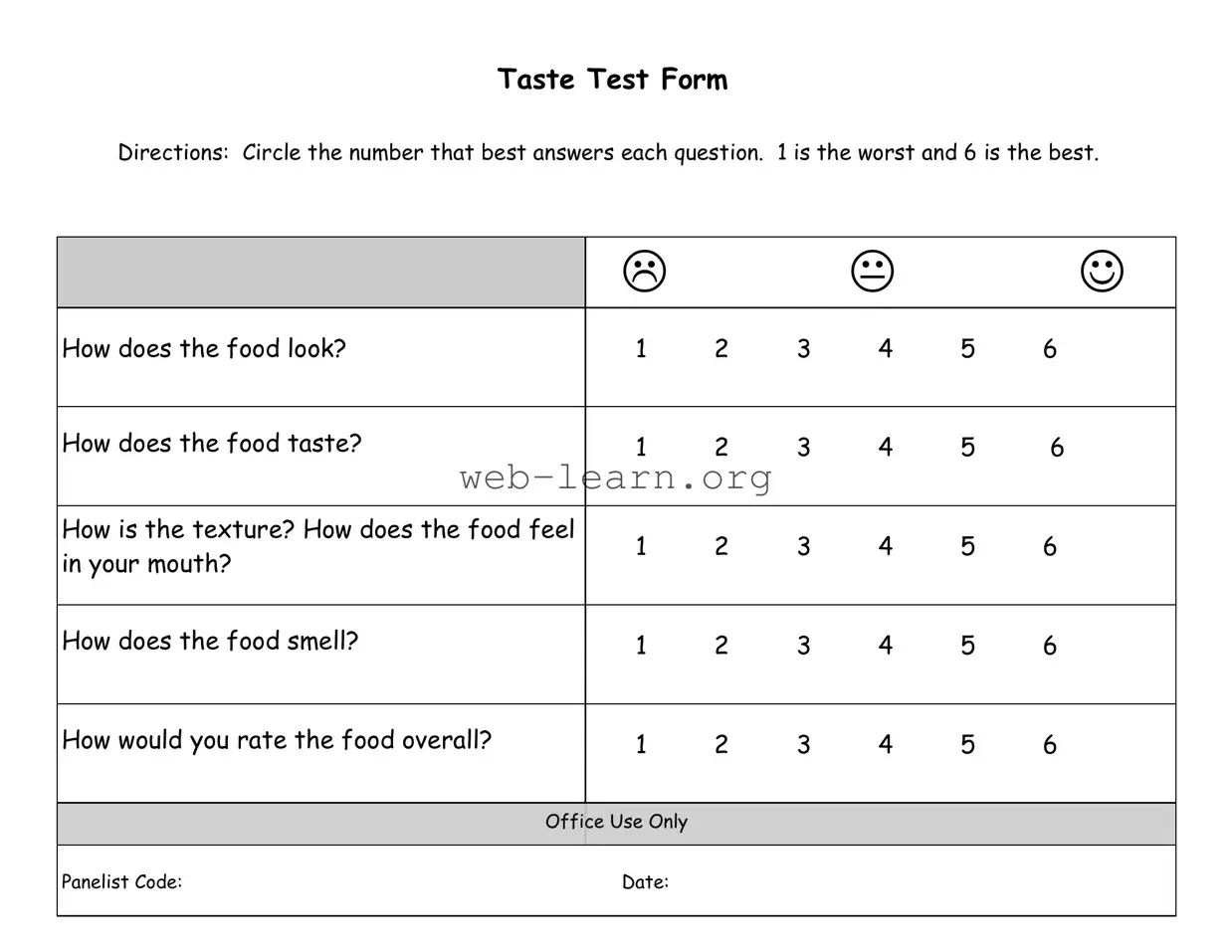
The Taste Test form serves as a valuable tool for gathering feedback on food products. It is designed to assess various sensory attributes, including appearance, taste, texture, and aroma. Each aspect is rated on a scale from 1 to 6, where 1 indicates the lowest satisfaction and 6 represents the highest. This simple yet effective rating system allows panelists to express their opinions clearly. Additionally, the form includes a section for an overall rating, encouraging participants to consider their complete experience with the food item. To ensure organized data collection, there is a designated area for office use, which includes a panelist code and the date of the evaluation. This structure not only facilitates ease of use for the testers but also enhances the reliability of the feedback collected.
TASTE TEST FORM
Directions: Circle the number that best answers each question. 1 is the worst and 6 is the best.
|
|
|
|
|
|
|
|
How does the food look? |
|
1 |
2 |
3 |
4 |
5 |
6 |
|
|
|
|
|
|
|
|
How does the food taste? |
|
1 |
2 |
3 |
4 |
5 |
6 |
|
|
|
|
|
|
|
|
How is the texture? How does the food feel |
1 |
2 |
3 |
4 |
5 |
6 |
|
in your mouth? |
|
||||||
|
|
|
|
|
|
|
|
|
|
|
|
|
|
|
|
How does the food smell? |
|
1 |
2 |
3 |
4 |
5 |
6 |
|
|
|
|
|
|
|
|
How would you rate the food overall? |
|
1 |
2 |
3 |
4 |
5 |
6 |
|
|
|
|
|
|
|
|
|
Office Use Only |
|
|
|
|
|
|
|
|
|
|
|
|
|
|
Panelist Code: |
|
Date: |
|
|
|
|
|
|
|
|
|
|
|
|
|
| Fact Name | Description |
|---|---|
| Purpose | The Taste Test form is designed to gather feedback on food items based on various sensory evaluations. |
| Rating Scale | Participants use a scale from 1 to 6, where 1 indicates the worst experience and 6 indicates the best. |
| Visual Assessment | One of the key questions focuses on how the food looks, allowing for an initial impression. |
| Taste Evaluation | Participants are asked to rate the taste of the food, providing insights into flavor profiles. |
| Texture Feedback | The form includes a question about texture, addressing how the food feels in the mouth. |
| Smell Assessment | Evaluating the aroma of the food is also crucial, as smell significantly influences taste. |
| Overall Rating | Participants provide an overall rating, summarizing their complete experience with the food item. |
| Panelist Code | A unique code for each panelist is included for tracking and analysis purposes. |
| Date of Test | The date on which the taste test is conducted is recorded for reference and organization. |
After completing the Taste Test form, it will be submitted for evaluation. This feedback will help improve the food product being tested. Follow these steps to ensure the form is filled out correctly.
What is the purpose of the Taste Test form?
The Taste Test form is designed to gather feedback on food products. It allows participants to evaluate various aspects of the food, including appearance, taste, texture, smell, and overall quality. By rating these factors on a scale from 1 to 6, the form helps food developers understand consumer preferences and make improvements as needed.
How should I fill out the Taste Test form?
To complete the form, simply circle the number that best represents your opinion for each question. The scale ranges from 1, which indicates the worst experience, to 6, representing the best. Take your time to consider each aspect of the food, and be honest in your evaluations. Your feedback is crucial for enhancing the product.
What do the different rating numbers mean?
The numbers on the Taste Test form correspond to specific ratings:
Each number reflects your experience with the food in that category. Use this scale to provide clear and meaningful feedback.
Is my feedback anonymous?
Yes, your feedback is collected anonymously. The form includes a panelist code for internal tracking purposes only. This ensures that your individual responses remain confidential while still allowing the team to analyze overall trends in the feedback.
Filling out the Taste Test form can seem straightforward, but there are common mistakes that can lead to inaccurate results. Understanding these pitfalls can help ensure that your feedback is both valuable and meaningful. Here are ten mistakes to avoid when completing the form.
One frequent error is not paying attention to the instructions. The form clearly states to circle a number for each question, yet some individuals might write in their answers instead. This can create confusion for those analyzing the data, as they may not be able to interpret written responses easily.
Another common mistake is failing to consider each aspect of the food separately. Some people might rush through the form, providing a single score for multiple questions. For example, rating the food's appearance and taste with the same number can obscure important details about the experience.
Additionally, individuals sometimes overlook the scale's range. The form uses a scale from 1 to 6, with 1 being the worst and 6 being the best. However, some may inadvertently give all scores a 3, which does not provide useful feedback. It's essential to reflect on the nuances of each characteristic.
Another issue arises when participants do not take their time to evaluate the food properly. Rushing through the form can lead to hasty judgments. Instead, savor the food and allow yourself to experience its qualities fully before assigning a score.
Moreover, some participants might forget to provide their panelist code or date. This information is crucial for tracking responses and ensuring that feedback can be accurately attributed. Omitting this information can hinder the analysis process.
Emotional bias can also play a role in how individuals score the food. If someone has a strong personal preference for or against a certain ingredient, it may cloud their judgment. Strive to approach each tasting with an open mind, focusing on the food itself rather than personal feelings.
Inconsistent scoring is another mistake that can affect the reliability of the feedback. For instance, if a participant rates the taste as a 4 but the overall rating as a 2, it raises questions about the rationale behind these scores. Each rating should be consistent with the others to provide a clearer picture.
Some individuals may also neglect to consider the context in which they are tasting the food. Factors such as temperature, presentation, and even the environment can significantly impact the tasting experience. Take these elements into account when filling out the form.
Lastly, failing to ask for clarification on any confusing aspects of the form can lead to errors. If something is unclear, seeking assistance can help ensure that the feedback is accurate and constructive. Don’t hesitate to reach out for help if needed.
By being mindful of these common mistakes, participants can contribute valuable insights through the Taste Test form. Thoughtful and accurate feedback benefits not only the food producers but also enhances the overall tasting experience for everyone involved.
The Taste Test form is a valuable tool for gathering feedback on food products. However, it is often accompanied by several other forms and documents that help streamline the testing process and ensure comprehensive data collection. Below is a list of related documents frequently used alongside the Taste Test form.
Using these documents in conjunction with the Taste Test form enhances the overall testing process. Together, they create a comprehensive framework that ensures reliable feedback and valuable insights into food products.
The Taste Test form is designed to gather subjective feedback on food items. Several other documents serve similar purposes in evaluating products or experiences. Here are eight documents that share similarities with the Taste Test form:
When filling out the Taste Test form, it’s important to keep a few things in mind. Here’s a list of what you should and shouldn’t do:
Misconceptions about the Taste Test form can lead to confusion and misinterpretation of results. Here are eight common misunderstandings:
This is incorrect. Anyone can fill out the Taste Test form, regardless of their experience with food tasting.
A score of 1 indicates the lowest level of satisfaction, but it does not necessarily mean the food cannot be consumed.
In fact, the form assesses multiple aspects of food, including appearance, texture, smell, and overall rating.
While higher scores generally indicate better quality, the context of the tasting and individual preferences can influence results.
While it is encouraged to answer all questions, participants can skip any that they feel uncomfortable with.
This form can be beneficial for various food producers, including home cooks, food manufacturers, and catering services.
Qualitative feedback, such as comments about specific flavors or textures, is equally valuable for understanding preferences.
Repeated use of the form can provide insights into trends and changes in food quality over time.
When using the Taste Test form, keep these key points in mind: