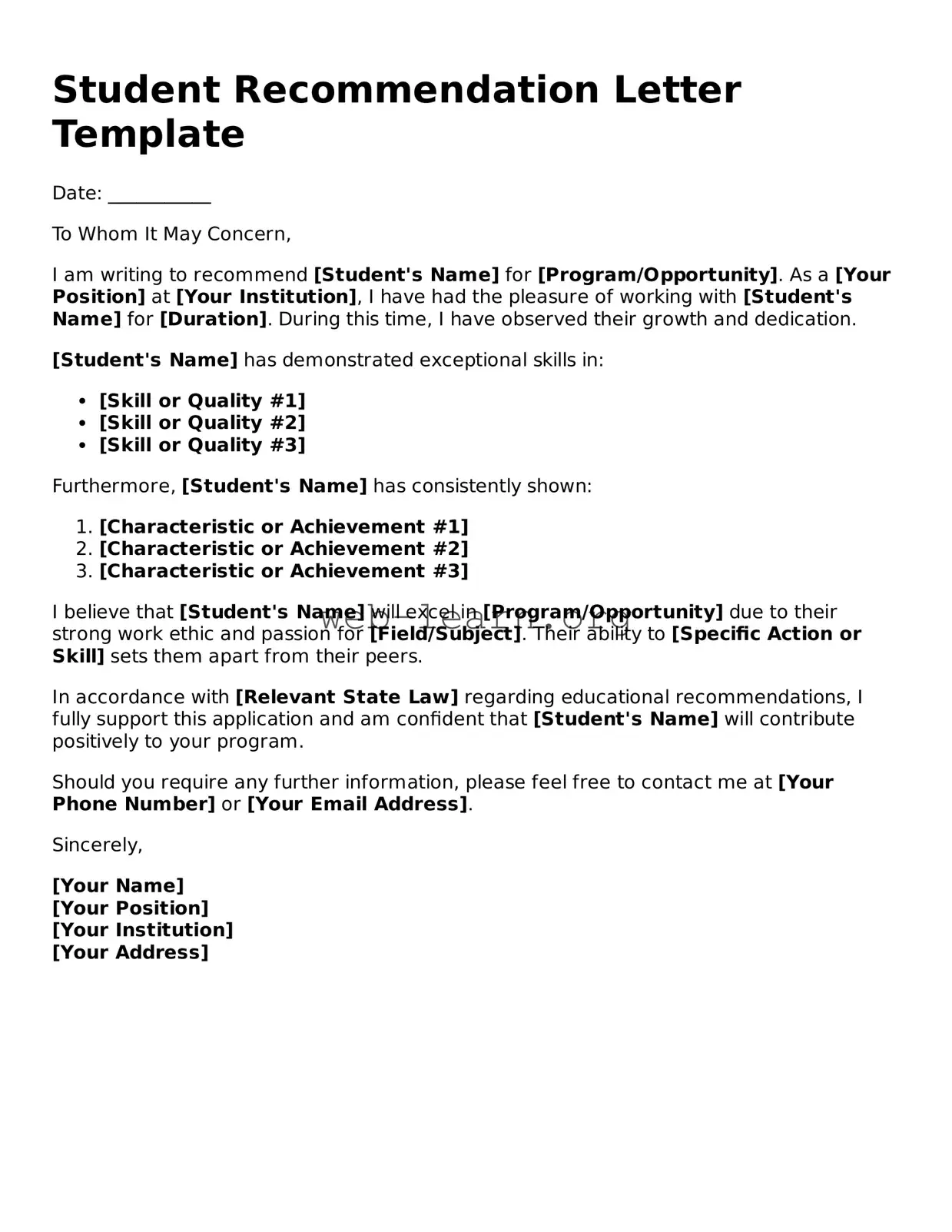
The Student Recommendation Letter form serves as a critical tool in the academic and professional advancement of students. This document typically includes essential information such as the student's name, the relationship between the recommender and the student, and specific details about the student's achievements and character traits. It often requires the recommender to provide insights into the student's skills, work ethic, and potential for success in future endeavors. Additionally, the form may ask for examples that illustrate the student's capabilities and contributions, making it a personalized endorsement. The structure of the form is designed to guide the recommender in crafting a comprehensive and compelling letter that highlights the student's qualifications. Ultimately, the Student Recommendation Letter form plays a significant role in helping students secure opportunities for higher education, scholarships, or employment by providing a formal and structured way for mentors and educators to support their aspirations.
Student Recommendation Letter Template
Date: ___________
To Whom It May Concern,
I am writing to recommend [Student's Name] for [Program/Opportunity]. As a [Your Position] at [Your Institution], I have had the pleasure of working with [Student's Name] for [Duration]. During this time, I have observed their growth and dedication.
[Student's Name] has demonstrated exceptional skills in:
Furthermore, [Student's Name] has consistently shown:
I believe that [Student's Name] will excel in [Program/Opportunity] due to their strong work ethic and passion for [Field/Subject]. Their ability to [Specific Action or Skill] sets them apart from their peers.
In accordance with [Relevant State Law] regarding educational recommendations, I fully support this application and am confident that [Student's Name] will contribute positively to your program.
Should you require any further information, please feel free to contact me at [Your Phone Number] or [Your Email Address].
Sincerely,
[Your Name]
[Your Position]
[Your Institution]
[Your Address]
| Fact Name | Details |
|---|---|
| Purpose | A Student Recommendation Letter form is used to provide a written endorsement of a student's abilities and character. |
| Format | The letter typically follows a standard format, including an introduction, body, and conclusion. |
| Who Can Write | Teachers, counselors, or employers can write a recommendation letter for a student. |
| Content | The letter should highlight the student's strengths, achievements, and potential. |
| Length | Most recommendation letters are one to two pages long. |
| Submission | Students typically submit these letters as part of college applications or scholarship requests. |
| Confidentiality | Some recommendation letters may be confidential, meaning the student cannot see them. |
| State-Specific Forms | Some states may have specific guidelines regarding recommendation letters. Check local education laws. |
| Importance | A strong recommendation letter can significantly impact a student's application and opportunities. |
Completing the Student Recommendation Letter form is a straightforward process that requires careful attention to detail. Follow the steps below to ensure that the form is filled out correctly and thoroughly.
What is a Student Recommendation Letter?
A Student Recommendation Letter is a document that provides an assessment of a student's skills, character, and achievements. It is often requested by colleges, universities, or scholarship programs to help evaluate a student's application. The letter is typically written by a teacher, counselor, or another individual who knows the student well.
Who can write a Student Recommendation Letter?
Generally, a Student Recommendation Letter can be written by anyone who has a significant understanding of the student's abilities and experiences. Common recommenders include:
It is important that the recommender can provide specific examples of the student's strengths and contributions.
What information should be included in the letter?
A comprehensive Student Recommendation Letter should include:
Including these details can help create a well-rounded picture of the student.
How long should the letter be?
Typically, a Student Recommendation Letter should be one page long. This length allows for enough detail to provide a thorough recommendation without overwhelming the reader. It is essential to be concise while still offering meaningful insights.
When is the letter due?
Deadlines for Student Recommendation Letters can vary depending on the institution or program. It is crucial for students to communicate these deadlines clearly to their recommenders. Providing at least two to four weeks' notice is recommended to give the writer ample time to compose a thoughtful letter.
Can I see the letter before it is submitted?
Whether a student can see the letter before submission depends on the recommender's policy. Some recommenders may allow students to review the letter, while others prefer to keep it confidential. It is best to discuss this with the recommender in advance.
How should the letter be submitted?
Submission methods for Student Recommendation Letters can vary. Some institutions may require letters to be submitted online through an application portal, while others may accept mailed or emailed letters. Students should verify the submission guidelines provided by the institution to ensure proper delivery.
What if my recommender cannot write the letter?
If a recommender is unable to write the letter, it is important to seek an alternative as soon as possible. Students should approach another individual who is familiar with their work and character. Offering to provide information about achievements and experiences can help the new recommender write a strong letter.
Filling out a Student Recommendation Letter form can be a critical task that significantly influences a student's academic and professional future. However, many individuals make common mistakes that can undermine the effectiveness of their recommendations. Understanding these pitfalls can help ensure that the letter serves its intended purpose.
One frequent mistake is failing to provide specific examples of the student’s accomplishments and character. General statements may sound flattering, but they often lack the depth needed to convey the student's unique qualities. Instead of simply stating that a student is hardworking, a recommender should illustrate this with a specific instance where the student demonstrated exceptional effort.
Another error involves neglecting to tailor the letter to the specific program or opportunity for which the student is applying. A generic recommendation may not resonate with the admissions committee. Each program has its own values and expectations, and addressing these can make a significant difference in how the letter is received.
Additionally, some recommenders overlook the importance of adhering to the guidelines provided by the institution or organization requesting the letter. Many forms specify word limits, submission methods, or particular points to cover. Ignoring these instructions can lead to a recommendation that is dismissed or not considered at all.
Another common oversight is focusing too much on the student’s academic achievements while neglecting personal attributes. While grades and test scores are important, qualities such as leadership, teamwork, and resilience can set a candidate apart. A well-rounded letter should balance both academic and personal strengths.
Some recommenders may also underestimate the importance of proofreading. Spelling and grammatical errors can detract from the professionalism of the letter. A polished document reflects not only on the student but also on the recommender’s attention to detail and commitment to the student’s success.
Moreover, it is crucial to avoid using overly formal or complex language that may obscure the message. The goal is to communicate effectively, and clarity should always take precedence over sophistication. A recommendation that is easy to read and understand will have a more significant impact.
Another mistake is not mentioning how long the recommender has known the student and in what capacity. This context helps the reader gauge the depth of the recommender’s insights into the student’s abilities and character. A letter that lacks this information can come across as less credible.
Lastly, some individuals fail to submit the letter on time. Deadlines are often strict, and late submissions can jeopardize a student's application. It is essential to plan ahead and ensure that the letter is completed and submitted according to the specified timeline.
When applying for schools, scholarships, or programs, a Student Recommendation Letter is often required. This letter provides insight into a student's abilities and character from someone who knows them well. Along with this letter, several other documents may be needed to complete the application process. Here are five common forms and documents that are often used alongside the Student Recommendation Letter.
Each of these documents plays a crucial role in presenting a comprehensive picture of the student. Together, they help admissions committees make informed decisions. Ensure that all documents are prepared carefully and submitted on time to strengthen the application.
The Student Recommendation Letter form shares similarities with several other documents. Here’s a list of six related forms and how they are alike:
When filling out a Student Recommendation Letter form, it’s important to approach the task thoughtfully. Here are some essential dos and don’ts to keep in mind:
When it comes to student recommendation letters, misconceptions can lead to confusion and missed opportunities. Here are seven common misunderstandings about the Student Recommendation Letter form, along with clarifications to set the record straight.
Understanding these misconceptions can empower students to approach the recommendation process more effectively, ensuring they present themselves in the best light possible.
Filling out and utilizing the Student Recommendation Letter form can be a crucial step in the academic journey of a student. Here are some key takeaways to consider: