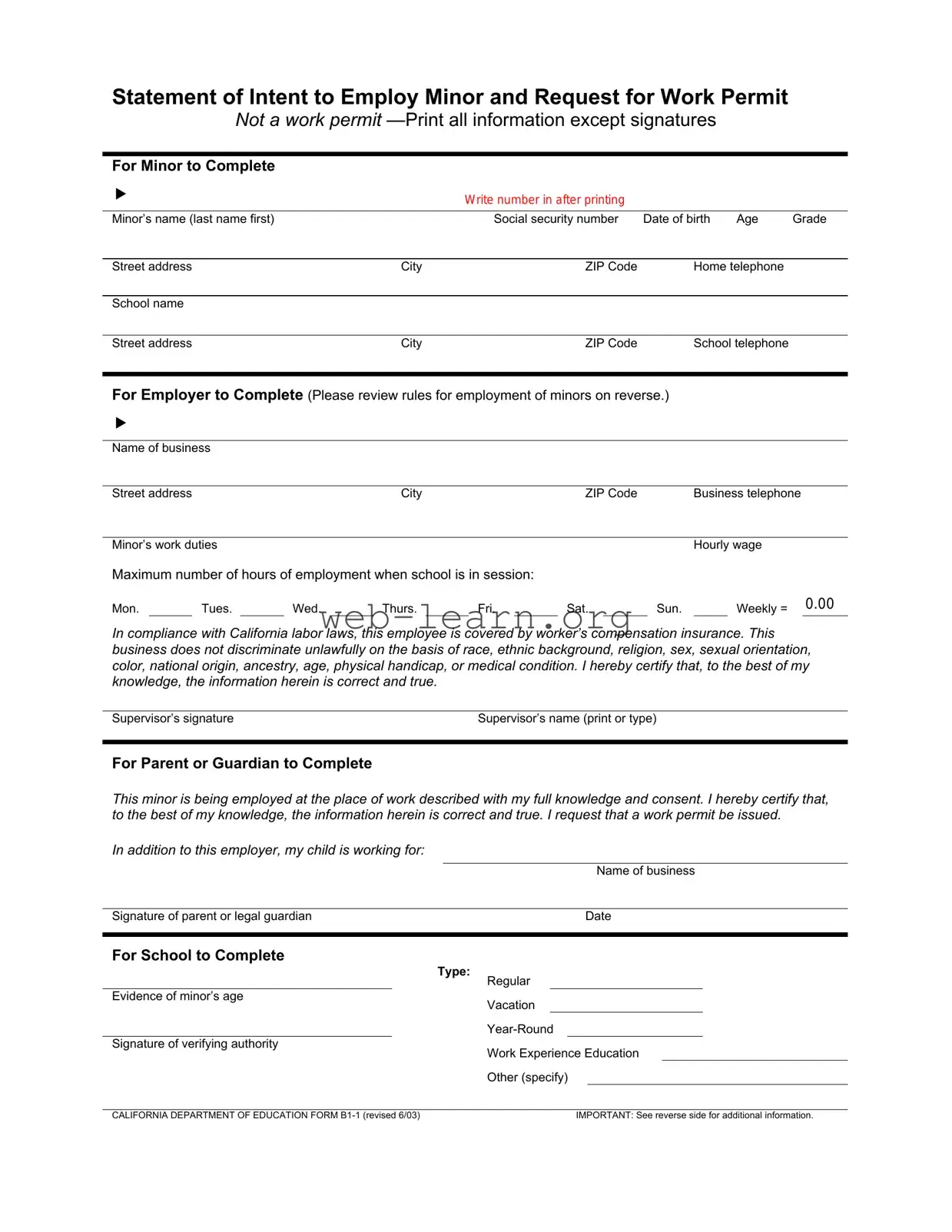
When it comes to employing minors, understanding the legal requirements is essential for both employers and young workers. The Statement of Intent to Employ Minor and Request for Work Permit form serves as a crucial document in this process. This form is designed to ensure that minors are protected while gaining valuable work experience. It outlines the responsibilities of the employer, including the need to provide a safe working environment and adhere to labor laws. Additionally, it requires parental consent, highlighting the importance of family involvement in the decision to enter the workforce. The form also includes details about the minor's proposed job, hours of work, and the nature of the employment. By completing this form, employers demonstrate their commitment to following regulations that safeguard the well-being of young employees. This document is not just a formality; it plays a vital role in fostering a responsible approach to youth employment.

Statement of Intent to Employ Minor and Request for Work Permit
Not a work permit
For Minor to Complete
• |
|
Write number in after printing |
|
|
|
|
|
|
|
|
|
Minor’s name (last name first) |
|
Social security number |
Date of birth |
Age |
Grade |
|
|
|
|
|
|
Street address |
City |
ZIP Code |
Home telephone |
|
|
|
|
|
|
|
|
School name |
|
|
|
|
|
|
|
|
|
|
|
Street address |
City |
ZIP Code |
School telephone |
|
|
For Employer to Complete (Please review rules for employment of minors on reverse.)
•
Name of business
Street address |
City |
ZIP Code |
Business telephone |
|
|
|
|
Minor’s work duties |
|
|
Hourly wage |
Maximum number of hours of employment when school is in session:
Mon. |
|
Tues. |
|
Wed. |
|
Thurs. |
|
Fri. |
|
Sat. |
|
Sun. |
|
Weekly = 0.00 |
|
|
|
|
|
|
|
|
|
|
|
|
|
|
|
|
|
In compliance with California labor laws, this employee is covered by worker’s compensation insurance. This business does not discriminate unlawfully on the basis of race, ethnic background, religion, sex, sexual orientation, color, national origin, ancestry, age, physical handicap, or medical condition. I hereby certify that, to the best of my knowledge, the information herein is correct and true.
Supervisor’s signature |
Supervisor’s name (print or type) |
For Parent or Guardian to Complete
This minor is being employed at the place of work described with my full knowledge and consent. I hereby certify that, to the best of my knowledge, the information herein is correct and true. I request that a work permit be issued.
In addition to this employer, my child is working for:
Name of business
Signature of parent or legal guardian |
Date |
|
|
For School to Complete
Type: Regular
Evidence of minor’s age
Vacation
Signature of verifying authority
Work Experience Education
Other (specify)
CALIFORNIA DEPARTMENT OF EDUCATION FORM |
IMPORTANT: See reverse side for additional information. |

General Summary of Minors’ Work Regulations
•If federal laws, state laws and school district policies conflict, the more restrictive law (the one most protective of the employee) prevails.
•Generally, minors must attend school until age 18 unless they are 16 years or older and have graduated from high school or received a state Certificate of Proficiency.
•Employers of minors required to attend school must complete a “Statement of Intent to Employ Minor and Request for Work Permit” (form
•Employers must retain a “Permit to Employ and Work” (form
•Work permits
•A work permit
Minors under the age of 18 may not work in environments declared hazardous or dangerous for young workers as listed below:
1.Explosive exposure
2.Motor vehicle driving/outside helper
3.Coal mining
4.Logging and sawmilling
5.
6.Radiation exposure
7.
8.
9.Other mining
10.
11.
12.
13.Manufacturing brick, tile products
14.Power saws and shears
15.Wrecking, demolition
16.Roofing
17.Excavation operation
For more complete information about hazardous occupations, contact the U.S. Department of Labor (Child Labor Bulletins 101 and 102) and the California Department of Industrial Relations, Division of Labor Standards Enforcement. Regional offices are located in several California cities. They are listed in the “Government Listings” sections of telephone directories.
•Minors younger than 16 years are allowed to work only in limited, specified occupations that exclude baking, manufacturing, processing, construction, warehouse, and transportation occupations.
•In addition to safety regulations, labor laws applicable to adult employees also generally apply to minor employees, including workers’ compensation insurance requirements.
•Child labor laws do not generally apply to minors who deliver newspapers or work at odd jobs, such as yard
work and
•A day of rest from work is required if the total hours worked per week exceed 30 or if more than 6 hours are worked on any one day during the week.
Ages |
Hours of Work |
16 – 17 When school is in session: Daily maximum of 4 hours, Monday through Thursday. May work up to 8 hours on any
When school not in session: May work up to 48 hours per week but no more than 8 hours in any one day.
Work must be performed no earlier than 5 a.m. or later than 10 p.m. except that work may extend to 12:30 a.m. on nights preceding non- school days. Students in Work Experience Education or cooperative vocational education programs may be authorized to work until 12:30 a.m. on nights preceding school days with specified written permission.
14 – 15 When school is in session: On school days daily maximum 3 hours. On
When school is not in session: Daily maximum 8 hours and weekly maximum 40 hours.
May not work during public school hours except students in Work Experience Education or career exploration programs.
Work must be performed no earlier than 7 a.m. nor later than 7 p.m. any day of the week. From June 1 to Labor Day work hours may be extended to 9 p.m.
Younger Labor laws generally prohibit nonfarm than 14 employment of children younger than 14.
Special rules apply to agricultural work, domestic work and the entertainment industry.
| Fact Name | Description |
|---|---|
| Purpose | The Statement of Intent to Employ Minor and Request for Work Permit form is designed to ensure that minors are legally allowed to work and that their employment conditions are safe and appropriate. |
| Eligibility | This form is required for minors under the age of 18 who wish to work in various jobs, ensuring compliance with child labor laws. |
| Governing Law | The specific laws governing the employment of minors vary by state, but generally include provisions from the Fair Labor Standards Act (FLSA) and state labor laws. |
| Parental Consent | In most cases, the form must be signed by a parent or guardian, providing consent for the minor's employment. |
| Employer Responsibilities | Employers must complete their section of the form, affirming that they will comply with all applicable labor laws regarding minor employment. |
| Work Permit Issuance | Once the form is completed and submitted, a work permit may be issued by the appropriate state authority, allowing the minor to begin work. |
| Time Restrictions | Many states impose specific time restrictions on when minors can work, which must be adhered to as part of the employment agreement. |
| Expiration | The work permit typically has an expiration date, after which a new form must be submitted if the minor continues to work. |
Completing the Statement of Intent to Employ Minor and Request for Work Permit form is an important step for employers wishing to hire minors. After filling out this form, it will need to be submitted to the appropriate authority for approval. Ensure that all information is accurate to avoid delays in processing.
Once submitted, you will receive further instructions regarding the next steps in the process. Be prepared to provide any additional information if requested.
What is the Statement of Intent to Employ Minor and Request for Work Permit form?
This form is a legal document that employers must complete when they intend to hire a minor. It serves as a request for a work permit, ensuring that the employment complies with state labor laws designed to protect young workers. By submitting this form, employers affirm their commitment to providing a safe and appropriate working environment for minors.
Who needs to fill out this form?
Employers who wish to hire individuals under the age of 18 are required to fill out this form. Additionally, the minor’s parent or guardian may need to provide consent, depending on state regulations. This ensures that all parties are aware of the employment terms and conditions.
What information is required on the form?
The form typically requires the following information:
Providing accurate information is crucial, as it helps ensure compliance with labor laws.
How do I submit the form?
The submission process can vary by state. Generally, after completing the form, you will need to submit it to the appropriate state labor department or agency. Some states may allow online submissions, while others may require a physical copy to be mailed or delivered in person. Always check your state’s specific guidelines for the correct submission method.
How long does it take to receive the work permit?
The time frame for receiving a work permit can differ based on the state and the volume of applications being processed. In many cases, you may receive a response within a few days to a couple of weeks. It’s advisable to submit the form well in advance of the intended start date to avoid any delays.
What happens if the form is not submitted?
Failure to submit the Statement of Intent to Employ Minor and Request for Work Permit form can lead to legal consequences for the employer. This may include fines or penalties, and it could also jeopardize the minor’s ability to work legally. It is crucial to follow all legal requirements to protect both the employer and the minor.
Can a minor work without a work permit?
In most cases, minors are not allowed to work without a valid work permit. There are specific exceptions based on the type of work and the minor’s age, but generally, obtaining a work permit is a necessary step. Employers should always verify the requirements in their state to ensure compliance.
What are the consequences of employing a minor without a work permit?
Employing a minor without the appropriate work permit can lead to serious repercussions. Employers may face fines, legal action, and restrictions on their ability to hire minors in the future. Additionally, the minor may be at risk of exploitation or unsafe working conditions, which is why these regulations are in place.
Filling out the Statement of Intent to Employ Minor and Request for Work Permit form can be a straightforward process, but many individuals make common mistakes that can delay approval. One of the most frequent errors is failing to provide accurate personal information. This includes the minor’s full name, date of birth, and contact details. Inaccurate information can lead to confusion and may result in the application being rejected.
Another mistake is neglecting to obtain the necessary signatures. The form typically requires signatures from both the employer and the minor's parent or guardian. Without these signatures, the application is incomplete and cannot be processed. It’s essential to double-check that all required parties have signed before submitting the form.
People often overlook the importance of providing the correct job description. The form asks for a detailed description of the minor’s job duties. If this section is vague or incomplete, it may raise red flags during the review process. Clearly outlining the responsibilities helps ensure that the job complies with labor laws.
Additionally, many applicants fail to check the work permit regulations specific to their state. Each state has different laws regarding the employment of minors, including age restrictions and the number of hours they can work. Not adhering to these regulations can result in the denial of the work permit.
Another common error is submitting the form without the required documentation. Supporting documents, such as proof of age or school enrollment, may be necessary. Failing to include these documents can lead to delays or rejection of the application.
Some individuals also make the mistake of not keeping copies of the submitted form. It is wise to maintain a record for future reference. Having a copy can be helpful if there are questions or issues that arise later in the process.
Furthermore, individuals sometimes underestimate the importance of following up after submission. It’s a good practice to check in with the relevant authority to confirm that the application is being processed. This proactive approach can help address any potential issues early on.
Finally, many applicants rush through the form, leading to careless mistakes. Taking the time to read each section carefully and ensuring all information is accurate can save a lot of time and frustration later. Patience and attention to detail are key when completing this important document.
The Statement of Intent to Employ Minor and Request for Work Permit form is a crucial document for employers looking to hire minors. However, several other forms and documents are often used in conjunction with this form to ensure compliance with labor laws and to protect the rights of young workers. Below is a list of these documents, each serving a specific purpose.
Using these forms and documents alongside the Statement of Intent to Employ Minor and Request for Work Permit form helps ensure that both the employer and the minor are protected and informed. Proper documentation is essential for a smooth and lawful employment experience for young workers.
Parental Consent Form: This document is similar because it requires parental approval for a minor to engage in employment. Just like the Statement of Intent, it ensures that the minor's guardians are aware of and agree to the work arrangement.
Employment Application: An employment application gathers information about a job candidate, including minors. It shares the purpose of assessing qualifications, similar to how the Statement of Intent assesses a minor's eligibility for work.
Job Offer Letter: This letter outlines the terms of employment and is crucial for formalizing the hiring process. It parallels the Statement of Intent by confirming the employer's intent to hire the minor.
Work Permit Application: This document is specifically designed to request permission for a minor to work. Like the Statement of Intent, it involves submitting necessary information to the appropriate authorities.
Minor's Employment Agreement: This agreement details the conditions of employment for a minor. It is similar in that it formalizes the employment relationship, just as the Statement of Intent does.
Child Labor Law Compliance Form: This form ensures that employment adheres to child labor laws. It is similar to the Statement of Intent as both documents aim to protect minors in the workplace.
Tax Identification Form: This form is necessary for tax purposes when hiring any employee, including minors. It shares the objective of ensuring compliance with legal requirements, akin to the Statement of Intent.
Health and Safety Compliance Document: This document outlines the health and safety regulations that must be followed in the workplace. It is similar because both aim to protect the well-being of minors at work.
Workplace Safety Training Acknowledgment: This acknowledgment confirms that the minor has received training on workplace safety. Like the Statement of Intent, it emphasizes the importance of a safe working environment for minors.
Employment Verification Form: This form is used to confirm employment status and is often required for various purposes. It relates to the Statement of Intent as both involve verification of employment details for minors.
When filling out the Statement of Intent to Employ Minor and Request for Work Permit form, keep these tips in mind:
The Statement of Intent to Employ Minor and Request for Work Permit form is often misunderstood. Here are nine common misconceptions about this important document:
Understanding these misconceptions can help ensure compliance with labor laws and protect the rights of minors in the workforce.
Filling out the Statement of Intent to Employ Minor and Request for Work Permit form is an important process for employers who wish to hire minors. Here are some key takeaways to keep in mind:
By following these guidelines, employers can ensure a smoother process when hiring minors and remain compliant with legal requirements.