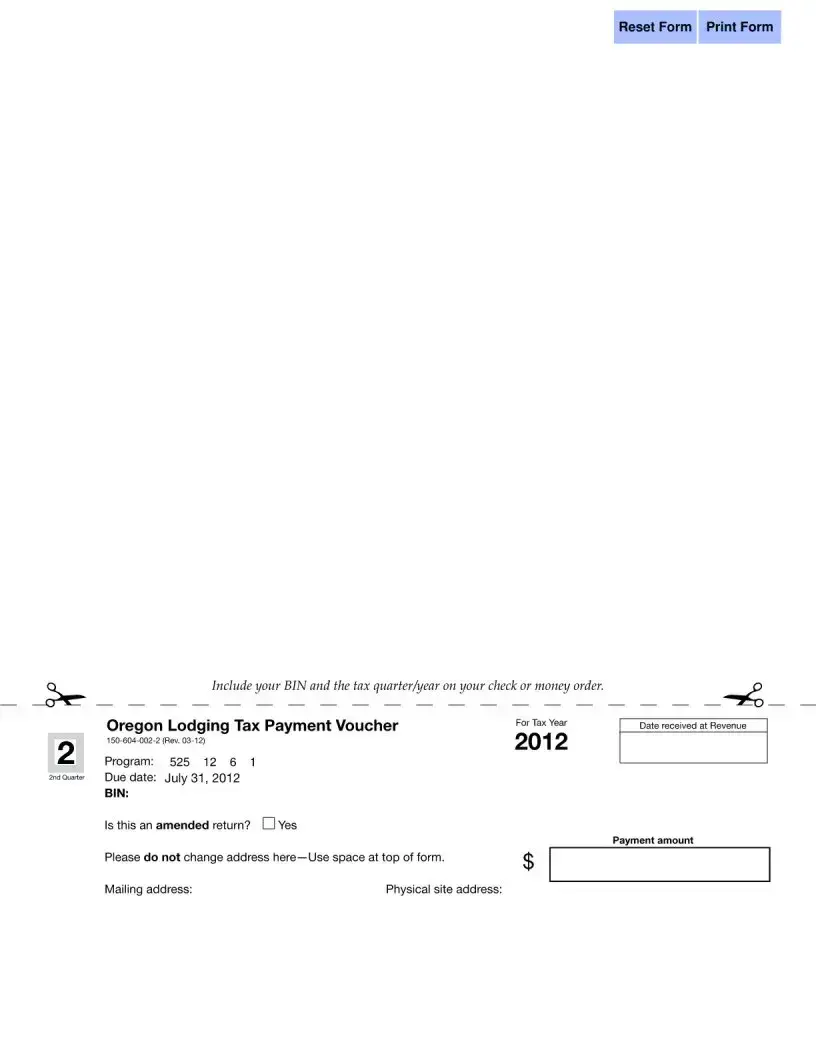
Homepage Blank State Of Oregon Lodging Tax Form
Outline

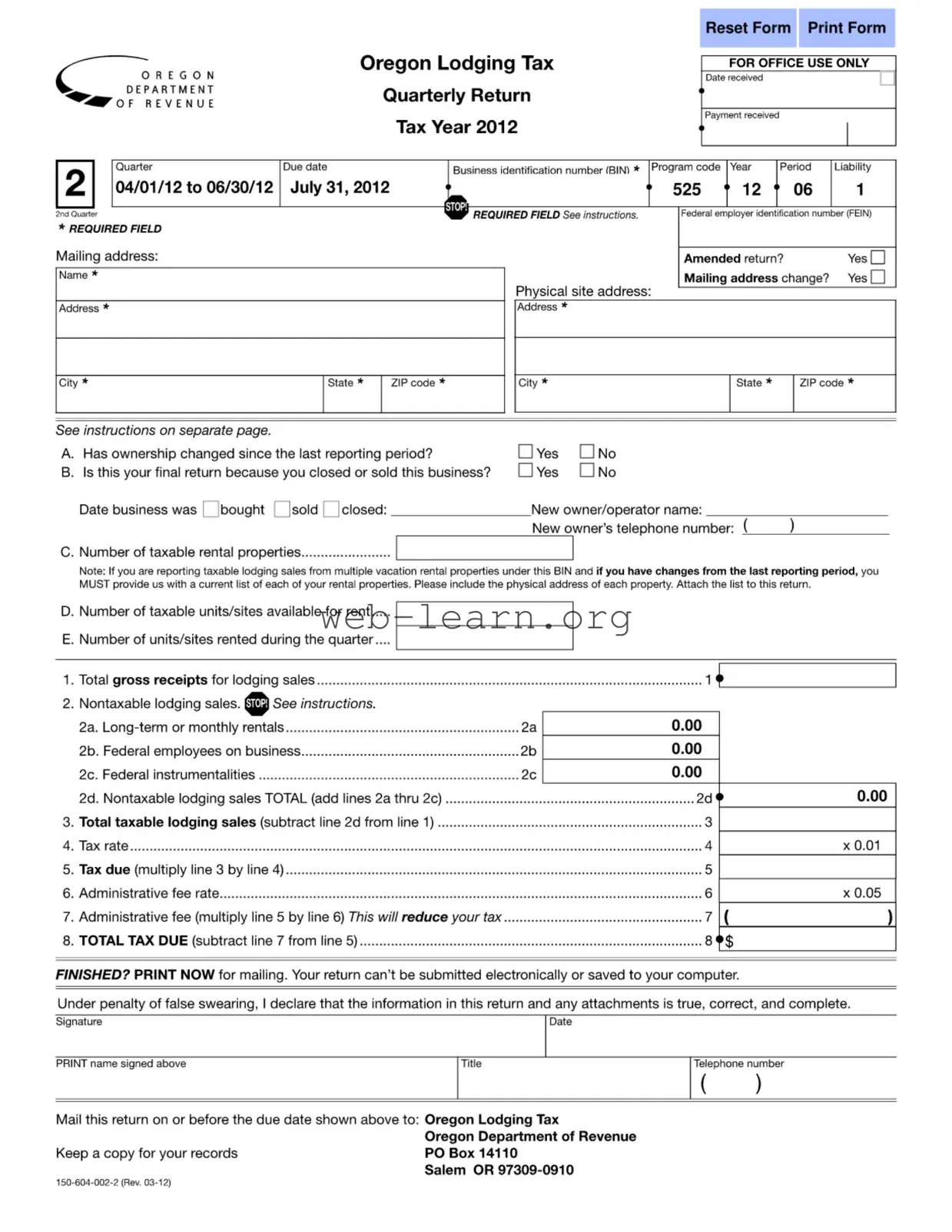
The State of Oregon Lodging Tax form serves as a crucial document for lodging providers, ensuring compliance with state tax regulations. This form must be filled out quarterly, capturing essential details about taxable lodging sales, nontaxable sales, and the number of rental properties operated. It requires the lodging provider's business identification number (BIN) and federal employer identification number (FEIN), both of which are mandatory. Additionally, the form prompts for information regarding ownership changes and whether the return is final due to business closure or sale. Providers must report the total gross receipts from lodging sales while distinguishing between taxable and nontaxable transactions, such as long-term rentals or stays by federal employees. The tax rate is applied to the taxable sales, and an administrative fee may also be deducted. As a reminder, this form must be printed and mailed, as electronic submissions are not permitted. Understanding the intricacies of this form is vital for lodging operators to maintain compliance and avoid penalties.
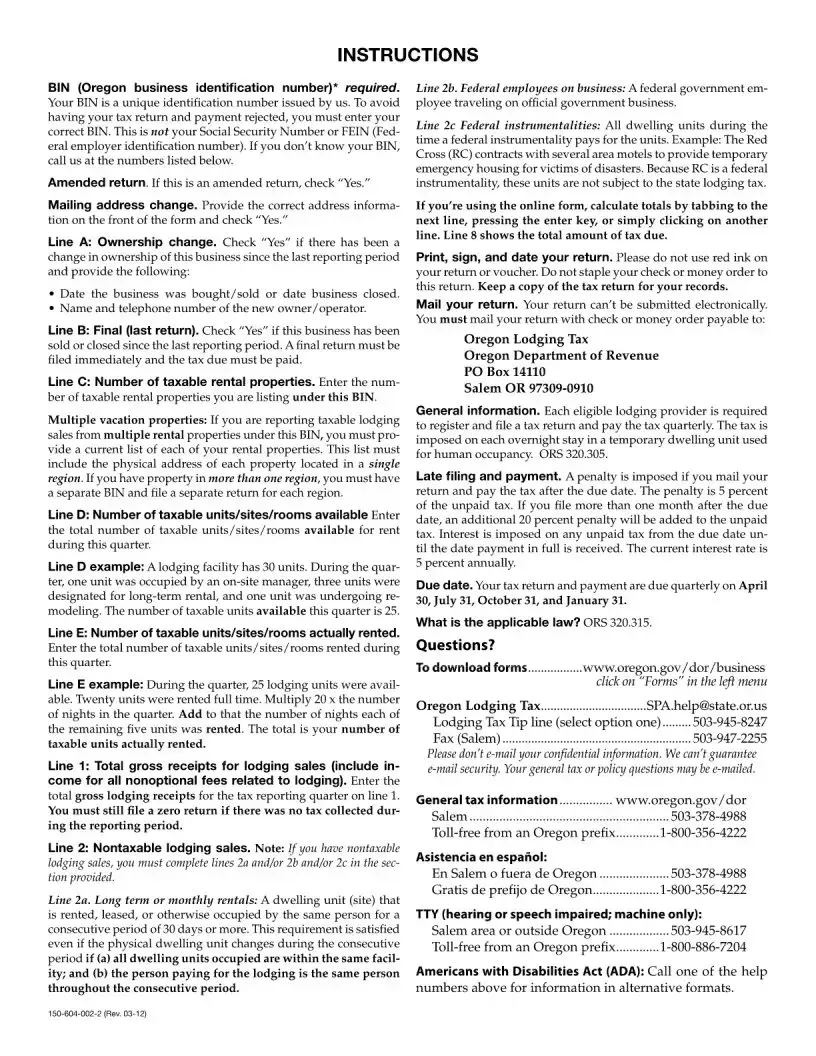
Sample - State Of Oregon Lodging Tax Form

Form Information

Fact Name Details
Governing Law The Oregon Lodging Tax is governed by Oregon Revised Statutes (ORS) 320.300 to 320.350.
Filing Frequency Lodging providers must file the Oregon Lodging Tax return quarterly.
Due Dates The return is due on the last day of the month following the end of each quarter.
Required Information Essential fields include the Business Identification Number (BIN) and Federal Employer Identification Number (FEIN).
Tax Calculation The tax due is calculated by multiplying total taxable lodging sales by the applicable tax rate.
Submission Method Returns must be mailed; electronic submission is not permitted.

Detailed Guide for Filling Out State Of Oregon Lodging Tax

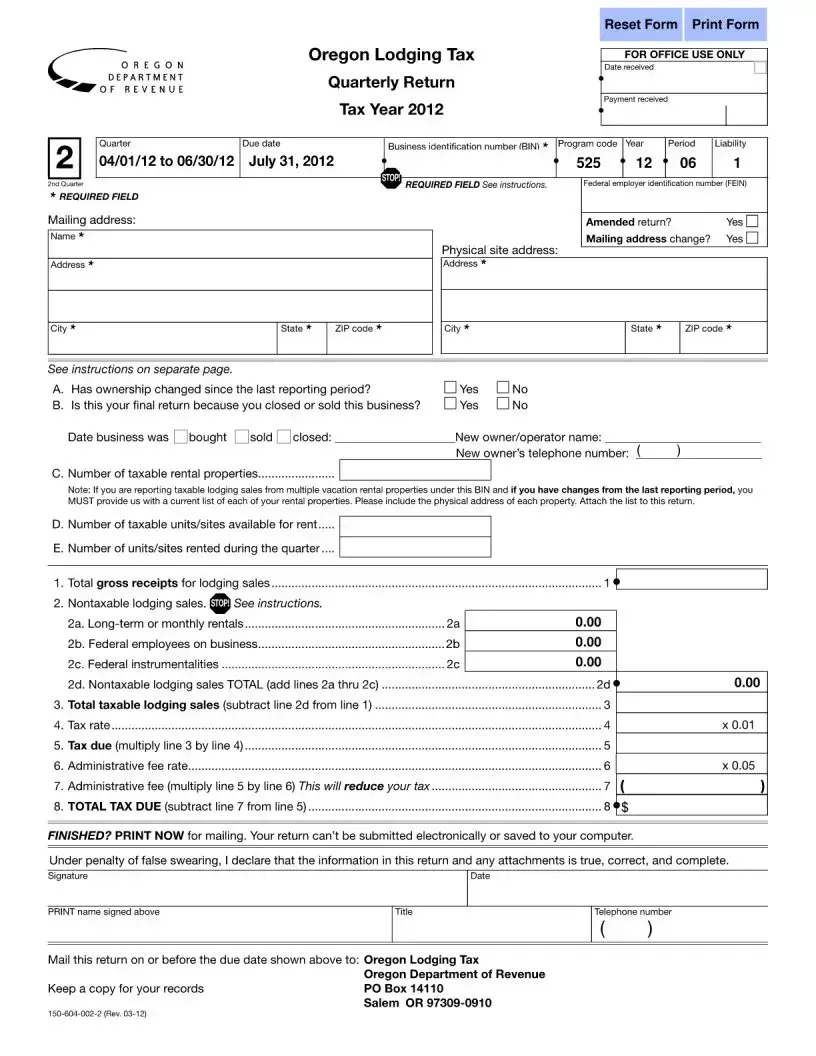
Filling out the State of Oregon Lodging Tax form requires attention to detail to ensure accurate reporting. After completing the form, it must be mailed to the appropriate address by the due date. Below are the steps to fill out the form correctly.

  1. Locate your Oregon Business Identification Number (BIN) and Federal Employer Identification Number (FEIN). These are required fields.
  2. Fill in your mailing address. If your mailing address has changed, indicate that by checking the corresponding box.
  3. Provide the physical site address of your lodging business.
  4. Answer the questions regarding ownership changes and whether this is your final return.
  5. Indicate the number of taxable rental properties you are reporting under your BIN. If you have multiple properties, prepare a current list with their physical addresses and attach it to the return.
  6. Enter the total number of taxable units/sites available for rent during the quarter.
  7. Record the number of taxable units/sites rented during the quarter.
  8. Calculate and enter the total gross receipts for lodging sales on line 1.
  9. Complete line 2 by reporting any nontaxable lodging sales, including long-term rentals and federal employees on business.
  10. Subtract the total nontaxable lodging sales from the total gross receipts to find the total taxable lodging sales.
  11. Enter the tax rate applicable to your lodging sales.
  12. Calculate the tax due by multiplying the total taxable lodging sales by the tax rate.
  13. Determine the administrative fee rate and calculate the administrative fee by multiplying the tax due by the administrative fee rate.
  14. Subtract the administrative fee from the tax due to find the total tax due.
  15. Print the form, sign it, and date it. Include your title and telephone number.
  16. Mail the completed return along with payment to the Oregon Department of Revenue at the specified address. Keep a copy for your records.

Obtain Answers on State Of Oregon Lodging Tax

  1. What is the Oregon Lodging Tax?

    The Oregon Lodging Tax is a tax imposed on overnight stays in temporary dwelling units, such as hotels, motels, and vacation rentals. This tax is collected from guests and must be reported and paid by lodging providers on a quarterly basis. The funds generated from this tax are typically used to support local tourism and community services.

  2. Who needs to file the Oregon Lodging Tax form?

    Any lodging provider operating in Oregon must file the Oregon Lodging Tax form. This includes hotels, motels, vacation rentals, and any other temporary dwelling units used for human occupancy. If you have multiple properties, you may need a separate Business Identification Number (BIN) for each location.

  3. What information is required on the form?

    The form requires several key pieces of information:

    • Your Business Identification Number (BIN)
    • Federal Employer Identification Number (FEIN)
    • Mailing and physical site addresses
    • Details about ownership changes, if applicable
    • The number of taxable rental properties
    • Total gross receipts for lodging sales
    • Nontaxable lodging sales information

    Completing the form accurately is crucial to avoid penalties or rejection of your tax return.

  4. What if I have nontaxable lodging sales?

    If you have nontaxable lodging sales, such as long-term rentals or stays by federal employees, you must report these on the form. There are specific lines to fill out for each type of nontaxable sale. It is important to accurately complete these sections to ensure you are only taxed on taxable lodging sales.

  5. How do I submit my Oregon Lodging Tax form?

    Once you have completed the form, you must print it out, sign it, and mail it to the Oregon Department of Revenue. The address is:

    Oregon Department of Revenue
    PO Box 14110
    Salem, OR 97309-0910

    Your return cannot be submitted electronically, so ensure you mail it by the due date to avoid penalties. Keep a copy for your records as well.

Common mistakes

Filling out the State of Oregon Lodging Tax form can be straightforward, but many make common mistakes that can lead to complications. One major error is failing to provide the correct Business Identification Number (BIN). This number is crucial for processing your return. If you enter the wrong BIN, your return may be rejected. Always double-check this number against your records before submitting.

Another frequent mistake involves the Federal Employer Identification Number (FEIN). Some individuals confuse their FEIN with their BIN. Ensure you enter the correct identification number to avoid delays. If you’re unsure, consult the instructions or contact the Oregon Department of Revenue for clarification.

People often overlook the importance of reporting nontaxable lodging sales accurately. If you have nontaxable sales, you must fill out the corresponding sections. Missing this information can lead to incorrect calculations and potential penalties. Take the time to review your sales thoroughly and categorize them correctly.

Many filers neglect to list all their taxable rental properties if they have multiple locations. If you are reporting sales from more than one property, you must provide a current list of each property’s physical address. Failing to do so can result in incomplete returns and further inquiries from the tax authorities.

Another common error is not checking the box for an amended return when applicable. If you’ve made changes to your previous submission, it’s essential to indicate this on the form. Ignoring this can complicate your tax situation and lead to confusion in future filings.

Finally, many individuals forget to sign and date their return. This step is often overlooked but is essential for validating your submission. A missing signature can delay processing and may even require you to resubmit the form. Always ensure that you complete this step before mailing your return.

Documents used along the form

The State of Oregon Lodging Tax form is just one part of the process for lodging providers. There are several other documents that may be needed to ensure compliance with local regulations. Here’s a list of common forms and documents that often accompany the lodging tax form.

  • Business License: This document shows that your lodging business is legally registered to operate in Oregon. It is essential for all businesses and must be renewed periodically.
  • Tax Identification Number (TIN): This number is assigned by the IRS and is used for tax purposes. It’s important for reporting income and paying taxes correctly.
  • Sales Tax Permit: If you collect sales tax from guests, you need this permit. It allows you to legally charge and remit sales tax to the state.
  • Property Management Agreement: If you hire a property management company, this agreement outlines the responsibilities and terms of their service. It’s useful for clarity and accountability.
  • Insurance Documents: Proof of insurance coverage is crucial. This protects your property and guests, and some local regulations may require specific types of coverage.
  • List of Rental Properties: If you manage multiple properties, you may need to provide a current list that includes addresses and details for each rental. This helps with accurate reporting and compliance.

Having these documents ready can streamline the filing process and help avoid any potential issues. Staying organized and informed is key to running a successful lodging business in Oregon.

Similar forms

  • IRS Form 1040: This is the standard individual income tax return form used by U.S. taxpayers. Like the Oregon Lodging Tax form, it requires personal and financial information, including identification numbers and income details. Both forms aim to report financial obligations to the government.
  • Sales Tax Return: Businesses file this form to report sales tax collected from customers. Similar to the lodging tax form, it requires detailed information about sales and exemptions. Both forms ensure compliance with tax laws and accurate reporting of liabilities.
  • Property Tax Return: This document is submitted by property owners to report property value and calculate taxes owed. Both the property tax return and the lodging tax form require information about property ownership and usage, helping assess the appropriate tax amount.
  • Business License Application: This form is necessary for businesses to operate legally. It collects information about ownership, location, and business activities, similar to the lodging tax form's requirements for business identification and property details.
  • Federal Employer Identification Number (FEIN) Application: This application is used to obtain a unique identifier for businesses. Like the lodging tax form, it requires accurate business information and serves to identify the business for tax purposes.
  • Quarterly Estimated Tax Payment Form: This form is used by individuals and businesses to report estimated tax payments throughout the year. Both forms require calculations of tax liabilities and adherence to deadlines, ensuring timely payment of taxes owed.

Dos and Don'ts

When filling out the State of Oregon Lodging Tax form, certain practices can help ensure accuracy and compliance. Here are five recommendations:

  • Double-check your BIN: Ensure you enter the correct Oregon business identification number. This is essential to avoid rejection of your tax return.
  • Report ownership changes: If there has been a change in ownership since the last reporting period, provide the necessary details, including the date of change and new owner’s information.
  • Include all taxable properties: List all taxable rental properties under your BIN. This includes providing the physical address for each property.
  • File even with no tax collected: If no tax was collected during the reporting period, you must still submit a zero return.
  • Keep a copy: Retain a copy of the completed tax return for your records after mailing it.

Conversely, there are also practices to avoid:

  • Do not use red ink: Avoid using red ink on your return or voucher, as it may not be processed correctly.
  • Do not staple documents: Refrain from stapling your check or money order to the return, as this can complicate processing.
  • Do not submit electronically: Remember that the return must be mailed; electronic submissions are not accepted.
  • Do not leave fields blank: Ensure all required fields are filled out to prevent delays or issues with your return.
  • Do not forget the due date: Be aware of the due date for filing to avoid penalties.

Misconceptions

Misconceptions about the State of Oregon Lodging Tax form can lead to confusion and mistakes. Here are eight common misunderstandings:

  • The BIN is the same as my Social Security Number. The Business Identification Number (BIN) is different from your Social Security Number or Federal Employer Identification Number (FEIN). It is a unique number issued specifically for your business.
  • I don’t need to file a return if I had no taxable sales. Even if you had no taxable sales during the reporting period, you must still file a zero return. Failure to do so could result in penalties.
  • Amended returns are optional. If there are changes to your previous return, such as ownership changes or corrections, you must file an amended return. This is not optional.
  • All rental properties are automatically included. If you have multiple rental properties, you must provide a current list of each property under your BIN. This includes their physical addresses.
  • I can submit my return electronically. The Oregon Lodging Tax return cannot be submitted electronically. You must print it and mail it to the specified address.
  • Only hotels need to file this tax. Any eligible lodging provider, including vacation rentals and short-term rentals, is required to register and file a tax return.
  • The tax rate is the same for all properties. The tax rate may vary depending on the locality. Be sure to check the current rate applicable to your property.
  • I can staple my check to the return. You should not staple your check or money order to the return. This can cause processing issues.

Understanding these misconceptions can help ensure that you complete the Oregon Lodging Tax form correctly and avoid potential penalties.

Key takeaways

Filling out and using the State of Oregon Lodging Tax form can be straightforward if you keep a few essential points in mind. Here are some key takeaways to help ensure your submission is accurate and timely:

  • Understand Required Information: You must provide your Oregon business identification number (BIN) and federal employer identification number (FEIN). These are crucial for processing your tax return. Without them, your submission may be rejected.
  • Report Changes Promptly: If there has been a change in ownership or if you are filing a final return because the business has been sold or closed, indicate this clearly on the form. This ensures the state has accurate records of your business status.
  • Detail Taxable Properties: When reporting taxable rental properties, include a current list of all properties under your BIN. This list should contain the physical addresses of each property, especially if you manage multiple locations.
  • Submit on Time: The form must be mailed by the due date, which is typically the last day of the month following the end of the quarter. Late submissions may incur penalties or additional fees, so it is vital to stay on schedule.

By adhering to these guidelines, you can streamline the process of completing the Oregon Lodging Tax form and ensure compliance with state regulations.