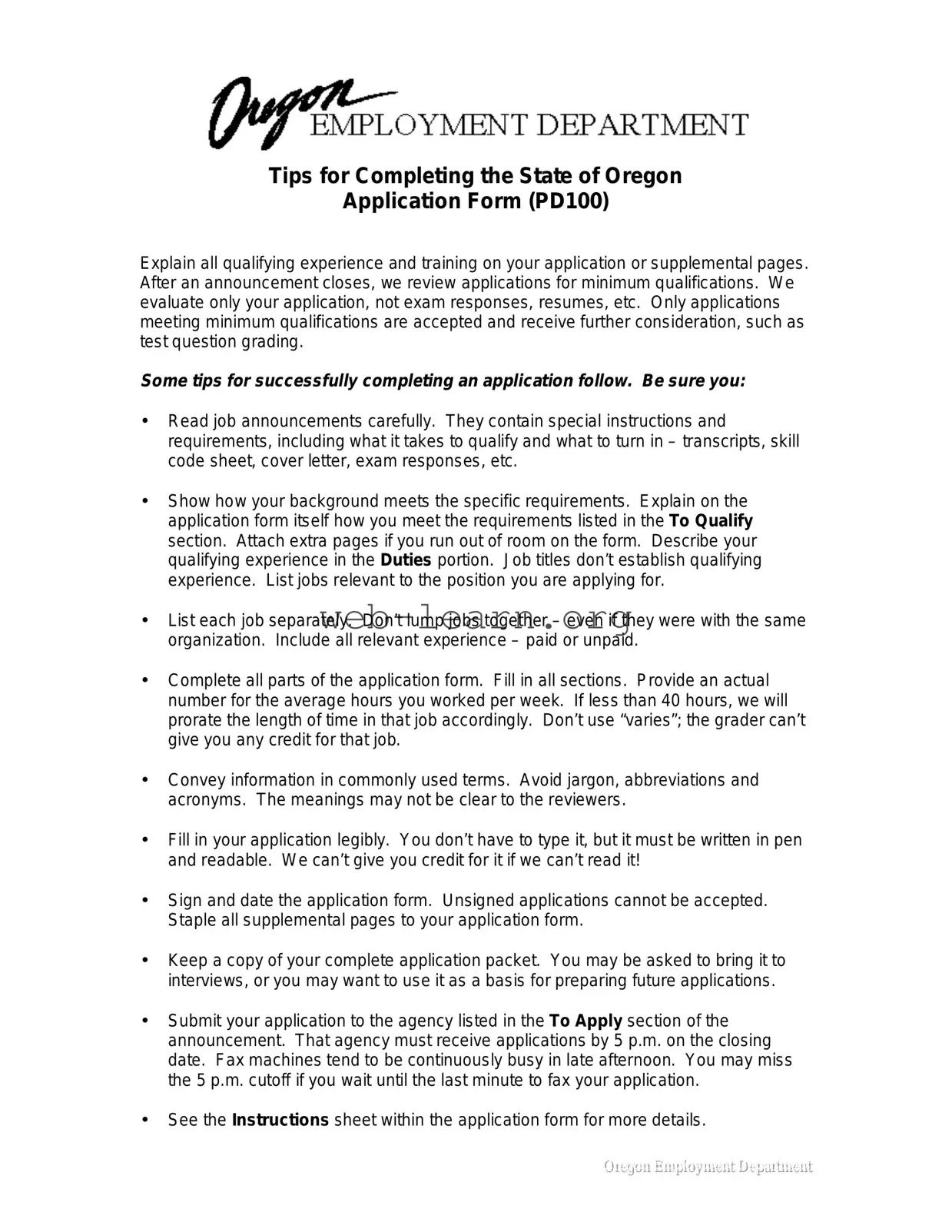
The State of Oregon Jobs form, officially known as the PD100, is a crucial tool for individuals seeking employment within state agencies. Completing this application accurately and thoroughly can significantly impact the chances of securing a position. The form requires applicants to detail their qualifying experience and training, ensuring that all relevant information is clearly presented. It is essential to read job announcements carefully, as they outline specific instructions and requirements that must be followed. Applicants should demonstrate how their background aligns with the qualifications listed, using the application itself to explain their relevant experiences. Each job must be listed separately, with clear descriptions of duties, avoiding vague terms like "varies." Furthermore, completing all sections of the application is vital, including providing actual hours worked per week. Legibility is key; the application should be written clearly to ensure reviewers can easily read it. Signing and dating the form is also necessary, as unsigned applications will not be accepted. Applicants should remember to keep a copy of their completed application for reference and submit it to the appropriate agency by the specified deadline. Overall, understanding these guidelines can help streamline the application process and improve the likelihood of being considered for a job in Oregon's state government.

Tips for Completing the State of Oregon
Application Form (PD100)
Explain all qualifying experience and training on your application or supplemental pages. After an announcement closes, we review applications for minimum qualifications. We evaluate only your application, not exam responses, resumes, etc. Only applications meeting minimum qualifications are accepted and receive further consideration, such as test question grading.
Some tips for successfully completing an application follow. Be sure you:
·Read job announcements carefully. They contain special instructions and requirements, including what it takes to qualify and what to turn in – transcripts, skill code sheet, cover letter, exam responses, etc.
·Show how your background meets the specific requirements. Explain on the application form itself how you meet the requirements listed in the To Qualify section. Attach extra pages if you run out of room on the form. Describe your qualifying experience in the Duties portion. Job titles don’t establish qualifying experience. List jobs relevant to the position you are applying for.
·List each job separately. Don’t lump jobs together – even if they were with the same organization. Include all relevant experience – paid or unpaid.
·Complete all parts of the application form. Fill in all sections. Provide an actual number for the average hours you worked per week. If less than 40 hours, we will prorate the length of time in that job accordingly. Don’t use “varies”; the grader can’t give you any credit for that job.
·Convey information in commonly used terms. Avoid jargon, abbreviations and acronyms. The meanings may not be clear to the reviewers.
·Fill in your application legibly. You don’t have to type it, but it must be written in pen and readable. We can’t give you credit for it if we can’t read it!
·Sign and date the application form. Unsigned applications cannot be accepted. Staple all supplemental pages to your application form.
·Keep a copy of your complete application packet. You may be asked to bring it to interviews, or you may want to use it as a basis for preparing future applications.
·Submit your application to the agency listed in the To Apply section of the announcement. That agency must receive applications by 5 p.m. on the closing date. Fax machines tend to be continuously busy in late afternoon. You may miss the 5 p.m. cutoff if you wait until the last minute to fax your application.
·See the Instructions sheet within the application form for more details.
r |
l |
t |
rt |
t |
| Fact Name | Fact Description |
|---|---|
| Application Review Process | Applications are reviewed for minimum qualifications only after the job announcement closes. |
| Qualifying Experience | Applicants must explain their qualifying experience directly on the application form. |
| Completeness Requirement | All sections of the application form must be completed for it to be considered valid. |
| Submission Deadline | Applications must be submitted by 5 p.m. on the closing date specified in the job announcement. |
| Governing Law | The application process is governed by Oregon Administrative Rules (OAR) related to state employment. |
After completing the State of Oregon Jobs form, applicants will submit it to the designated agency by the specified deadline. It is essential to ensure that all information is accurate and complete, as this will determine eligibility for further consideration.
What is the State of Oregon Jobs form (PD100)?
The State of Oregon Jobs form, also known as PD100, is an application form used by individuals seeking employment with the State of Oregon. It allows applicants to provide detailed information about their qualifications, experience, and training relevant to the job they are applying for.
How should I complete the application form?
Completing the application form requires careful attention to detail. Applicants should:
What information should I include about my experience?
When detailing your experience, it is essential to focus on relevant positions. Describe your qualifying experience in the Duties portion of the application. Avoid simply listing job titles; instead, explain your responsibilities and how they relate to the position you are applying for. If necessary, attach extra pages to provide a complete picture.
Why is it important to avoid jargon and abbreviations?
Using commonly understood terms is crucial. Reviewers may not be familiar with specific jargon, abbreviations, or acronyms, which can lead to misunderstandings. Clear communication ensures that your qualifications are accurately assessed.
What happens if I do not complete all parts of the application?
Incomplete applications cannot be considered for further evaluation. It is vital to fill in every section of the form and provide accurate information, including the average number of hours worked per week. If you indicate “varies,” it may hinder your chances of receiving credit for that experience.
Is it necessary to keep a copy of my application?
Yes, it is highly recommended that you keep a copy of your complete application packet. This can be beneficial for future reference, especially during interviews or when preparing applications for other positions.
What is the deadline for submitting my application?
Your application must be received by the agency listed in the job announcement by 5 p.m. on the closing date. It is advisable to avoid last-minute submissions, as fax machines may be busy, and you risk missing the deadline.
Where can I find additional instructions for completing the application?
Additional instructions can be found on the Instructions sheet included within the application form. This document provides further guidance on how to complete the application correctly and what additional documents may be required.
What should I do if I have more questions about the application process?
If you have further questions, consider reaching out to the agency listed in the job announcement. They can provide clarification and assistance regarding the application process and any specific requirements for the position.
Filling out the State of Oregon Jobs form can be a straightforward process, but many applicants make common mistakes that can hinder their chances of being considered for a position. One significant error is failing to read the job announcement carefully. Each announcement contains specific instructions and requirements. Ignoring these details can lead to missing essential documents, such as transcripts or cover letters, which are necessary for qualification.
Another frequent mistake is not clearly explaining how one's background meets the job requirements. Applicants often assume that job titles alone will convey their qualifications. However, it is crucial to describe relevant experience directly on the application form. This includes detailing duties and responsibilities rather than merely listing job titles. Providing context helps reviewers understand the applicant's qualifications better.
Many individuals also make the mistake of lumping jobs together rather than listing each position separately. This can obscure relevant experience and make it difficult for reviewers to assess qualifications accurately. It is important to include all relevant experiences, whether paid or unpaid, to present a comprehensive view of one's background.
Completing all parts of the application form is essential. Some applicants leave sections blank or use vague terms like "varies" when indicating hours worked. This can lead to confusion, as reviewers need specific information to evaluate qualifications properly. Providing actual numbers and completing every section ensures clarity and completeness.
Lastly, legibility is a critical factor that applicants often overlook. Handwritten applications must be clear and easy to read. If reviewers cannot decipher the information, it may not be credited. Additionally, forgetting to sign and date the application can lead to outright rejection. Keeping a copy of the completed application packet is also advisable, as it can be useful for interviews or future applications.
When applying for jobs in Oregon, several forms and documents may accompany the State of Oregon Jobs form. Each of these documents serves a specific purpose in the application process. Below is a list of commonly used forms that applicants should consider submitting along with their application.
Submitting the correct forms and documents can significantly enhance your application. Be sure to follow the instructions carefully and provide all necessary information to improve your chances of being considered for the position.
The State of Oregon Jobs form (PD100) shares similarities with several other application documents used in various contexts. Here are seven documents that are comparable, along with a brief explanation of their similarities:
When filling out the State of Oregon Jobs form, it’s crucial to follow specific guidelines to ensure your application stands out. Here’s a list of things you should and shouldn’t do:
Following these tips can significantly improve your chances of a successful application. Make sure to take your time and provide thorough, clear information.
Here are some common misconceptions about the State of Oregon Jobs form (PD100) that applicants often have:
Filling out the State of Oregon Jobs form can be a straightforward process if you follow some key guidelines. Here are important takeaways to keep in mind:
By adhering to these guidelines, you can enhance your chances of successfully navigating the application process for jobs in Oregon.