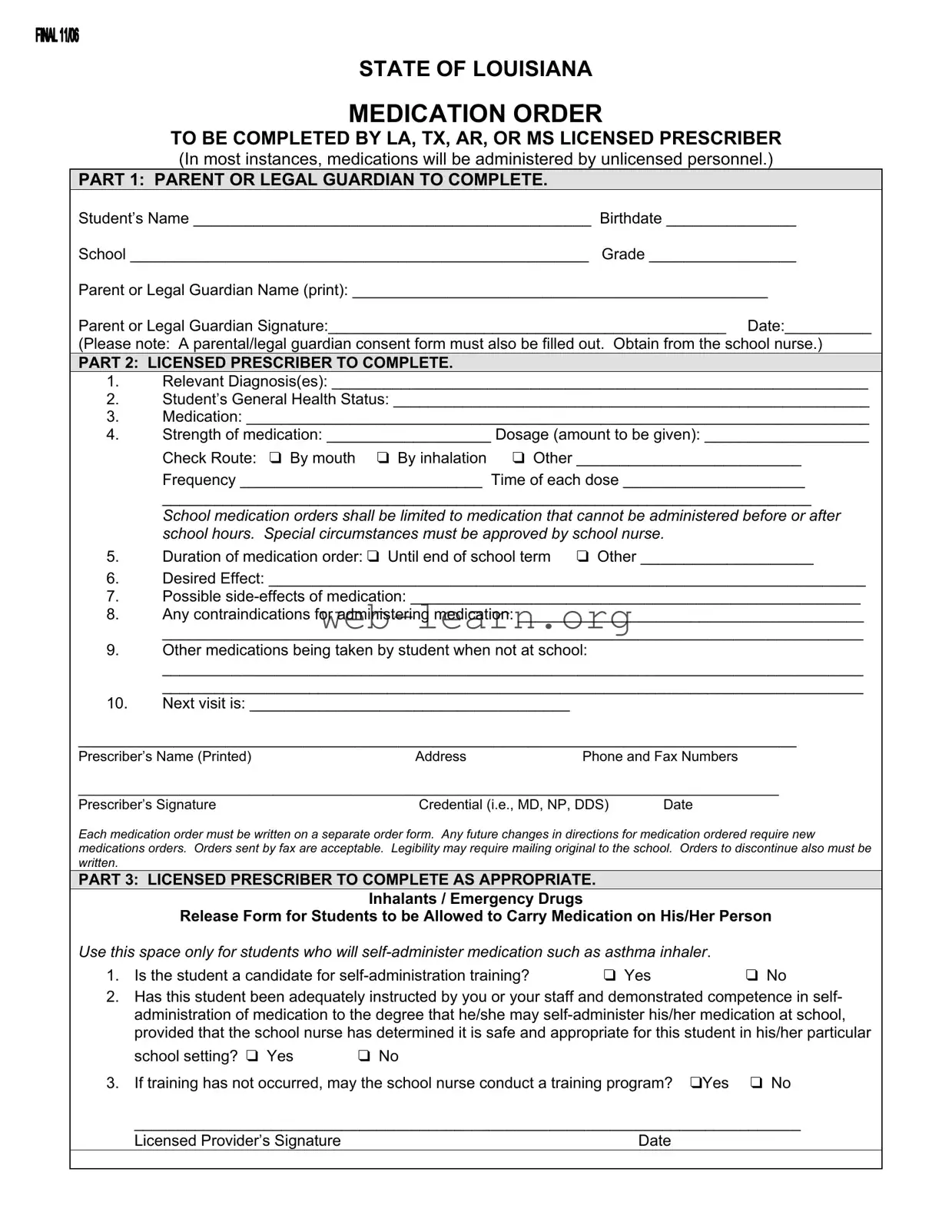
The State of Louisiana Medication Order form serves as a crucial document designed to ensure the safe administration of medications to students during school hours. This form is divided into three distinct parts, each tailored to gather essential information from different parties involved in a child's healthcare. Initially, a parent or legal guardian must provide their child's name, birthdate, school, and grade, along with their own signature, confirming consent for medication administration. Following this, a licensed prescriber is required to complete a detailed section that includes the student’s relevant diagnoses, general health status, and specific medication details, such as dosage, frequency, and desired effects. It is important to note that the form restricts medication orders to those that cannot be administered outside of school hours, unless special circumstances are approved by the school nurse. Furthermore, the prescriber must also assess potential side effects and contraindications, ensuring that all necessary precautions are taken. In cases where students may need to self-administer medications, such as inhalers, additional information must be provided to verify their capability and readiness for self-administration. This comprehensive approach not only prioritizes the well-being of the student but also fosters collaboration among parents, healthcare providers, and school staff to create a safe educational environment.

STATE OF LOUISIANA
MEDICATION ORDER
TO BE COMPLETED BY LA, TX, AR, OR MS LICENSED PRESCRIBER
(In most instances, medications will be administered by unlicensed personnel.)
PART 1: PARENT OR LEGAL GUARDIAN TO COMPLETE.
Student’s Name ______________________________________________ Birthdate _______________
School _____________________________________________________ Grade _________________
Parent or Legal Guardian Name (print): ________________________________________________
Parent or Legal Guardian Signature:______________________________________________ Date:__________
(Please note: A parental/legal guardian consent form must also be filled out. Obtain from the school nurse.)
PART 2: LICENSED PRESCRIBER TO COMPLETE.
1.Relevant Diagnosis(es): ______________________________________________________________
2.Student’s General Health Status: _______________________________________________________
3.Medication: ________________________________________________________________________
4.Strength of medication: ___________________ Dosage (amount to be given): ___________________
|
Check Route: ❑ By mouth ❑ By inhalation ❑ Other __________________________ |
|
|
Frequency ____________________________ Time of each dose _____________________ |
|
|
___________________________________________________________________________ |
|
|
School medication orders shall be limited to medication that cannot be administered before or after |
|
|
school hours. Special circumstances must be approved by school nurse. |
|
5. |
Duration of medication order: ❑ Until end of school term |
❑ Other ____________________ |
6.Desired Effect: _____________________________________________________________________
7.Possible
8.Any contraindications for administering medication: ________________________________________
_________________________________________________________________________________
9.Other medications being taken by student when not at school:
_________________________________________________________________________________
_________________________________________________________________________________
10.Next visit is: _____________________________________
___________________________________________________________________________________
Prescriber’s Name (Printed)AddressPhone and Fax Numbers
__________________________________________________________________________________________
Prescriber’s Signature |
Credential (i.e., MD, NP, DDS) |
Date |
Each medication order must be written on a separate order form. Any future changes in directions for medication ordered require new medications orders. Orders sent by fax are acceptable. Legibility may require mailing original to the school. Orders to discontinue also must be written.
PART 3: LICENSED PRESCRIBER TO COMPLETE AS APPROPRIATE.
Inhalants / Emergency Drugs
Release Form for Students to be Allowed to Carry Medication on His/Her Person
Use this space only for students who will |
|
|
1. Is the student a candidate for |
❑ Yes |
❑ No |
2.Has this student been adequately instructed by you or your staff and demonstrated competence in self- administration of medication to the degree that he/she may
school setting? ❑ Yes ❑ No
3. If training has not occurred, may the school nurse conduct a training program? ❑Yes ❑ No
_____________________________________________________________________________
Licensed Provider’s Signature |
Date |
| Fact Name | Details |
|---|---|
| Purpose | The Louisiana Medication Order form is used to authorize the administration of medication to students at school. |
| Completion Requirements | The form must be completed by a licensed prescriber and signed by a parent or legal guardian. |
| Governing Law | This form is governed by Louisiana state laws regarding medication administration in schools. |
| Special Conditions | Medications must be administered by unlicensed personnel, and special circumstances require approval from the school nurse. |
Filling out the State of Louisiana Medication Order form is essential for ensuring that students receive the medications they need while at school. This form must be completed accurately to facilitate proper medication administration. Below are the steps to guide you through the process.
After completing the form, ensure that all sections are filled out clearly. This will help the school nurse understand the student's medication needs and ensure compliance with school policies.
What is the purpose of the State of Louisiana Medication Order form?
The State of Louisiana Medication Order form is designed to facilitate the administration of medications to students during school hours. It ensures that medications are prescribed, documented, and administered in a safe and effective manner, particularly when unlicensed personnel are responsible for administering these medications.
Who needs to complete the form?
The form must be completed by a licensed prescriber, such as a physician or nurse practitioner, and a parent or legal guardian. The parent or guardian provides consent, while the prescriber details the necessary medical information regarding the student's health and medication.
What information is required from the parent or legal guardian?
The parent or legal guardian must provide the student’s name, birthdate, school, grade, and their own name and signature. Additionally, they must indicate the date of signing. It is important to note that a separate parental/legal guardian consent form is also required, which can be obtained from the school nurse.
What details must the licensed prescriber include in the form?
The licensed prescriber must provide the following information:
Can medications be administered outside of school hours?
No, school medication orders are generally limited to medications that cannot be administered before or after school hours. Any special circumstances must receive prior approval from the school nurse.
What happens if there are changes to the medication order?
If there are any changes in the directions for the medication ordered, a new medication order must be written. Each medication must be documented on a separate order form. Orders can be sent by fax, but the original may need to be mailed for legibility.
What is required for students who self-administer medication?
For students who will carry and self-administer medications, such as asthma inhalers, the prescriber must indicate whether the student is a candidate for self-administration training. The prescriber must also confirm if the student has been adequately instructed and demonstrated competence in self-administration. If training has not occurred, the prescriber must indicate whether the school nurse can conduct a training program.
Is there a requirement for a signature on the form?
Yes, both the parent or legal guardian and the licensed prescriber must sign the form. The prescriber’s signature must include their credentials and the date. This ensures accountability and verifies that the information provided is accurate and complete.
Filling out the State of Louisiana Medication Order form can be straightforward, but there are common mistakes that can lead to issues. One frequent error is failing to include the student's full name and birthdate. This information is essential for proper identification and must be accurate. Omitting this detail can result in delays in medication administration.
Another mistake is neglecting to provide the parent or legal guardian's signature. This signature is crucial for consent. Without it, the school may not be able to administer the medication, even if all other information is complete. Additionally, the date of the signature must be included; otherwise, it may create confusion regarding the validity of the order.
In Part 2, licensed prescribers often forget to detail the relevant diagnosis. This information helps school staff understand the reason for the medication. Additionally, some prescribers may leave out the strength and dosage of the medication. Both details are necessary to ensure the student receives the correct amount at the right time.
Another common oversight is not checking the appropriate route of administration. Whether the medication is to be taken by mouth, inhalation, or another method should be clearly indicated. Failing to do so can lead to improper administration, which could affect the student’s health.
Some individuals may also overlook the section for possible side effects and contraindications. This information is vital for school staff to monitor the student’s reaction to the medication. If these details are missing, it could lead to serious health risks.
In the section regarding other medications the student is taking, people sometimes provide incomplete information. It is important to list all medications, as interactions can occur. This helps ensure the safety of the student while at school.
Another mistake involves misunderstanding the duration of the medication order. If a parent or guardian indicates "Other" without specifying, it can create confusion. Clarity in this section is necessary for proper planning and administration of the medication.
Finally, some prescribers may forget to sign the form or include their credentials. This signature validates the order and confirms the prescriber’s authority. Without it, the order may not be accepted by the school.
Taking the time to carefully complete each section of the State of Louisiana Medication Order form can help prevent these common mistakes. Attention to detail ensures that students receive the necessary care and support while at school.
The State of Louisiana Medication Order form is a critical document for managing student medications in schools. Alongside this form, several other documents are commonly used to ensure the safe administration of medications and to comply with legal requirements. Below is a list of these essential forms, each serving a specific purpose in the medication management process.
Utilizing these forms alongside the State of Louisiana Medication Order form helps ensure that students receive their medications safely and effectively while at school. Proper documentation is vital for maintaining clear communication between parents, healthcare providers, and school staff.
The State of Louisiana Medication Order form serves a specific purpose in managing student medications in schools. However, it shares similarities with several other important documents in healthcare and education. Here are four documents that are comparable, along with a brief explanation of how they relate to the Medication Order form:
When filling out the State of Louisiana Medication Order form, it is essential to follow specific guidelines to ensure the process is smooth and effective. Below is a list of things you should and shouldn't do:
This is incorrect. Only licensed prescribers from Louisiana, Texas, Arkansas, or Mississippi are authorized to complete the medication order form. The involvement of a qualified professional ensures that the medication prescribed is appropriate for the student’s health needs.
In reality, school medication orders are specifically limited to medications that cannot be given before or after school hours. This restriction helps to manage the administration of medication effectively and safely within the school environment.
This is a common misunderstanding. Each medication order must be documented on a separate form. This requirement ensures clarity and reduces the risk of errors in medication administration.
This is not accurate. Any changes to the directions for medication must be documented through new medication orders. This protocol maintains a clear and formal record of the prescribed treatments and helps safeguard the student’s health.
The State of Louisiana Medication Order form is a critical document for ensuring that students receive the necessary medications during school hours. Here are key takeaways regarding its completion and use: