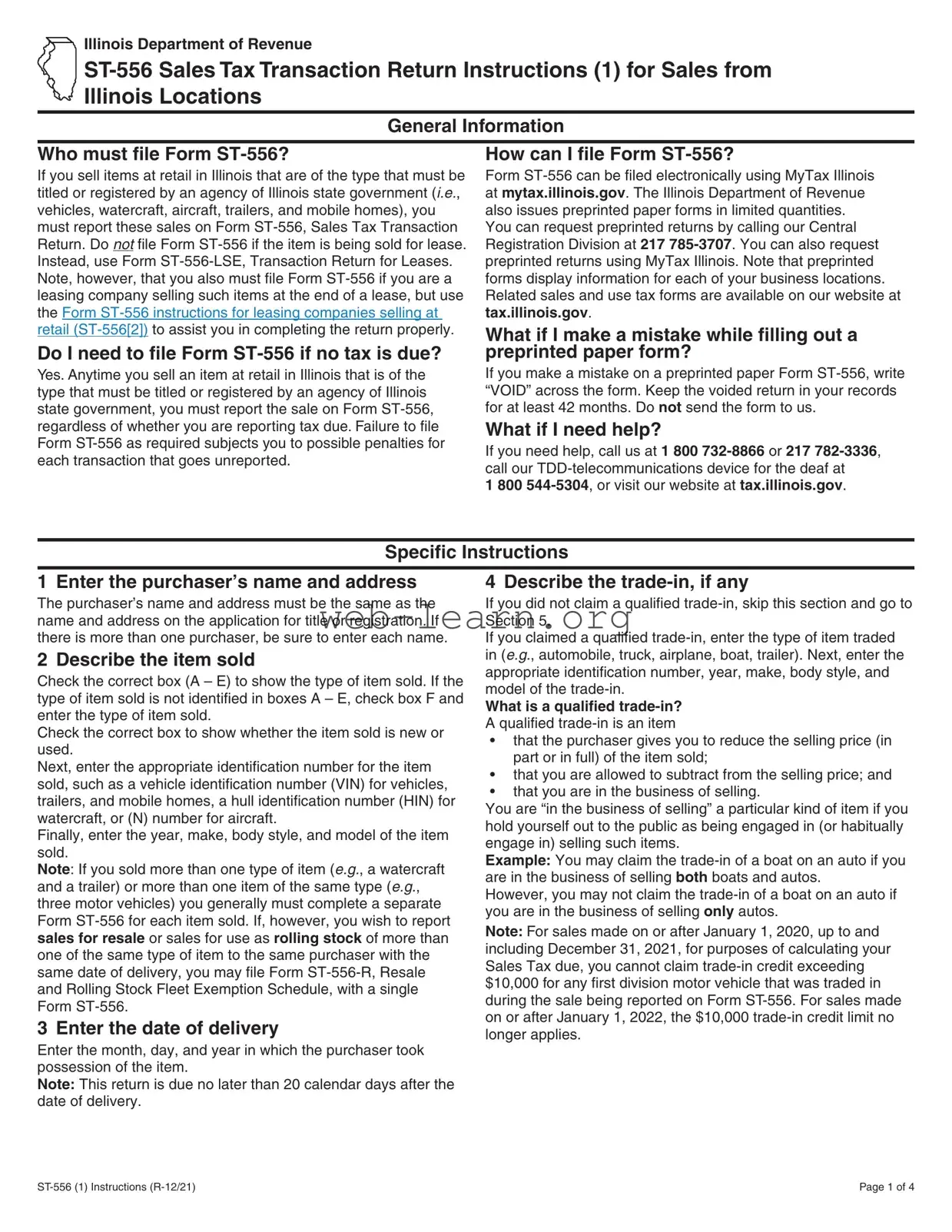
The ST-556 form, officially known as the Sales Tax Transaction Return, is a crucial document for businesses operating within Illinois that engage in the retail sale of certain items that require state titling or registration. This includes vehicles, watercraft, aircraft, trailers, and mobile homes. Any retailer selling these items must file the ST-556, even if no tax is due, to avoid potential penalties for unreported transactions. The form must be completed accurately, detailing the purchaser's information, the item sold, and any applicable exemptions or trade-ins. Notably, if an item is sold for lease, the seller must use a different form, specifically the ST-556-LSE. Filing can be done electronically through MyTax Illinois or via preprinted paper forms, which can be requested from the Illinois Department of Revenue. If errors occur while completing the form, sellers should void the incorrect document and retain it for their records rather than submitting it. The ST-556 form serves not only as a tax reporting tool but also as a means to ensure compliance with state regulations governing the sale of high-value items.

Illinois Department of Revenue
General Information
Who must file Form
If you sell items at retail in Illinois that are of the type that must be titled or registered by an agency of Illinois state government (i.e., vehicles, watercraft, aircraft, trailers, and mobile homes), you must report these sales on Form ST‑556, Sales Tax Transaction Return. Do not file Form ST‑556 if the item is being sold for lease. Instead, use Form ST‑556‑LSE, Transaction Return for Leases. Note, however, that you also must file Form ST‑556 if you are a leasing company selling such items at the end of a lease, but use the Form ST‑556 instructions for leasing companies selling at retail (ST‑556[2]) to assist you in completing the return properly.
Do I need to file Form
Yes. Anytime you sell an item at retail in Illinois that is of the type that must be titled or registered by an agency of Illinois state government, you must report the sale on Form ST‑556, regardless of whether you are reporting tax due. Failure to file Form ST‑556 as required subjects you to possible penalties for each transaction that goes unreported.
How can I file Form
Form ST‑556 can be filed electronically using MyTax Illinois at mytax.illinois.gov. The Illinois Department of Revenue also issues preprinted paper forms in limited quantities. You can request preprinted returns by calling our Central Registration Division at 217
What if I make a mistake while filling out a preprinted paper form?
If you make a mistake on a preprinted paper Form ST‑556, write “VOID” across the form. Keep the voided return in your records for at least 42 months. Do not send the form to us.
What if I need help?
If you need help, call us at 1 800
1 800
Specific Instructions
1 Enter the purchaser’s name and address
The purchaser’s name and address must be the same as the name and address on the application for title or registration. If there is more than one purchaser, be sure to enter each name.
2 Describe the item sold
Check the correct box (A – E) to show the type of item sold. If the type of item sold is not identified in boxes A – E, check box F and enter the type of item sold.
Check the correct box to show whether the item sold is new or used.
Next, enter the appropriate identification number for the item sold, such as a vehicle identification number (VIN) for vehicles, trailers, and mobile homes, a hull identification number (HIN) for watercraft, or (N) number for aircraft.
Finally, enter the year, make, body style, and model of the item sold.
Note: If you sold more than one type of item (e.g., a watercraft and a trailer) or more than one item of the same type (e.g., three motor vehicles) you generally must complete a separate Form ST‑556 for each item sold. If, however, you wish to report sales for resale or sales for use as rolling stock of more than one of the same type of item to the same purchaser with the same date of delivery, you may file Form ST‑556‑R, Resale and Rolling Stock Fleet Exemption Schedule, with a single Form ST‑556.
3 Enter the date of delivery
Enter the month, day, and year in which the purchaser took possession of the item.
Note: This return is due no later than 20 calendar days after the date of delivery.
4 Describe the
If you did not claim a qualified trade‑in, skip this section and go to Section 5.
If you claimed a qualified trade‑in, enter the type of item traded in (e.g., automobile, truck, airplane, boat, trailer). Next, enter the appropriate identification number, year, make, body style, and model of the trade‑in.
What is a qualified
•that the purchaser gives you to reduce the selling price (in part or in full) of the item sold;
•that you are allowed to subtract from the selling price; and
•that you are in the business of selling.
You are “in the business of selling” a particular kind of item if you hold yourself out to the public as being engaged in (or habitually engage in) selling such items.
Example: You may claim the trade‑in of a boat on an auto if you are in the business of selling both boats and autos.
However, you may not claim the trade‑in of a boat on an auto if you are in the business of selling only autos.
Note: For sales made on or after January 1, 2020, up to and including December 31, 2021, for purposes of calculating your Sales Tax due, you cannot claim trade‑in credit exceeding $10,000 for any first division motor vehicle that was traded in during the sale being reported on Form ST‑556. For sales made on or after January 1, 2022, the $10,000 trade‑in credit limit no longer applies.
ST‑556 (1) Instructions (R‑12/21) |
Page 1 of 4 |
5 Exempt or sale to a nonresident
If the sale is to an Illinois resident and also taxable, skip this section and go to Section 6.
If the sale is exempt from tax, check the correct box (A – F), and complete Section 6, Lines 1 and 2.
If the sale is to a nonresident purchaser who is subject to tax
(i.e., a non‑reciprocal purchaser), complete box A as instructed below and complete all of Section 6.
If you are not required to submit title or registration paperwork on the item, send the return directly to us at:
ILLINOIS DEPARTMENT OF REVENUE
RETAILERS’ OCCUPATION TAX
PO BOX 19042
SPRINGFIELD IL
A. Sold to a nonresident purchaser
Check this box if you sold an item to a nonresident purchaser who is not an out‑of‑state dealer, and who took possession of the item in Illinois, and either
•you issued a drive‑away permit for the item sold; or
•the purchaser transferred out‑of‑state license plates to the item sold.
If you issued a drive‑away permit, enter the drive‑away permit number and the
Exemption is determined by whether the purchaser’s state gives Illinois residents a nonresident purchaser exemption on their purchases of items that will be titled in Illinois. See ST‑58, Reciprocal ‑ Non‑Reciprocal Vehicle Tax Rate Chart, available on our website at tax.illinois.gov, and the instructions for Section 6, Line 4 below for more information.
Note: If you claim the nonresident purchaser exemption, keep a copy of the purchaser’s valid out‑of‑state driver’s license in your records as proof of nonresidency. You also are responsible for obtaining a signed certification documenting the purchaser’s eligibility for the nonresident purchaser exemption. As a condition of claiming this exemption, nonresident purchasers must certify that they are not residents of Illinois. See ST‑588, Nonresidency Exemption Certification for Sales and Leases of Motor Vehicles and Trailers, available on our website at tax.illinois.gov. Retain this certification in your records as proof that no tax was due on the sale of the specified item.
Indiana Purchaser of an RV or Cargo Trailer
If you sell a recreational vehicle or a cargo trailer to a purchaser that will title or register that item in Indiana, the transaction is exempt from Illinois tax if a drive‑away permit is issued or the Indiana purchaser has vehicle registration plates to transfer to the item upon returning to Indiana. You must check Section 5, box F, “Other” and enter “recreational vehicle” or “cargo trailer” on the line provided.
B. Sold for resale to a DEALER
Check this box if you sold the item to either an Illinois or out‑of‑state dealer for resale.
•If you sold to an Illinois dealer, enter the dealer’s account ID number in the space provided.
•If you sold to an Illinois dealer as junk or salvage or for parts, enter “Junked,” “Salvage,” or “Parts Only” after the account ID number.
•If you sold to an out‑of‑state dealer, enter “Out‑of‑State Dealer” in the space provided for the account ID number.
Keep a completed Form CRT‑61, Certificate of Resale, in your books and records for documentation.
C. Sold to an exempt organization
Check this box if you sold the item to an exempt organization that has an active Illinois Sales Tax exemption “E” number, such as:
•a governmental body
•a school
•a religious organization
•a charitable organization
In the space provided, enter the organization’s active Illinois Sales Tax exemption “E” number. The purchaser must be the organization itself rather than a member or officer of the organization. The item must be titled or registered in the organization’s name and paid for with the organization’s funds. The organization’s exemption number must have been in effect on the day you made the sale.
D. Sold to an interstate carrier for hire for use as rolling stock Check this box if you sold an item for use as rolling stock to haul persons or commodities for hire in interstate commerce. In the space provided, enter the certificate of authority number. Keep
a properly completed Form RUT‑7, Rolling Stock Certification, in your books and records for documentation.
E. Sold for rental use
Check this box if
•you sold the item to a business that is registered to collect Automobile Renting Occupation Tax; and
•the purchaser will use the item for rental purposes in rental agreements of one year or less.
Enter the purchaser’s Illinois Automobile Renting Occupation Tax account ID number.
F. Other
Check this box if the sale is exempt for a reason not identified in boxes A – E.
For example:
•You sold a recreational vehicle or cargo trailer to a purchaser that will title and register the item in Indiana and you have issued a drive‑away permit or the Indiana purchaser has vehicle registration plates to transfer to the item upon returning to Indiana. In the space provided, enter “recreational vehicle” or “cargo trailer.”
•You delivered (or caused to be delivered) an item to a purchaser outside Illinois. In the space provided, enter “Delivered Out‑of‑State.”
•You sold the item to a foreign consul who has a card from the U.S. Department of State declaring that the foreign consul does not have to pay sales tax on that item. In the space provided, enter “Foreign Consul.”
•You will use the item for your own interim use. For the item to remain exempt from sales or use tax, it must remain in your sales inventory and be available for sale at all times. In the space provided, enter “Interim Use”.
If you have aircraft or watercraft that you have purchased for resale in your sales inventory and you use these items for demonstration or business purposes, you must pay Illinois Use Tax on your cost price of these items if you hold them for more than 18 months. If you later sell the items and collect Illinois Sales Tax, you cannot claim credit for any Illinois Use Tax you may have paid.
6 Enter the price, and figure the tax
Note: When completing Section 6, round to the nearest dollar by dropping amounts of less than 50 cents and increasing amounts of 50 cents or more to the next higher dollar.
ST‑556 (1) Instructions (R‑12/21) |
Page 2 of 4 |
Line 1 Enter the selling price, including accessories, federal excise taxes, freight and labor, dealer preparation, documentary fees, and any rebates or incentives for which you as a dealer receive reimbursement. Do not subtract the value of any rebate made directly to the customer. In general, any cost passed on to the customer as part of the sale of an item and for which gross receipts are received should be included in the selling price. Note: If you are selling a new truck weighing 33,000 pounds
or more or a new trailer or semitrailer chassis weighing 26,000 pounds or more, you may exclude the federal excise tax from the selling price.
Line 2 If you claimed a qualified trade‑in (see Section 4), enter the total trade‑in credit or value (see Note below). You must identify the traded‑in item in the spaces provided in Section 4. If you claimed an exemption in Section 5 and no tax is due, you do not need to complete the remaining Lines 3 – 14 of Section 6. Remember that you and all purchasers must sign the return.
Note: For sales made on or after January 1, 2020, up to and including December 31, 2021, for purposes of calculating your Sales Tax due, you cannot claim trade‑in credit exceeding $10,000 for any first division motor vehicle that was traded in during the sale being reported on Form ST‑556. For sales made on or after January 1, 2022, the $10,000 trade‑in credit limit no longer applies.
Line 3 Subtract Line 2 from Line 1.
Line 4 Calculate your tax due using the following to determine the appropriate rate:
•If you made this sale at your standard business location (i.e., the location printed on the front of the paper
Form ST‑556 returns the Department issues to you), multiply Line 3 by the tax rate printed on your return.
•If you made this sale at an off‑site location (e.g., a tent sale), follow the instructions on ST‑23, How to Report Off‑Site Sales on Form ST‑556, Sales Tax Transaction Return, or Form ST‑556‑LSE, Transaction Return for Leases, available on our website at tax.illinois.gov.
•If you made this sale to a nonresident who is taking delivery of the item in Illinois but who will title it in a state that does not have a reciprocal nonresident purchaser exemption
for Illinois residents, multiply Line 3 by the nonresident’s state sales tax rate, up to 6.25 percent. See ST‑58, Reciprocal ‑ Non‑Reciprocal Vehicle Tax Rate Chart, available on our website at tax.illinois.gov.
Note for business locations in Cook, DuPage, Kane, Lake, McHenry, or Will County when the customer’s address is in Chicago:
If your sales location is in Cook, DuPage, Kane, Lake, McHenry, or Will County and the purchaser’s address on Form ST‑556, Section 1, is within the corporate limits of the city of Chicago, you must collect an additional 1.25 percent (.0125) Chicago Home Rule Use Tax. To help you calculate the tax due on one of these sales, we preprint a combined rate below Line 4 on the paper Form ST‑556 returns the Department issues to you. This combined rate includes your tax rate, plus the additional 1.25 percent Chicago Home Rule Use Tax. To figure the correct tax due, multiply the amount subject to tax on Line 3 by the combined rate. Enter the result on Line 4.
Line 5 - Read these instructions if your buyer’s address is in Cook, DuPage, Kane, Lake, McHenry, Will, Madison, or St. Clair County.
If the item will be titled or registered in an area in which tax has been imposed by the Regional Transportation Authority or Metro‑East Transit District, the purchaser may owe additional tax. If your sales location is within the boundaries of one of these areas, the additional tax is already included in your combined tax rate. If, however, your sales location falls outside these boundaries, you are not required to collect any additional use tax, but you may do your purchaser the courtesy of collecting the additional tax so that the purchaser will not be billed for it later.
If you have determined that the purchaser is subject to the additional use tax and you have decided to collect and remit that additional tax on the purchaser’s behalf, multiply the amount on Line 3 by any difference in rates (expressed as a decimal), and enter the result on Line 5. Finally, enter the name of the Illinois county in which the purchaser’s address is located. If the purchaser’s address falls within the limits of an Illinois city or village, enter the name of the city or village. If the purchaser’s address falls within Madison or St. Clair County, enter the name of the township in which the address is located.
Do not report municipal or county home rule use tax on Line 5. Line 6 Add Lines 4 and 5.
Line 7 If you are filing this return and paying the tax due within 20 days of the date of delivery entered in Section 3, multiply Line 6 by the rate printed on your return.
Note: Line 7a is preprinted only if you have a business location in the
Line 7a The Illinois Department of Revenue is responsible for collecting and administering the fee imposed in the Metro‑East Mass Transit District on items that are required to be titled or registered in Illinois. Multiply Line 3 by 0.5 percent (0.005).
•If the result is less than $20, enter the result on Line 7a.
•If the result is $20 or more, enter $20 on Line 7a.
Line 8 Subtract Line 7 from Line 6. If you calculated an amount on Line 7a according to the above instruction, subtract Line 7 from Line 6, and then add to that total the amount on Line 7a.
Line 9 If we have notified you that you have an overpayment credit on your account, you may use this overpayment credit to pay some or all of the tax due on this return. Enter the amount you wish to use.
Line 10 This credit is applicable only to lessors selling previously leased items at the expiration of the lease term. See Form ST‑556 instructions for leasing companies selling at retail (ST‑556[2]) for instructions on how to claim a credit for tax paid on an item you are now selling at the end of a lease.
Line 11 If you collected more tax than is due on this sale, enter the amount you overcollected.
Line 12 Subtract Lines 9 and 10 from Line 8 and add Line 11.
Line 13 If you have a credit memorandum and you wish to use it towards what you owe, enter the amount you are using on Line 13.
Line 14 Subtract Line 13 from Line 12, and enter the amount due. Also, enter the identifying number from the remittance you are sending to pay the tax due on this return. If you are filing more than one Form ST‑556, enclose a separate remittance for each return.
ST‑556 (1) Instructions (R‑12/21) |
Page 3 of 4 |
Sign the return
Both the seller and all purchasers must sign the return.
If you claimed a qualified trade‑in for the item sold, the signatures also declare that the title of the traded‑in item has been properly assigned and surrendered to the seller.
Penalty and Fee Information
We will bill you for any amounts owed, including the following penalties and fees:
•You owe a late filing penalty if you do not file a processable return by the due date.
•You owe a late payment penalty if you do not pay the amount you owe by the original due date of the return.
•You owe a bad check penalty if your remittance is not honored by your financial institution.
•You owe a cost of collection fee if you do not pay the amount you owe within 30 days of the date printed on a bill that we send you.
•You owe a nonfiling penalty for transaction returns if you do not file a processable transaction return (ST‑556, Sales Tax Transaction Return, or ST‑556‑LSE, Transaction Return for Leases) by the due date, but only if no tax is due on the return.
For more information, see Publication 103, Penalties and Interest for Illinois Taxes, available on our website at tax.illinois.gov.
|
Printed by authority of the State of |
Illinois |
ST‑556 (1) Instructions (R‑12/21) |
200 copies, PO #: 2220140 |
Page 4 of 4 |
| Fact Name | Details |
|---|---|
| Filing Requirement | Form ST-556 must be filed by any retailer selling items in Illinois that require titling or registration, such as vehicles, trailers, and watercraft. |
| Tax Reporting | Even if no tax is due, sellers must file Form ST-556 to report sales. Failure to do so can result in penalties. |
| Filing Methods | Form ST-556 can be filed electronically through MyTax Illinois or by requesting preprinted paper forms from the Illinois Department of Revenue. |
| Trade-In Credit Limit | For sales on or after January 1, 2020, the trade-in credit for first division motor vehicles cannot exceed $10,000. |
| Governing Law | The Illinois Department of Revenue governs the use of Form ST-556 under the Illinois Sales Tax Act (35 ILCS 105). |
Filling out the ST-556 form is essential for reporting sales of items that require registration or titling in Illinois. Follow these steps carefully to ensure that your form is completed accurately and submitted on time.
After completing these steps, review the form for accuracy before submission. Ensure that all required signatures are included. If you have any questions or need assistance, consider reaching out to the Illinois Department of Revenue for guidance.
If you are engaged in retail sales in Illinois of items that require titling or registration by a state agency, you must file Form ST-556. This includes vehicles, watercraft, aircraft, trailers, and mobile homes. However, if the item is being sold for lease, you should use Form ST-556-LSE instead. Leasing companies must also file Form ST-556 when selling items at the end of a lease, following specific instructions for leasing companies.
Yes, you are required to file Form ST-556 even if there is no tax due on the sale. It is essential to report all retail sales of items that must be titled or registered. Failing to file this form can result in penalties for each unreported transaction.
You can file Form ST-556 electronically through MyTax Illinois at mytax.illinois.gov. If you prefer a paper form, the Illinois Department of Revenue provides preprinted forms in limited quantities. You can request these by calling the Central Registration Division at 217-785-3707 or through MyTax Illinois. Preprinted forms will include information specific to your business locations.
If you notice an error on your preprinted Form ST-556, write "VOID" across the form and keep it in your records for at least 42 months. Do not send the voided form back to the Illinois Department of Revenue.
Filling out the ST-556 Illinois form can be a straightforward process, but many people make common mistakes that can lead to complications. One frequent error is failing to provide the correct purchaser's name and address. The information must match the details on the title or registration application. If there are multiple purchasers, all names should be included. Omitting or incorrectly entering this information can result in delays or penalties.
Another mistake involves misidentifying the item sold. It is crucial to check the appropriate box that corresponds to the type of item. If the item does not fit into the predefined categories, selecting "Other" and providing a description is necessary. Additionally, not entering the identification number, such as a Vehicle Identification Number (VIN), can lead to issues during processing.
Many individuals also neglect to accurately record the date of delivery. This date is significant as the form must be filed within 20 calendar days after the item is delivered. Missing this deadline can result in late fees and penalties, so it is vital to be precise.
Some people mistakenly skip the section on trade-ins. If a trade-in is claimed, it must be described accurately, including the identification number and details of the traded item. Failing to do so can lead to incorrect tax calculations and potential audits.
Another common error occurs when individuals miscalculate the sales tax due. Properly calculating the tax requires understanding the applicable rates, especially if the sale occurs in areas with additional taxes, such as Chicago. Rounding errors can also affect the final amount, so it’s essential to follow the instructions carefully.
Lastly, individuals often forget to sign the return. Both the seller and all purchasers must provide their signatures. Without these, the form may be considered incomplete, leading to processing delays. Ensuring that all required signatures are present is crucial for a smooth filing process.
When dealing with the ST-556 Illinois form, several other documents may be necessary to ensure compliance with state regulations. These forms facilitate various aspects of sales tax reporting and exemptions. Below is a list of related forms and documents often used in conjunction with the ST-556.
Using these forms alongside the ST-556 ensures accurate reporting and compliance with Illinois tax regulations. Each document plays a crucial role in various sales transactions, helping both sellers and buyers navigate the complexities of sales tax obligations.
When completing the ST-556 Illinois form, there are several important guidelines to follow to ensure accuracy and compliance. Below is a list of things to do and avoid.
This is incorrect. You must file Form ST-556 for any retail sale of items that require titling or registration, regardless of whether tax is due.
While vehicles are a common item, the form is also needed for watercraft, aircraft, trailers, and mobile homes sold at retail.
If you make a mistake on a preprinted paper Form ST-556, you should write "VOID" across the form and keep it for your records. Do not send it to the Department.
Form ST-556 can be filed electronically through MyTax Illinois, making the process quicker and easier.
As of January 1, 2020, the trade-in credit for first division motor vehicles is capped at $10,000. This limit applies to the credit you can claim on the return.
Sales to nonresidents can be taxable if the purchaser's state does not provide a nonresident purchaser exemption for Illinois residents.
It is essential to maintain documentation for any claimed exemptions, such as a copy of the purchaser's valid out-of-state driver’s license for nonresident exemptions.
Understanding the ST-556 Illinois form is crucial for anyone involved in selling items that require state registration. Here are some key takeaways to keep in mind:
Filling out the ST-556 form correctly can save you time and potential headaches down the road. Always double-check your entries and stay informed about any updates to the filing process.