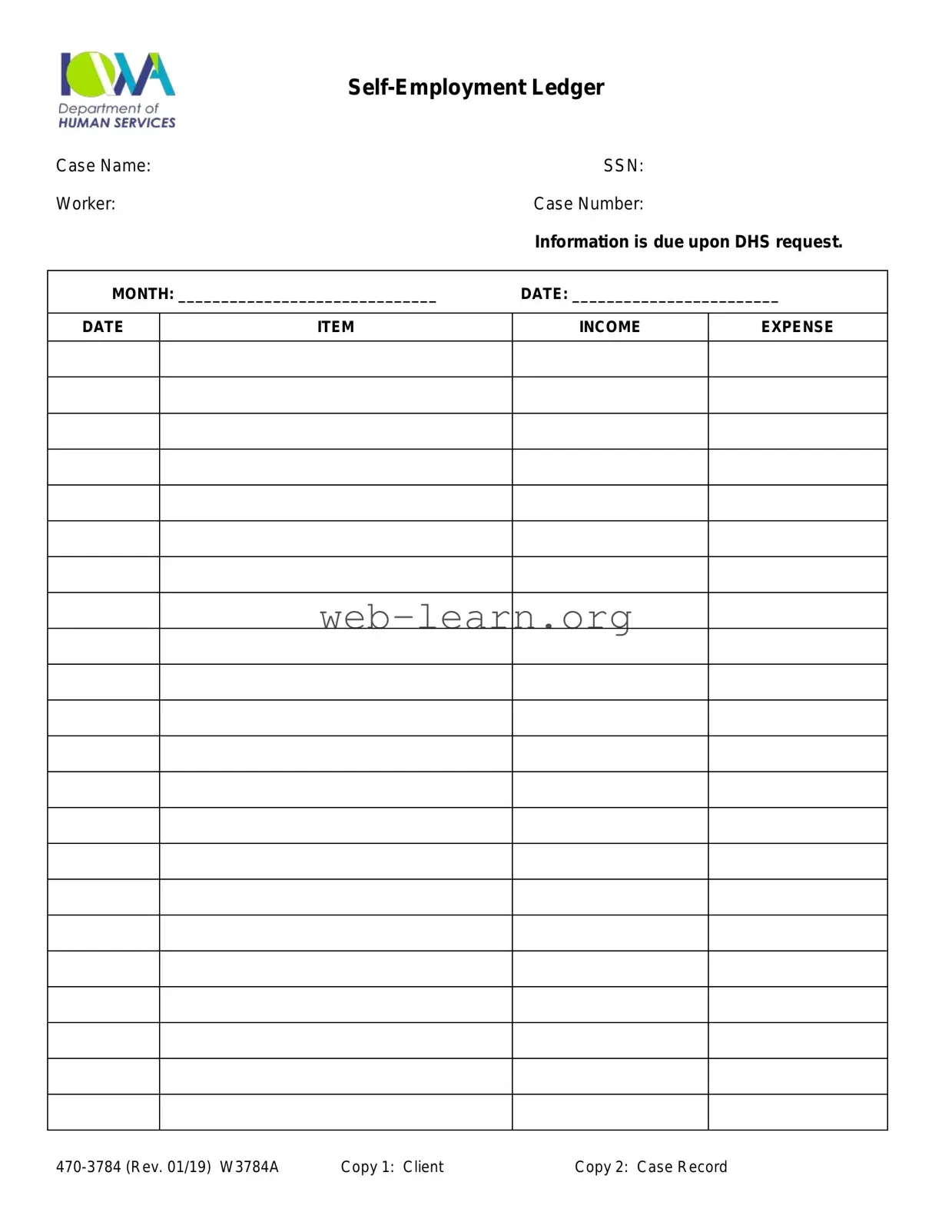
The Self Employment Ledger form is an essential tool for individuals who are self-employed and receiving assistance from the Iowa Department of Human Services. This form helps track income and expenses associated with self-employment activities. It requires basic information such as the case name, Social Security Number (SSN), worker details, and case number. Additionally, the form prompts users to provide specific monthly income and expense data. It is important to note that this information must be submitted upon request by the Department of Human Services. The structure of the form is straightforward, with designated spaces for entering the month and relevant financial details, ensuring that individuals can easily maintain accurate records. By keeping this ledger up to date, self-employed individuals can demonstrate their financial situation clearly and comply with reporting requirements.

Case Name: |
|
SSN: |
|
Worker: |
|
Case Number: |
|
|
|
Information is due upon DHS request. |
|
|
|
|
|
MONTH: ______________________________ |
DATE: ________________________ |
||
|
|
|
|
DATE |
ITEM |
INCOME |
EXPENSE |
|
|
|
|
|
|
|
|
|
|
|
|
|
|
|
|
|
|
|
|
|
|
|
|
|
|
|
|
|
|
|
|
|
|
|
|
|
|
|
|
|
|
|
|
|
|
|
|
|
|
|
|
|
|
|
|
|
|
|
|
|
|
|
|
|
|
|
|
|
|
|
|
|
|
|
|
|
|
|
|
|
|
|
|
|
|
|
|
|
|
|
|
Copy 1: Client |
Copy 2: Case Record |
| Fact Name | Description |
|---|---|
| Form Purpose | The Self Employment Ledger is used to track income and expenses for individuals who are self-employed. |
| Governing Authority | This form is governed by the Iowa Department of Human Services regulations. |
| Case Information | Users must provide their case name, Social Security Number (SSN), worker's name, and case number. |
| Submission Requirement | Information must be submitted upon request by the Iowa Department of Human Services. |
| Monthly Tracking | The form requires users to specify the month for which income and expenses are being reported. |
| Date of Income/Expense | Each entry requires a date to indicate when the income or expense was incurred. |
| Form Version | The current version of the form is 470-3784, revised in March 2012. |
| Copies | Two copies of the form are provided: one for the client and one for the case record. |
| Itemization | Users must itemize their income and expenses clearly on the form. |
Once you have your Self Employment Ledger form ready, it's time to fill it out accurately. This form is essential for tracking your income and expenses related to self-employment. Follow these steps carefully to ensure all necessary information is recorded correctly.
Make sure to keep a copy for your records and submit the form as required by the Iowa Department of Human Services.
What is the Self Employment Ledger form?
The Self Employment Ledger form is a document used by individuals who are self-employed to track their income and expenses. This form is required by the Iowa Department of Human Services (DHS) for reporting purposes.
Who needs to fill out the Self Employment Ledger?
Individuals who are self-employed and receiving assistance from the Iowa DHS may need to complete this form. It helps to ensure that all income and expenses are documented accurately.
What information is required on the form?
The form requires the following information:
How often do I need to submit the Self Employment Ledger?
You must submit the Self Employment Ledger upon request from the Iowa DHS. It is important to keep your records up to date and ready for review.
What happens if I do not submit the form?
Failure to submit the Self Employment Ledger when requested may affect your eligibility for assistance. It is essential to comply with DHS requests to maintain your benefits.
Can I make copies of the Self Employment Ledger?
Yes, you can make copies of the Self Employment Ledger for your records. It is advisable to keep a copy for yourself after submitting the original to DHS.
Where can I find the Self Employment Ledger form?
The Self Employment Ledger form can be obtained from the Iowa Department of Human Services website or by contacting your local DHS office.
Is there a specific format for reporting income and expenses?
While the form provides sections for income and expenses, it is important to include all relevant details clearly. You should list each item with its corresponding date and amount.
What if I have questions while filling out the form?
If you have questions while completing the Self Employment Ledger, you can reach out to your local DHS office for assistance. They can provide guidance on how to fill out the form correctly.
Filling out the Self Employment Ledger form can be a straightforward process, but several common mistakes can lead to complications. One frequent error is failing to include the case name and Social Security Number (SSN). These details are essential for the processing of your information. Without them, your submission may be delayed or even rejected.
Another mistake is not specifying the month for which the income and expenses are being reported. This omission can create confusion and may result in inaccurate assessments of your financial situation. Always ensure that the month is clearly indicated at the top of the form.
Many individuals also overlook the importance of providing accurate dates for each income and expense entry. Inaccurate or missing dates can lead to discrepancies in your records, which may affect your eligibility for benefits. Each entry should reflect the exact date it was incurred or received.
In addition, some people fail to itemize their income and expenses clearly. It is crucial to list each source of income and each expense separately. This detailed breakdown allows for a more accurate review of your financial situation and helps prevent misunderstandings with the Department of Human Services.
Another common oversight is neglecting to sign and date the form before submission. A signature is a formal acknowledgment of the information provided, and without it, the form may not be considered valid. Always double-check that you have signed and dated the document.
Moreover, failing to keep a copy of the completed form for personal records is a mistake many make. Having a copy can be invaluable for future reference or if any questions arise regarding your submissions. It is advisable to maintain a personal file of all submitted documents.
Lastly, individuals often do not respond promptly to any requests for additional information from the Department of Human Services. Timely responses are crucial to avoid delays in processing your case. Make it a priority to address any inquiries as soon as they arise.
The Self Employment Ledger form is an essential document for tracking income and expenses for self-employed individuals. However, it is often accompanied by other forms and documents that can help provide a comprehensive view of your financial situation. Below is a list of related documents that you may find useful.
Having these documents on hand can streamline your financial reporting and ensure that you are prepared for any inquiries or assessments. Organizing your records will not only help you maintain compliance but also provide clarity in managing your self-employment finances.
When filling out the Self Employment Ledger form, it's essential to follow specific guidelines to ensure accuracy and compliance. Here are nine things you should and shouldn't do:
Following these guidelines will help ensure that your Self Employment Ledger form is completed correctly and submitted on time.
The Self Employment Ledger form is an important document for individuals who are self-employed and receiving assistance from the Iowa Department of Human Services. However, there are several misconceptions surrounding its use. Here are nine common misunderstandings:
Understanding these misconceptions can help individuals accurately complete the Self Employment Ledger and maintain their eligibility for benefits.
Filling out and using the Self Employment Ledger form is an important process for tracking income and expenses related to self-employment. Here are some key takeaways: