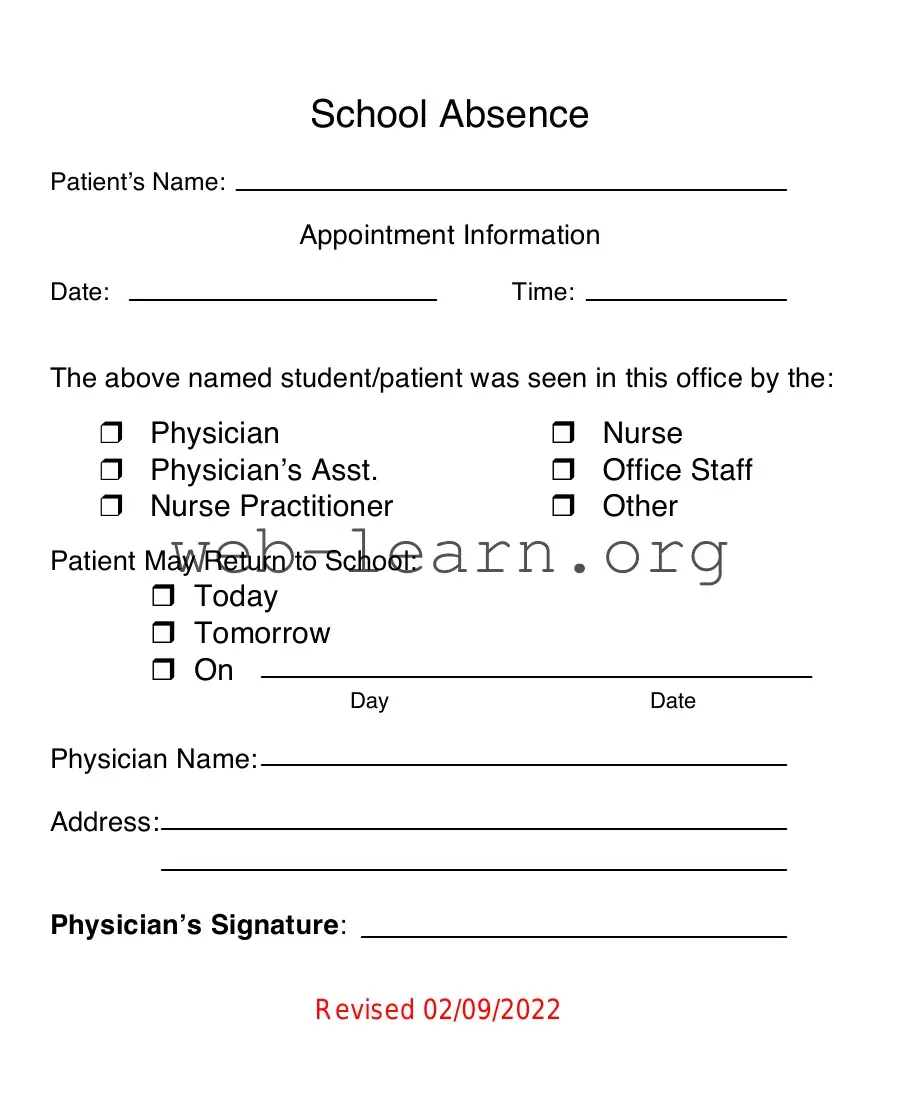
When students miss school due to medical appointments, a School Absence form serves as an essential tool for both parents and educational institutions. This form captures vital information, including the patient's name and appointment details such as the date and time of the visit. It identifies the healthcare provider who attended to the student, whether it be a physician, nurse, or other medical staff. Additionally, the form specifies when the student may return to school, offering options like today, tomorrow, or a specific date. The physician's signature adds an official touch, confirming the legitimacy of the absence. Understanding the nuances of this form is crucial for ensuring that students receive appropriate accommodations and that schools maintain accurate attendance records. As parents navigate the complexities of their child's health and education, timely completion of the School Absence form can alleviate potential issues related to attendance policies.

School Absence
Patientʼs Name:
Appointment Information
Date:Time:
The above named student/patient was seen in this office by the:
|
Physician |
Nurse |
|
Physicianʼs Asst. |
Office Staff |
|
Nurse Practitioner |
Other |
Patient May Return to School:
Today
Tomorrow
On
DayDate
Physician Name:
Address:
Physicianʼs Signature:
Revised 02/09/2022
| Fact Name | Description |
|---|---|
| Patient's Name | The form requires the full name of the student or patient who is absent from school. |
| Appointment Information | Details such as the date and time of the appointment must be filled out. |
| Provider Type | The form includes checkboxes for different types of healthcare providers who may have seen the patient. |
| Return to School | Parents or guardians must indicate when the student may return to school, with options for today, tomorrow, or a specified date. |
| Physician's Information | Contact details of the physician, including their name and address, are required on the form. |
| Physician's Signature | A signature from the healthcare provider is necessary to validate the absence. |
| Governing Law | In some states, specific laws govern school absence forms, such as state education codes or health regulations. |
After you have gathered all necessary information, you can proceed to fill out the School Absence form. This form requires specific details about the student and the appointment they attended. Once completed, it will be ready for submission to the appropriate school authority.
What is the purpose of the School Absence form?
The School Absence form is used to officially document a student's absence from school due to a medical appointment or illness. It provides necessary information to the school about the student's condition and when they are expected to return.
Who needs to fill out the School Absence form?
The form should be completed by the healthcare provider who sees the student. This could be a physician, nurse, or any other authorized medical personnel. Their signature confirms the student's appointment and medical status.
What information is required on the form?
Essential details include the patient's name, appointment date and time, the name of the healthcare provider, and their signature. Additionally, the form specifies when the student may return to school, whether it’s the same day, the next day, or on a specified date.
How does the form benefit the student?
This form helps ensure that the student's absence is excused and properly documented. It also informs teachers and school staff about the reason for the absence, which can help in managing the student's academic responsibilities upon their return.
When should the form be submitted?
The form should be submitted as soon as possible after the appointment. Ideally, it should be given to the school on the day of the student’s return or shortly thereafter to avoid any confusion regarding attendance records.
What happens if the form is not submitted?
If the form is not submitted, the absence may be considered unexcused. This could lead to potential consequences for the student, including loss of participation points or other disciplinary actions, depending on the school’s policies.
Can a parent or guardian fill out the form?
No, the School Absence form must be filled out by a healthcare provider. This requirement ensures that the information is accurate and verified by a medical professional.
Is there a specific format for the form?
While the form should include specific details as outlined, schools may have their own version or template. It’s important to check with the school for any specific requirements they may have regarding the format.
What if the student has multiple appointments?
If a student has multiple appointments, a separate form may be required for each visit. Each form should detail the specific appointment and return date to ensure accurate documentation of each absence.
Where can I obtain a School Absence form?
School Absence forms can typically be obtained from the school’s administrative office or website. Additionally, healthcare providers often have their own versions of the form that can be filled out during the appointment.
Completing a School Absence form may seem straightforward, but several common mistakes can lead to complications. One frequent error is failing to include the patient's name. This essential detail is crucial for the school to identify the student accurately. Without it, the absence may not be recorded properly, leading to potential issues with attendance records.
Another common mistake involves omitting the appointment information. The form requires both the date and time of the appointment. Leaving this section blank can create confusion and may result in the school questioning the legitimacy of the absence. Accurate appointment details help validate the reason for missing school.
Many individuals also forget to indicate who saw the patient. The form provides options such as physician, nurse, or other medical staff. Neglecting to mark this section can hinder the school's understanding of the patient's care. It is important for the school to know the level of medical professional involved in the visit.
Additionally, some people overlook the section that specifies when the patient may return to school. Selecting the appropriate option—whether today, tomorrow, or on a specific date—is vital. Failing to do so can lead to misunderstandings about when the student is expected back, potentially impacting their academic progress.
Lastly, a common oversight is not obtaining the physician's signature. This signature serves as a formal acknowledgment of the appointment and the reason for the absence. Without it, the form may be deemed incomplete, and the school may question the validity of the absence. Ensuring all sections are filled out accurately and signed is essential for a smooth process.
When a student is absent from school, several documents may accompany the School Absence form to provide necessary information and support. Each of these forms serves a specific purpose in the process of tracking attendance and ensuring that students receive appropriate care and support during their time away from school.
These documents work together to create a comprehensive approach to managing school absences. By ensuring that all necessary forms are completed and submitted, students, parents, and school staff can collaborate effectively to support the student’s health and education.
The School Absence form serves a specific purpose, but there are several other documents that share similarities in their structure and function. Here are five documents that are comparable to the School Absence form:
When filling out the School Absence form, it’s important to ensure accuracy and clarity. Here are some guidelines to follow:
However, there are also things to avoid when completing this form:
Understanding the School Absence form is crucial for both parents and students. However, there are several misconceptions that can lead to confusion. Here are seven common misunderstandings:
By clearing up these misconceptions, parents and students can better navigate the process of school absences and ensure that all necessary documentation is properly handled.
When filling out the School Absence form, consider the following key takeaways: