Applying for scholarships can be a pivotal moment in a student’s academic journey, and a well-crafted recommendation letter can make a significant difference in the outcome. The Scholarship Recommendation Letter form serves as a vital tool in this process, guiding recommenders in highlighting a candidate's strengths and accomplishments. Typically, the form requests specific information about the student, such as their academic achievements, extracurricular activities, and personal qualities that make them a worthy recipient of financial aid. It often includes sections for the recommender to provide their relationship to the student, as well as their insights into the student’s character and potential. Additionally, the form may prompt the recommender to address the applicant’s goals and aspirations, allowing them to paint a comprehensive picture of the student’s future prospects. By following the structure outlined in the form, recommenders can deliver a compelling endorsement that resonates with scholarship committees, ultimately helping deserving students secure the funding they need to pursue their educational dreams.
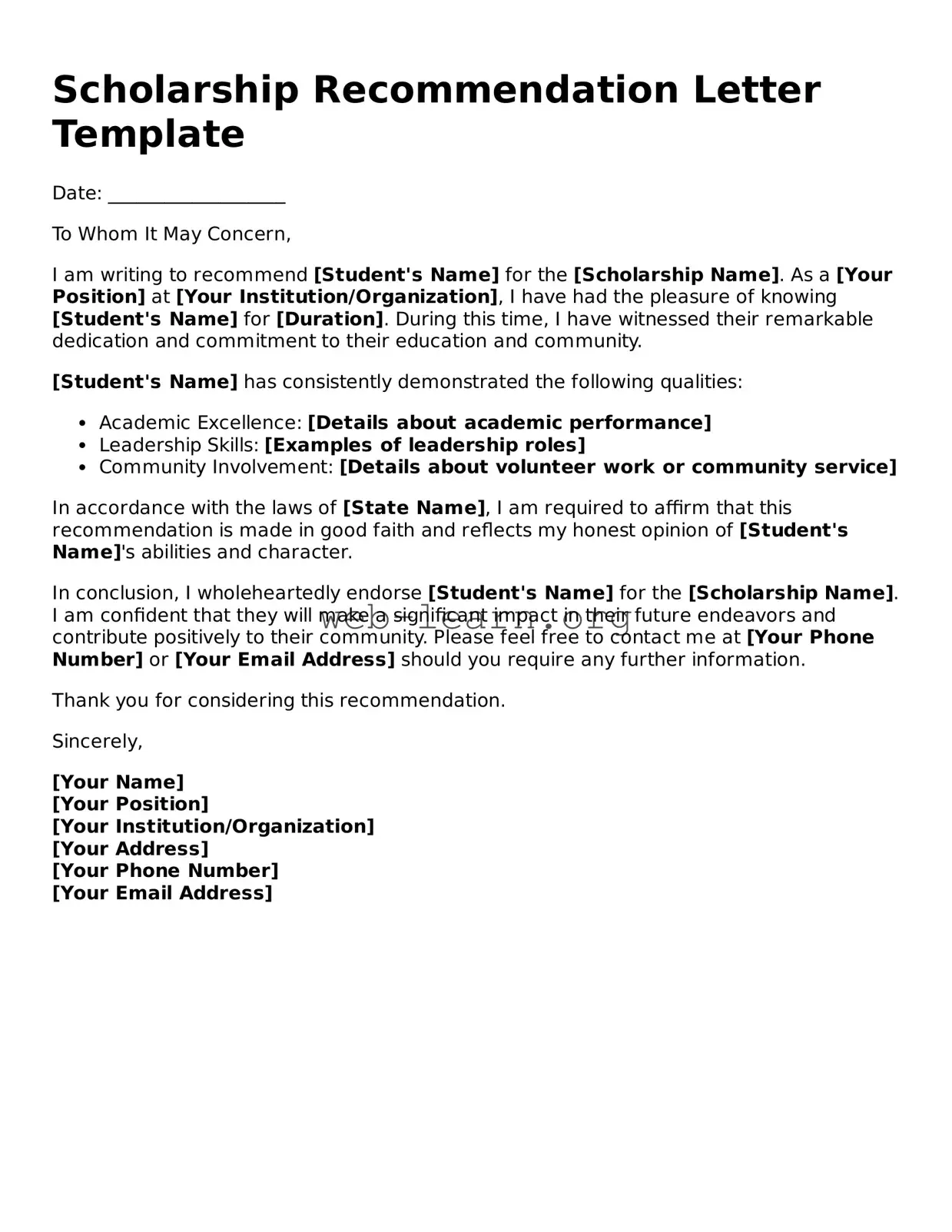
Scholarship Recommendation Letter Template
Date: ___________________
To Whom It May Concern,
I am writing to recommend [Student's Name] for the [Scholarship Name]. As a [Your Position] at [Your Institution/Organization], I have had the pleasure of knowing [Student's Name] for [Duration]. During this time, I have witnessed their remarkable dedication and commitment to their education and community.
[Student's Name] has consistently demonstrated the following qualities:
In accordance with the laws of [State Name], I am required to affirm that this recommendation is made in good faith and reflects my honest opinion of [Student's Name]'s abilities and character.
In conclusion, I wholeheartedly endorse [Student's Name] for the [Scholarship Name]. I am confident that they will make a significant impact in their future endeavors and contribute positively to their community. Please feel free to contact me at [Your Phone Number] or [Your Email Address] should you require any further information.
Thank you for considering this recommendation.
Sincerely,
[Your Name]
[Your Position]
[Your Institution/Organization]
[Your Address]
[Your Phone Number]
[Your Email Address]
| Fact Name | Description |
|---|---|
| Purpose | The Scholarship Recommendation Letter form is used to provide endorsements for scholarship applicants. |
| Components | The form typically includes the recommender's information, applicant's details, and a section for comments. |
| Confidentiality | Many forms allow for confidentiality, meaning the applicant may not see the recommendation. |
| Submission Process | Recommenders usually submit the form directly to the scholarship committee or organization. |
| Deadline | Each scholarship has its own deadline for submission, which must be adhered to by recommenders. |
| State-Specific Forms | Some states have specific requirements for recommendation letters, governed by local education laws. |
| Governing Laws | In California, for instance, the California Education Code governs scholarship recommendations. |
| Format | The form can be submitted in various formats, including paper and electronic versions. |
| Importance of Specificity | Recommenders should provide specific examples of the applicant's skills and accomplishments. |
| Impact on Decision | A strong recommendation can significantly influence the scholarship committee's decision-making process. |
After you gather all necessary information, you can begin filling out the Scholarship Recommendation Letter form. This process will help you provide a comprehensive and supportive recommendation for the applicant. Follow the steps below to ensure you complete the form correctly.
A Scholarship Recommendation Letter is a document written by someone who can vouch for a student's qualifications and character. This letter supports the student's application for a scholarship by highlighting their achievements, skills, and potential.
The letter should be written by someone familiar with the student's academic and personal qualities. This could be a teacher, school counselor, employer, or community leader. Choose someone who can provide specific examples of the student's strengths.
The letter should include:
The letter should typically be one page long. It should be concise while still providing enough detail to give a clear picture of the student's qualifications.
While there is no strict format, the letter should be typed and professionally presented. It should include the writer's contact information, the date, and a formal greeting. A closing statement and signature are also important.
Submission methods vary by scholarship program. Some may require the letter to be sent directly to them, while others may ask the student to include it in their application package. Always check the specific requirements of the scholarship.
Yes, you can request letters from multiple recommenders. However, ensure that each letter offers a unique perspective on your qualifications. It’s beneficial to have a diverse range of recommendations.
It’s best to ask at least 4-6 weeks before the deadline. This gives the writer ample time to craft a thoughtful letter without feeling rushed.
If your recommender has questions, encourage open communication. Offer to provide additional information about the scholarship or your achievements to help them write a strong letter.
Filling out a Scholarship Recommendation Letter form can be a daunting task. Many people make common mistakes that can undermine the effectiveness of the letter. One frequent error is providing vague or generic information. A recommendation should highlight specific achievements and qualities of the student. Instead of saying, "She is a good student," it is more impactful to mention, "She consistently scores in the top 10% of her class."
Another mistake is failing to tailor the letter to the specific scholarship. Each scholarship may have different criteria or values. It is essential to align the recommendation with what the scholarship committee is looking for. A one-size-fits-all approach can weaken the recommendation's impact.
Some recommenders overlook the importance of structure. A well-organized letter makes it easier for the committee to read and understand. Starting with an introduction, followed by specific examples, and concluding with a strong endorsement can create a compelling narrative. Without this structure, the letter may come across as disjointed or unfocused.
Additionally, not including personal anecdotes can be a missed opportunity. Personal stories can illustrate the student's character and capabilities in a way that statistics cannot. For instance, sharing a story about a time the student demonstrated leadership or resilience can leave a lasting impression.
Another common mistake is neglecting to proofread the letter. Spelling and grammatical errors can detract from the professionalism of the recommendation. A well-written letter reflects positively on both the student and the recommender. Taking the time to review the letter can prevent these issues.
Lastly, some recommenders forget to include their contact information. This oversight can hinder the committee's ability to reach out for further clarification or questions. Including a phone number and email address ensures that the committee can follow up if needed.
When applying for scholarships, various forms and documents are often required to support the application. Each of these documents serves a specific purpose and helps provide a comprehensive view of the applicant's qualifications, achievements, and character. Below is a list of common forms and documents that may accompany the Scholarship Recommendation Letter form.
By gathering and submitting these documents along with the Scholarship Recommendation Letter, applicants can present a well-rounded picture of their qualifications. Each piece plays a vital role in the evaluation process, helping scholarship committees make informed decisions.
Job Recommendation Letter: Similar to a scholarship recommendation letter, this document provides a character and skills assessment of an individual applying for a job. It highlights qualifications and experiences relevant to the position.
College Admission Recommendation Letter: This letter supports a student's application to a college or university, detailing their academic abilities and personal qualities that make them a good fit for the institution.
Graduate School Recommendation Letter: Much like a scholarship letter, this document is crucial for applicants seeking advanced degrees. It discusses the candidate's readiness for graduate-level work and their potential for success in the program.
Internship Recommendation Letter: This type of letter endorses a candidate for an internship position, focusing on relevant skills, experiences, and the potential to contribute to the organization.
Volunteer Recommendation Letter: Similar in purpose, this letter highlights an individual's commitment and contributions to volunteer work, showcasing their character and work ethic.
Character Reference Letter: This document provides insight into a person's character and personal qualities, often used in various applications, including legal matters and housing.
Professional Reference Letter: This letter serves to validate a person's professional skills and experiences, often used in job applications or networking opportunities.
Personal Reference Letter: A personal reference letter discusses an individual's personal attributes and experiences, often used for various applications, such as housing or community involvement.
Membership Recommendation Letter: This document supports an individual's application for membership in a professional organization or society, detailing their qualifications and commitment to the field.
Grant Recommendation Letter: Similar to a scholarship recommendation, this letter endorses an individual or organization applying for a grant, emphasizing their qualifications and the impact of their work.
When filling out a Scholarship Recommendation Letter form, there are several important guidelines to follow. Here is a list of things you should and shouldn't do:
By following these guidelines, you can create a strong and effective recommendation letter that supports the candidate's scholarship application.
When it comes to scholarship recommendation letters, there are several misconceptions that can lead to confusion. Understanding these can help both recommenders and applicants navigate the process more effectively. Here are five common misconceptions:
By clarifying these misconceptions, both applicants and recommenders can approach the scholarship recommendation letter process with greater confidence and understanding.
When filling out and using the Scholarship Recommendation Letter form, it's essential to keep several key points in mind. Here are nine important takeaways:
By following these guidelines, the process of filling out and using the Scholarship Recommendation Letter form can be more effective and impactful.