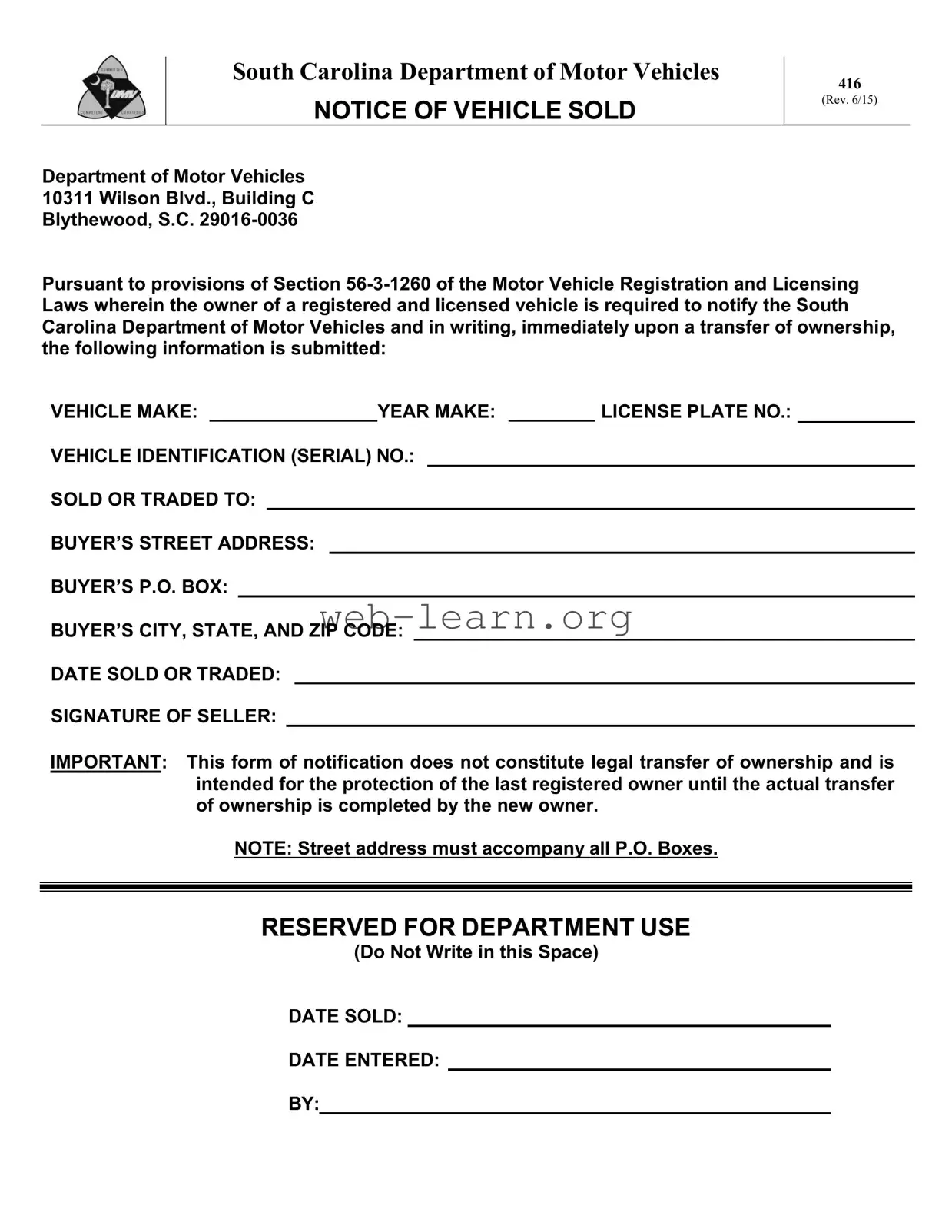
The South Carolina DMV 416 form serves a crucial role in the vehicle ownership transfer process. When you sell or trade your vehicle, it is your responsibility to notify the South Carolina Department of Motor Vehicles (DMV) immediately. This form is designed to document essential details about the vehicle, including its make, year, license number, and vehicle identification number. Additionally, it requires information about the new owner, such as their name, address, and the date of the sale or trade. It's important to understand that while this form acts as a notification of the sale, it does not legally transfer ownership. This distinction is significant, as the last registered owner remains liable for the vehicle until the new owner completes the official transfer process. The form must be filled out accurately and submitted promptly to ensure your protection as the seller. Remember, including a street address alongside any P.O. Box is a requirement. This form is a straightforward yet essential step in safeguarding your interests during the vehicle transfer process.

South Carolina Department of Motor Vehicles |
416 |
NOTICE OF VEHICLE SOLD |
(Rev. 6/15) |
|
Department of Motor Vehicles
10311 Wilson Blvd., Building C
Blythewood, S.C.
Pursuant to provisions of Section
VEHICLE MAKE: |
|
YEAR MAKE: |
|
LICENSE PLATE NO.: |
VEHICLE IDENTIFICATION (SERIAL) NO.:
SOLD OR TRADED TO:
BUYER’S STREET ADDRESS:
BUYER’S P.O. BOX:
BUYER’S CITY, STATE, AND ZIP CODE:
DATE SOLD OR TRADED:
SIGNATURE OF SELLER:
IMPORTANT: This form of notification does not constitute legal transfer of ownership and is intended for the protection of the last registered owner until the actual transfer of ownership is completed by the new owner.
NOTE: Street address must accompany all P.O. Boxes.
RESERVED FOR DEPARTMENT USE
(Do Not Write in this Space)
DATE SOLD:
DATE ENTERED:
BY:
| Fact Name | Details |
|---|---|
| Form Title | South Carolina Department of Motor Vehicles Notice of Vehicle Sold (Form 416) |
| Governing Law | Section 56-3-1260 of the Motor Vehicle Registration and Licensing Laws |
| Purpose | This form notifies the DMV of a vehicle's transfer of ownership. |
| Required Information | Details such as vehicle make, year, license number, and VIN must be provided. |
| Seller's Responsibility | The seller must notify the DMV in writing upon the sale or trade of the vehicle. |
| Protection for Seller | This form protects the last registered owner until the new owner completes the transfer. |
| P.O. Box Requirement | A street address must accompany all P.O. Box addresses submitted on the form. |
| Signature Requirement | The seller must sign the form to validate the notification. |
| Department Use Only | There is a section reserved for DMV use, which should not be filled out by the seller. |
Filling out the SC DMV 416 form is an important step when you sell or trade your vehicle in South Carolina. Completing this form helps ensure that the South Carolina Department of Motor Vehicles is informed about the change in ownership. After submitting it, the DMV will process the information, but remember that this form does not finalize the legal transfer of ownership.
Once you have completed the form, submit it to the South Carolina DMV. Keep a copy for your records, as it may be useful in case of any future inquiries regarding the vehicle's ownership.
What is the SC DMV 416 form?
The SC DMV 416 form, also known as the Notice of Vehicle Sold, is a document required by the South Carolina Department of Motor Vehicles. This form is used to notify the DMV when a vehicle has been sold or traded. It is essential for ensuring that the last registered owner is protected until the new owner completes the legal transfer of ownership.
When do I need to submit the SC DMV 416 form?
You must submit the SC DMV 416 form immediately after you sell or trade your vehicle. This notification is required by law, specifically under Section 56-3-1260 of the Motor Vehicle Registration and Licensing Laws in South Carolina. Prompt submission helps protect you from any future liabilities associated with the vehicle.
What information is required on the SC DMV 416 form?
To complete the SC DMV 416 form, you will need to provide several key details:
Does submitting the SC DMV 416 form transfer ownership of the vehicle?
No, submitting the SC DMV 416 form does not legally transfer ownership of the vehicle. It serves as a notification to the DMV that the vehicle has been sold or traded. The actual transfer of ownership occurs when the new owner registers the vehicle in their name. Until that happens, you remain the last registered owner and are protected from any potential liabilities.
Where do I send the completed SC DMV 416 form?
Once you have completed the SC DMV 416 form, send it to the South Carolina Department of Motor Vehicles at the following address:
P.O. Box 1498
Blythewood, S.C. 29016-0036
Is there a fee associated with submitting the SC DMV 416 form?
No, there is no fee for submitting the SC DMV 416 form. This form is provided as a service to help protect the seller and ensure that the DMV has up-to-date information regarding vehicle ownership. It is important to complete this step to avoid any future complications.
Filling out the South Carolina DMV 416 form can seem straightforward, but many people make mistakes that can lead to complications. One common error is not providing the correct vehicle identification number (VIN). This number is crucial for identifying the vehicle and must match the one on the title. Any discrepancies can delay the processing of the notification.
Another frequent mistake is failing to include the full street address when a P.O. Box is provided. The form clearly states that a street address must accompany any P.O. Box. Omitting this information can result in the form being rejected or returned.
Many individuals also overlook the signature of the seller. This signature is essential as it verifies that the seller is indeed notifying the DMV of the sale or trade. Without it, the form cannot be processed, and the seller may remain liable for the vehicle.
Some people do not enter the date sold or traded accurately. This date is important for record-keeping and helps establish the timeline of ownership transfer. An incorrect date can lead to confusion and potential legal issues.
Inaccurate vehicle make and model information is another common issue. It is vital to ensure that the make and year of the vehicle are correctly filled out. Mistakes in this section can complicate the transfer process.
Not double-checking the license number is also a mistake that can cause delays. This number should match what is on the vehicle registration. Any errors can lead to a mismatch in records.
Some individuals forget to review the entire form before submission. Taking a moment to read through the completed form can help catch errors that may have been overlooked initially. This simple step can save time and prevent issues.
People often neglect to keep a copy of the submitted form for their records. Having a copy can be useful if any questions arise later regarding the sale or trade of the vehicle.
Another mistake is not understanding that this form does not legally transfer ownership. Many assume that submitting the form is enough to complete the sale. However, the actual transfer must be finalized by the new owner at the DMV.
Lastly, failing to submit the form in a timely manner can lead to problems. The form should be submitted immediately upon the transfer of ownership to protect the last registered owner from any liabilities associated with the vehicle.
The South Carolina DMV 416 form, also known as the Notice of Vehicle Sold, is essential for notifying the DMV about a vehicle's change of ownership. Alongside this form, several other documents may be necessary to ensure a smooth transaction and proper record-keeping. Below is a list of common forms and documents that often accompany the SC DMV 416 form.
These documents work together to facilitate a clear and legal transfer of vehicle ownership. Ensuring all necessary paperwork is completed can help prevent issues down the line and make the process smoother for everyone involved.
The SC DMV 416 form serves a specific purpose in notifying the DMV about the sale or trade of a vehicle. Several other documents share similar functions in vehicle ownership transfer and notification. Here are four such documents:
When filling out the South Carolina DMV 416 form, it’s important to follow specific guidelines to ensure accuracy and compliance. Here’s a list of things you should and shouldn’t do:
Understanding the South Carolina DMV 416 form is crucial for anyone involved in the sale or trade of a vehicle. However, several misconceptions often arise about this form. Here are eight common misunderstandings:
Being aware of these misconceptions can help ensure a smoother transaction when selling or trading a vehicle in South Carolina. Always take the time to understand the requirements and implications of the DMV 416 form.
When filling out the SC DMV 416 form, there are several important points to consider. Understanding these key takeaways can help ensure a smooth process for notifying the South Carolina Department of Motor Vehicles about the sale or trade of a vehicle.
By following these guidelines, you can ensure that your notification is processed efficiently, safeguarding your interests as a seller.