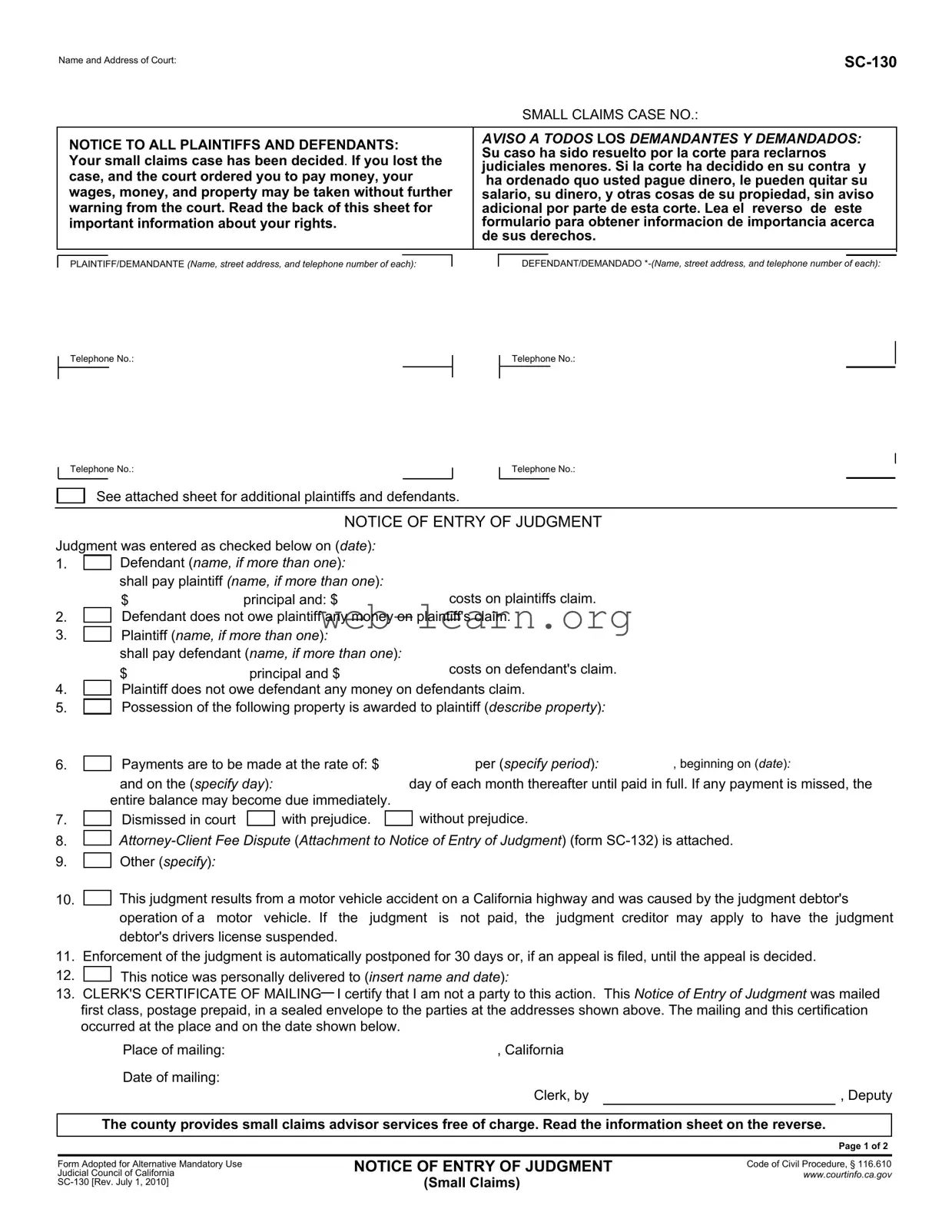
The SC-130 form is a crucial document used in California's small claims court system, serving as the official notice of entry of judgment. This form outlines the court's decision regarding a small claims case, detailing whether one party is required to pay money to the other or if no payment is owed. It includes essential information such as the names and addresses of both plaintiffs and defendants, the case number, and the specific terms of the judgment. For those who have lost their case, the SC-130 form warns that their wages or property may be seized to satisfy the judgment, emphasizing the importance of understanding one's rights and options following the court's decision. Conversely, for the winning party, the form provides guidance on how to collect the awarded amount or reclaim property. The document also highlights the potential for appeals and outlines the steps each party can take, ensuring that both plaintiffs and defendants are aware of their responsibilities and rights after the judgment is entered. This comprehensive approach not only facilitates clarity but also reassures individuals navigating the small claims process that there are avenues available for addressing their situations post-judgment.
Name and Address of Court:
SMALL CLAIMS CASE NO.:
NOTICE TO ALL PLAINTIFFS AND DEFENDANTS: |
AVISO A TODOS LOS DEMANDANTES Y DEMANDADOS: |
||
Su caso ha sido resuelto por la corte para reclarnos |
|||
Your small claims case has been decided. If you lost the |
|||
judiciales menores. Si la corte ha decidido en su contra y |
|||
case, and the court ordered you to pay money, your |
|||
ha ordenado quo usted pague dinero, le pueden quitar su |
|||
wages, money, and property may be taken without further |
|||
salario, su dinero, y otras cosas de su propiedad, sin aviso |
|||
warning from the court. Read the back of this sheet for |
adicional por parte de esta corte. Lea el reverso de este |
||
important information about your rights. |
formulario para obtener informacion de importancia acerca |
||
|
de sus derechos. |
||
|
|
|
|
|
|
|
|
PLAINTIFF/DEMANDANTE (Name, street address, and telephone number of each):
DEFENDANT/DEMANDADO
Telephone No.:
Telephone No.:
Telephone No.:
See attached sheet for additional plaintiffs and defendants.
Telephone No.:
|
|
|
|
|
NOTICE OF ENTRY OF JUDGMENT |
|
|||
Judgment was entered as checked below on (date): |
|
|
|
||||||
1. |
|
Defendant (name, if more than one): |
|
|
|
||||
|
|
shall pay plaintiff (name, if more than one): |
|
|
|
||||
|
$ |
principal and: $ |
|
costs on plaintiffs claim. |
|
||||
2. |
|
Defendant does not owe plaintiff any money on plaintiff's claim. |
|
||||||
3. |
|
Plaintiff (name, if more than one): |
|
|
|
||||
|
|
|
|
||||||
|
|
shall pay defendant (name, if more than one): |
|
|
|
||||
|
$ |
|
principal and $ |
|
costs on defendant's claim. |
|
|||
|
|
|
|
|
|||||
4. |
|
Plaintiff does not owe defendant any money on defendants claim. |
|
||||||
5. |
|
Possession of the following property is awarded to plaintiff (describe property): |
|
||||||
|
|
||||||||
6. |
|
Payments are to be made at the rate of: $ |
|
per (specify period): |
, beginning on (date): |
||||
|
|
||||||||
|
|
and on the (specify day): |
day of each month thereafter until paid in full. If any payment is missed, the |
||||||
|
|
entire balance may become due immediately. |
|
|
|
||||
7. |
|
Dismissed in court |
|
|
with prejudice. |
|
|
without prejudice. |
|
|
|
|
|
|
|
||||
8. |
|
||||||||
|
|||||||||
|
|||||||||
9. |
|
Other (specify): |
|
|
|
|
|
|
|
|
|
|
|
|
|
|
|
||
This judgment results from a motor vehicle accident on a California highway and was caused by the judgment debtor's operation of a motor vehicle. If the judgment is not paid, the judgment creditor may apply to have the judgment debtor's drivers license suspended.
11.Enforcement of the judgment is automatically postponed for 30 days or, if an appeal is filed, until the appeal is decided.
12. This notice was personally delivered to (insert name and date):
13. CLERK'S CERTIFICATE OF MAILING |
|
I certify that I am not a party to this action. This Notice of Entry of Judgment was mailed |
||
|
||||
first class, postage prepaid, in a sealed envelope to the parties at the addresses shown above. The mailing and this certification |
||||
occurred at the place and on the date shown below. |
|
|
||
Place of mailing: |
|
, California |
|
|
Date of mailing: |
|
|
|
|
|
|
Clerk, by |
|
, Deputy |
|
|
|
|
|
The county provides small claims advisor services free of charge. Read the information sheet on the reverse.
Page 1 of 2
Form Adopted for Alternative Mandatory Use Judicial Council of California
NOTICE OF ENTRY OF JUDGMENT
(Small Claims)
Code of Civil Procedure, § 116.610
www.courtinfo.ca.gov
|
|
INFORMATION AFTER JUDGMENT |
INFORMACION DESPUES DEL FALLO DE LA CORTE |
|
|
Your small claims case has been decided. The judgment or decision of the court appears on the front of this sheet. The court may have ordered one party to pay money to the other party. The person (or business) who won the case and who can collect the money is called the judgment creditor. The person (or business) who lost the case and who owes the money is called the judgment debtor.
Enforcement of the judgment is postponed until the time for appeal ends or until the appeal is decided. This means that the judgment creditor cannot collect any money or take any action until this period is over. Generally, both parties may be represented by lawyers after judgment.
IF YOU LOST THE CASE . . .
1 . If you lost the case on your own claim and the court did not award you any money, the court's decision on your claim is FINAL. You may not appeal your own claim.
2 . If you lost the case and the court ordered you to pay money,
your money and property may be taken to pay the claim unless you do one of the following things:
a. PAY THE JUDGMENT
The law requires you to pay the amount of the judgment. You may pay the judgment creditor directly, or pay the judgment to the court for an additional fee. You may also ask the court to order monthly payments you can afford.
Ask the clerk for information about these procedures.
b.APPEAL
If you disagree with the court's decision, you may appeal the decision on the other party's claim. You may not
appeal the decision on your own claim. However, if any party appeals, there will be a new trial on all the claims. If you appeared at the trial, you must begin your appeal by filing a form called a Notice of Appeal (form
you. Your appeal will be in the superior court. You will
have a new trial and you must present your evidence again. You may be represented by a lawyer.
c.VACATE OR CANCEL THE JUDGMENT
If you did not go to the trial, you may ask the court to vacate or cancel the judgment. To make this request, you must file a Motion to Vacate the Judgment (form
IF YOU WON THE CASE . . .
1.If you were sued by the other party and you won the case, then the other party may not appeal the court's decision.
2.If you won the case and the court awarded you money, here are some steps you may take to collect your money or get possession of your property:
a.COLLECTING FEES AND INTEREST
Sometimes fees are charged for filing court papers or for serving the judgment debtor. These extra costs can become part of your original judgment. To claim these fees, ask the clerk for a Memorandum of Costs.
b.VOLUNTARY PAYMENT
Ask the judgment debtor to pay the money. If your claim was for possession of property, ask the judgment debtor to return the property to you. THE COURT WILL NOT COLLECT THE
MONEY OR ENFORCE THE JUDGMENT FOR YOU.
c.STATEMENT OF ASSETS
If the judgment debtor does not pay the money, the law requires the debtor to fill out a form called the Judgment Debtor's Statement of Assets (form
d.ORDER OF EXAMINATION
You may also make the debtor come to court to answer questions about income and property. To do this, ask the clerk for an Application and Order for Appearance and Examination (Enforcement of Judgment) (form
e.WRIT OF EXECUTION
After you find out about the judgment debtor's property, you may ask the court for a Writ of Execution (form
f.ABSTRACT OF JUDGMENT
The judgment debtor may own land or a house or other buildings. You may want to put a lien on the property so that you will be paid if the property is sold. You can get a lien by filing an Abstract of Judgment (form
NOTICE TO THE PARTY WHO WON: As soon as you have been paid in full, you must fill out the form below and mail it to the court immediately or you may be fined. If an Abstract of Judgment has been recorded, you must use another form; see the clerk for the proper form.
SMALL CLAIMS CASE NO.:
ACKNOWLEDGMENT OF SATISFACTION OF JUDGMENT (Do not
use this form if an Abstract of Judgment has been recorded.)
To the Clerk of the Court:
I am the
judgment creditor
assignee of record.
I agree that the judgment in this action has been paid in full or otherwise satisfied.
Date:
(TYPE OR PRINT NAME) |
(SIGNATURE) |
NOTICE OF ENTRY OF JUDGMENT |
Page 2 of 2
(Small Claims)
| Fact Name | Details |
|---|---|
| Form Purpose | The SC-130 form is used to notify parties of the judgment entered in a small claims case. |
| Governing Law | This form is governed by California Code of Civil Procedure, § 116.610. |
| Judgment Notification | The form informs both plaintiffs and defendants about the outcome of their case. |
| Judgment Creditor and Debtor | The winning party is referred to as the judgment creditor, while the losing party is the judgment debtor. |
| Enforcement Delay | Enforcement of the judgment is postponed for 30 days or until any appeal is resolved. |
| Payment Options | Judgment debtors may pay the judgment directly or request monthly payment arrangements through the court. |
| Appeal Process | If a party disagrees with the judgment, they may file a Notice of Appeal within 30 days. |
| Judgment Satisfaction | Once the judgment is paid, the creditor must notify the court to avoid penalties. |
Filling out the SC-130 form involves providing essential information about the court's decision regarding a small claims case. This form is used to notify the parties involved about the judgment entered by the court. Proper completion of this form is crucial for ensuring that all parties are informed about their rights and obligations following the judgment.
The SC-130 form, also known as the Notice of Entry of Judgment, is used in California small claims court cases. It provides official notification of the court's decision in a small claims case, detailing the judgment that has been entered.
The form identifies two main parties: the plaintiff (the person or business who filed the claim) and the defendant (the person or business being sued). Their names, addresses, and contact information are included on the form.
The SC-130 form includes:
If you lost the case, the court's decision is final regarding your own claim. You may be required to pay the judgment amount. Options available include paying the judgment, appealing the decision, or requesting to vacate the judgment if you did not attend the trial.
You can appeal the judgment only if you lost on the other party's claim. To initiate an appeal, you must file a Notice of Appeal within 30 days of receiving the SC-130 form. The appeal will be heard in superior court, and you will need to present your evidence again.
If you won the case, the other party cannot appeal the court's decision. You can take steps to collect your judgment, such as requesting payment or possession of property. If the judgment debtor does not pay, you may need to file additional forms to enforce the judgment.
Collecting a judgment may involve several steps:
Enforcement of the judgment is automatically postponed for 30 days after the judgment is entered. If an appeal is filed, enforcement is delayed until the appeal is resolved.
Once the judgment has been paid in full, the judgment creditor must complete and submit an Acknowledgment of Satisfaction of Judgment form to the court. Failure to do so may result in fines.
The county provides free small claims advisor services. You can contact your local court for more information or assistance with the small claims process.
Filling out the SC-130 California form can be a straightforward process, but there are common mistakes that individuals often make. Awareness of these pitfalls can help ensure that your submission is accurate and complete.
One frequent error is failing to provide complete contact information for all parties involved. Each plaintiff and defendant must include their full name, street address, and telephone number. Omitting any of these details can lead to delays in processing or even a dismissal of the case.
Another mistake is not checking the appropriate boxes regarding the judgment details. The form includes several options related to the outcome of the case. It is crucial to accurately reflect the court's decision, whether it involves payment, dismissal, or possession of property. Misrepresenting this information can create confusion and may lead to legal complications.
Many people also overlook the importance of signing the form. A signature is necessary to validate the document. Without it, the court may not accept the form, and the case could be jeopardized.
In addition, individuals often neglect to include the correct date of judgment. This date is essential for tracking deadlines related to appeals or payment schedules. Providing an incorrect date can result in missed opportunities to respond or comply with court orders.
Another common oversight is failing to attach any required additional documents. If there are multiple plaintiffs or defendants, an attached sheet must be included. Not doing so can lead to incomplete submissions, causing delays in the legal process.
People sometimes misinterpret the instructions regarding payment plans. If the court has ordered payments, it is important to specify the amount and frequency clearly. Misunderstanding this section can lead to disputes later on.
Additionally, some individuals forget to review the back of the form for important information regarding their rights. This section often contains crucial details that can impact the next steps in the legal process. Ignoring this information can leave parties unprepared for what comes next.
Lastly, not seeking assistance when needed can be a significant mistake. The county provides small claims advisor services free of charge. Utilizing these resources can help clarify any uncertainties and ensure that the form is filled out correctly.
By being aware of these common mistakes, you can approach the SC-130 California form with greater confidence. Taking the time to double-check your information can make a substantial difference in the outcome of your small claims case.
The SC-130 form, known as the Notice of Entry of Judgment, is a critical document in the California small claims process. It outlines the court's decision regarding the case and details the obligations of the parties involved. Several other forms and documents are often utilized alongside the SC-130 to facilitate various aspects of the small claims process. Below is a list of these documents, each with a brief description.
These forms and documents serve distinct purposes in the small claims process, enhancing the ability of parties to navigate the legal landscape following a judgment. Understanding each document's role is essential for both plaintiffs and defendants as they seek to enforce or contest a judgment.
When filling out the SC-130 California form, it is essential to approach the task with care and attention to detail. Below is a list of things you should and should not do to ensure that your form is completed correctly.
By adhering to these guidelines, individuals can navigate the process of completing the SC-130 form with greater confidence and clarity. Remember, attention to detail can significantly impact the outcome of your case.
Misconceptions about the SC-130 California form can lead to confusion and unintended consequences. Here are eight common misconceptions, along with clarifications to help you better understand this important document.
This is not true. Both plaintiffs and defendants are addressed in the SC-130 form. It provides information relevant to both parties involved in a small claims case.
While the judgment is generally final, there are options available for appealing or vacating the judgment under specific circumstances. Understanding these options is crucial if you wish to contest the outcome.
Although having legal representation can be beneficial, it is not required. The small claims court system is designed to be accessible, allowing individuals to represent themselves.
This is incorrect. If the court orders you to pay money, you are legally obligated to do so. Ignoring the judgment can lead to wage garnishments or property seizures.
The court does not take on the responsibility of collecting the judgment. It is up to the winning party to take the necessary steps to enforce the judgment.
You can only appeal the opposing party's claims, not your own. This limitation can be frustrating but is a key aspect of the small claims process.
Judgment enforcement is often postponed for a period, usually 30 days, allowing the losing party time to respond or appeal. This delay is important to understand for both parties.
While the SC-130 form is crucial, other forms may be necessary depending on the actions you choose to take following the judgment. Be prepared to explore additional paperwork, such as motions or appeals, if needed.
When dealing with the SC-130 form in California, it is essential to understand its purpose and implications. Here are some key takeaways:
Understanding these points can help navigate the complexities of small claims judgments effectively.