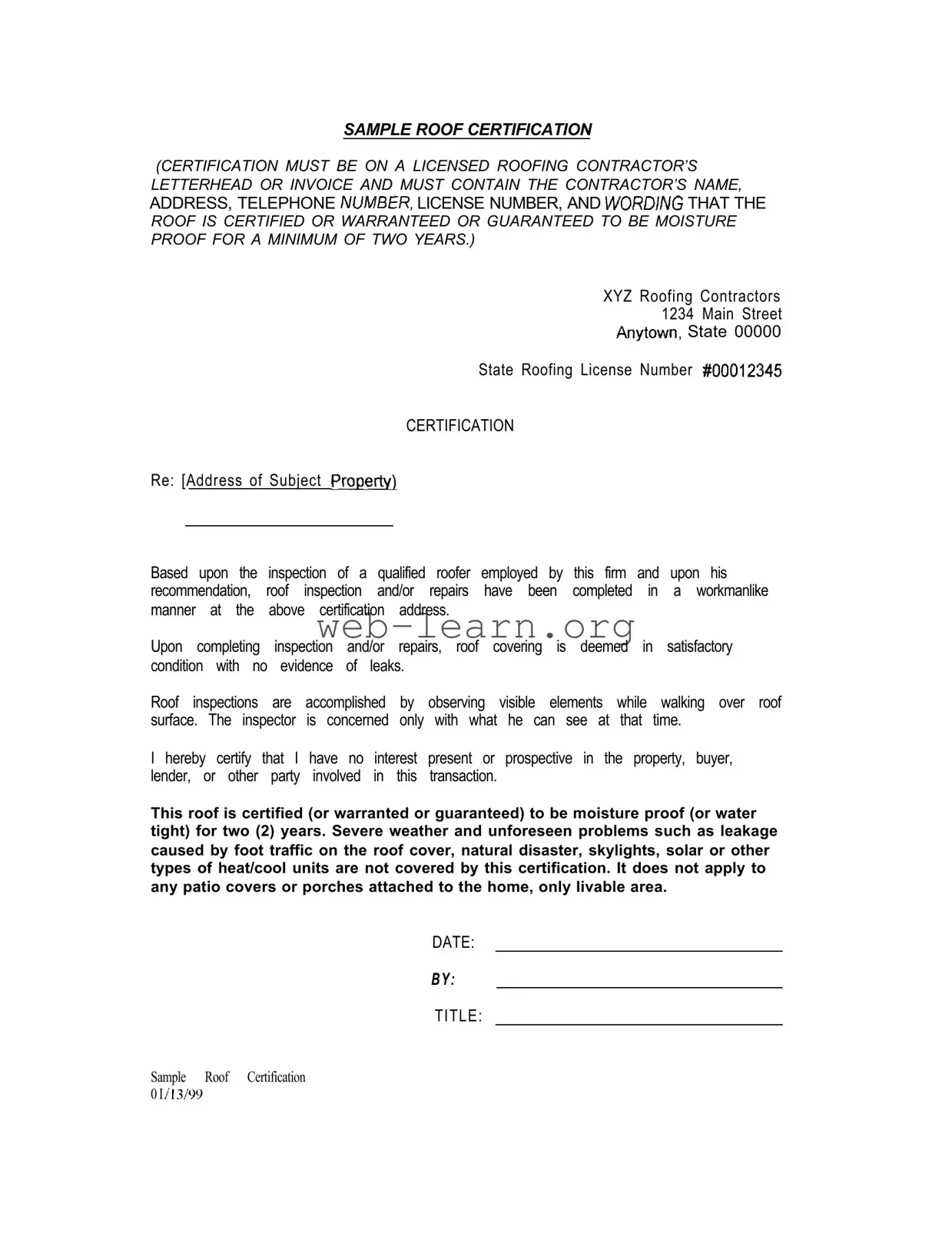
The Sample Roof Certification form is an essential document for homeowners and real estate professionals alike. It serves as proof that a qualified roofing contractor has inspected a roof and deemed it to be in satisfactory condition. This certification must be issued on the contractor's official letterhead or invoice, ensuring that it includes important details such as the contractor's name, address, telephone number, and license number. The form explicitly states that the roof is certified to be moisture-proof for a minimum of two years, providing peace of mind to buyers and lenders. It highlights that the inspection was conducted by a qualified roofer and emphasizes that any repairs were completed in a workmanlike manner. However, it is important to note that this certification does not cover damage caused by severe weather, foot traffic, or other unforeseen issues. Additionally, it applies only to livable areas of the property, excluding patio covers or porches. This comprehensive overview of the certification process helps protect all parties involved in a real estate transaction.
SAMPLE ROOF CERTIFICATION
(CERTIFICATION MUST BE ON A LICENSED ROOFING CONTRACTOR’S LETTERHEAD OR INVOICE AND MUST CONTAIN THE CONTRACTOR’S NAME,
ADDRESS, TELEPHONE NUMSER, LICENSE NUMBER, AND WORDlNG THAT THE
ROOF IS CERTIFIED OR WARRANTEED OR GUARANTEED TO BE MOISTURE PROOF FOR A MINIMUM OF TWO YEARS.)
XYZ Roofing Contractors
1234 Main Street
Anytown, State 00000
State Roofing License Number #00012345
CERTIFICATION
Re: [Address of Subject Property)
Based upon the inspection of a qualified roofer employed by this firm and upon his recommendation, roof inspection and/or repairs have been completed in a workmanlike manner at the above certification address.
Upon completing inspection and/or repairs, roof covering is deemed in satisfactory condition with no evidence of leaks.
Roof inspections are accomplished by observing visible elements while walking over roof surface. The inspector is concerned only with what he can see at that time.
I hereby certify that I have no interest present or prospective in the property, buyer, lender, or other party involved in this transaction.
This roof is certified (or warranted or guaranteed) to be moisture proof (or water tight) for two (2) years. Severe weather and unforeseen problems such as leakage caused by foot traffic on the roof cover, natural disaster, skylights, solar or other types of heat/cool units are not covered by this certification. It does not apply to any patio covers or porches attached to the home, only livable area.
DATE:
BY:
TITLE:
Sample Roof Certification 0I/13/w
| Fact Name | Description |
|---|---|
| Form Requirement | The Sample Roof Certification must be on the letterhead or invoice of a licensed roofing contractor. |
| Contractor Information | The form must include the contractor’s name, address, telephone number, and license number. |
| Certification Duration | This certification guarantees that the roof will be moisture proof for a minimum of two years. |
| Inspection Basis | The certification is based on an inspection conducted by a qualified roofer, who assesses visible elements of the roof. |
| Exclusions | It does not cover damages from severe weather, foot traffic, natural disasters, or issues related to skylights and HVAC units. |
| Governing Law | The specific governing laws may vary by state; for example, California's Business and Professions Code § 7026 governs roofing contractors. |
Filling out the Sample Roof Certification form is an important step in ensuring that a roof meets certain standards of quality and durability. This process involves gathering necessary information and providing a clear statement of certification from a licensed roofing contractor. Once completed, the form serves as a formal acknowledgment of the roof's condition and the contractor's assurances.
The Sample Roof Certification form serves as a formal document from a licensed roofing contractor, confirming that a roof has been inspected and deemed satisfactory. It assures property owners, buyers, and lenders that the roof is moisture-proof for a minimum of two years.
The certification must be printed on the contractor's letterhead or invoice and should include:
A qualified roofer conducts the inspection by walking over the roof surface and observing visible elements. The inspection focuses on what can be seen at that time, ensuring that there is no evidence of leaks or significant damage.
The certification guarantees that the roof is moisture-proof for two years. However, it does not cover:
Yes, the contractor must be licensed and qualified to perform roofing inspections and repairs. This ensures that the certification is credible and that the work has been completed in a professional manner.
If you encounter problems with your roof after receiving the certification, it is important to contact the contractor who issued the certification. Review the terms of the certification and discuss any concerns you may have regarding coverage and potential remedies.
The certification is valid for a minimum of two years from the date it is issued. After this period, it is advisable to have another inspection conducted to ensure the ongoing integrity of the roof.
When filling out the Sample Roof Certification form, individuals often make several common mistakes that can lead to complications down the line. One frequent error is failing to use the correct letterhead. The certification must be on a licensed roofing contractor's letterhead or invoice. Without this, the document may not be considered valid.
Another mistake involves omitting essential contact information. The form requires the contractor’s name, address, telephone number, and license number. If any of these details are missing, it can raise questions about the legitimacy of the certification.
People also sometimes forget to include the specific wording that states the roof is certified, warranted, or guaranteed to be moisture-proof for a minimum of two years. This language is crucial because it defines the terms of the certification. Without it, the certification lacks clarity and may not hold up in a dispute.
In addition, individuals often neglect to specify the address of the subject property in the certification. This omission can lead to confusion about which property the certification applies to, potentially complicating transactions or warranty claims.
Another common error is misrepresenting the condition of the roof. The certification should reflect an accurate assessment based on a thorough inspection. If the roof is not in satisfactory condition but is certified as such, this could lead to legal issues later.
People sometimes misunderstand the limitations of the certification. The form explicitly states that severe weather and unforeseen problems are not covered. Failing to acknowledge this can lead to unrealistic expectations about the roof's performance.
Additionally, there is often confusion regarding what areas the certification covers. The certification applies only to the livable area of the home and does not extend to patio covers or porches. Misinterpretation of this detail can result in significant misunderstandings.
Finally, individuals frequently overlook the importance of signing and dating the certification. A missing signature or date can render the document invalid, which undermines its purpose. Ensuring that all required elements are completed accurately is vital for the certification to be effective.
When dealing with roofing certifications, several other forms and documents often accompany the Sample Roof Certification form. These documents help ensure that all parties involved have a clear understanding of the roof's condition and any warranties or guarantees provided. Below is a list of commonly used documents in conjunction with the roof certification process.
Having these documents on hand can streamline the process of buying or selling a property, ensuring that everyone involved has the necessary information regarding the roof's condition and any warranties that may apply. Proper documentation not only protects the interests of homeowners but also fosters transparency in real estate transactions.
When filling out the Sample Roof Certification form, attention to detail is crucial. Here are five important dos and don'ts to keep in mind:
Following these guidelines will help ensure the form is completed accurately and effectively. This can prevent misunderstandings and ensure that all parties are aware of the roof's condition and warranty status.
There are several misconceptions surrounding the Sample Roof Certification form that can lead to confusion for homeowners and contractors alike. Here are eight common misunderstandings:
Understanding these misconceptions can help homeowners make informed decisions regarding their roofing needs and ensure they are adequately protected.
Filling out and using the Sample Roof Certification form is an important step in ensuring that a roof meets certain standards. Here are key takeaways to consider: