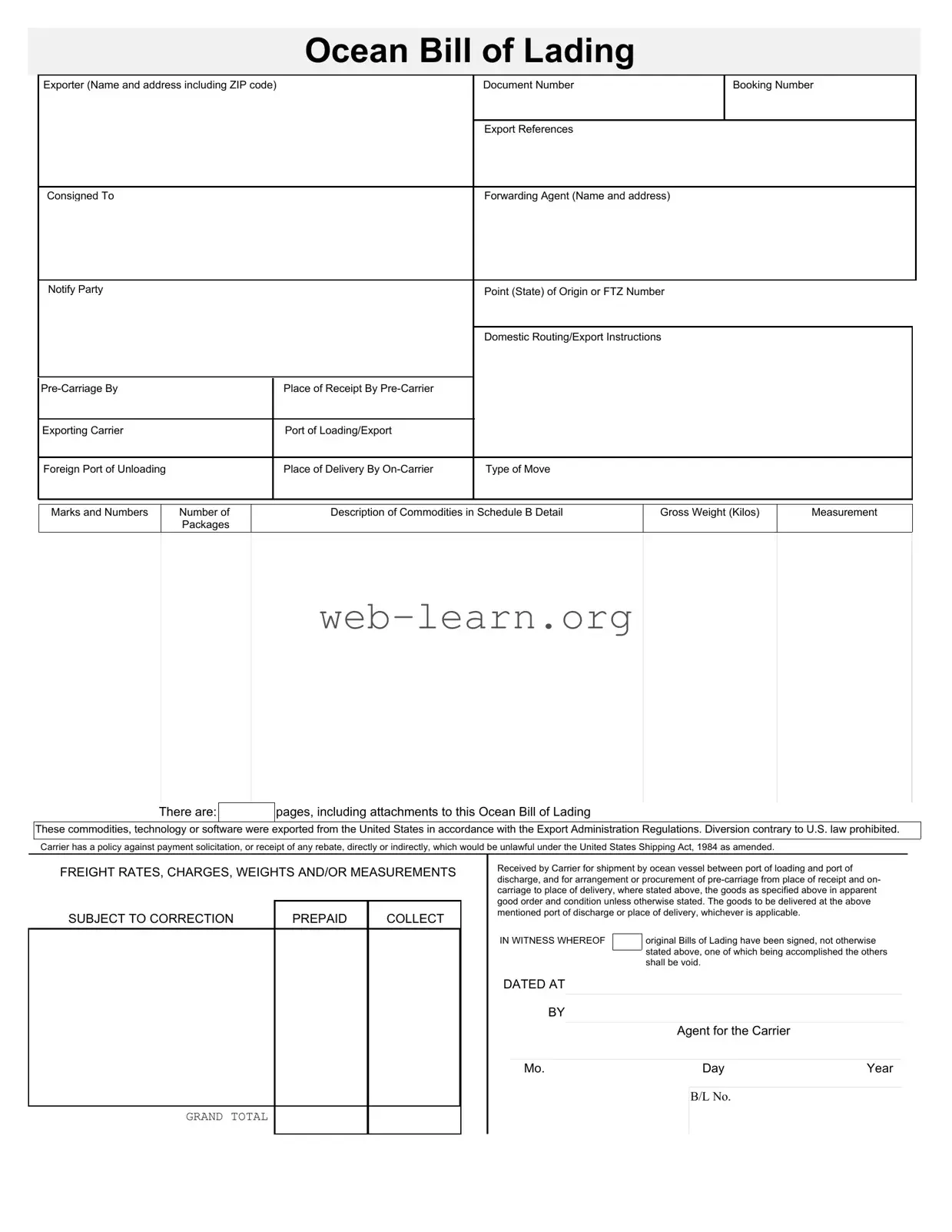
When it comes to shipping goods internationally, the Sample Ocean Bill of Lading form plays a crucial role in the process. This document serves as a receipt for the cargo, outlining essential details such as the exporter’s name and address, booking number, and the specifics of the consignment. It includes information about the forwarding agent, the point of origin, and the ports of loading and unloading. Each section of the form is designed to ensure that all parties involved—exporters, carriers, and consignees—have a clear understanding of the shipment's journey. The form also emphasizes compliance with U.S. export regulations, highlighting that any diversion of goods contrary to U.S. law is prohibited. Additionally, it addresses freight rates and charges, which are subject to correction, ensuring transparency throughout the shipping process. With a careful review of this form, shippers can confidently navigate the complexities of international trade, knowing that their goods are documented and protected every step of the way.
Ocean Bill of Lading
Exporter (Name and address including ZIP code) |
|
Document Number |
|
Booking Number |
|||||
|
|
|
|
|
|
|
|
|
|
|
|
|
|
|
|
Export References |
|
|
|
|
|
|
|
|
|
|
|
|
|
Consigned To |
|
|
|
|
Forwarding Agent (Name and address) |
|
|||
|
|
|
|
|
|
|
|
|
|
Notify Party |
|
|
|
|
Point (State) of Origin or FTZ Number |
|
|||
|
|
|
|
|
|
|
|
|
|
|
|
|
|
|
|
Domestic Routing/Export Instructions |
|
||
|
|
|
|
|
|
|
|
|
|
|
|
|
Place of Receipt By |
|
|
|
|
||
|
|
|
|
|
|
|
|
|
|
Exporting Carrier |
|
|
|
Port of Loading/Export |
|
|
|
|
|
|
|
|
|
|
|
|
|
|
|
Foreign Port of Unloading |
|
|
|
Place of Delivery By |
Type of Move |
|
|
|
|
|
|
|
|
|
|
|
|
|
|
|
|
|
|
|
|
|
|||
Marks and Numbers |
|
Number of |
|
|
Description of Commodities in Schedule B Detail |
Gross Weight (Kilos) |
Measurement |
||
|
|
Packages |
|
|
|
|
|
|
|
There are:
pages, including attachments to this Ocean Bill of Lading
These commodities, technology or software were exported from the United States in accordance with the Export Administration Regulations. Diversion contrary to U.S. law prohibited.
Carrier has a policy against payment solicitation, or receipt of any rebate, directly or indirectly, which would be unlawful under the United States Shipping Act, 1984 as amended.
FREIGHT RATES, CHARGES, WEIGHTS AND/OR MEASUREMENTS
SUBJECT TO CORRECTION |
PREPAID |
COLLECT |
GRAND TOTAL
Received by Carrier for shipment by ocean vessel between port of loading and port of discharge, and for arrangement or procurement of
IN WITNESS WHEREOF |
|
original Bills of Lading have been signed, not otherwise |
|
|
stated above, one of which being accomplished the others |
|
|
|
|
|
shall be void. |
DATED AT
BY
Agent for the Carrier
Mo. |
Day |
Year |
B/L NO.
| Fact Name | Description |
|---|---|
| Exporter Information | The Ocean Bill of Lading requires the name and address of the exporter, including the ZIP code, ensuring proper identification and accountability. |
| Document and Booking Numbers | Each form includes unique document and booking numbers. These identifiers facilitate tracking and management of shipments throughout the shipping process. |
| Consigned To and Notify Party | Details regarding the recipient of the goods and the notifying party are essential. This information ensures that all parties are informed about the shipment's status and location. |
| Legal Compliance Statement | The form contains a statement affirming that the exported commodities comply with U.S. Export Administration Regulations, highlighting the legal framework governing international trade. |
| Carrier's Policy | It includes a declaration of the carrier's policy against unlawful payment solicitation, aligning with the United States Shipping Act of 1984, thus promoting fair shipping practices. |
Filling out the Sample Ocean Bill of Lading form requires attention to detail. Each section must be completed accurately to ensure the proper handling and transportation of goods. Follow the steps below to fill out the form correctly.
Finally, ensure all sections are completed before submitting the form. Double-check for accuracy to avoid any issues during the shipping process.
What is an Ocean Bill of Lading?
An Ocean Bill of Lading is a crucial shipping document that serves multiple purposes. It acts as a receipt for goods, a contract between the shipper and the carrier, and a document of title. Essentially, it confirms that the carrier has received the goods in good condition and agrees to transport them to a specified destination.
What information is included in the Sample Ocean Bill of Lading form?
The Sample Ocean Bill of Lading form contains various essential details, including:
This information helps ensure that all parties involved have a clear understanding of the shipment details.
What does "prepaid" and "collect" mean in the context of freight charges?
In the context of freight charges, "prepaid" means that the shipping costs have been paid by the shipper before the goods are transported. On the other hand, "collect" indicates that the recipient will pay the shipping charges upon delivery. Understanding these terms is essential for both the shipper and the consignee to avoid any confusion regarding payment responsibilities.
What are the legal implications of the Ocean Bill of Lading?
The Ocean Bill of Lading has significant legal implications. It serves as a binding contract that outlines the rights and responsibilities of both the shipper and the carrier. If any disputes arise regarding the shipment, this document can be referenced to determine liability, ownership, and the terms of transport.
What is meant by "Diversion contrary to U.S. law prohibited"?
This statement indicates that the exported commodities must comply with U.S. laws and regulations. Any diversion of goods to unauthorized locations or uses is strictly prohibited. This clause helps ensure that all shipments adhere to legal standards, promoting safe and lawful trade practices.
How should discrepancies in freight rates or measurements be handled?
Discrepancies in freight rates, charges, weights, or measurements should be addressed promptly. The Ocean Bill of Lading notes that these details are subject to correction, meaning that if any errors are found, they can be amended. It is advisable for shippers and consignees to keep accurate records and communicate any issues with the carrier as soon as possible.
What should be done if the goods are not in good condition upon delivery?
If the goods are not in good condition upon delivery, the consignee should document the damage and notify the carrier immediately. The Ocean Bill of Lading serves as proof that the goods were received in apparent good order unless otherwise noted. This documentation is crucial for filing claims for damages or discrepancies.
Filling out the Sample Ocean Bill of Lading form can be straightforward, but several common mistakes can lead to complications. One frequent error is providing incomplete or incorrect information in the Exporter section. This includes omitting the ZIP code or miswriting the address. Accurate details are essential, as they ensure the shipment is correctly identified and can be tracked throughout its journey.
Another common mistake occurs in the Consigned To and Notify Party sections. People often confuse these two fields, leading to delays in communication. The Consigned To section should clearly identify the party receiving the goods, while the Notify Party is typically a separate entity that should be informed about the shipment’s status. Misplacing this information can cause significant issues when trying to coordinate delivery.
Inaccuracies in the Description of Commodities field can also create problems. Some individuals may use vague terms or fail to include necessary details, such as the Schedule B number. This can lead to customs issues or delays in the shipment process. Providing a precise and complete description helps ensure compliance with regulations and facilitates smoother transportation.
Additionally, errors in the Gross Weight and Measurement sections are common. Incorrect weight or measurement can affect freight charges and may lead to penalties. It is crucial to double-check these figures to ensure they accurately reflect the shipment's contents. Using the correct units of measurement is equally important to avoid confusion.
Lastly, neglecting to review the Carrier and Port of Loading information can result in significant issues. If these details are incorrect, it may lead to the goods being sent to the wrong location. Ensuring that all information is up to date and accurate helps prevent logistical nightmares and ensures timely delivery of goods.
The Ocean Bill of Lading is a crucial document in international shipping, serving as a receipt for goods and a contract between the shipper and carrier. Along with this document, several other forms and documents are commonly used to ensure smooth transportation and compliance with regulations. Here’s a brief overview of some of these important documents.
Using these documents in conjunction with the Ocean Bill of Lading helps facilitate the shipping process, ensuring that all parties are informed and compliant with regulations. Proper documentation minimizes delays and potential legal issues, making it essential for anyone involved in international trade.
The Sample Ocean Bill of Lading form shares similarities with several other shipping and transportation documents. Each of these documents serves specific purposes in the shipping process and contains essential information about the cargo and the parties involved. Below is a list of nine documents that are similar to the Ocean Bill of Lading:
When filling out the Sample Ocean Bill of Lading form, it is important to follow certain guidelines to ensure accuracy and compliance. Here is a list of things you should and shouldn't do:
Here are 10 common misconceptions about the Sample Ocean Bill of Lading form:
When filling out and using the Sample Ocean Bill of Lading form, consider the following key takeaways:
These takeaways provide a foundational understanding of how to effectively complete and utilize the Ocean Bill of Lading form, ensuring compliance and efficiency in the shipping process.