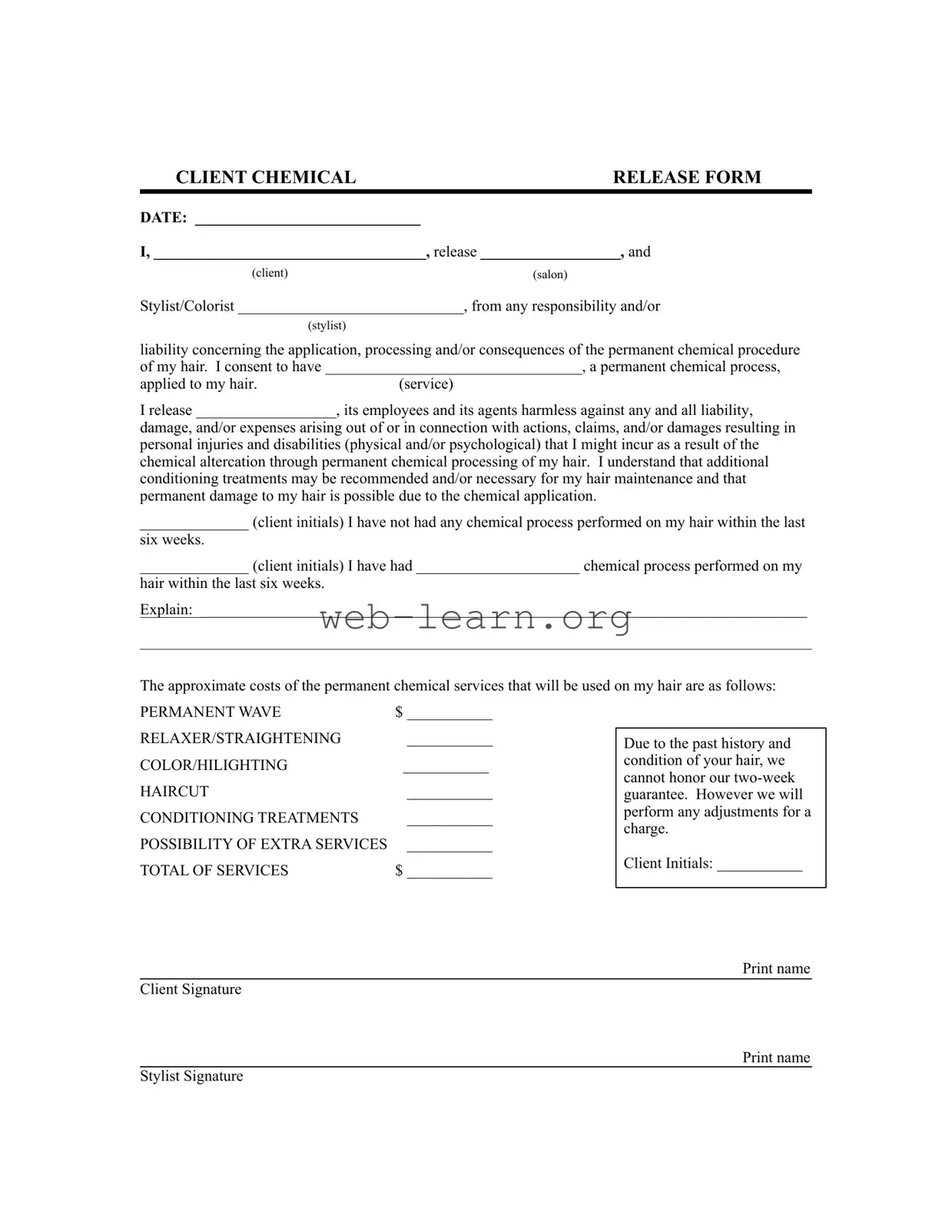
The Salon Chemical Waiver form serves as a crucial document for both clients and salons, ensuring a clear understanding of the responsibilities and potential risks associated with chemical hair treatments. This form is designed to protect the salon and its staff from liability by requiring clients to acknowledge and accept the inherent risks involved in procedures such as permanent waves, relaxers, and other chemical processes. Clients are asked to release the salon and their stylist from any responsibility for injuries or damages that may arise from these treatments. Additionally, the form outlines the necessity for clients to disclose any prior chemical processes they may have undergone within the last six weeks, which can significantly affect the outcome and health of their hair. It also highlights the possibility of requiring additional conditioning treatments and informs clients about the costs associated with the services being rendered. By signing this waiver, clients not only consent to the chemical application but also affirm their understanding of the potential for permanent damage to their hair, thus fostering an informed and transparent relationship between the client and the salon.

CLIENT CHEMICALRELEASE FORM
DATE: _____________________________
I, ___________________________________, release __________________, and
(client)(salon)
Stylist/Colorist _____________________________, from any responsibility and/or
(stylist)
liability concerning the application, processing and/or consequences of the permanent chemical procedure of my hair. I consent to have _________________________________, a permanent chemical process,
applied to my hair.(service)
I release __________________, its employees and its agents harmless against any and all liability,
damage, and/or expenses arising out of or in connection with actions, claims, and/or damages resulting in personal injuries and disabilities (physical and/or psychological) that I might incur as a result of the chemical altercation through permanent chemical processing of my hair. I understand that additional conditioning treatments may be recommended and/or necessary for my hair maintenance and that permanent damage to my hair is possible due to the chemical application.
______________ (client initials) I have not had any chemical process performed on my hair within the last
six weeks.
______________ (client initials) I have had _____________________ chemical process performed on my
hair within the last six weeks.
Explain: ______________________________________________________________________________
The approximate costs of the permanent chemical services that will be used on my hair are as follows:
PERMANENT WAVE |
$ ___________ |
|
|
RELAXER/STRAIGHTENING |
___________ |
|
|
Due to the past history and |
|||
COLOR/HILIGHTING |
___________ |
condition of your hair, we |
|
HAIRCUT |
___________ |
cannot honor our |
|
guarantee. However we will |
|||
CONDITIONING TREATMENTS |
___________ |
perform any adjustments for a |
|
charge. |
|||
POSSIBILITY OF EXTRA SERVICES |
___________ |
||
Client Initials: ___________ |
|||
TOTAL OF SERVICES |
$ ___________ |
||
|
|||
|
|
|
Print name
Client Signature
Print name
Stylist Signature
| Fact Name | Details |
|---|---|
| Purpose of the Waiver | The Salon Chemical Waiver form releases the salon and stylist from liability related to chemical hair treatments. |
| Client Consent | Clients must provide explicit consent for the application of permanent chemical processes on their hair. |
| Health Considerations | The form addresses potential personal injuries or psychological effects resulting from the chemical treatment. |
| Prior Chemical Treatments | Clients must disclose any chemical processes performed on their hair within the last six weeks. |
| Cost Disclosure | The form outlines approximate costs for various services such as permanent waves, relaxers, and conditioning treatments. |
| Additional Treatments | Clients may be advised to undergo additional conditioning treatments to maintain hair health after the procedure. |
| Two-Week Guarantee | Due to hair condition, the salon may not honor a two-week guarantee for the chemical services provided. |
| Client Initials | Clients must initial specific sections of the form to acknowledge their understanding and acceptance of the terms. |
| Governing Law | State-specific laws may govern the waiver; consult local regulations for compliance. |
| Signatures Required | Both the client and stylist must sign the form to validate the agreement and acknowledgment of the risks involved. |
Filling out the Salon Chemical Waiver form is an important step before receiving any chemical treatment for your hair. By completing this form, you acknowledge the potential risks involved and provide consent for the services. Follow the steps below to ensure that you fill out the form correctly.
What is the purpose of the Salon Chemical Waiver form?
The Salon Chemical Waiver form is designed to protect both the client and the salon. By signing this form, clients acknowledge the risks associated with chemical hair treatments and release the salon and its staff from liability for any adverse effects that may occur as a result of these procedures.
What types of services does the waiver cover?
The waiver covers various permanent chemical processes, including but not limited to:
Clients must specify which service they are consenting to in the form.
What should I do if I have had a chemical process recently?
If you have had a chemical process performed on your hair within the last six weeks, you must indicate this on the form. This information is crucial as it helps the stylist assess the condition of your hair and determine the appropriate treatment.
Are there any risks associated with chemical hair treatments?
Yes, there are potential risks. The form outlines that clients may experience personal injuries or disabilities, both physical and psychological, as a result of the chemical processes. It is important to understand that permanent damage to hair is also a possibility.
What happens if I experience damage after the treatment?
The waiver states that the salon will not be held liable for any damage. However, if adjustments are necessary, the salon may perform them for an additional charge. Clients are encouraged to discuss any concerns with their stylist.
Will I need additional treatments after my chemical process?
Yes, additional conditioning treatments may be recommended for hair maintenance. This is particularly important to help mitigate any potential damage caused by the chemical application.
How are the costs for services outlined in the waiver?
The waiver includes a section for clients to see the approximate costs of the services they are receiving. Clients will need to fill in the specific amounts for each service, ensuring transparency regarding total expenses before proceeding with the treatment.
When filling out the Salon Chemical Waiver form, clients often make several common mistakes that can lead to misunderstandings or complications. One frequent error is failing to provide the correct date at the top of the form. Without a clear date, it becomes difficult to track when the waiver was signed, which can create issues if there are any disputes later on.
Another mistake is neglecting to fill in their full name in the designated space. This omission can result in a waiver that is not legally binding, as it lacks the necessary identification of the client. Similarly, clients sometimes forget to include the salon name, which is crucial for establishing the context of the agreement.
Many clients also overlook the importance of specifying the stylist or colorist’s name. This detail ensures that the waiver applies to the correct individual performing the chemical treatment. Additionally, clients may skip over the section that requires them to specify the type of permanent chemical process being applied. Without this information, the salon cannot fully understand the scope of the service being requested.
In some cases, clients may not initial the required sections that indicate they have not had any chemical processes performed within the last six weeks. This initialing is critical as it confirms the client's hair condition and helps the stylist make informed decisions regarding the treatment.
Clients sometimes miscalculate or leave blank the cost estimates for the services. Providing accurate figures is essential for transparency and helps avoid surprises when it comes time to pay. Furthermore, not acknowledging the possibility of extra services can lead to misunderstandings about what the total cost might entail.
Another common error is failing to provide a clear explanation if they have had a chemical process performed within the last six weeks. This information is vital for the stylist to assess the hair's condition and determine the best approach for the upcoming treatment.
Clients may also forget to sign the form, which is a critical step in making the waiver valid. A signature indicates that the client understands and agrees to the terms outlined in the document. Lastly, neglecting to have the stylist sign the form can result in an incomplete agreement, leaving both parties without a clear record of consent.
Being mindful of these common mistakes can help ensure that the Salon Chemical Waiver form is filled out correctly. This not only protects the client but also the salon and stylist involved in the chemical treatment process.
When visiting a salon for chemical treatments, several important forms and documents often accompany the Salon Chemical Waiver form. These documents help ensure that both the client and the salon are on the same page regarding services, expectations, and responsibilities. Below is a list of common forms that may be used in conjunction with the Salon Chemical Waiver.
Understanding these forms can enhance the salon experience. Each document plays a vital role in ensuring safety, clarity, and satisfaction for both clients and stylists. Being informed about these forms can help clients feel more confident and prepared for their salon visit.
The Salon Chemical Waiver form shares similarities with several other documents that also aim to protect service providers from liability. Below is a list of eight documents that serve comparable purposes:
Each of these documents serves to inform clients of potential risks and to protect service providers from liability, ensuring that both parties have a clear understanding of the terms involved.
When filling out the Salon Chemical Waiver form, it is important to proceed with care. Here are some guidelines to help you navigate the process effectively.
Misconceptions about the Salon Chemical Waiver form can lead to misunderstandings regarding its purpose and implications. Here are four common misconceptions:
While the waiver does release the salon from certain liabilities, it does not protect against gross negligence or willful misconduct. If a stylist acts irresponsibly, the waiver may not be enforceable.
This is not entirely accurate. Clients still have the right to pursue legal action if they suffer harm due to the salon's negligence. The waiver primarily addresses risks associated with chemical treatments.
The waiver also covers potential physical and psychological injuries that could arise from the treatment. Clients should be aware that the form addresses a broader range of risks than just the chemical application.
Clients are required to inform the stylist about any chemical processes performed within the last six weeks. This information is crucial for assessing the hair's condition and determining the appropriate treatment.
Filling out and using the Salon Chemical Waiver form is an important step for clients undergoing chemical treatments. Here are some key takeaways: