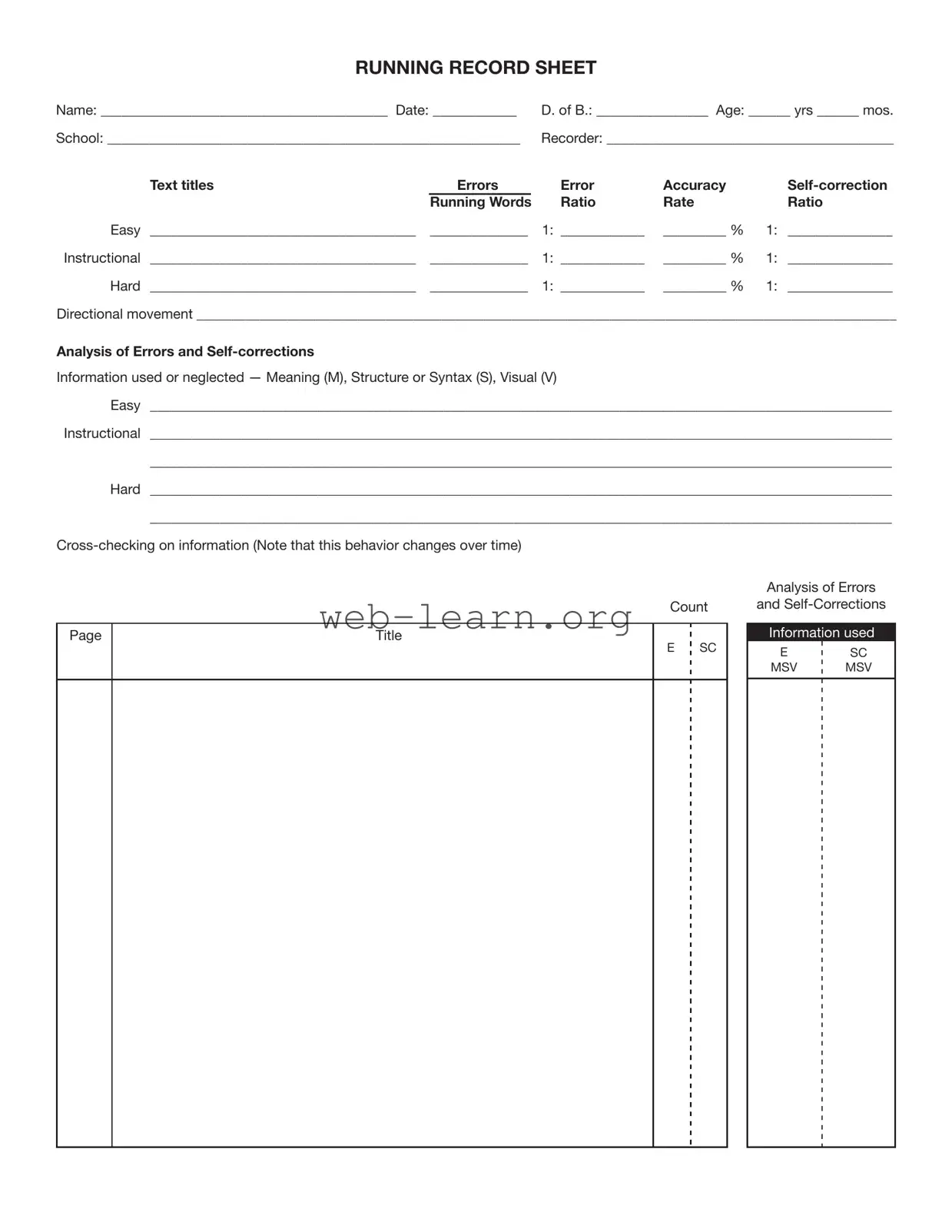
The Running Record Sheet is an essential tool for educators and literacy specialists, designed to capture a wealth of information about a student’s reading performance. This form facilitates a detailed analysis of reading behaviors by documenting key aspects such as the student’s name, date, date of birth, age, and school. It also includes sections for the recorder's name and the titles of texts used during the assessment. One of the primary features of the form is the ability to track errors, self-corrections, and accuracy ratios, which provide insight into the student’s reading proficiency. The form categorizes texts into three levels of difficulty: easy, instructional, and hard, allowing for a nuanced understanding of a student's capabilities. Additionally, the Running Record Sheet includes space for directional movement and a thorough analysis of errors and self-corrections, focusing on the types of information utilized or overlooked during reading. This analysis considers meaning, structure, and visual cues, which are crucial for identifying specific areas where a student may need support. Ultimately, the Running Record Sheet serves as a comprehensive framework for educators to assess and enhance students' reading skills effectively.

RUNNING RECORD SHEET
Name: _________________________________________ Date: ____________ |
D. of B.: ________________ Age: ______ yrs ______ mos. |
|||||
School: ___________________________________________________________ |
Recorder: _________________________________________ |
|||||
|
Text titles |
Errors |
|
Error |
Accuracy |
|
|
|
Running Words |
Ratio |
Rate |
Ratio |
|
Easy |
______________________________________ |
______________ |
|
1: ____________ |
_________ % |
1: _______________ |
Instructional |
______________________________________ |
______________ |
|
1: ____________ |
_________ % |
1: _______________ |
Hard |
______________________________________ |
______________ |
|
1: ____________ |
_________ % |
1: _______________ |
Directional movement ____________________________________________________________________________________________________
Analysis of Errors and
Information used or neglected — Meaning (M), Structure or Syntax (S), Visual (V)
Easy __________________________________________________________________________________________________________
Instructional __________________________________________________________________________________________________________
__________________________________________________________________________________________________________
Hard __________________________________________________________________________________________________________
__________________________________________________________________________________________________________
Page
Title
Count
ESC
Analysis of Errors
and
Information used
ESC
MSV MSV

Page
Title
Count
ESC
Analysis of Errors
and
Information used
ESC
MSV MSV
| Fact Name | Details |
|---|---|
| Purpose | The Running Record Sheet is used to assess a student's reading ability by documenting errors, self-corrections, and overall reading fluency. |
| Components | The form includes sections for the student's name, date, date of birth, age, school, and the recorder's name. |
| Error Tracking | Errors are recorded in three categories: Easy, Instructional, and Hard, allowing for differentiated analysis based on reading level. |
| Accuracy Calculation | The accuracy ratio is calculated to determine the percentage of words read correctly, which helps gauge reading proficiency. |
| Self-Correction Rate | The form tracks the self-correction rate, indicating how often a student corrects their own mistakes during reading. |
| Analysis of Errors | Errors are analyzed based on meaning, structure, or visual cues, providing insight into the student's reading strategies. |
| Directional Movement | The form includes a section for noting directional movement, which can affect reading fluency and comprehension. |
| State-Specific Forms | Some states may have specific guidelines or laws governing the use of Running Record Sheets in educational settings, such as the Individuals with Disabilities Education Act (IDEA). |
| Usage in Education | Educators use the Running Record Sheet to tailor instruction and support for students based on their individual reading needs. |
Filling out the Running Record Sheet is a straightforward process that requires attention to detail. Each section of the form captures important information about the reading session. Follow the steps below to ensure accurate completion of the form.
Once the form is filled out, it will provide valuable insights into the reading abilities and challenges faced by the individual. This information can be used to inform future instruction and support strategies.
A Running Record Sheet is a tool used to assess a reader's fluency and comprehension while reading a specific text. It allows educators to document errors, self-corrections, and overall reading performance. This information helps in determining the appropriate reading level for students and tailoring instruction to meet their needs.
To complete the Running Record Sheet, start by entering the student's name, date, date of birth, age, and school. Next, record the title of the text being read. As the student reads, note any errors and self-corrections in the designated sections. Calculate the error accuracy and self-correction ratios based on the total words read. Finally, analyze the errors by categorizing them into meaning, structure, or visual cues.
These terms refer to the difficulty levels of the texts being read. An Easy text is one that the student can read with minimal errors and high comprehension. An Instructional text presents a challenge but is still manageable for the student with some support. A Hard text is one that the student struggles to read, resulting in many errors and low comprehension.
Error analysis provides insights into a student's reading process. By categorizing errors as meaning, structure, or visual, educators can identify specific areas where the student may need additional support. Understanding the types of errors can guide instruction and help improve reading strategies.
The data collected from the Running Record Sheet can be used to inform instruction. It helps educators to determine the appropriate reading level for students, identify areas for improvement, and track progress over time. Additionally, this information can be shared with parents to discuss their child's reading development.
Filling out the Running Record Sheet form accurately is essential for assessing a student's reading abilities. However, several common mistakes can occur during this process. Understanding these errors can help ensure that the information collected is both reliable and useful.
One frequent mistake is failing to record the student's name and other identifying information correctly. This may seem minor, but without accurate identification, it becomes challenging to track a student's progress over time. Incomplete or incorrect details can lead to confusion, especially if multiple students are being assessed.
Another common error involves miscalculating the error accuracy rate. This rate is crucial for understanding how well a student is reading a particular text. If the number of errors is not accurately counted or if the total words read is miscalculated, the resulting percentage will be misleading. This miscalculation can affect instructional decisions and strategies.
Additionally, people often neglect to analyze the self-correction data thoroughly. Self-corrections are significant indicators of a student's reading comprehension and problem-solving skills. If this section is overlooked or filled out hastily, valuable insights into the student's reading process may be lost.
Another mistake relates to the directional movement section. This part of the form is essential for understanding how a student interacts with the text. Failing to note this behavior can lead to an incomplete picture of the student's reading strategies and habits. Observations about how a student navigates through the text can reveal much about their reading comprehension.
People sometimes also forget to provide a comprehensive analysis of errors and self-corrections. Each type of error—whether it relates to meaning, structure, or visual cues—offers critical insights into a student's reading challenges. A superficial analysis can result in missed opportunities for targeted instruction.
Lastly, individuals may overlook the importance of cross-checking information. This aspect is vital for ensuring that the data collected is accurate and reflective of the student's abilities. Without proper cross-checking, inconsistencies may arise, leading to erroneous conclusions about a student's reading skills.
The Running Record Sheet is a vital tool for educators to assess a student's reading abilities. It provides detailed insights into errors, self-corrections, and overall reading fluency. To complement this form, several other documents can enhance the assessment process and provide a more comprehensive view of a student's literacy development.
Using these documents alongside the Running Record Sheet creates a robust framework for monitoring and supporting a student's reading development. Together, they offer a comprehensive approach to literacy assessment and instruction.
The Running Record Sheet form is a valuable tool for assessing reading proficiency. It shares similarities with several other documents used in educational settings. Below is a list of these documents and how they relate to the Running Record Sheet.
When filling out the Running Record Sheet form, attention to detail is crucial. Here are five things to keep in mind:
By following these guidelines, you can ensure that the Running Record Sheet is filled out effectively, providing valuable information for assessment and instruction.
Understanding the Running Record Sheet form is essential for accurate assessment and analysis of reading progress. However, several misconceptions exist that may lead to confusion. Here are five common misunderstandings:
Addressing these misconceptions can enhance the effectiveness of the Running Record Sheet and ultimately support a child's reading journey.
Filling out and using the Running Record Sheet form can significantly enhance the assessment of reading skills. Here are some key takeaways to keep in mind:
By focusing on these aspects, the Running Record Sheet can be a valuable tool in assessing and improving reading skills.