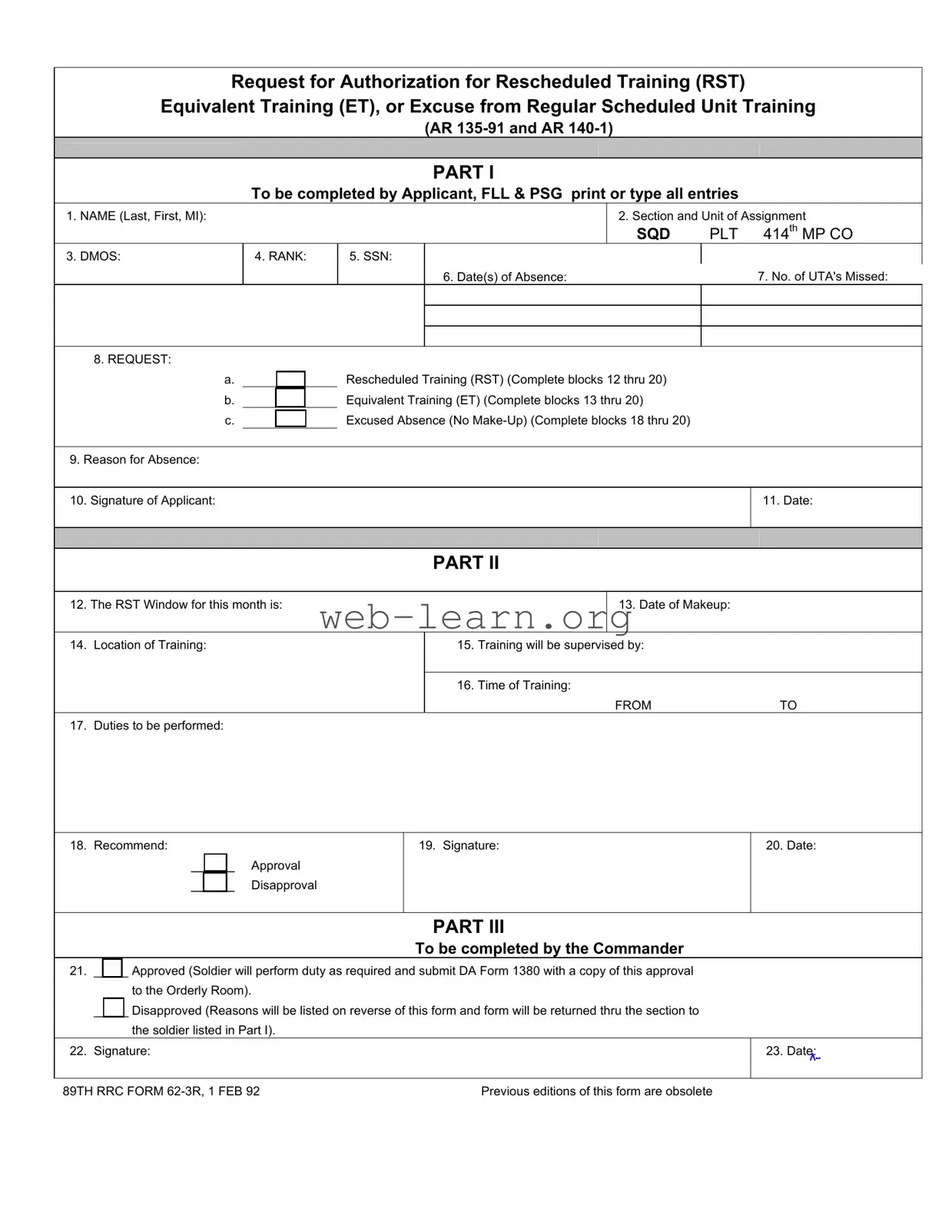
The Request for Authorization for Rescheduled Training (RST), Equivalent Training (ET), or Excuse from Regular Scheduled Unit Training is an essential form used within the military structure to manage training absences. This form serves multiple purposes, allowing soldiers to formally request rescheduled training, seek equivalent training opportunities, or obtain an excused absence from regular scheduled unit training. Each request requires specific information, starting with the soldier's name, rank, and unit assignment. Applicants must also indicate the dates of absence and the number of Unit Training Assemblies (UTAs) missed. The form is divided into several parts, with the first section completed by the soldier, detailing the reason for absence and their signature. The subsequent sections involve planning for rescheduled training, including the training window, date, location, and supervision details. Commanders play a critical role in the final decision-making process, indicating approval or disapproval of the request, along with their signature and date. This structured approach ensures accountability and clarity in managing training schedules and soldier commitments.
Request for Authorization for Rescheduled Training (RST)
Equivalent Training (ET), or Excuse from Regular Scheduled Unit Training
(AR
PART I
To be completed by Applicant, FLL & PSG print or type all entries
1. NAME (Last, First, MI):
2. Section and Unit of Assignment
SQD |
PLT 414th MP CO |
3. DMOS:
4. RANK:
5. SSN:
6. Date(s) of Absence: |
7. No. of UTA's Missed: |
8. REQUEST:
a.
b.
c.
Rescheduled Training (RST) (Complete blocks 12 thru 20) Equivalent Training (ET) (Complete blocks 13 thru 20) Excused Absence (No
9. Reason for Absence:
10. Signature of Applicant:
11. Date:
PART II
12. The RST Window for this month is:
13. Date of Makeup:
14. Location of Training: |
15. Training will be supervised by: |
16. Time of Training:
FROMTO
17. Duties to be performed:
18. Recommend:
_____ Approval
_____ Disapproval
19. Signature:
20. Date:
PART III
To be completed by the Commander
21._____ Approved (Soldier will perform duty as required and submit DA Form 1380 with a copy of this approval to the Orderly Room).
_____ Disapproved (Reasons will be listed on reverse of this form and form will be returned thru the section to
the soldier listed in Part I).
22. Signature: |
|
23. Date: |
|
|
|
89TH RRC FORM |
Previous editions of this form are obsolete |
|
| Fact Name | Description |
|---|---|
| Form Title | Request for Authorization for Rescheduled Training (RST), Equivalent Training (ET), or Excuse from Regular Scheduled Unit Training |
| Governing Laws | AR 135-91 and AR 140-1 |
| Part I Responsibility | This section must be completed by the Applicant, FLL, and PSG. |
| Required Information | Includes name, unit assignment, DMOS, rank, SSN, dates of absence, and number of UTAs missed. |
| Types of Requests | Options include Rescheduled Training (RST), Equivalent Training (ET), and Excused Absence. |
| Part II Purpose | This section outlines details for the rescheduled training, including dates, location, and supervision. |
| Recommendation Section | Recommends approval or disapproval of the request. |
| Part III Completion | This part must be filled out by the Commander, indicating approval or disapproval. |
| Obsolete Editions | Previous editions of this form are considered obsolete. |
Completing the RST Army form requires careful attention to detail. Each section must be filled out accurately to ensure that your request is processed smoothly. After submitting the form, it will be reviewed by your commander, who will either approve or disapprove your request based on the information provided.
The RST Army form is designed to formally request authorization for rescheduled training, equivalent training, or an excuse from regular scheduled unit training. It serves as a mechanism for soldiers to communicate their needs regarding training attendance and ensures that their requests are documented and processed appropriately.
The form must be completed by the applicant, which typically includes the soldier requesting the rescheduling or excuse. Additionally, the First Line Leader (FLL) and the Platoon Sergeant (PSG) are also involved in the process, ensuring that all necessary information is accurately captured.
Part I requires several critical pieces of information. The applicant must provide their name, unit assignment, duty military occupational specialty (DMOS), rank, and Social Security Number (SSN). Furthermore, the dates of absence, the number of Unit Training Assemblies (UTAs) missed, and the reason for the absence must also be included. This section culminates with the applicant's signature and date, affirming the accuracy of the information provided.
In Part I, the applicant must select one of three options for their request: Rescheduled Training (RST), Equivalent Training (ET), or Excused Absence (No Make-Up). Each option requires different sections of the form to be completed, allowing for tailored responses based on the soldier's specific circumstances.
Part II focuses on the specifics of the rescheduled or equivalent training. It requires the RST window for the month, the date and location of the makeup training, the supervisor overseeing the training, and the time frame for the training. Additionally, it asks for a description of the duties to be performed during this training. The section concludes with a recommendation for approval or disapproval, along with the signature and date of the person completing this part.
Part III is designated for the commander’s review and decision. The commander can either approve or disapprove the request. If approved, the soldier is instructed to perform the required duties and submit a DA Form 1380 along with the approval documentation. In the event of disapproval, the commander must provide reasons for the decision, which will be noted on the reverse side of the form before returning it to the soldier.
If the request is disapproved, the reasons for this decision will be documented on the reverse side of the form. The completed form will then be returned through the soldier's section, ensuring that the applicant is aware of the outcome and the rationale behind it. This transparency is crucial for maintaining clear communication within the unit.
The RST Army form should be filled out clearly and legibly, with all required fields completed. It is important that the form is submitted in a timely manner, following any unit-specific protocols for documentation. Submissions typically occur through the chain of command, ensuring that all relevant parties are informed and involved in the process.
Yes, previous editions of the RST Army form are considered obsolete. Users must ensure that they are utilizing the most current version, which is the 89TH RRC FORM 62-3R, dated 1 FEB 92. Using outdated forms could lead to processing delays or complications in the approval of requests.
Filling out the Request for Authorization for Rescheduled Training (RST) form can be straightforward, but many individuals still make common mistakes that can lead to delays or rejections. One frequent error is failing to provide complete information in the NAME section. It’s essential to include the last name, first name, and middle initial. Omitting any part of this information can cause confusion and may result in the application being returned for correction.
Another common mistake occurs in the Reason for Absence section. Applicants often provide vague explanations or fail to include sufficient details. A clear and specific reason is necessary to justify the request. This section should communicate the circumstances surrounding the absence effectively. Without clarity, commanders may not fully understand the situation, leading to potential disapproval.
Additionally, many individuals neglect to check the REQUEST section thoroughly. This form allows for different types of requests, such as Rescheduled Training, Equivalent Training, or Excused Absence. Failing to complete the appropriate blocks for the chosen request can result in processing delays. Each request type has specific requirements that must be met, so attention to detail is crucial.
Lastly, the signature and date sections are often overlooked. Some applicants forget to sign the form or fail to date it correctly. This oversight can cause significant delays in processing the request. A missing signature or an incorrect date can lead to the form being deemed incomplete, requiring the applicant to start the process over again.
The Request for Authorization for Rescheduled Training (RST) form is an essential document for military personnel seeking to adjust their training schedules due to various circumstances. Alongside the RST form, several other forms and documents play a crucial role in the training and attendance management process. Understanding these documents can help streamline procedures and ensure compliance with military regulations.
In summary, the RST form operates within a framework of various supporting documents that facilitate effective training management in the military. Each of these forms serves a distinct purpose, contributing to the overall structure that ensures soldiers meet their training obligations while accommodating individual circumstances.
The Request for Authorization for Rescheduled Training (RST) form shares similarities with several other military and administrative documents. Each of these documents serves specific purposes related to training, absence, or duty assignments. Below is a list of ten documents that are similar to the RST form:
When filling out the RST Army form, attention to detail is crucial. Here are ten essential dos and don’ts to ensure your submission is accurate and complete.
By following these guidelines, you can help ensure that your RST Army form is processed smoothly and efficiently.
Misconceptions about the Request for Authorization for Rescheduled Training (RST) form can lead to confusion among service members. Here are ten common misconceptions explained:
When filling out the RST Army form, it’s important to follow specific guidelines to ensure accuracy and compliance. Here are key takeaways to consider:
By adhering to these takeaways, you can streamline the process of filling out and using the RST Army form effectively.