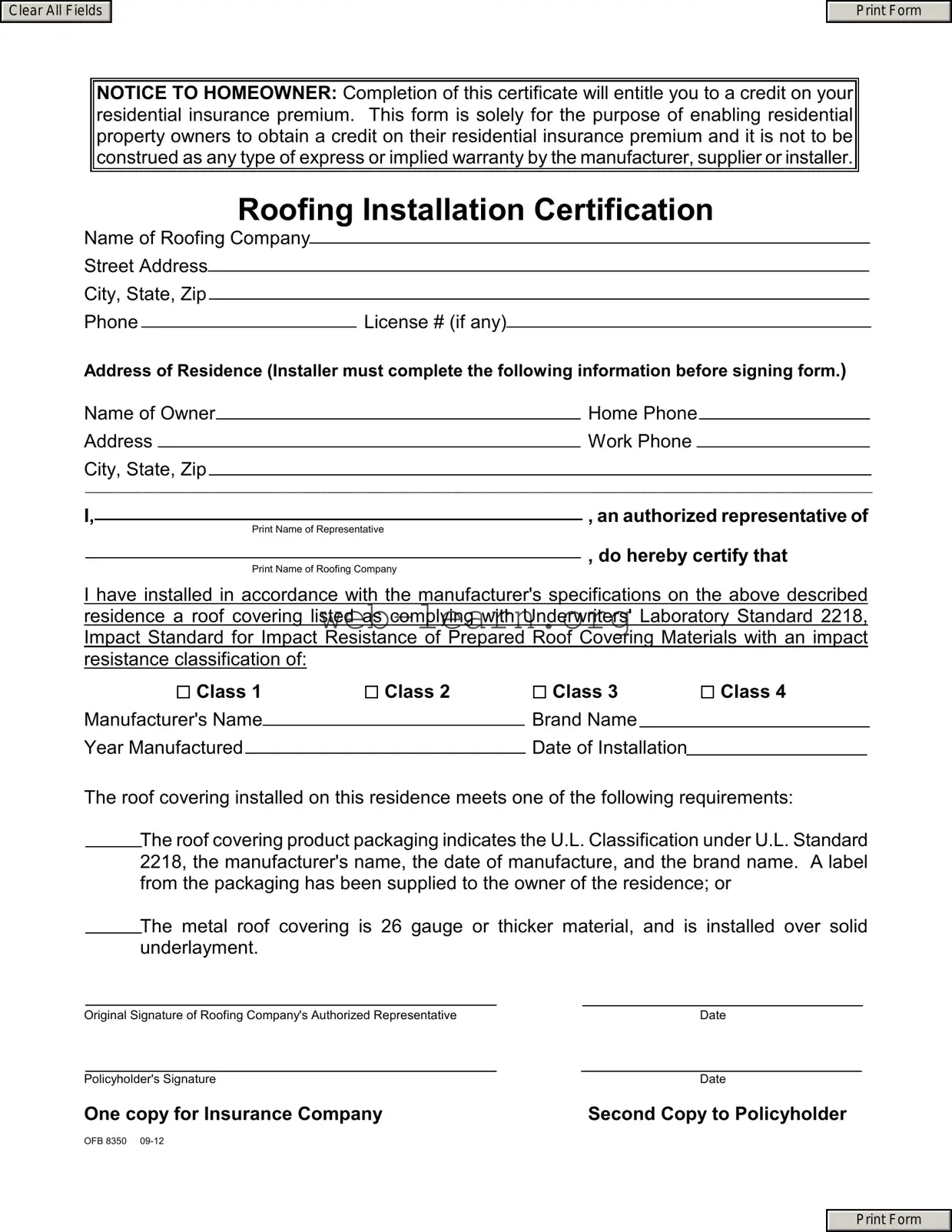
The Roofing Installation Certification form serves as an important document for residential property owners seeking to reduce their insurance premiums. By completing this form, homeowners can qualify for a credit on their residential insurance, providing a financial incentive for proper roofing installation. This form requires specific information, including details about the roofing company, the property owner's name, and the installation details. The authorized representative of the roofing company must certify that the installation complies with the manufacturer's specifications and meets the Underwriters' Laboratory Standard 2218 for impact resistance. The form also includes a section where the representative must indicate the impact resistance classification of the roof covering installed, ranging from Class 1 to Class 4. Additionally, the form specifies the requirements for the roof covering product, ensuring that it includes necessary information such as the U.L. classification, manufacturer's name, and date of manufacture. Finally, both the roofing company's representative and the policyholder must sign the form, with copies distributed to the insurance company and the homeowner, thereby formalizing the certification process.
Clear All Fields
Print Form
NOTICE TO HOMEOWNER: Completion of this certificate will entitle you to a credit on your residential insurance premium. This form is solely for the purpose of enabling residential property owners to obtain a credit on their residential insurance premium and it is not to be construed as any type of express or implied warranty by the manufacturer, supplier or installer.
Roofing Installation Certification
Name of Roofing Company
Street Address
City, State, Zip
PhoneLicense # (if any)
Address of Residence (Installer must complete the following information before signing form.)
Name of Owner |
|
Home Phone |
|
|
|||||
Address |
|
|
|
Work Phone |
|
|
|||
City, State, Zip |
|
|
|
|
|
|
|||
I, |
|
|
, an authorized representative of |
||||||
|
|
||||||||
|
|
|
|
|
Print Name of Representative |
||||
|
|
|
|
|
|
, do hereby certify that |
|||
|
|
|
|
|
|
||||
|
|
|
|
|
Print Name of Roofing Company |
||||
I have installed in accordance with the manufacturer's specifications on the above described residence a roof covering listed as complying with Underwriters' Laboratory Standard 2218, Impact Standard for Impact Resistance of Prepared Roof Covering Materials with an impact resistance classification of:
Class 1 |
Class 2 |
|
Class 3 |
Class 4 |
||||
Manufacturer's Name |
|
|
Brand Name |
|
|
|
||
Year Manufactured |
|
|
|
Date of Installation |
|
|
||
|
|
|
|
|
|
|
|
|
The roof covering installed on this residence meets one of the following requirements:
The roof covering product packaging indicates the U.L. Classification under U.L. Standard 2218, the manufacturer's name, the date of manufacture, and the brand name. A label from the packaging has been supplied to the owner of the residence; or
The metal roof covering is 26 gauge or thicker material, and is installed over solid underlayment.
|
|
|
|
|
Original Signature of Roofing Company's Authorized Representative |
|
Date |
||
|
|
|
|
|
|
Policyholder's Signature |
|
Date |
|
One copy for Insurance Company |
|
Second Copy to Policyholder |
||
OFB 8350 |
|
|
|
|
Print Form
| Fact Name | Description |
|---|---|
| Purpose | This form helps homeowners obtain a credit on their residential insurance premium. |
| Not a Warranty | The form does not serve as a warranty from the manufacturer, supplier, or installer. |
| Certification Requirement | An authorized representative of the roofing company must complete and sign the form. |
| Impact Resistance | The roof covering must comply with Underwriters' Laboratory Standard 2218 for impact resistance. |
| U.L. Classification | The roof covering must have a U.L. classification indicated on the product packaging. |
| Material Specification | Metal roof coverings must be 26 gauge or thicker and installed over solid underlayment. |
| Distribution of Copies | One copy of the completed form goes to the insurance company and another to the policyholder. |
Filling out the Roofing Installation Certification form is a straightforward process that ensures you receive the necessary credit on your residential insurance premium. This form requires specific information about the roofing company, the installation details, and the homeowner. Once completed, it should be submitted to the relevant parties for processing.
What is the purpose of the Roofing Installation Certification form?
The Roofing Installation Certification form helps homeowners secure a credit on their residential insurance premium. It serves as proof that the roof was installed according to the manufacturer's specifications. It is important to note that this form does not act as a warranty from the manufacturer, supplier, or installer.
Who needs to complete the form?
The form must be completed by an authorized representative of the roofing company that installed the roof. This representative will provide specific details about the installation, including the type of roofing material used and the compliance with relevant standards.
What information is required on the form?
The form requires several key pieces of information, including:
What should homeowners do with the completed form?
Once the form is completed and signed, homeowners should keep one copy for their records and submit another copy to their insurance company. This will help ensure that they receive the appropriate credit on their insurance premium.
What is the significance of the U.L. Standard 2218 mentioned in the form?
The U.L. Standard 2218 refers to a classification system for the impact resistance of roofing materials. Roof coverings that meet this standard are categorized into classes based on their ability to withstand impacts. Homeowners should ensure that the roofing material installed has the appropriate classification, as this can affect insurance credits and the overall durability of the roof.
Filling out the Roofing Installation Certification form correctly is essential for homeowners seeking insurance premium credits. However, many people make common mistakes that can lead to delays or complications. Understanding these pitfalls can help ensure a smooth submission process.
One frequent error is failing to provide complete information. Homeowners often overlook essential details, such as the roofing company’s name, address, and license number. Missing this information can result in the form being rejected or delayed. It is crucial to double-check that all fields are filled out accurately before submission.
Another mistake involves inaccurate certification of installation. The installer must confirm that the roofing was done according to the manufacturer’s specifications. If the installation does not meet these standards, the certification may not be valid. Homeowners should ensure that the installer is knowledgeable about the requirements and can provide the necessary details.
Many people also forget to include the U.L. Classification of the roof covering. This classification is vital for insurance purposes. Without it, insurers may not recognize the roof’s impact resistance, which could affect the premium credit. Homeowners should verify that the roofing product packaging clearly states this classification and keep a copy for their records.
Additionally, neglecting to obtain the required signatures can lead to significant issues. Both the roofing company’s authorized representative and the policyholder must sign the form. Without these signatures, the certification will be incomplete. It is advisable to review the document together to ensure all necessary signatures are present.
Lastly, many homeowners fail to retain copies of the completed form. Keeping a copy for personal records is important, as it serves as proof of the certification. Additionally, it allows homeowners to reference the details in case of any disputes with their insurance company. Ensuring that all copies are made before submission can prevent future headaches.
When dealing with roofing installation, several documents work hand-in-hand with the Roofing Installation Certification form. Each serves a specific purpose to ensure compliance, safety, and proper communication between parties involved. Here’s a list of some commonly used forms and documents:
Understanding these documents can help homeowners navigate the roofing installation process more effectively. Each form plays a vital role in ensuring that the project runs smoothly and that all parties are protected.
The Roofing Installation Certification form serves a specific purpose for homeowners, particularly in relation to their insurance premiums. However, several other documents share similarities with this form, primarily in their intent to provide verification or certification for certain home improvements or installations. Here are nine documents that are similar to the Roofing Installation Certification form:
When filling out the Roofing Installation Certification form, attention to detail is crucial. Here’s a list of things you should and shouldn’t do to ensure the process goes smoothly.
By following these guidelines, you can help ensure that your Roofing Installation Certification form is filled out correctly, paving the way for a smoother process in obtaining your insurance credit.
Here are ten common misconceptions about the Roofing Installation Certification form:
Filling out the Roofing Installation Certification form is an important step for homeowners seeking to receive a credit on their residential insurance premium. Here are some key takeaways to consider:
By following these guidelines, homeowners can effectively utilize the Roofing Installation Certification form to potentially lower their insurance costs.