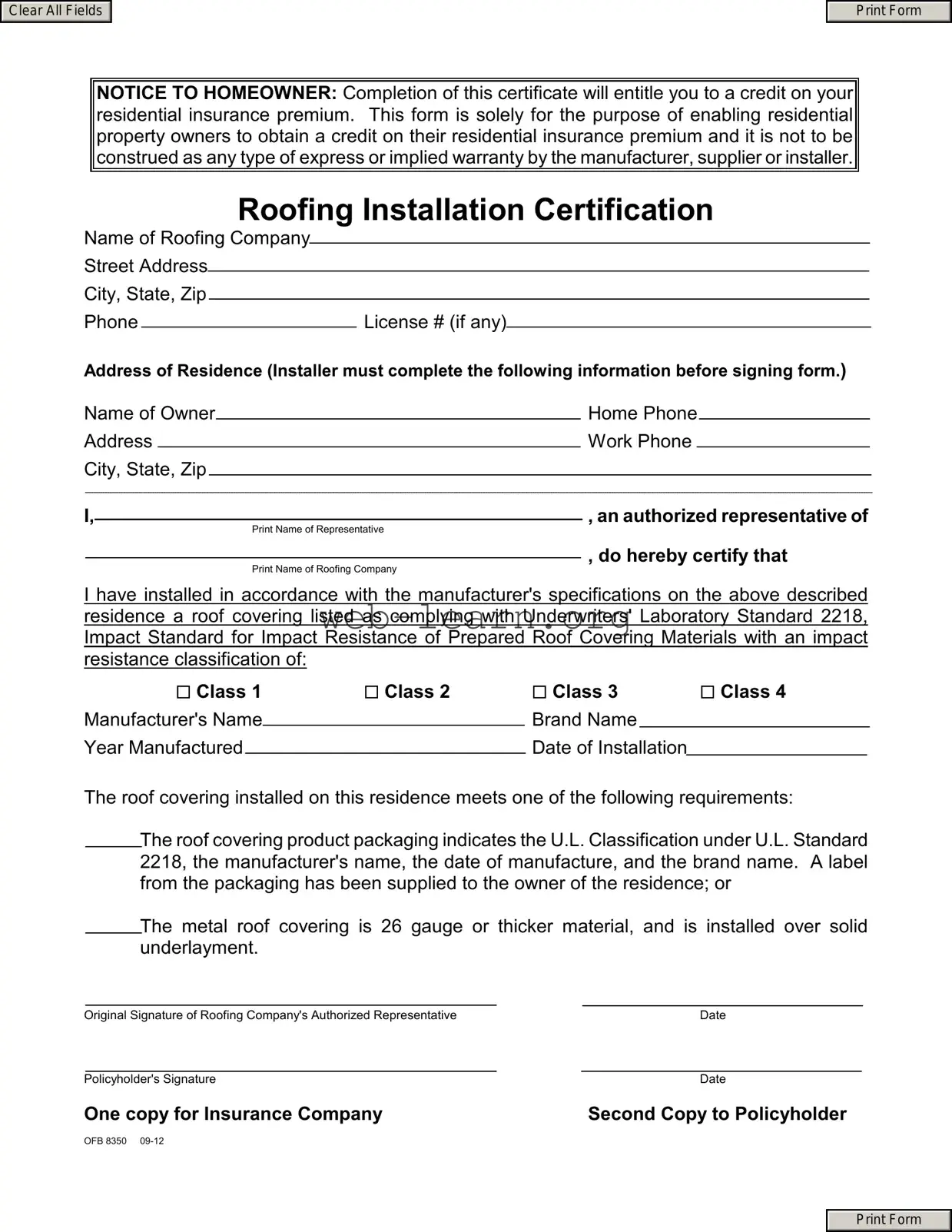
The Roofing Certificate form is an essential document for homeowners in Texas looking to reduce their residential insurance premiums. By completing this form, homeowners can certify that their roof has been installed according to specific manufacturer guidelines, which may qualify them for a discount on their insurance. The form requires important details such as the name and address of the roofing company, the license number, and the installation date. Additionally, it asks for information about the roofing materials used, including their compliance with Underwriters’ Laboratory Standard 2218, which assesses the impact resistance of roofing materials. Homeowners must also provide their own contact information and the address of the property where the roofing work was done. The roofing company's authorized representative must sign the form, confirming that all information is accurate and that the materials meet the required standards. This certification does not imply any warranty from the manufacturer or installer but serves solely to facilitate potential savings on insurance costs. It is crucial for homeowners to retain a copy of this form for their records and provide another copy to their insurance company. Misrepresentation in this process can lead to serious consequences, including claims of fraud.
Clear All Fields
Print Form
NOTICE TO HOMEOWNER: Completion of this certificate will entitle you to a credit on your residential insurance premium. This form is solely for the purpose of enabling residential property owners to obtain a credit on their residential insurance premium and it is not to be construed as any type of express or implied warranty by the manufacturer, supplier or installer.
Roofing Installation Certification
Name of Roofing Company
Street Address
City, State, Zip
PhoneLicense # (if any)
Address of Residence (Installer must complete the following information before signing form.)
Name of Owner |
|
Home Phone |
|
|
|||||
Address |
|
|
|
Work Phone |
|
|
|||
City, State, Zip |
|
|
|
|
|
|
|||
I, |
|
|
, an authorized representative of |
||||||
|
|
||||||||
|
|
|
|
|
Print Name of Representative |
||||
|
|
|
|
|
|
, do hereby certify that |
|||
|
|
|
|
|
|
||||
|
|
|
|
|
Print Name of Roofing Company |
||||
I have installed in accordance with the manufacturer's specifications on the above described residence a roof covering listed as complying with Underwriters' Laboratory Standard 2218, Impact Standard for Impact Resistance of Prepared Roof Covering Materials with an impact resistance classification of:
Class 1 |
Class 2 |
|
Class 3 |
Class 4 |
||||
Manufacturer's Name |
|
|
Brand Name |
|
|
|
||
Year Manufactured |
|
|
|
Date of Installation |
|
|
||
|
|
|
|
|
|
|
|
|
The roof covering installed on this residence meets one of the following requirements:
The roof covering product packaging indicates the U.L. Classification under U.L. Standard 2218, the manufacturer's name, the date of manufacture, and the brand name. A label from the packaging has been supplied to the owner of the residence; or
The metal roof covering is 26 gauge or thicker material, and is installed over solid underlayment.
|
|
|
|
|
Original Signature of Roofing Company's Authorized Representative |
|
Date |
||
|
|
|
|
|
|
Policyholder's Signature |
|
Date |
|
One copy for Insurance Company |
|
Second Copy to Policyholder |
||
OFB 8350 |
|
|
|
|
Print Form
| Fact Name | Description |
|---|---|
| Issuing Authority | This form is issued by the Texas Department of Insurance, specifically the Property and Casualty Section. |
| Purpose | The form is designed to help homeowners obtain a reduction in their residential insurance premiums. |
| Certification Requirement | Completion of this certificate is mandatory for homeowners seeking insurance premium reductions. |
| Impact Resistance | The roof covering must comply with Underwriters’ Laboratory Standard 2218 for impact resistance. |
| Labeling Standards | All roofing materials must be labeled according to U.L. Standard 2218, including the manufacturer's name and date of manufacture. |
| Signature Requirement | An authorized representative of the roofing company must sign the form to validate the certification. |
| Fraud Warning | Any intentional misrepresentation on this form may be considered fraud. |
| Retention of Copies | One copy of the form must be retained by the homeowner, and another must be sent to the insurance company. |
| Contact Information | The form includes contact details for the Texas Department of Insurance, including a phone number and website. |
| Governing Law | This form is governed by Texas insurance laws and regulations pertaining to residential insurance premium reductions. |
Once you have gathered all necessary information, you can begin filling out the Roofing Certificate form. This form is important for homeowners looking to receive a reduction in their residential insurance premiums. Make sure to fill it out accurately and completely to avoid any delays.
Once the form is completed, make sure to keep one copy for your records and send another to your insurance company. It’s essential to double-check all entries to ensure accuracy before submission.
What is the purpose of the Roofing Certificate form?
The Roofing Certificate form is designed to help residential property owners obtain a reduction in their insurance premiums. By completing this form, homeowners can demonstrate that their roof meets specific impact resistance standards, which may qualify them for lower rates on their insurance policies.
Who needs to complete the Roofing Certificate form?
The form must be completed by an authorized representative of the roofing company that installed the roof. This representative certifies that the installation meets the necessary manufacturer specifications and complies with Underwriters’ Laboratory Standard 2218.
What information is required on the form?
What are the impact resistance classifications?
The form specifies four classifications based on the Underwriters’ Laboratory Standard 2218: Class 1, Class 2, Class 3, and Class 4. Class 4 offers the highest level of impact resistance, making it the most desirable for insurance premium reductions.
What happens if the information on the form is misrepresented?
Any intentional misrepresentation related to the completion or presentation of the Roofing Certificate form is considered fraud. This can have serious legal implications for the individual or company involved.
How should the completed form be submitted?
Once the form is completed and signed by the roofing company’s authorized representative, it should be distributed in two copies: one for the homeowner and one for the insurance company. This ensures that both parties have a record of the certification.
Is there a specific format for labeling the roofing products?
Yes, the roofing products must be labeled according to the U.L. Standard 2218. This includes the manufacturer’s name, date of manufacture, brand name, and the impact resistance classification. After January 1, 1999, all individual roofing components must display this information.
What should homeowners do with the Roofing Certificate?
Homeowners should retain a copy of the Roofing Certificate for their records. This document may be required by their insurance company to validate the premium reduction. It is advisable to keep this certificate in a safe place alongside other important home documents.
Where can I find more information about the Roofing Certificate form?
For additional details, homeowners can visit the Texas Department of Insurance website at www.tdi.texas.gov or contact the Property and Casualty Section directly at 512-305-6711.
Completing the Roofing Certificate form can seem straightforward, but many homeowners make common mistakes that can lead to complications. One frequent error is failing to include the name of the roofing company. This information is essential for proper identification and processing of the form. Without it, the certification may be deemed incomplete.
Another common mistake is neglecting to provide the license number of the roofing company, if applicable. This number serves as a verification of the company's legitimacy and qualifications. Omitting it can raise questions about the credibility of the installation.
Homeowners often forget to fill in the address of the residence where the roofing work was completed. This detail is crucial for linking the certification to the correct property. Inaccuracies in this section can lead to delays in processing or even rejection of the certificate.
Many individuals also overlook the importance of the date of installation. This date is necessary for determining the eligibility of the roofing system for the insurance premium reduction. Without it, the insurance company may not honor the request for a premium reduction.
Another mistake involves the classification of the roof covering. Homeowners sometimes fail to check the appropriate impact resistance classification box. This classification is vital for ensuring that the installed roof meets the necessary standards for premium reduction. Inaccurate information in this section could invalidate the certification.
Additionally, it is essential to ensure that the manufacturer's name and brand name are clearly stated. Missing this information can lead to confusion and could result in the insurance company questioning the validity of the roofing materials used.
Some homeowners neglect to provide the labeling of products as required. Each individual roofing component must be labeled according to the U.L. Standard 2218. If this information is missing, the certification may not be accepted, and the homeowner may miss out on potential savings.
Another common error is not obtaining the original signature of the roofing company’s authorized representative. This signature is a crucial element of the certification process. Without it, the form lacks the necessary authenticity, which can lead to complications with the insurance company.
Lastly, homeowners sometimes fail to keep track of the copies of the form as instructed. One copy should be retained by the homeowner, while another must be sent to the insurance company. Losing track of these documents can lead to disputes or issues with the insurance claim.
The Roofing Certificate form is an essential document for homeowners seeking to reduce their residential insurance premiums after installing a new roof. Several other forms and documents often accompany this certificate to provide additional information, ensure compliance, and facilitate the insurance process. Below is a list of related documents commonly used in conjunction with the Roofing Certificate form.
Each of these documents plays a vital role in the roofing process and insurance claims. Homeowners should ensure they have all necessary forms completed and submitted to avoid any issues with their insurance premiums or claims in the future.
The Roofing Certificate form is similar to several other documents that serve specific purposes in the context of home improvement and insurance. Here are five documents that share similarities:
When filling out the Roofing Certificate form, it is important to follow certain guidelines to ensure accuracy and compliance. Below are seven things you should and shouldn't do.
By adhering to these guidelines, homeowners can facilitate a smoother process in obtaining a reduction in their residential insurance premium.
Understanding the Roofing Certificate form can be tricky, and there are several misconceptions that often arise. Here are six common misunderstandings about this important document:
By clearing up these misconceptions, homeowners can better navigate the process of obtaining their Roofing Certificate and enjoy potential savings on their insurance premiums.
Here are some key takeaways about filling out and using the Roofing Certificate form:
By following these key points, homeowners can effectively utilize the Roofing Certificate form to secure potential savings on their insurance premiums.