When navigating the often complex world of rental agreements, understanding the Rent Increase Letter form is essential for both landlords and tenants. This form serves as a formal notice to tenants about upcoming changes in rent, providing them with crucial information regarding the new rental amount, the effective date of the increase, and any applicable laws or regulations governing such changes. Clarity is key; the letter should be written in a straightforward manner, ensuring that tenants fully grasp the reasons behind the increase and their rights in response to it. Additionally, the form may outline any necessary steps tenants can take if they wish to dispute the increase or seek further clarification. By adhering to proper notice periods and legal requirements, landlords can foster transparency and maintain positive relationships with their tenants, while tenants can feel empowered to understand and respond to changes in their living expenses.
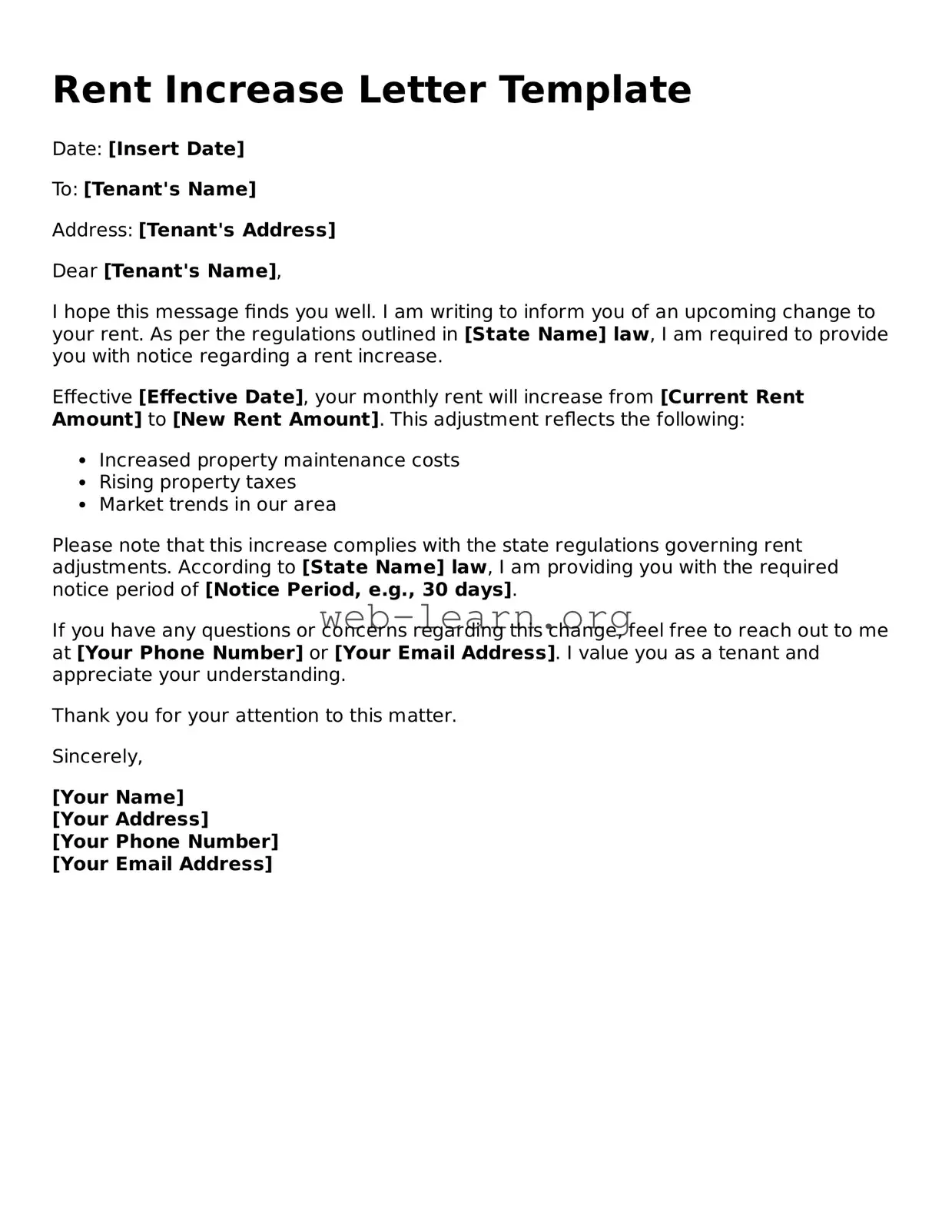
Rent Increase Letter Template
Date: [Insert Date]
To: [Tenant's Name]
Address: [Tenant's Address]
Dear [Tenant's Name],
I hope this message finds you well. I am writing to inform you of an upcoming change to your rent. As per the regulations outlined in [State Name] law, I am required to provide you with notice regarding a rent increase.
Effective [Effective Date], your monthly rent will increase from [Current Rent Amount] to [New Rent Amount]. This adjustment reflects the following:
Please note that this increase complies with the state regulations governing rent adjustments. According to [State Name] law, I am providing you with the required notice period of [Notice Period, e.g., 30 days].
If you have any questions or concerns regarding this change, feel free to reach out to me at [Your Phone Number] or [Your Email Address]. I value you as a tenant and appreciate your understanding.
Thank you for your attention to this matter.
Sincerely,
[Your Name]
[Your Address]
[Your Phone Number]
[Your Email Address]
| Fact Name | Description |
|---|---|
| Purpose | The Rent Increase Letter form is used by landlords to formally notify tenants of an increase in rent. |
| Notice Period | Most states require landlords to provide tenants with a specific notice period before the rent increase takes effect, often ranging from 30 to 90 days. |
| State-Specific Laws | Each state has its own regulations governing rent increases. For example, in California, the law limits rent increases to 5% plus inflation, with a maximum of 10% per year. |
| Delivery Method | The letter can typically be delivered in person, by mail, or electronically, depending on state laws and lease agreements. |
| Documentation | It is important for landlords to keep a copy of the Rent Increase Letter for their records, as it serves as proof of notice to the tenant. |
Once you have the Rent Increase Letter form in front of you, it’s essential to approach the completion process methodically. This ensures that all necessary information is accurately conveyed, which can help avoid any potential disputes or misunderstandings. After filling out the form, you will be required to send it to your tenant, keeping in mind any local regulations regarding notice periods.
What is a Rent Increase Letter?
A Rent Increase Letter is a formal document that a landlord uses to notify tenants of an upcoming increase in rent. This letter outlines the new rental amount, the effective date of the increase, and any relevant details regarding the change.
When should I send a Rent Increase Letter?
It's important to send the Rent Increase Letter well in advance of the increase. Most states require landlords to provide a notice period ranging from 30 to 90 days before the new rent takes effect. Check your local laws to ensure compliance.
What information should be included in the letter?
The letter should include:
Can I increase rent without notice?
No, landlords are generally required to provide tenants with written notice before increasing rent. Failing to do so could lead to disputes or legal issues. Always follow the required notice period as specified by your state laws.
What if a tenant refuses to accept the rent increase?
If a tenant refuses to accept the rent increase, they may choose to move out. It’s advisable to have a conversation with them to understand their concerns. If they remain in the property and do not pay the new rent, you may need to consider your options, which could include legal action.
Is there a limit to how much I can increase rent?
Some states and localities have rent control laws that limit the amount a landlord can increase rent. It’s crucial to check your local regulations to ensure that your increase complies with any applicable limits.
Do I need to provide a reason for the rent increase?
While it’s not always required to provide a reason, including one can help maintain a positive relationship with your tenant. Common reasons include increased property taxes, maintenance costs, or improvements made to the property.
Can I increase rent during a lease term?
Typically, if a tenant is in a fixed-term lease, you cannot increase the rent until the lease ends unless the lease agreement specifically allows for it. For month-to-month leases, you can increase rent with proper notice.
What should I do if I need help drafting a Rent Increase Letter?
If you need assistance, consider seeking guidance from a legal professional or using templates available online. Ensuring that your letter is clear and compliant with local laws is essential for a smooth process.
Filling out a Rent Increase Letter form can seem straightforward, but many individuals make common mistakes that can lead to confusion or disputes. One frequent error is failing to provide the correct address of the rental property. This detail is crucial, as it ensures that the notice reaches the right tenant and pertains to the correct unit.
Another common mistake is neglecting to include the date of the increase. Without this information, tenants may be unsure when the new rent will take effect, leading to potential misunderstandings. It is essential to specify the effective date clearly to avoid any ambiguity.
Some people also overlook the importance of specifying the amount of the rent increase. Simply stating that the rent will go up without providing the specific dollar amount can cause confusion. Tenants need to know exactly how much their rent will change to plan their finances accordingly.
Additionally, many individuals fail to mention the reason for the increase. While not always required, providing a rationale can foster better communication between landlords and tenants. Transparency in the reason for the increase can help maintain a positive landlord-tenant relationship.
Another frequent mistake is not adhering to local laws regarding notice periods. Different jurisdictions have specific requirements for how much advance notice must be given before a rent increase takes effect. Ignoring these regulations can result in legal complications.
Moreover, some landlords forget to sign the letter. A signature adds a personal touch and serves as a formal acknowledgment of the notice. Without a signature, the letter may lack the authority needed to be taken seriously by the tenant.
People also sometimes fail to keep a copy of the Rent Increase Letter for their records. Documentation is vital in case of disputes or misunderstandings. Having a copy ensures that both parties are on the same page regarding the terms of the increase.
Finally, many individuals do not send the letter via a traceable method, such as certified mail. This oversight can lead to disputes about whether the tenant received the notice. Using a method that provides proof of delivery can help avoid future conflicts.
When managing rental properties, several forms and documents complement the Rent Increase Letter. These documents help ensure clear communication and adherence to legal requirements. Below is a list of commonly used forms.
Utilizing these forms alongside the Rent Increase Letter fosters a transparent and organized rental process. Each document serves a specific purpose, ensuring that both landlords and tenants understand their rights and obligations.
The Rent Increase Letter form serves as a formal notification to tenants regarding changes in rental terms. Several other documents share similar functions or purposes. Here’s a list of those documents:
When filling out a Rent Increase Letter form, it is crucial to approach the task with care. Here are four essential do's and don'ts to consider:
When it comes to the Rent Increase Letter form, several misconceptions may arise. Understanding these can help both landlords and tenants navigate the process more effectively.
Understanding these misconceptions can lead to better communication and fewer disputes between landlords and tenants.
When it comes to filling out and using a Rent Increase Letter form, there are several important points to keep in mind. Here are some key takeaways to ensure a smooth process:
Photobooth Rental Contract - Describes how the photo booth will be monitored during the event.