The Release of Promissory Note form serves as a crucial document in the realm of financial transactions, particularly in the context of lending and borrowing. This form is utilized when a borrower has fulfilled their obligation to repay a loan, effectively signaling the lender's acknowledgment of this completion. By executing this form, the lender formally releases the borrower from any further liability associated with the promissory note. Key components of the form typically include the names of the parties involved, details of the original loan agreement, and the specific terms under which the release is granted. Moreover, it often requires signatures from both the lender and the borrower, ensuring that both parties agree to the terms of the release. Understanding the importance of this form is essential for anyone involved in a lending relationship, as it not only provides legal protection but also fosters transparency and trust between the parties.
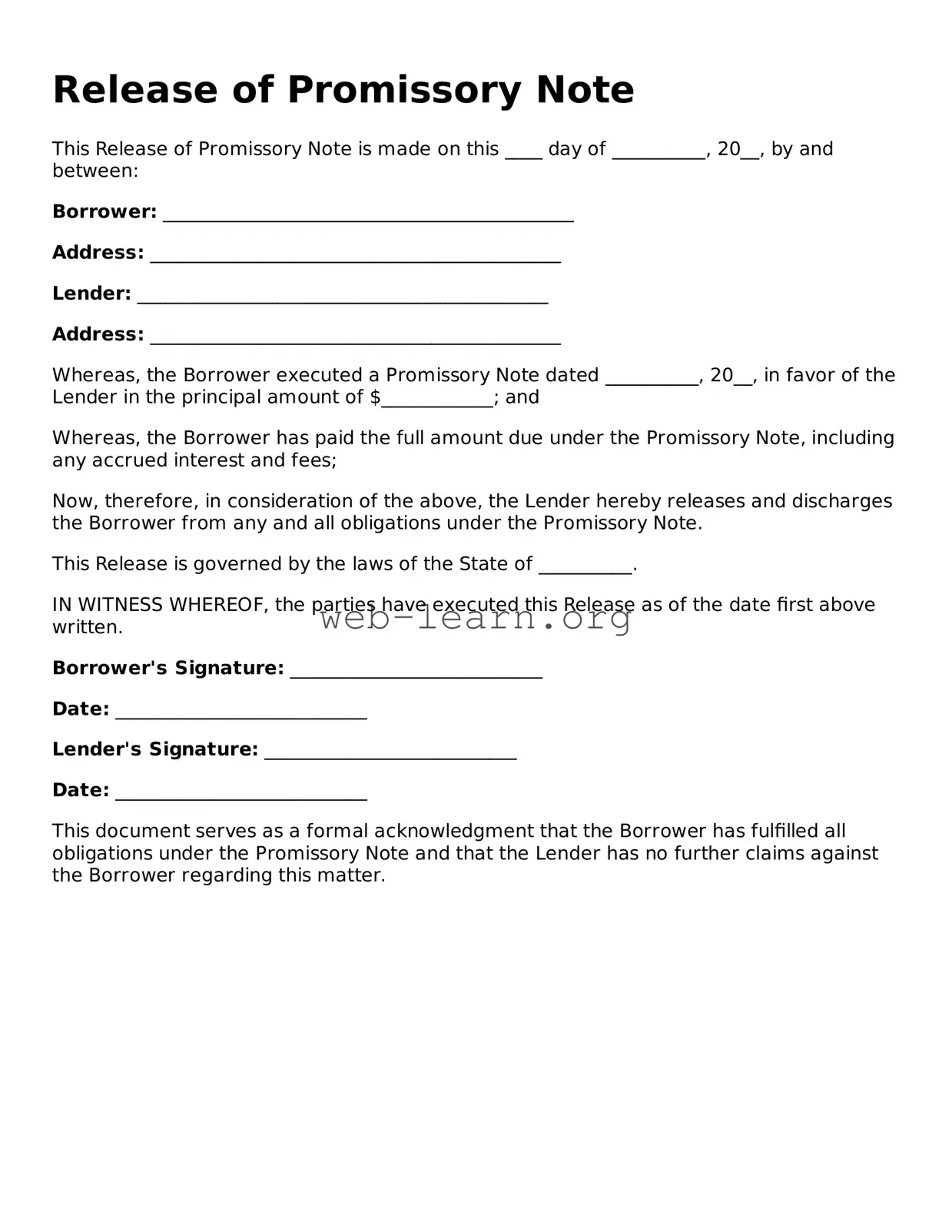
Release of Promissory Note
This Release of Promissory Note is made on this ____ day of __________, 20__, by and between:
Borrower: ____________________________________________
Address: ____________________________________________
Lender: ____________________________________________
Address: ____________________________________________
Whereas, the Borrower executed a Promissory Note dated __________, 20__, in favor of the Lender in the principal amount of $____________; and
Whereas, the Borrower has paid the full amount due under the Promissory Note, including any accrued interest and fees;
Now, therefore, in consideration of the above, the Lender hereby releases and discharges the Borrower from any and all obligations under the Promissory Note.
This Release is governed by the laws of the State of __________.
IN WITNESS WHEREOF, the parties have executed this Release as of the date first above written.
Borrower's Signature: ___________________________
Date: ___________________________
Lender's Signature: ___________________________
Date: ___________________________
This document serves as a formal acknowledgment that the Borrower has fulfilled all obligations under the Promissory Note and that the Lender has no further claims against the Borrower regarding this matter.
| Fact Name | Description |
|---|---|
| Definition | A Release of Promissory Note form is used to officially acknowledge that a debt has been paid in full. |
| Purpose | This form serves to protect both the borrower and lender by providing proof that the obligation has been fulfilled. |
| State-Specific Laws | In California, the governing law for promissory notes is found in the California Commercial Code. |
| Execution | The form should be signed by the lender to confirm the release of the obligation. |
After completing the Release of Promissory Note form, you will need to submit it to the appropriate party, such as the lender or the borrower, depending on your situation. Ensure that all parties involved have copies for their records. This step is crucial for maintaining clarity and transparency in the transaction.
What is a Release of Promissory Note form?
The Release of Promissory Note form is a legal document that formally acknowledges the satisfaction of a debt represented by a promissory note. When a borrower has paid off their debt, this form serves as proof that the lender has released their claim to the amount owed. It is important for both parties to have a record of this release to avoid future disputes.
Who needs to complete this form?
Typically, both the lender and the borrower should complete the Release of Promissory Note form. The lender must confirm that the debt has been satisfied, while the borrower should keep a copy for their records. This ensures that both parties have a clear understanding of the transaction's conclusion.
What information is required on the form?
The form generally requires several key pieces of information, including:
Providing accurate information is crucial to ensure that the release is legally binding.
Is this form legally binding?
Yes, the Release of Promissory Note form is legally binding once it is properly completed and signed by both parties. It serves as evidence that the borrower has fulfilled their obligation and that the lender has relinquished their rights to collect the debt. However, it is advisable to have the document notarized to add an extra layer of authenticity.
What happens if the form is not completed?
If the Release of Promissory Note form is not completed, the lender may still have the legal right to pursue payment for the debt, even if the borrower believes it has been paid off. This can lead to misunderstandings and potential legal disputes in the future. Completing the form protects both parties by providing clear documentation of the debt's status.
Can this form be used for any type of loan?
While the Release of Promissory Note form is primarily designed for promissory notes, it can also be adapted for various types of loans, including personal loans, business loans, and mortgages. However, it is important to ensure that the form complies with any specific state laws or requirements related to the type of loan being released.
Where can I obtain a Release of Promissory Note form?
Release of Promissory Note forms can often be found online through legal document services, or they may be available at local offices that provide legal forms. Additionally, consulting with a legal professional can ensure that the correct form is used and that it meets all necessary legal standards.
When filling out the Release of Promissory Note form, individuals often encounter various pitfalls that can lead to complications. One common mistake is failing to provide accurate information regarding the parties involved. It is crucial to include the full legal names of both the borrower and the lender. Omitting or misspelling names can create confusion and may invalidate the document.
Another frequent error involves neglecting to include the date of the release. This detail is essential, as it establishes the timeline for the release of the promissory note. Without a date, it may be unclear when the release became effective, potentially leading to disputes in the future.
People sometimes overlook the importance of clearly stating the terms of the release. The form should explicitly outline what is being released, including any obligations or debts that are being discharged. Ambiguity in this section can result in misunderstandings and may not provide the intended legal protection.
Additionally, individuals may forget to sign and date the form. A signature is a critical component that indicates consent and agreement to the terms outlined in the release. Without a signature, the document lacks legal validity, rendering it ineffective.
Another mistake involves not having the release witnessed or notarized when required. Depending on state laws, certain documents may need to be signed in the presence of a witness or a notary public. Failing to adhere to these requirements can jeopardize the enforceability of the release.
Some individuals may also neglect to keep a copy of the completed form. Retaining a copy is vital for record-keeping purposes. It provides proof of the release and can be essential if any disputes arise later on.
In certain cases, people might rush through the process without thoroughly reviewing the entire document. This haste can lead to overlooking critical details or making errors that could have been easily corrected. Taking the time to carefully read and verify the information is essential for a successful release.
Finally, misunderstanding the implications of the release can lead to significant issues. Individuals should be aware of the legal consequences of signing the form. It is advisable to seek guidance or consult with a legal professional if there are any uncertainties regarding the release of a promissory note.
The Release of Promissory Note form is a crucial document in the context of debt repayment and financial transactions. It serves to formally acknowledge the satisfaction of a debt, thereby releasing the borrower from any further obligations under the promissory note. Alongside this form, several other documents are often utilized to ensure clarity and legality in financial dealings. Below is a list of related forms and documents that may accompany the Release of Promissory Note.
These documents work together to provide a comprehensive framework for managing loans and ensuring that all parties understand their rights and obligations. Proper use of these forms can prevent misunderstandings and protect the interests of both lenders and borrowers.
The Release of Promissory Note form is a crucial document in financial transactions, particularly when a borrower has paid off their debt. However, several other documents serve similar purposes in various contexts. Here’s a list of nine documents that share similarities with the Release of Promissory Note:
When filling out the Release of Promissory Note form, it is important to follow certain guidelines to ensure accuracy and compliance. Below are ten dos and don'ts to consider:
Understanding the Release of Promissory Note form is crucial for anyone involved in lending or borrowing money. However, several misconceptions can cloud the clarity of this important document. Here are seven common misunderstandings:
By dispelling these misconceptions, individuals can navigate the complexities of promissory notes and their releases with greater confidence and understanding.
When filling out and using the Release of Promissory Note form, consider the following key takeaways:
Car Loan Promissory Note - It can be a useful reference if the borrower needs to negotiate terms later.