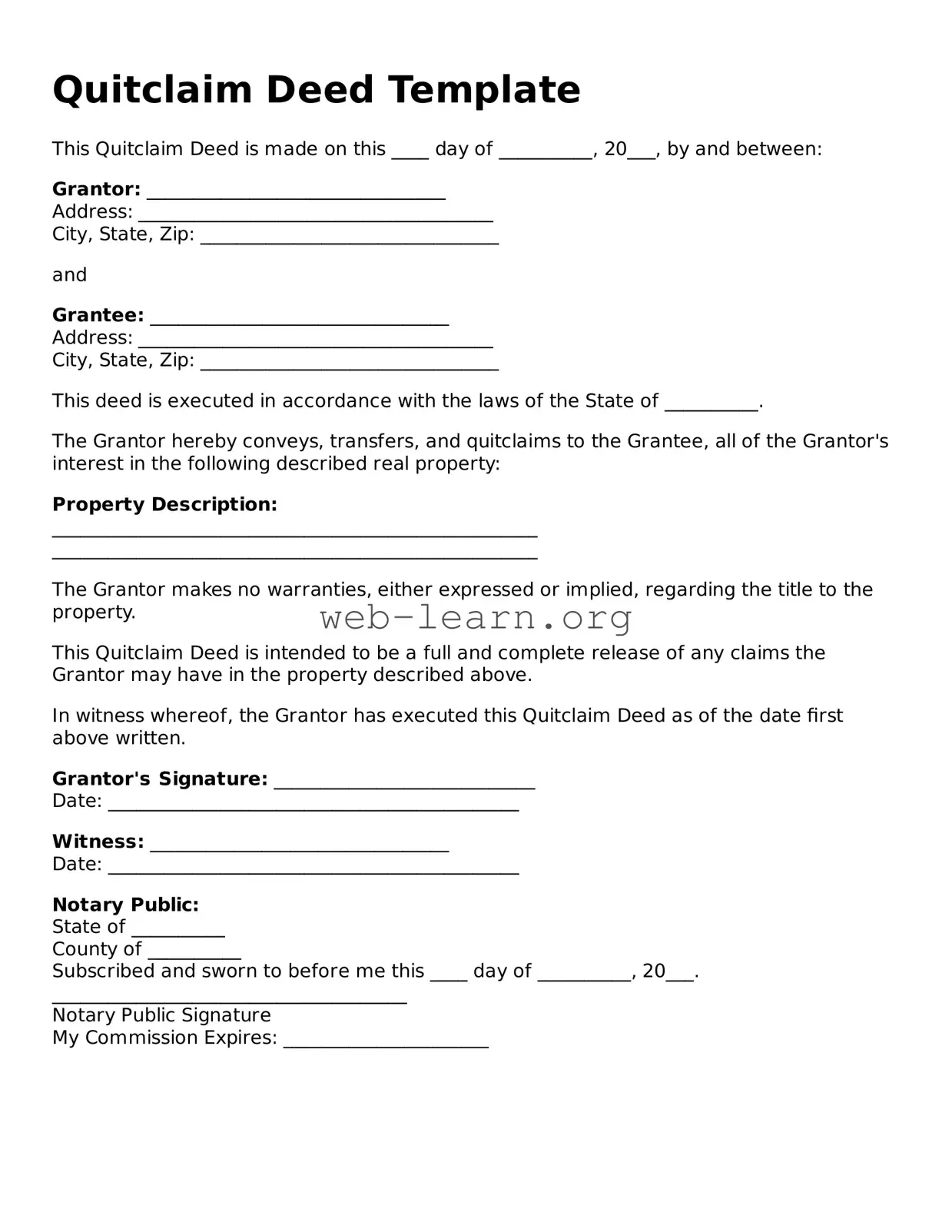
The Quitclaim Deed form serves as a vital legal instrument in the realm of property transfer, allowing an individual to relinquish any interest they may have in a piece of real estate to another party. This form is particularly useful in situations where the granter may not have complete ownership or when the transfer is made between family members or in divorce settlements. Unlike other types of deeds, a Quitclaim Deed does not guarantee that the granter holds a valid title; instead, it simply conveys whatever interest they possess, if any. This aspect makes it essential for the grantee to conduct thorough due diligence before accepting the transfer. Additionally, the Quitclaim Deed often requires notarization and may need to be recorded in the appropriate county office to ensure the change in ownership is recognized publicly. Understanding the implications of using a Quitclaim Deed is crucial for both parties involved, as it can affect future property rights and liabilities.
Quitclaim Deed Template
This Quitclaim Deed is made on this ____ day of __________, 20___, by and between:
Grantor: ________________________________
Address: ______________________________________
City, State, Zip: ________________________________
and
Grantee: ________________________________
Address: ______________________________________
City, State, Zip: ________________________________
This deed is executed in accordance with the laws of the State of __________.
The Grantor hereby conveys, transfers, and quitclaims to the Grantee, all of the Grantor's interest in the following described real property:
Property Description:
____________________________________________________
____________________________________________________
The Grantor makes no warranties, either expressed or implied, regarding the title to the property.
This Quitclaim Deed is intended to be a full and complete release of any claims the Grantor may have in the property described above.
In witness whereof, the Grantor has executed this Quitclaim Deed as of the date first above written.
Grantor's Signature: ____________________________
Date: ____________________________________________
Witness: ________________________________
Date: ____________________________________________
Notary Public:
State of __________
County of __________
Subscribed and sworn to before me this ____ day of __________, 20___.
______________________________________
Notary Public Signature
My Commission Expires: ______________________
| Fact Name | Description |
|---|---|
| Definition | A quitclaim deed is a legal document that transfers ownership interest in a property from one party to another without any warranties. |
| Usage | Commonly used among family members or in situations where the parties know each other well. |
| Governing Law | Each state has its own laws governing quitclaim deeds. For example, in California, it falls under California Civil Code Section 1092. |
| Warranties | Unlike warranty deeds, quitclaim deeds do not guarantee that the grantor has clear title to the property. |
| Tax Implications | Transferring property via a quitclaim deed may have tax implications, including potential gift tax if the transfer is not for fair market value. |
| Recording | To provide public notice of the transfer, quitclaim deeds should be recorded with the appropriate county office. |
After completing the Quitclaim Deed form, it’s important to ensure that all information is accurate. This form must be signed and notarized before it can be filed with the appropriate county office. Make sure to keep a copy for your records.
What is a Quitclaim Deed?
A Quitclaim Deed is a legal document used to transfer ownership of property from one person to another. Unlike other types of deeds, a Quitclaim Deed does not guarantee that the person transferring the property has clear title to it. Instead, it simply conveys whatever interest the grantor has in the property, if any.
When should I use a Quitclaim Deed?
Quitclaim Deeds are often used in situations where the parties know each other and trust each other, such as between family members or friends. Common scenarios include transferring property after a divorce, gifting property, or adding a spouse to a property title.
What are the advantages of using a Quitclaim Deed?
One of the main advantages is the simplicity of the process. Quitclaim Deeds are generally straightforward and do not require extensive documentation or legal formalities. They can be a quick way to transfer property without the need for a lengthy title search.
Are there any disadvantages to using a Quitclaim Deed?
Yes, the primary disadvantage is the lack of warranty. If the grantor does not have clear title to the property, the grantee may face challenges in asserting ownership. Additionally, it may not be suitable for transactions involving strangers or situations where title issues are present.
Do I need to have the Quitclaim Deed notarized?
Yes, most states require that a Quitclaim Deed be signed in the presence of a notary public. This helps to verify the identities of the parties involved and ensures that the document is legally binding.
How do I file a Quitclaim Deed?
After completing the Quitclaim Deed, you will typically need to file it with the county recorder’s office in the county where the property is located. There may be a small fee for recording the deed. It’s important to check local regulations for specific filing requirements.
Can I revoke a Quitclaim Deed?
Once a Quitclaim Deed is executed and recorded, it cannot be revoked unilaterally. If you wish to change ownership, you would need to create a new deed to transfer the property back or to a new owner.
Is a Quitclaim Deed the same as a Warranty Deed?
No, they are not the same. A Warranty Deed provides a guarantee that the grantor holds clear title to the property and has the right to sell it. In contrast, a Quitclaim Deed offers no such guarantee, making it a riskier option for the grantee.
Can I use a Quitclaim Deed for commercial property?
Yes, Quitclaim Deeds can be used for both residential and commercial properties. However, it is crucial to consider the implications of not having title insurance, especially for commercial transactions, where title issues can be more complex.
What should I do if I have more questions about Quitclaim Deeds?
If you have further questions, it may be beneficial to consult with a real estate attorney or a professional who specializes in property transactions. They can provide tailored advice based on your specific situation and help you understand the implications of using a Quitclaim Deed.
Filling out a Quitclaim Deed form can be a straightforward process, but there are common mistakes that individuals often make. One frequent error is failing to accurately identify the parties involved. The form requires the names of the grantor (the person transferring the property) and the grantee (the person receiving the property) to be clearly stated. If there are any discrepancies in the names, such as misspellings or incorrect middle initials, it can lead to confusion or even legal disputes in the future.
Another common mistake is neglecting to include a legal description of the property. The Quitclaim Deed must specify the exact location and boundaries of the property being transferred. This description should be detailed enough to avoid ambiguity. Without a proper legal description, the deed may be deemed invalid, leaving the property transfer unrecognized by the courts.
People often overlook the importance of notarization. A Quitclaim Deed typically requires the signature of the grantor to be notarized. This step is crucial as it verifies the identity of the person signing the document and ensures that they are doing so willingly. Failing to have the deed notarized can render it ineffective and may complicate the transfer process.
Lastly, individuals sometimes forget to record the Quitclaim Deed with the appropriate county office. Recording the deed is essential for establishing public notice of the property transfer. Without this step, the new ownership may not be recognized by third parties, which can lead to complications if the grantee attempts to sell or refinance the property in the future. Properly completing and recording the Quitclaim Deed protects the interests of all parties involved.
A Quitclaim Deed is a legal document used to transfer ownership of property from one party to another. While it serves a specific purpose, several other forms and documents are often associated with or used alongside a Quitclaim Deed to ensure a smooth transaction and protect the interests of all parties involved. Below is a list of some common documents that may accompany a Quitclaim Deed.
Understanding these additional documents can help facilitate a smoother property transfer process. Each document plays a critical role in ensuring that the rights and responsibilities of all parties are clearly defined and protected during the transaction.
When filling out a Quitclaim Deed form, it's important to be careful and thorough. Here are some things to keep in mind:
By following these guidelines, you can help ensure that your Quitclaim Deed is filled out correctly and efficiently.
Many people have misunderstandings about the Quitclaim Deed form. Here are six common misconceptions:
Understanding these misconceptions can help you make informed decisions about property transfers.
When dealing with property transfers, a Quitclaim Deed can be a useful tool. Here are seven key takeaways to keep in mind when filling out and using this form:
By keeping these takeaways in mind, you can navigate the Quitclaim Deed process more confidently and effectively.
Transfer on Death Deed California Common Questions - It can help ensure that your property is passed on to the right beneficiaries without complications.