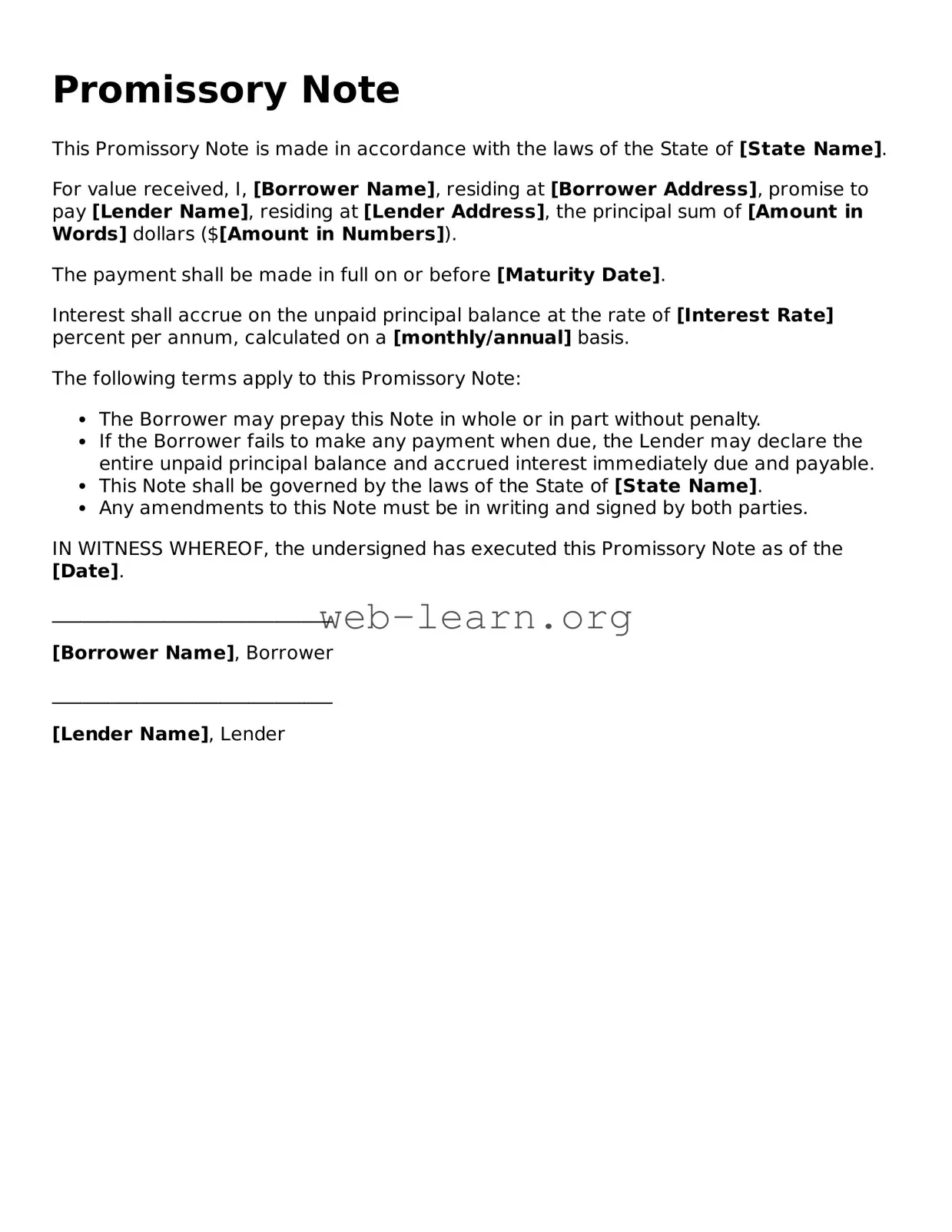
The Promissory Note form serves as a crucial financial instrument in various lending scenarios, establishing a clear agreement between a borrower and a lender. This document outlines the terms of a loan, including the principal amount, interest rate, repayment schedule, and any applicable fees. It is essential for both parties to understand their rights and obligations as detailed in the note. The form typically includes spaces for signatures, which validate the agreement and indicate acceptance of the terms. Additionally, it may specify consequences for default, ensuring that both parties are aware of the potential risks involved. By providing a structured framework for borrowing and lending, the Promissory Note form facilitates trust and accountability in financial transactions.
Promissory Note
This Promissory Note is made in accordance with the laws of the State of [State Name].
For value received, I, [Borrower Name], residing at [Borrower Address], promise to pay [Lender Name], residing at [Lender Address], the principal sum of [Amount in Words] dollars ($[Amount in Numbers]).
The payment shall be made in full on or before [Maturity Date].
Interest shall accrue on the unpaid principal balance at the rate of [Interest Rate] percent per annum, calculated on a [monthly/annual] basis.
The following terms apply to this Promissory Note:
IN WITNESS WHEREOF, the undersigned has executed this Promissory Note as of the [Date].
______________________________
[Borrower Name], Borrower
______________________________
[Lender Name], Lender
| Fact Name | Description |
|---|---|
| Definition | A promissory note is a written promise to pay a specified amount of money to a designated person or entity at a future date or on demand. |
| Parties Involved | Typically, there are two parties: the maker (who promises to pay) and the payee (to whom the payment is owed). |
| Key Components | A valid promissory note includes the principal amount, interest rate, maturity date, and signatures of the parties involved. |
| Governing Law | The laws governing promissory notes can vary by state, but they are generally regulated under the Uniform Commercial Code (UCC). |
| Enforceability | For a promissory note to be enforceable, it must be clear, complete, and signed by the maker. |
| Types of Notes | There are various types of promissory notes, including secured and unsecured notes, each with different implications for the parties involved. |
| Transferability | Promissory notes can often be transferred to other parties, allowing the payee to assign their rights to receive payment. |
| Default Consequences | If the maker defaults on the payment, the payee may have legal recourse to recover the owed amount, including potential court action. |
Filling out a Promissory Note form is an important step in formalizing a loan agreement between two parties. Once completed, this document serves as a legal record of the terms agreed upon by the borrower and lender. Following the steps below will help ensure that all necessary information is included, making the process straightforward and clear.
A promissory note is a written promise to pay a specified amount of money to a designated person or entity at a defined time or on demand. This document outlines the terms of the loan, including the principal amount, interest rate, and repayment schedule. It serves as a legal instrument that protects both the lender and the borrower by clearly stating the obligations of each party.
Anyone can use a promissory note, whether they are individuals, businesses, or organizations. It is commonly used in personal loans, business financing, and real estate transactions. If you are lending money or borrowing it, a promissory note can help formalize the agreement and ensure that everyone understands their responsibilities.
A valid promissory note should include the following elements:
These components are crucial for ensuring the note is enforceable in a court of law.
While both documents serve to outline the terms of a loan, a promissory note is typically simpler and focuses on the promise to pay. A loan agreement, on the other hand, is more detailed and may include additional terms and conditions, such as collateral requirements, representations, and warranties. In essence, a promissory note is a subset of a loan agreement.
Yes, a promissory note is legally binding as long as it meets the necessary legal requirements. Both parties must agree to the terms, and the document must be signed. If either party fails to uphold their end of the agreement, the other party may seek legal recourse to enforce the terms of the note.
Yes, a promissory note can be modified, but both parties must agree to the changes. It is best practice to document any modifications in writing and have both parties sign the revised note. This helps prevent misunderstandings and ensures that all parties are on the same page regarding the new terms.
When filling out a Promissory Note, clarity and accuracy are essential. One common mistake is failing to include all necessary details. This includes the names of the borrower and lender, the loan amount, and the repayment terms. Omitting any of these key elements can lead to confusion and disputes later on.
Another frequent error is not specifying the interest rate. Without a clear interest rate, both parties may have different expectations about the cost of the loan. It’s important to state whether the interest is fixed or variable and to outline how it will be calculated.
Many individuals also neglect to include the repayment schedule. Stating when payments are due and how much each payment will be can prevent misunderstandings. A vague repayment plan can lead to missed payments and financial strain.
Some people mistakenly sign the Promissory Note without reading it thoroughly. This can result in agreeing to terms that are not fully understood. Always take the time to review the document to ensure that all terms are clear and acceptable.
Another error is using ambiguous language. Terms like “as soon as possible” or “reasonable time” can lead to differing interpretations. It’s best to use precise language to avoid any potential conflicts.
Additionally, failing to date the document is a common oversight. The date of signing is crucial for establishing the timeline of the loan and for any legal considerations. Always include the date when the Promissory Note is signed.
Some individuals forget to include a default clause. This clause outlines what happens if the borrower fails to make payments. Without this, there may be uncertainty about the consequences of defaulting on the loan.
Another mistake is not having the document witnessed or notarized when required. Depending on state laws, having a witness or notary can add an extra layer of legitimacy to the agreement. This step can be crucial in case of disputes.
Many people also fail to keep a copy of the signed Promissory Note. It’s important for both the borrower and lender to retain a copy for their records. This ensures that both parties have access to the same information regarding the loan.
Finally, some individuals overlook the importance of consulting a professional. Seeking advice from a legal expert or financial advisor can help ensure that the Promissory Note is filled out correctly and serves its intended purpose.
When dealing with a Promissory Note, several other documents often accompany it to ensure clarity and protect the interests of all parties involved. Understanding these documents can help you navigate the lending process more effectively.
Having a good grasp of these documents can empower borrowers and lenders alike. They work together to create a clear understanding of the loan terms and responsibilities, ultimately fostering a smoother lending experience.
When filling out a Promissory Note form, it is crucial to follow certain guidelines to ensure that the document is valid and enforceable. Here are five things you should and shouldn't do:
Understanding the Promissory Note form is crucial for both lenders and borrowers. However, several misconceptions can lead to confusion. Here are ten common misconceptions:
While it is a formal agreement, its enforceability depends on various factors, including the terms and the parties involved.
Notarization is not always required. It depends on state laws and the specific agreement between parties.
They can be used for any amount, regardless of size. Small loans can also benefit from this form.
While verbal agreements can be binding, having a written Promissory Note provides clear documentation and protection.
While many notes do include interest rates, it is not a requirement. A zero-interest note is valid.
Although both serve as evidence of debt, a Promissory Note is more formal and includes specific terms.
Modifications are possible, but they must be documented and agreed upon by all parties involved.
Promissory Notes are also common in business transactions and real estate deals.
While it is a strong document, disputes can arise based on circumstances or misunderstandings.
They can vary widely in terms, conditions, and formats. Customization is often necessary to meet specific needs.
By addressing these misconceptions, individuals can better navigate the complexities of Promissory Notes and ensure they are adequately protected in financial agreements.
When dealing with a Promissory Note, it's important to understand its key elements and how to use it effectively. Here are some essential takeaways:
Understanding these key points can help ensure that both parties are protected and that the agreement is clear and enforceable.