When individuals decide to purchase a car, they often rely on financing options to make this significant investment more manageable. One common financial instrument used in such transactions is the promissory note for a car. This document serves as a written promise from the borrower to repay the lender a specified amount over a designated period, typically including interest. It outlines key details such as the total loan amount, the interest rate, the payment schedule, and any penalties for late payments. By clearly delineating the responsibilities of both parties, the promissory note helps to establish a mutual understanding and provides legal protection should any disputes arise. Additionally, it may include clauses regarding default, allowing the lender to reclaim the vehicle if payments are not made as agreed. Understanding the components and implications of a promissory note is crucial for both buyers and sellers, as it plays a vital role in the financing process and can impact credit ratings and financial stability.
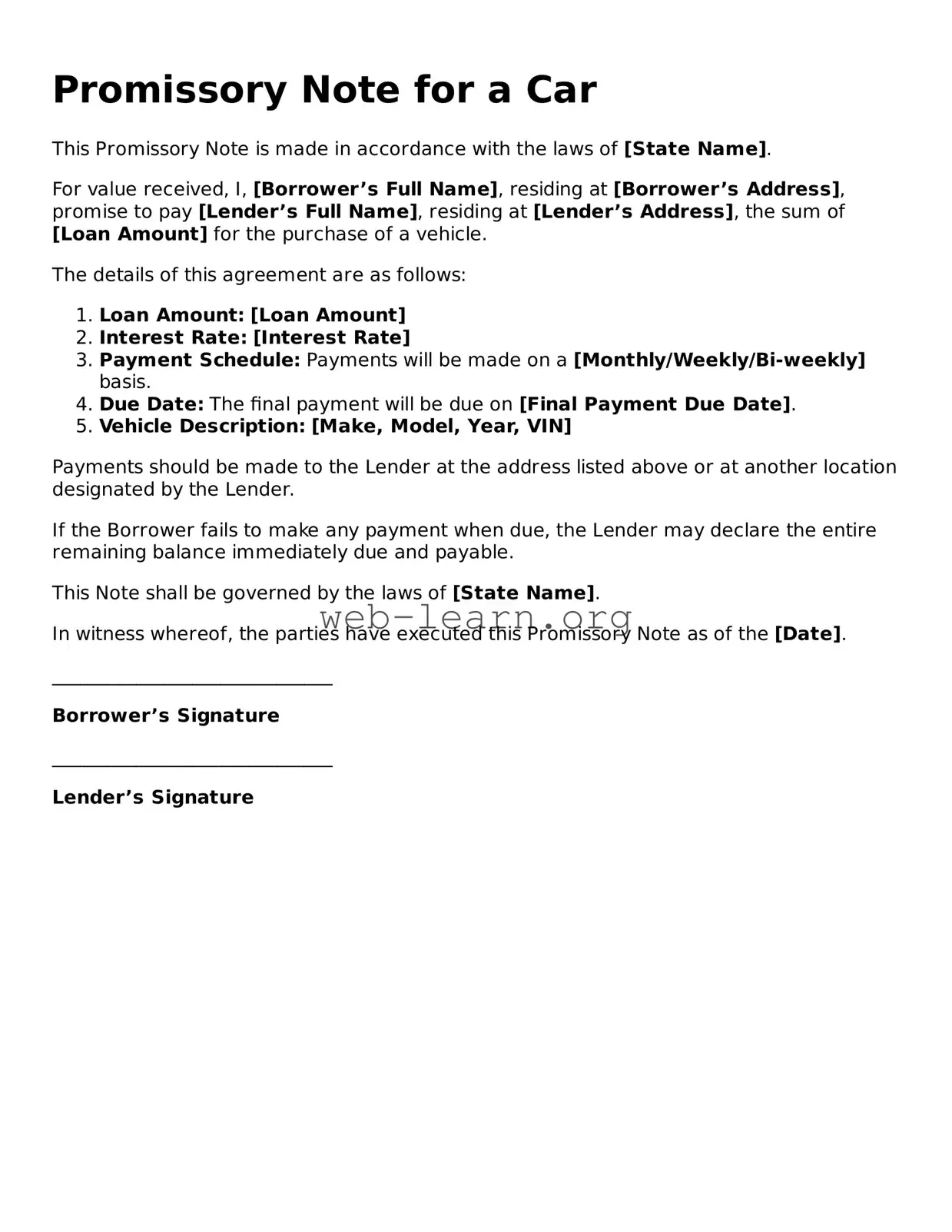
Promissory Note for a Car
This Promissory Note is made in accordance with the laws of [State Name].
For value received, I, [Borrower’s Full Name], residing at [Borrower’s Address], promise to pay [Lender’s Full Name], residing at [Lender’s Address], the sum of [Loan Amount] for the purchase of a vehicle.
The details of this agreement are as follows:
Payments should be made to the Lender at the address listed above or at another location designated by the Lender.
If the Borrower fails to make any payment when due, the Lender may declare the entire remaining balance immediately due and payable.
This Note shall be governed by the laws of [State Name].
In witness whereof, the parties have executed this Promissory Note as of the [Date].
______________________________
Borrower’s Signature
______________________________
Lender’s Signature
| Fact Name | Description |
|---|---|
| Definition | A promissory note for a car is a written promise to pay a specified amount for the purchase of a vehicle. |
| Parties Involved | The note involves two primary parties: the borrower (buyer) and the lender (seller or financial institution). |
| Payment Terms | It outlines the payment schedule, including the amount due, frequency of payments, and total duration. |
| Interest Rate | The note specifies the interest rate, which can be fixed or variable, affecting the total repayment amount. |
| Governing Law | The applicable laws governing the promissory note vary by state. For example, in California, it is governed by the California Commercial Code. |
| Default Clause | A default clause is often included, detailing the consequences if the borrower fails to make payments. |
| Secured vs. Unsecured | This note can be secured by the vehicle itself, meaning the lender has a claim to the car if payments are not made. |
| Transferability | Promissory notes can often be transferred to another party, allowing the lender to sell the debt to someone else. |
| Signatures Required | Both parties must sign the note for it to be legally binding, indicating their agreement to the terms. |
| State-Specific Variations | Different states may have unique requirements for the form, such as notarization or specific disclosures. |
Filling out a Promissory Note for a car is an important step in the process of securing a loan for your vehicle. Once you have completed the form, you will be ready to finalize the financing agreement with the lender. Follow these steps to ensure that you fill out the form correctly.
After completing these steps, review the form for accuracy. Once everything is in order, you can present the Promissory Note to your lender. They will guide you through the next steps in the financing process.
What is a Promissory Note for a Car?
A Promissory Note for a Car is a legal document that outlines the terms of a loan used to purchase a vehicle. It serves as a written promise from the borrower to repay the lender a specific amount of money, usually with interest, over a defined period. This document includes details such as the loan amount, interest rate, repayment schedule, and any collateral, which is typically the car itself.
Why do I need a Promissory Note for a Car?
Having a Promissory Note protects both the borrower and the lender. For the borrower, it clarifies the repayment terms and helps avoid misunderstandings. For the lender, it provides legal recourse in case the borrower fails to repay the loan. It establishes a formal agreement that can be enforced in court if necessary.
What should I include in a Promissory Note for a Car?
When drafting a Promissory Note, include the following key elements:
Can I modify a Promissory Note after it is signed?
Yes, a Promissory Note can be modified after it has been signed, but both parties must agree to the changes. It is essential to document any modifications in writing and have both parties sign the amended note. This ensures clarity and prevents disputes in the future.
What happens if I default on my Promissory Note?
If a borrower defaults on a Promissory Note, the lender has the right to take legal action to recover the owed amount. This may include repossessing the car, pursuing a lawsuit, or reporting the default to credit agencies. Defaulting can significantly impact the borrower's credit score, making future loans more difficult to obtain.
Filling out a Promissory Note for a car can seem straightforward, but many people make mistakes that could lead to complications later on. One common error is failing to include the correct names of all parties involved. If the buyer or seller's name is misspelled or incomplete, it could create issues in enforcing the agreement.
Another frequent mistake is not specifying the loan amount clearly. The total amount borrowed should be explicitly stated, and any additional fees or interest should be clearly outlined. Ambiguities in this section can lead to disputes about how much is actually owed.
People often overlook the importance of detailing the payment schedule. Without a clear timeline for payments, misunderstandings can arise. Specify when payments are due and how many payments will be made. Vague terms can lead to confusion about deadlines.
Some individuals forget to include the interest rate or fail to specify whether it is fixed or variable. This information is crucial for both parties to understand how the total amount owed may change over time. Always ensure that the interest rate is clearly stated to avoid future disagreements.
Another mistake is neglecting to sign and date the document. A Promissory Note is not valid unless it is signed by all parties involved. Missing signatures or dates can render the note unenforceable, leaving one party unprotected.
People sometimes assume that verbal agreements are sufficient. However, a Promissory Note should always be in writing. Relying on verbal promises can lead to misunderstandings and disputes down the line.
Additionally, failing to include a clause about default can be problematic. It’s important to specify what happens if a payment is missed. This clause can outline penalties or late fees, providing clarity for both parties.
Another common oversight is not keeping a copy of the signed Promissory Note. Each party should have a copy for their records. Without documentation, it becomes difficult to prove the terms of the agreement if disputes arise.
People may also forget to review the entire document before signing. Reading through the note carefully ensures that all terms are understood and agreed upon. Skimming can lead to missing critical details that may cause issues later.
Lastly, some individuals do not seek legal advice when drafting or signing a Promissory Note. Consulting a legal expert can provide valuable insights and help avoid common pitfalls. Taking this step can save time and money in the long run.
When financing a vehicle, several important documents accompany the Promissory Note for a Car. Each of these forms serves a unique purpose in the transaction, ensuring that both the buyer and the seller are protected and that the terms of the agreement are clear. Below is a list of commonly used documents in conjunction with the Promissory Note.
Understanding these documents can make the car buying process smoother and more transparent. Each one plays a vital role in protecting your interests and ensuring a successful transaction.
When filling out a Promissory Note for a Car form, it is essential to approach the process with care. The following guidelines can help ensure that the document is completed correctly.
Many people have misunderstandings about the Promissory Note for a Car form. Here are seven common misconceptions:
A Promissory Note is not the same as a car loan agreement. While both documents involve borrowing money, a Promissory Note is a simple document that outlines the borrower's promise to repay the loan, whereas a loan agreement includes detailed terms and conditions.
Some believe that a Promissory Note lacks legal weight. In fact, it is a legally binding document that can be enforced in court if the borrower fails to repay the loan.
This is incorrect. Individuals can create and sign Promissory Notes. They are not limited to financial institutions.
While notarization can add an extra layer of authenticity, it is not a requirement for a Promissory Note to be valid. As long as both parties agree to the terms, it is enforceable.
A Promissory Note can be used for various types of loans, not just for purchasing a car. It is a flexible document applicable in many borrowing situations.
Some assume that payment terms are optional. However, a clear outline of payment terms, including amounts and due dates, is crucial for both parties to avoid misunderstandings.
Many think that creating a Promissory Note is overly complex. In reality, it is a straightforward document that can be easily drafted with essential information included.
When filling out and using the Promissory Note for a Car form, keep the following key points in mind:
Satisfaction of Promissory Note - May include a statement of good standing for the borrower.