Homepage Blank Progress Notes Form
Outline

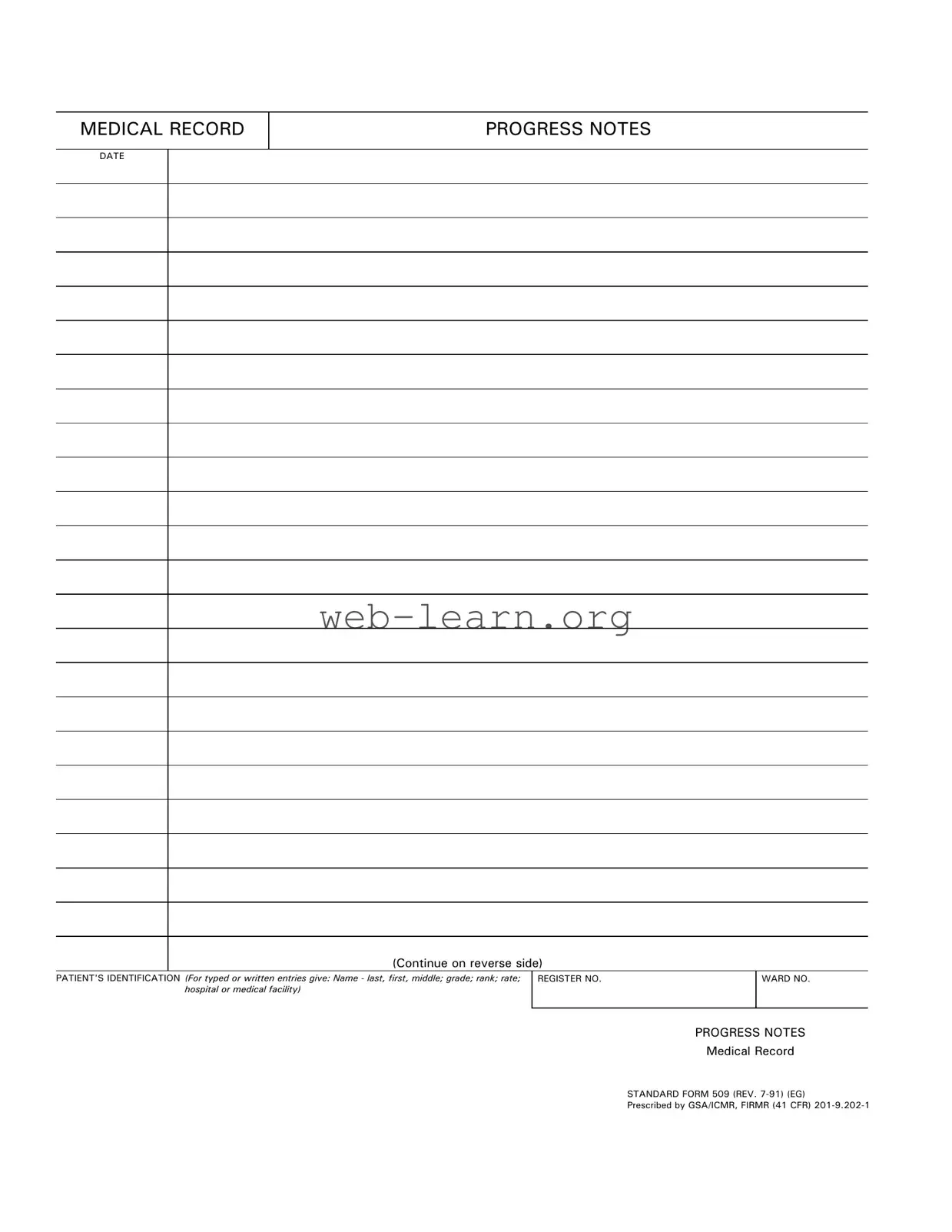
The Progress Notes form is an essential document in the medical record-keeping process, designed to capture vital information about a patient's ongoing treatment and health status. It includes specific fields for the patient's identification, such as their name, grade, rank, and the medical facility where they are receiving care. Each entry begins with the date, ensuring that all notes are chronologically organized, which is crucial for tracking the patient's progress over time. The form is standardized, as indicated by the designation of Standard Form 509, and it adheres to guidelines set forth by the General Services Administration and other regulatory bodies. This structure allows healthcare providers to document observations, treatment plans, and any changes in the patient's condition in a clear and concise manner. By maintaining accurate and up-to-date Progress Notes, medical professionals can communicate effectively with one another, ultimately improving patient care and outcomes.

Sample - Progress Notes Form

MEDICAL RECORD

PROGRESS NOTES

DATE

(Continue on reverse side)

PATIENT'S IDENTIFICATION (For typed or written entries give: Name - last, first, middle; grade; rank; rate; hospital or medical facility)

REGISTER NO.

WARD NO.


PROGRESS NOTES

Medical Record

STANDARD FORM 509 (REV. 7-91) (EG)

Prescribed by GSA/ICMR, FIRMR (41 CFR) 201-9.202-1

PROGRESS NOTES

DATE

STANDARD FORM 509 (REV. 7-91) BACK

Form Information

Fact Name Description
Form Purpose The Progress Notes form is used to document a patient's medical history and ongoing treatment in a structured manner.
Identification Requirements It requires the patient's identification details, including name, grade, rank, rate, and the medical facility's name.
Standardization This form is a standardized document, specifically Standard Form 509, as prescribed by the General Services Administration (GSA).
Regulatory Compliance The form adheres to regulations outlined in the Federal Information Resources Management Regulation (FIRMR), specifically 41 CFR 201-9.202-1.

Detailed Guide for Filling Out Progress Notes

Once the Progress Notes form is completed, it will be used to document important information about a patient's medical history and treatment. This ensures that all relevant details are recorded accurately for future reference.

  1. Begin by entering the date at the top of the form.
  2. In the PATIENT'S IDENTIFICATION section, provide the patient's name in the following order: last name, first name, and middle initial.
  3. Include the patient's grade, rank, and rate as applicable.
  4. Specify the hospital or medical facility where the patient is receiving care.
  5. Fill in the REGISTER NO. assigned to the patient.
  6. Indicate the WARD NO. where the patient is located.
  7. Proceed to the PROGRESS NOTES section and document the relevant observations, assessments, and treatment updates.
  8. Ensure that all entries are clear and legible, whether typed or handwritten.

Obtain Answers on Progress Notes

  1. What is the purpose of the Progress Notes form?

    The Progress Notes form is used to document a patient's medical history and ongoing treatment. It provides a systematic way for healthcare providers to record observations, treatment plans, and any changes in the patient's condition. This ensures that all team members have access to up-to-date information, which is crucial for effective patient care.

  2. What information do I need to include in the Progress Notes?

    When filling out the Progress Notes form, include the following:

    • Patient's full name (last, first, middle)
    • Patient's grade, rank, or rate
    • Hospital or medical facility where the patient is being treated
    • Patient's identification number and ward number
    • Date of the entry
    • Detailed observations and treatment updates

    Accurate and thorough entries are essential for maintaining a comprehensive medical record.

  3. How should I document changes in a patient's condition?

    Document changes in a patient's condition clearly and concisely. Use objective language to describe symptoms, responses to treatment, and any relevant observations. If applicable, include the time of the change and any actions taken in response. This helps ensure continuity of care and provides valuable information for other healthcare providers.

  4. Can I continue writing on the reverse side of the Progress Notes form?

    Yes, if you need more space, you can continue your notes on the reverse side of the Progress Notes form. Ensure that you maintain the same level of detail and clarity as you would on the front. This allows for comprehensive documentation without losing important information.

  5. What should I do if I make a mistake on the Progress Notes form?

    If you make a mistake, do not erase or use correction fluid. Instead, draw a single line through the error and initial it. Then, write the correct information next to it. This practice maintains the integrity of the medical record and ensures that all entries are traceable.

Common mistakes

Filling out the Progress Notes form is a critical task in the medical documentation process. However, many individuals make common mistakes that can lead to confusion or miscommunication. One frequent error is failing to include the complete patient identification information. It is essential to provide the patient's full name, grade, rank, and hospital or medical facility to ensure accurate record-keeping.

Another mistake is not recording the date properly. Each entry should clearly indicate the date on which the notes were made. Omitting this detail can complicate the timeline of patient care and hinder effective communication among healthcare providers.

Some individuals neglect to use the correct standard form for progress notes. Using an outdated or incorrect form can lead to inconsistencies in documentation practices. Always ensure that the most recent version of the form is utilized to comply with regulatory standards.

Inaccurate or vague descriptions in the progress notes themselves are also common pitfalls. Detailed and specific notes are crucial for providing a clear picture of the patient's condition and treatment. Ambiguity can result in misunderstandings and affect patient care.

Another mistake involves skipping the reverse side of the form if additional space is needed. If the notes exceed the available space, it is important to continue on the back of the form rather than cramming information into a limited area, which can make it difficult to read.

Inconsistent terminology can confuse readers. Using different terms for the same condition or treatment can lead to misinterpretation. It is best to stick to standardized medical language throughout the notes.

Additionally, some individuals forget to include their signature or credentials at the end of the notes. This omission can raise questions about the authenticity of the documentation and may lead to compliance issues.

Lastly, failing to review the completed form for accuracy before submission is a significant oversight. Taking a moment to double-check entries can prevent many of the errors mentioned above and ensure that the documentation is both complete and precise.

Documents used along the form

The Progress Notes form is a critical document used in medical records to track patient care and treatment. Several other forms and documents are often used in conjunction with the Progress Notes to ensure comprehensive patient management and documentation.

  • Patient Intake Form: This document collects essential information about the patient at the beginning of their care. It typically includes personal details, medical history, and current medications, which help healthcare providers understand the patient's background.
  • Treatment Plan: This document outlines the specific goals and strategies for a patient's care. It details the interventions, timelines, and responsibilities of healthcare providers, ensuring everyone involved is aware of the patient's treatment path.
  • Medication Administration Record (MAR): The MAR tracks all medications administered to a patient during their stay. It includes dosages, administration times, and any reactions, providing a clear history of the patient's medication regimen.
  • Discharge Summary: This document is prepared when a patient is discharged from care. It summarizes the patient's treatment, progress, and any follow-up instructions, ensuring continuity of care after leaving the facility.

These documents, when used alongside the Progress Notes form, contribute to a well-rounded approach to patient care and documentation. Proper use of these forms enhances communication among healthcare providers and improves patient outcomes.

Similar forms

The Progress Notes form serves as a vital component in medical documentation, capturing essential information about a patient's treatment and progress. Several other documents share similarities with the Progress Notes form in terms of purpose and content. Here’s a list of ten such documents:

  • Patient Intake Form: This document collects initial information about the patient, including personal details and medical history, much like the Progress Notes form records ongoing treatment details.
  • SOAP Notes: SOAP stands for Subjective, Objective, Assessment, and Plan. This structured format allows healthcare providers to document patient encounters systematically, similar to how Progress Notes summarize patient progress.
  • Discharge Summary: This document outlines a patient’s treatment and progress during hospitalization. Like Progress Notes, it provides a comprehensive overview but focuses on the conclusion of care.
  • Clinical Assessment Form: This form captures a detailed evaluation of a patient's condition, similar to how Progress Notes track changes over time in a patient's health status.
  • Treatment Plan: A treatment plan outlines the proposed interventions and goals for a patient. It parallels Progress Notes by documenting the trajectory of care and adjustments made along the way.
  • Referral Form: This document is used to refer a patient to another healthcare provider. It often includes relevant medical history and treatment notes, akin to the information found in Progress Notes.
  • Medication Administration Record (MAR): This record tracks the administration of medications to patients. It shares similarities with Progress Notes in documenting specific actions taken regarding patient care.
  • Incident Report: Used to document any unusual occurrences during patient care, this report captures critical information, much like how Progress Notes detail significant changes in a patient's condition.
  • Follow-Up Notes: These notes are used to document subsequent visits or communications with a patient. They serve a similar purpose to Progress Notes by tracking ongoing care and patient responses.
  • Care Coordination Notes: These notes facilitate communication among healthcare providers involved in a patient’s care. They often summarize treatment updates, similar to the way Progress Notes do.

Dos and Don'ts

When filling out the Progress Notes form, attention to detail is crucial. Here are some essential guidelines to follow, as well as common pitfalls to avoid.

  • Do ensure that you enter the patient's identification accurately, including their full name, grade, rank, and medical facility.
  • Do write the date clearly at the top of the form to maintain a proper timeline of care.
  • Do use clear and concise language to describe the patient's condition and any treatments provided.
  • Do check for any spelling or grammatical errors before submitting the form.
  • Don't leave any sections of the form blank; every part should be filled out to provide a complete record.
  • Don't use jargon or abbreviations that may not be universally understood by all medical staff.

Following these guidelines will help ensure that the Progress Notes form is completed effectively, promoting clear communication within the healthcare team.

Misconceptions

Misconceptions about the Progress Notes form can lead to confusion and improper use. Here are nine common misunderstandings:

  1. Progress Notes are only for doctors. Many believe that only physicians can fill out Progress Notes. In reality, any healthcare professional involved in a patient's care can document their observations and treatments.
  2. Progress Notes are optional. Some think that completing Progress Notes is not mandatory. However, these notes are essential for maintaining accurate medical records and ensuring continuity of care.
  3. Progress Notes are only for inpatient care. There is a misconception that Progress Notes apply solely to hospital settings. In fact, they are relevant in outpatient clinics, rehabilitation facilities, and other healthcare environments.
  4. All Progress Notes must be lengthy and detailed. While thorough documentation is important, brevity is also key. Notes should be concise yet informative, capturing essential information without unnecessary detail.
  5. Progress Notes are private and cannot be shared. Some individuals believe that these notes are completely confidential. While they are protected, they may be shared with other healthcare providers involved in a patient's care, in accordance with privacy laws.
  6. Progress Notes are not legally binding. There is a common belief that these notes hold no legal weight. In fact, they can be critical in legal situations, as they provide a record of the care provided.
  7. Progress Notes are only for negative outcomes. Many think that Progress Notes should only document complications or failures. Positive progress and successful interventions should also be recorded.
  8. Progress Notes can be altered after the fact. Some may assume that it's acceptable to change notes once they are written. However, any modifications should be clearly documented to maintain integrity.
  9. Progress Notes are just for administrative purposes. While they do serve administrative needs, their primary purpose is to enhance patient care by providing a clear and accurate account of treatment and progress.

Understanding these misconceptions can lead to better practices in documentation and ultimately improve patient care.

Key takeaways

Filling out and using the Progress Notes form is essential for maintaining accurate medical records. Here are some key takeaways to keep in mind:

  • Accurate Patient Identification: Always include the patient's full name, grade, rank, rate, and the medical facility where they are being treated. This ensures that records are correctly attributed to the right individual.
  • Date Documentation: Clearly indicate the date on each entry. This helps in tracking the patient’s progress over time and is crucial for continuity of care.
  • Standardized Format: Use the provided Standard Form 509. This format is designed to streamline the documentation process and maintain consistency across medical records.
  • Detailed Progress Notes: Provide comprehensive details about the patient’s condition, treatments administered, and any changes observed. This information is vital for other healthcare providers who may review the records.
  • Revising Entries: If additional notes are needed, continue on the reverse side of the form. Ensure that all relevant information is included to avoid gaps in the patient’s medical history.
  • Compliance with Regulations: Be aware of the regulations governing medical records. Adhering to these guidelines protects patient confidentiality and ensures legal compliance.

By following these takeaways, healthcare professionals can effectively utilize the Progress Notes form to enhance patient care and maintain accurate medical documentation.