The Prescription Pad form is an essential tool for healthcare providers, streamlining the process of prescribing medications to patients. This form typically includes crucial patient information, such as name, date of birth, and contact details, ensuring that prescriptions are accurately tailored to individual needs. It also features sections for the prescribing physician's information, including their name, contact number, and license number, which helps maintain accountability and facilitates communication. The medication details section is vital, allowing for the specification of drug name, dosage, quantity, and instructions for use, thereby minimizing the risk of errors. Additionally, the form often includes a space for the physician's signature and the date of issuance, reinforcing its legal validity. By standardizing the prescription process, the Prescription Pad form not only enhances patient safety but also supports healthcare providers in delivering effective and timely care.
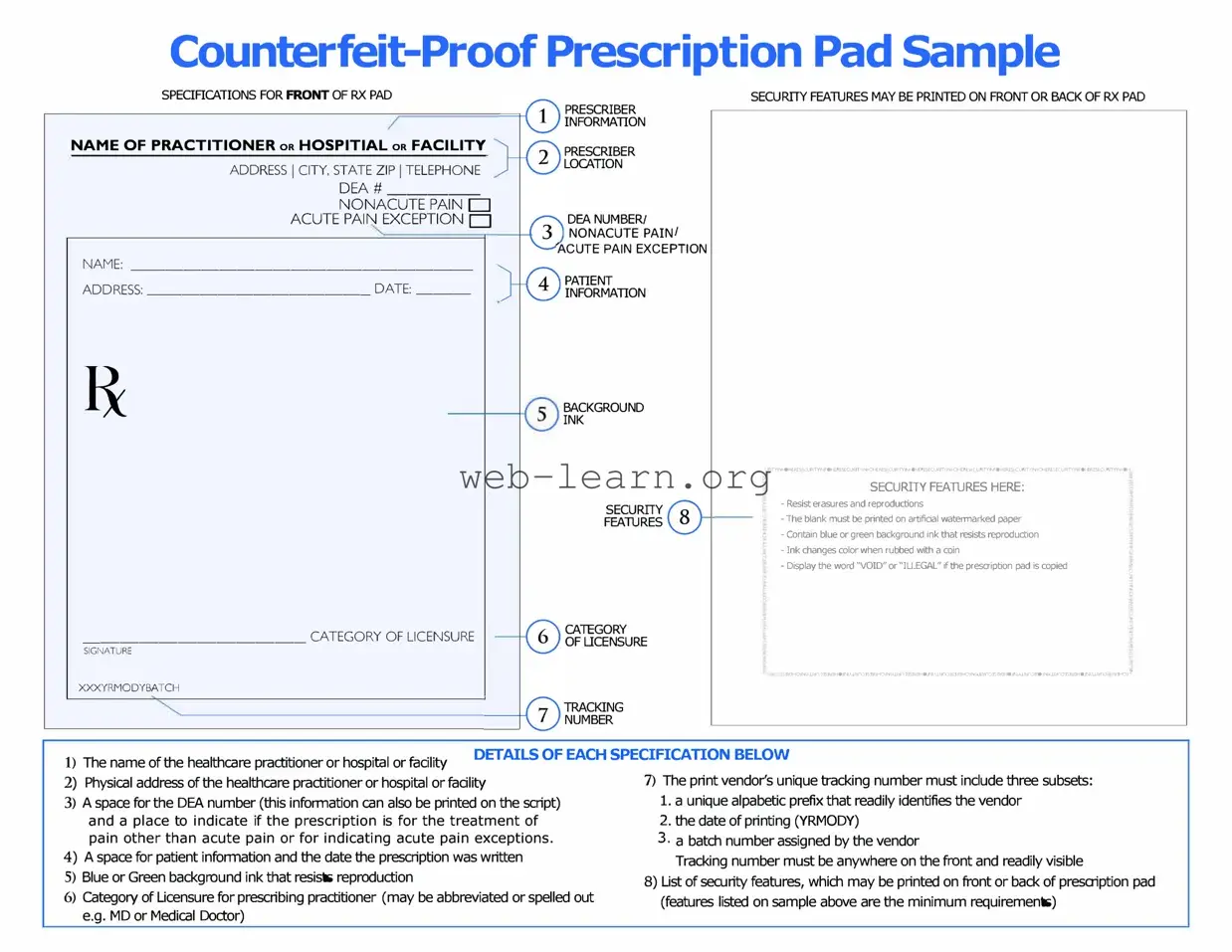
SPECIFICATIONS FOR FRONT OF RX PAD
NAME OF PRACTITIONER oR HOSPITIAL oR FACILITY
ADDRESS I CITY, STATE ZIP I TELEPHONE
DEA# _____□
NONACUTE PAIN
ACUTE PAIN EXCEPTION D
NAME: ___________________
ADDRESS: _____________ DATE: ___
____________ CATEGORY OF LICENSURE
SIGNATURE
XXXYRMODYBATCH
PRESCRIBER
INFORMATION
PRESCRIBER
LOCATION
DEA NUMBER/ NONACUTE PAIN/
ACUTE PAIN EXCEPTION
PATIENT
INFORMATION
BACKGROUND
INK
SECURITY
FEAllJRES
CATEGORY
OF LICENSURE
SECURITY FEAllJRES MAY BE PRINTED ON FRONT OR BACK OF RX PAD
� |
SECURITY FEAllJRES HERE: |
!i, |
|
|
|
|
- Resist erasures and reproductions |
|
|
- The blank must be printed on artificial waterrnarl<ed paper |
|
|
- Contain blue or green background ink that resists reproduction |
|
|
- Ink changes color when rubbed with a coin |
|
|
- Display the word "VOID" or"IU.EGAL" ifthe prescription pad is copied |
� |
|
|
_10HOJNIAl.nn::HS3'd3HOcJNl,Url!nJ=
1) |
The name of the healthc.are practitioner or hospital or facility |
DETAILS OF EACH SPECIFICATION BELOW |
|
|
7) The print vendor's unique tracking number must include three subsets: |
||
2) |
Physic.al address of the healthc.are practitioner or hospital or facility |
||
3) |
A space for the DEA number (this information c.an also be printed on the script) |
1. a unique alpabetic prefix that readily identifies the vendor |
|
|
and a place to indicate if the prescription is for the treatment of |
2. the date of printing (YRMODY) |
|
|
pain other than acute pain or for indicating acute pain exceptions. |
3 • a batch number assigned by the vendor |
|
4) |
A space for patient information and the date the prescription was written |
Tracking number must be anywhere on the front and readily visible |
|
5) |
Blue or Green background ink that resists reproduction |
|
8) List of security features, which may be printed on front or back of prescription pad |
6) |
Category of Licensure for prescribing practitioner (may be abbreviated or spelled out |
(features listed on sample above are the minimum requirements) |
|
|
e.g. MD or Medic.al Doctor) |
|
|
| Fact Name | Description |
|---|---|
| Definition | A Prescription Pad is a document used by healthcare providers to prescribe medications to patients. |
| Legal Requirement | In many states, a Prescription Pad must comply with specific state laws regarding format and content. |
| State-Specific Forms | Each state may have its own version of the Prescription Pad, governed by local regulations. |
| Security Features | Prescription Pads often include security features to prevent tampering and forgery. |
| Information Included | Typically, a Prescription Pad includes the patient's name, medication details, dosage, and prescribing provider's information. |
| Controlled Substances | Prescriptions for controlled substances must follow stricter guidelines under federal and state law. |
| Electronic Prescribing | Many states now allow electronic prescriptions, which can enhance security and streamline the prescribing process. |
| Record Keeping | Healthcare providers are usually required to keep records of all prescriptions written for a specified period. |
| Patient Information | It is essential to ensure that the patient's information is accurate and up-to-date on the Prescription Pad. |
| Governing Laws | Prescription Pad regulations are often governed by state pharmacy boards and the Drug Enforcement Administration (DEA). |
Completing the Prescription Pad form is an important step in ensuring that patients receive the correct medications. After filling out the form, it will be submitted to the appropriate pharmacy or medical provider for processing. This process is crucial for maintaining patient safety and ensuring that their healthcare needs are met effectively.
What is the Prescription Pad form?
The Prescription Pad form is a document used by healthcare providers to prescribe medications to patients. It includes essential information such as the patient's name, medication details, dosage, and instructions for use. This form ensures that prescriptions are clear and standardized, facilitating communication between the provider and the pharmacy.
Who can use the Prescription Pad form?
The Prescription Pad form is intended for use by licensed healthcare professionals, including doctors, nurse practitioners, and physician assistants. These individuals are authorized to prescribe medications and must follow state regulations regarding prescription practices.
What information is required on the Prescription Pad form?
Key information that must be included on the Prescription Pad form includes:
Completing all fields accurately helps prevent medication errors and ensures the pharmacy can fill the prescription without delay.
How should the Prescription Pad form be submitted?
The Prescription Pad form can be submitted in various ways, depending on the healthcare provider's practice. Common methods include:
Providers should ensure that the chosen method complies with applicable privacy laws and regulations.
What should a patient do if they lose their Prescription Pad form?
If a patient loses their Prescription Pad form, they should contact their healthcare provider as soon as possible. The provider can then verify the prescription and may issue a new form if necessary. It is important for patients to avoid attempting to recreate or alter a prescription without professional guidance.
Filling out a Prescription Pad form might seem straightforward, but many people make common mistakes that can lead to confusion or even legal issues. One frequent error is leaving out essential patient information. It’s crucial to include the patient's full name, date of birth, and contact information. Omitting this data can cause delays in processing the prescription or, worse, lead to the wrong medication being dispensed.
Another mistake occurs when the medication details are not clearly specified. This includes failing to write the correct dosage, frequency, or duration of treatment. Inadequate instructions can result in patients taking too much or too little of their medication, which can have serious health implications. Always double-check these details to ensure clarity.
Many people also overlook the importance of including the prescriber’s information. This includes the prescriber’s name, contact number, and license number. Without this information, pharmacists may hesitate to fill the prescription, which can delay treatment for the patient. Always ensure that the prescriber’s details are complete and accurate.
Additionally, some individuals forget to sign the Prescription Pad form. A signature is a critical element that validates the prescription. Without it, the document is not legally binding, and pharmacists may refuse to fill it. A simple signature can prevent a host of complications.
Lastly, failing to review the completed form before submission can lead to multiple errors. It’s always a good practice to take a moment to go over the entire prescription. Look for any typos, missing information, or unclear instructions. A thorough review can save time and prevent potential issues down the line.
The Prescription Pad form is a crucial document in the healthcare system, allowing healthcare providers to prescribe medications to patients. However, it is often accompanied by various other forms and documents that facilitate patient care and ensure compliance with regulations. Below is a list of commonly used documents alongside the Prescription Pad form.
Each of these documents plays a vital role in the patient care process. Ensuring that they are completed accurately and efficiently can greatly enhance the quality of care provided. It is crucial for healthcare providers to familiarize themselves with these forms to maintain compliance and improve patient outcomes.
The Prescription Pad form is an essential document in the healthcare field, serving as a means for healthcare providers to communicate medication needs to pharmacies. However, there are several other documents that share similarities with the Prescription Pad form. Here are seven such documents:
When filling out a Prescription Pad form, accuracy and attention to detail are paramount. Here are some essential dos and don'ts to keep in mind:
By following these guidelines, you can help ensure that the prescription process runs smoothly and safely for everyone involved.
Understanding the Prescription Pad form is essential for both healthcare providers and patients. However, several misconceptions can lead to confusion. Here’s a list of common misunderstandings about the Prescription Pad form, along with clarifications.
This is not true. While it is often associated with prescriptions for controlled substances, the Prescription Pad can also be used for non-controlled medications.
Not quite. Each provider must use a Prescription Pad that is specifically registered and authorized for their practice. This ensures accountability and proper tracking.
This is incorrect. Each state has its own regulations regarding Prescription Pads, including design, security features, and usage. Always check local laws.
This is a misunderstanding. Prescription Pads must be printed through a secure process to prevent forgery and misuse. Home printing is not allowed.
This is misleading. While the original prescription cannot be altered, providers can issue a new prescription if changes are needed.
This is false. Patients must present prescriptions from a valid and authorized source. Pharmacies will verify the legitimacy of the Prescription Pad.
This is not accurate. Prescription Pads often include various security features to prevent counterfeiting, such as watermarks and unique serial numbers.
This is a common misconception. Prescription Pads are utilized in various healthcare settings, including clinics, private practices, and telehealth services.
By addressing these misconceptions, individuals can better navigate the complexities of the Prescription Pad form and ensure proper medication management.
When filling out and using a Prescription Pad form, it’s essential to follow specific guidelines to ensure accuracy and compliance. Here are some key takeaways:
Following these guidelines can streamline the process and enhance patient safety.