Homepage Attorney-Approved Prenuptial Agreement Template
Outline

When couples decide to marry, they often envision a future filled with love and partnership. However, it's essential to consider the practical aspects of merging lives, especially when it comes to finances and assets. A prenuptial agreement serves as a proactive tool for couples, addressing important issues before they tie the knot. This legal document outlines the division of property, assets, and debts in the event of a divorce or separation. Additionally, it can clarify each partner's financial responsibilities during the marriage, ensuring both parties understand their rights and obligations. By discussing sensitive topics such as inheritance, business ownership, and spousal support, couples can create a solid foundation for their relationship. Ultimately, a well-crafted prenuptial agreement not only protects individual interests but also fosters open communication, helping partners navigate potential conflicts with greater ease.

Sample - Prenuptial Agreement Form

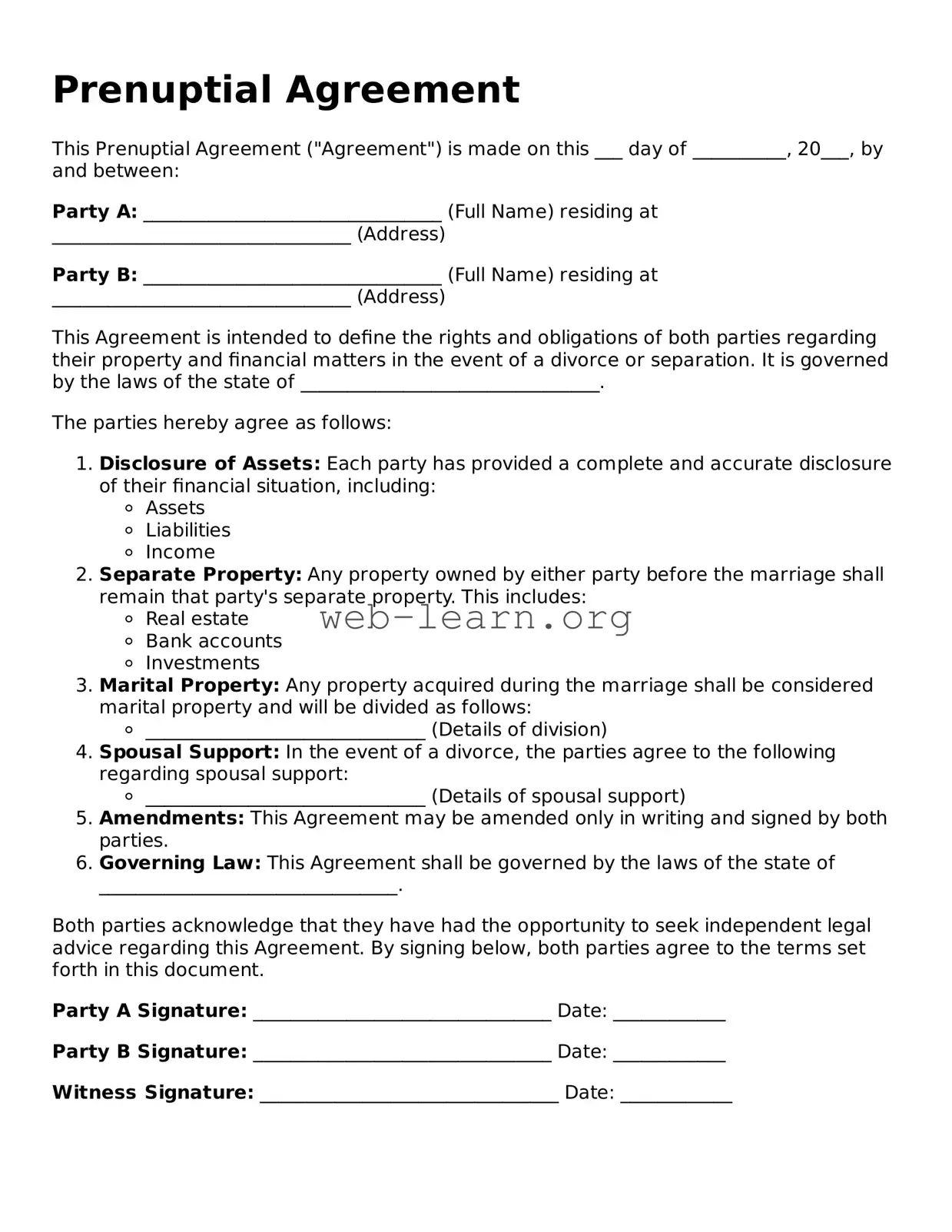
Prenuptial Agreement

This Prenuptial Agreement ("Agreement") is made on this ___ day of __________, 20___, by and between:

Party A: ________________________________ (Full Name) residing at ________________________________ (Address)

Party B: ________________________________ (Full Name) residing at ________________________________ (Address)

This Agreement is intended to define the rights and obligations of both parties regarding their property and financial matters in the event of a divorce or separation. It is governed by the laws of the state of ________________________________.

The parties hereby agree as follows:

  1. Disclosure of Assets: Each party has provided a complete and accurate disclosure of their financial situation, including:
    • Assets
    • Liabilities
    • Income
  2. Separate Property: Any property owned by either party before the marriage shall remain that party's separate property. This includes:
    • Real estate
    • Bank accounts
    • Investments
  3. Marital Property: Any property acquired during the marriage shall be considered marital property and will be divided as follows:
    • ______________________________ (Details of division)
  4. Spousal Support: In the event of a divorce, the parties agree to the following regarding spousal support:
    • ______________________________ (Details of spousal support)
  5. Amendments: This Agreement may be amended only in writing and signed by both parties.
  6. Governing Law: This Agreement shall be governed by the laws of the state of ________________________________.

Both parties acknowledge that they have had the opportunity to seek independent legal advice regarding this Agreement. By signing below, both parties agree to the terms set forth in this document.

Party A Signature: ________________________________ Date: ____________

Party B Signature: ________________________________ Date: ____________

Witness Signature: ________________________________ Date: ____________

File Characteristics

Fact Name Description
Definition A prenuptial agreement is a contract between two individuals before marriage that outlines the division of assets and responsibilities in case of divorce.
Purpose It helps to clarify financial rights and responsibilities, providing peace of mind for both parties.
State-Specific Forms Each state may have its own specific requirements and forms for prenuptial agreements.
Governing Law The laws governing prenuptial agreements vary by state. For example, California Family Code Section 1610 governs agreements in California.
Enforceability For a prenuptial agreement to be enforceable, it must be in writing and signed by both parties.
Full Disclosure Both parties should fully disclose their assets and debts to ensure fairness and transparency.
Legal Counsel It is recommended that both parties seek independent legal counsel before signing the agreement.
Changes Any changes to the agreement must be made in writing and signed by both parties to be valid.
Revocation A prenuptial agreement can be revoked or amended after marriage, but this must also be done in writing.
Common Misconceptions Many people believe prenuptial agreements are only for the wealthy, but they can benefit anyone entering a marriage.

Detailed Guide for Filling Out Prenuptial Agreement

Filling out a Prenuptial Agreement form is an important step for couples considering marriage. This process allows you to outline your financial rights and responsibilities, ensuring clarity and protection for both parties. Follow these steps carefully to complete the form accurately.

  1. Gather necessary information: Collect details about your assets, debts, income, and any other relevant financial information.
  2. Identify both parties: Clearly state the full legal names of both partners and include any relevant identifying information, such as dates of birth.
  3. Outline assets: List all assets owned individually and jointly, including property, bank accounts, investments, and personal belongings.
  4. Disclose debts: Provide a comprehensive list of debts for both parties, including loans, credit card debts, and mortgages.
  5. Discuss income: Include current income sources for both partners, such as salaries, bonuses, and any other financial contributions.
  6. Define property rights: Clearly articulate how property will be divided in the event of a divorce or separation.
  7. Include provisions: Consider any specific conditions or agreements, such as spousal support or other financial arrangements.
  8. Review the agreement: Both parties should carefully read the completed form to ensure accuracy and mutual understanding.
  9. Seek legal advice: It’s advisable to consult with a lawyer to review the agreement and ensure it meets legal standards.
  10. Sign the document: Both partners must sign the agreement in the presence of a notary public or witnesses, depending on state requirements.

Obtain Answers on Prenuptial Agreement

  1. What is a prenuptial agreement?

    A prenuptial agreement, often referred to as a "prenup," is a legal document created by two individuals before they marry. It outlines the distribution of assets, debts, and financial responsibilities in the event of divorce or separation. This agreement helps clarify expectations and can protect individual interests, especially when one or both parties have significant assets, children from previous relationships, or specific financial concerns.

  2. Why should couples consider a prenuptial agreement?

    Couples may consider a prenuptial agreement for several reasons:

    • To protect individual assets acquired before the marriage.
    • To clarify financial responsibilities during the marriage.
    • To ensure that children from previous relationships are provided for.
    • To avoid lengthy and costly disputes in the event of divorce.

    In essence, a prenup can foster open communication about financial matters and set clear expectations for both parties.

  3. What should be included in a prenuptial agreement?

    A prenuptial agreement can cover a variety of topics, including:

    • Division of property and assets acquired during the marriage.
    • Debt responsibilities for both parties.
    • Spousal support or alimony provisions.
    • How to handle financial matters during the marriage.
    • Provisions for any children from previous relationships.

    It is important that both parties fully disclose their financial situations to ensure fairness and transparency in the agreement.

  4. How can a prenuptial agreement be enforced?

    For a prenuptial agreement to be enforceable, it must meet certain legal requirements. These include:

    • Both parties must voluntarily agree to the terms without coercion.
    • Each party should have independent legal representation to ensure their rights are protected.
    • The agreement must be in writing and signed by both parties.
    • The terms must be fair and reasonable at the time of signing.

    If these conditions are met, courts generally uphold prenuptial agreements unless there is evidence of fraud, duress, or unconscionability.

  5. Can a prenuptial agreement be modified after marriage?

    Yes, a prenuptial agreement can be modified after marriage. Both parties must agree to any changes, and these modifications should be documented in writing and signed by both individuals. It is advisable to consult legal counsel when making changes to ensure that the revised agreement remains valid and enforceable.

Common mistakes

When individuals fill out a Prenuptial Agreement form, several common mistakes can arise. One frequent error is failing to fully disclose all assets and debts. Transparency is crucial in these agreements. If one party does not provide complete financial information, it could lead to disputes later on. This lack of disclosure can undermine the entire agreement.

Another mistake involves not considering future financial changes. People often focus solely on their current financial situation without contemplating potential changes, such as salary increases, inheritances, or investments. A well-crafted prenuptial agreement should account for these possibilities to remain relevant over time.

Many individuals also overlook the importance of having the agreement reviewed by separate legal counsel. Both parties should seek independent legal advice to ensure that their rights and interests are adequately protected. Failing to do so may lead to questions about the agreement's enforceability.

Additionally, some people rush through the process without fully understanding the terms and implications of the agreement. It is essential to take the time to read and comprehend each section. Rushing can result in overlooking critical details that may impact one’s financial future.

Another common error is using generic templates without customization. While templates can provide a useful starting point, they often do not address the unique circumstances of each couple. Tailoring the agreement to fit specific needs and situations can prevent misunderstandings and conflicts later.

Lastly, individuals sometimes fail to update the agreement after significant life changes, such as the birth of children or changes in financial status. Regularly reviewing and amending the prenuptial agreement ensures it remains relevant and reflective of the couple's current situation.

Documents used along the form

A Prenuptial Agreement is a crucial document for couples entering marriage, as it outlines the distribution of assets and responsibilities in the event of a divorce or separation. Alongside this agreement, several other forms and documents may be relevant to ensure a comprehensive understanding of the couple's legal and financial situation. Below is a list of common documents often used in conjunction with a Prenuptial Agreement.

  • Financial Disclosure Statement: This document details each party's assets, debts, income, and expenses. It promotes transparency and fairness in the negotiation of the prenuptial agreement.
  • Postnuptial Agreement: Similar to a prenuptial agreement, this document is created after marriage. It can address changes in financial circumstances or new agreements that arise during the marriage.
  • Separation Agreement: In the event of a separation, this document outlines how assets and responsibilities will be managed while the couple is living apart. It can serve as a precursor to divorce proceedings.
  • Will: A will specifies how a person's assets will be distributed upon their death. It is essential for ensuring that each party's wishes are honored and that beneficiaries are clearly defined.
  • Trust Documents: These documents establish a trust, which can hold assets for the benefit of one or more parties. Trusts can provide additional protection and management of assets.
  • Power of Attorney: This document allows one person to make financial or medical decisions on behalf of another if they become incapacitated. It is an important tool for managing affairs in emergencies.
  • Health Care Proxy: A health care proxy designates someone to make medical decisions for an individual if they are unable to do so themselves. This ensures that personal health care preferences are respected.
  • Debt Agreement: This document outlines how debts incurred before or during the marriage will be handled. It can clarify responsibilities and prevent disputes in the future.

Utilizing these documents alongside a Prenuptial Agreement can help couples navigate their financial and legal responsibilities more effectively. Each document serves a distinct purpose, contributing to a clearer understanding of rights and obligations in the relationship.

Similar forms

  • Postnuptial Agreement: Similar to a prenuptial agreement, a postnuptial agreement is created after marriage. It outlines the division of assets and responsibilities in the event of a divorce or separation.
  • Separation Agreement: This document details the terms of a couple's separation, including asset division, child custody, and support obligations. It serves to clarify each party's rights and responsibilities.
  • Co-habitation Agreement: For couples living together without marriage, this agreement establishes the terms of their partnership, including property rights and financial responsibilities.
  • Marriage Contract: A broader term that encompasses various agreements made before or during marriage, including prenuptial agreements. It can cover a wide range of issues, such as financial arrangements and personal obligations.
  • Divorce Settlement Agreement: This document outlines the terms agreed upon by both parties during a divorce. It includes asset division, alimony, and child support arrangements.
  • Asset Protection Trust: While not a marital agreement, this trust helps protect an individual's assets from creditors and can be used in conjunction with a prenuptial agreement to secure financial interests.
  • Living Will: Although primarily focused on healthcare decisions, a living will can complement a prenuptial agreement by clarifying each partner's wishes regarding medical treatment in case of incapacitation.

Dos and Don'ts

When filling out a Prenuptial Agreement form, it's essential to approach the process carefully. Here are five important things to keep in mind.

  • Do be open and honest about your financial situation. Transparency helps both parties understand each other's assets and debts.
  • Do consult with a legal professional. Having an attorney review the agreement can ensure that it meets legal standards and protects your interests.
  • Do discuss the terms with your partner. Communication is key to creating a fair and mutually agreeable document.
  • Don't rush the process. Take your time to consider all aspects of the agreement before signing.
  • Don't leave important details out. Omitting significant assets or debts can lead to misunderstandings and complications later on.

By following these guidelines, you can create a solid foundation for your prenuptial agreement.

Misconceptions

Many people have misconceptions about prenuptial agreements. These misunderstandings can lead to unnecessary stress and confusion. Here are eight common misconceptions explained.

  • Prenuptial agreements are only for the wealthy. Many believe that only rich individuals need a prenup. In reality, anyone with assets, debts, or children can benefit from this agreement.
  • Prenups are only about money. While financial matters are a significant part, prenuptial agreements can also address issues like property division, debt responsibility, and even child custody arrangements.
  • Prenuptial agreements are unromantic. Some think that discussing a prenup undermines the love and commitment in a relationship. However, having these discussions can strengthen communication and trust between partners.
  • Prenups are only for divorce situations. Many assume that prenuptial agreements are only useful if a marriage ends. They can also provide clarity and peace of mind during the marriage, helping couples navigate financial decisions together.
  • Prenuptial agreements are not legally binding. This is false. When properly drafted and executed, prenuptial agreements are enforceable in court, provided they meet certain legal requirements.
  • Only one spouse needs to hire a lawyer. It's a common belief that only one partner needs legal representation. Both parties should have independent legal counsel to ensure that their rights are protected and that the agreement is fair.
  • Prenups can cover anything. While many topics can be included, some issues like child support and custody arrangements may not be enforceable in a prenup, as courts prioritize the best interests of the child.
  • Prenups are permanent and cannot be changed. This misconception overlooks the fact that prenuptial agreements can be amended or revoked if both parties agree to the changes in writing.

Understanding these misconceptions can help couples approach prenuptial agreements with a clearer perspective and make informed decisions about their future.

Key takeaways

When considering a prenuptial agreement, it's essential to understand its purpose and implications. Here are some key takeaways to keep in mind:

  1. Clarify your intentions: A prenuptial agreement can help outline each partner's expectations regarding finances and property.
  2. Discuss openly: Communication is crucial. Both partners should discuss their financial situations and goals before drafting the agreement.
  3. Seek legal advice: Each partner should consult their own attorney to ensure that their rights are protected and that the agreement is fair.
  4. Be transparent: Full disclosure of assets and debts is vital. Hiding information can lead to the agreement being challenged later.
  5. Consider future changes: Address how changes in circumstances, such as children or significant income shifts, will be handled in the agreement.
  6. Timing matters: Draft the agreement well in advance of the wedding. Last-minute agreements can be seen as coercive.
  7. Keep it simple: While it can be detailed, clarity is key. Avoid overly complex language that could lead to misunderstandings.
  8. Review periodically: Life changes, and so should your agreement. Revisit it every few years or after major life events.
  9. Understand the laws: Familiarize yourself with your state’s laws regarding prenuptial agreements, as they can vary significantly.
  10. Sign with care: Ensure both parties sign the agreement voluntarily and without pressure. This can help uphold its validity in court.

By keeping these points in mind, couples can navigate the process of creating a prenuptial agreement more effectively, leading to a clearer understanding of their financial future together.