The Power of Attorney form is a crucial legal document that empowers one person to act on behalf of another in various matters, from financial decisions to healthcare choices. This form can be tailored to fit specific needs, allowing the principal—the person granting authority—to designate an agent who will manage their affairs if they become incapacitated or unable to make decisions. It can be general, granting broad powers, or limited, focusing on specific tasks. Understanding the implications of this document is vital, as it not only provides flexibility in managing personal and financial matters but also ensures that one's wishes are respected during times of need. The form typically requires signatures, dates, and, in some cases, witnesses or notarization to be legally binding. Knowing how to create and execute a Power of Attorney can provide peace of mind, ensuring that your interests are protected and your voice is heard, even when you cannot speak for yourself.
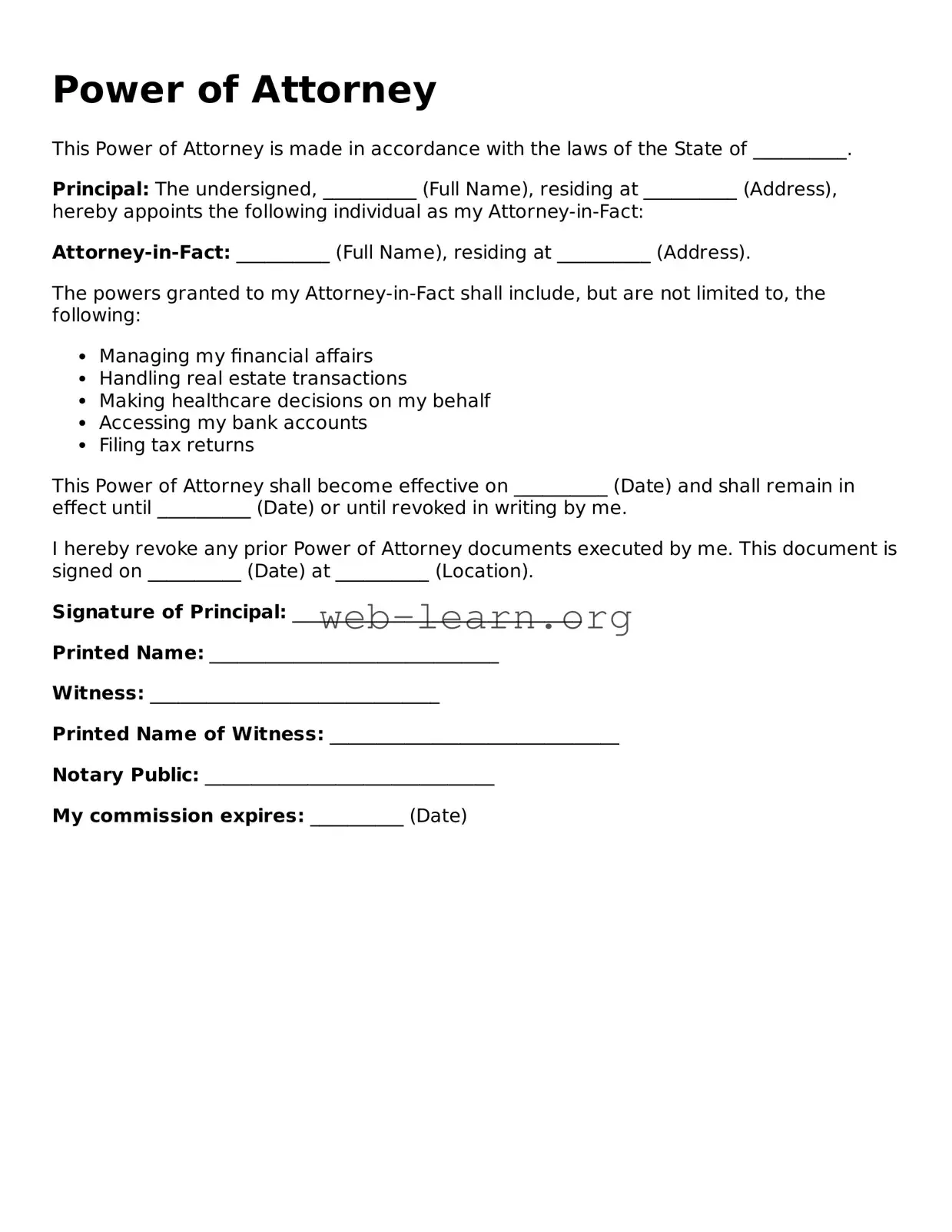
Power of Attorney
This Power of Attorney is made in accordance with the laws of the State of __________.
Principal: The undersigned, __________ (Full Name), residing at __________ (Address), hereby appoints the following individual as my Attorney-in-Fact:
Attorney-in-Fact: __________ (Full Name), residing at __________ (Address).
The powers granted to my Attorney-in-Fact shall include, but are not limited to, the following:
This Power of Attorney shall become effective on __________ (Date) and shall remain in effect until __________ (Date) or until revoked in writing by me.
I hereby revoke any prior Power of Attorney documents executed by me. This document is signed on __________ (Date) at __________ (Location).
Signature of Principal: _______________________________
Printed Name: _______________________________
Witness: _______________________________
Printed Name of Witness: _______________________________
Notary Public: _______________________________
My commission expires: __________ (Date)
| Fact Name | Description |
|---|---|
| Definition | A Power of Attorney (POA) form allows an individual (the principal) to authorize another person (the agent) to act on their behalf in legal or financial matters. |
| Types of POA | There are several types of POA, including General, Limited, Durable, and Medical. Each serves different purposes and has varying levels of authority. |
| Durability | A Durable Power of Attorney remains effective even if the principal becomes incapacitated. This is crucial for long-term planning. |
| Revocation | The principal can revoke a Power of Attorney at any time, as long as they are mentally competent. This revocation must be documented. |
| State-Specific Forms | Each state has its own specific requirements and forms for POA. For example, California's POA is governed by the California Probate Code. |
| Witness and Notarization | Many states require that the POA be signed in the presence of witnesses and/or notarized to be legally valid. |
| Agent's Responsibilities | The agent is obligated to act in the best interest of the principal and must keep accurate records of all transactions made on their behalf. |
| Limitations | Some actions, such as making a will or changing beneficiaries, may not be permitted under a Power of Attorney, depending on state laws. |
After obtaining the Power of Attorney form, you'll need to complete it carefully. Ensure that all information is accurate and clearly written. Once filled out, the next steps typically involve signing the document and possibly having it notarized, depending on your state’s requirements.
What is a Power of Attorney (POA)?
A Power of Attorney is a legal document that allows one person, known as the principal, to grant another person, called the agent or attorney-in-fact, the authority to act on their behalf. This authority can cover a wide range of decisions, including financial matters, legal issues, and healthcare decisions, depending on how the document is structured.
Why would someone need a Power of Attorney?
Individuals often establish a Power of Attorney to ensure that their affairs are managed according to their wishes in case they become incapacitated or unable to make decisions for themselves. This can provide peace of mind for both the principal and their loved ones, knowing that someone they trust can step in if necessary.
What are the different types of Power of Attorney?
How do I create a Power of Attorney?
To create a Power of Attorney, you typically need to follow these steps:
Can I revoke a Power of Attorney?
Yes, a Power of Attorney can be revoked at any time as long as the principal is mentally competent. To revoke, the principal should create a written notice of revocation and inform the agent and any relevant institutions or individuals who may have relied on the original document.
What happens if I do not have a Power of Attorney?
If an individual becomes incapacitated without a Power of Attorney, their family may need to go through a court process to appoint a guardian or conservator. This process can be time-consuming and may not reflect the individual's wishes, making it beneficial to establish a POA in advance.
Can I be both the principal and the agent?
In some cases, individuals can designate themselves as their own agent while they are still able to make decisions. However, this may not be practical or advisable for situations where the individual becomes incapacitated, as the agent role is intended to be a backup for when the principal is unable to act.
Are there any limitations to the Power of Attorney?
Yes, there are limitations. A Power of Attorney cannot grant the agent the authority to make decisions that are not legally permissible, such as changing a will or making decisions after the principal's death. Additionally, certain states may have specific regulations governing the powers granted.
How can I ensure my Power of Attorney is valid?
To ensure validity, follow your state’s requirements for creating a Power of Attorney. This typically includes having the document signed, dated, and notarized. It's also advisable to consult with a legal professional to confirm that the document meets all necessary legal standards.
Filling out a Power of Attorney (POA) form can seem straightforward, but many people make common mistakes that can lead to confusion or legal issues. One frequent error is failing to specify the powers granted. It’s essential to clearly outline what decisions the agent can make on your behalf. Without this clarity, the agent may not have the authority to act when needed.
Another mistake is not signing the document properly. Each state has specific requirements for signatures, and overlooking these can invalidate the POA. Ensure that you sign the form in the presence of a notary or witnesses if required by your state laws. This step is crucial for the document's acceptance.
Many individuals also forget to date the form. A missing date can create uncertainty about when the powers take effect. This oversight can lead to complications, especially if the POA is intended for future use. Always include the date to avoid any confusion.
Not informing the agent about their responsibilities is another common mistake. It’s important to have a conversation with the person you choose as your agent. They should understand what is expected of them and the scope of their authority. This conversation helps ensure that your wishes are honored.
People sometimes choose an agent who may not be the best fit for the role. Selecting someone who is trustworthy and capable of handling financial or medical decisions is crucial. Think carefully about who you choose; this person will have significant power over your affairs.
Lastly, many fail to review and update the Power of Attorney regularly. Life changes, such as marriage, divorce, or the death of an agent, can affect your POA. Regularly revisiting this document ensures it reflects your current wishes and circumstances. Keeping it up to date can prevent potential conflicts in the future.
When preparing a Power of Attorney (POA) document, it is essential to understand that several other forms and documents may complement it, ensuring a comprehensive approach to managing legal affairs. Each of these documents serves a specific purpose and can enhance the effectiveness of the POA.
Each of these documents plays a vital role in ensuring that an individual's wishes are respected and that their affairs are managed according to their preferences. Understanding their functions can help create a robust legal framework that safeguards personal and financial interests.
When filling out a Power of Attorney form, it’s important to approach the task carefully. This document grants someone else the authority to make decisions on your behalf, so accuracy and clarity are essential. Here are some guidelines to help you navigate the process effectively.
By following these dos and don’ts, you can help ensure that your Power of Attorney form is filled out correctly and meets your needs. This important document can provide peace of mind, knowing that your affairs will be handled according to your wishes.
Power of Attorney (POA) forms can be confusing, and many people hold misconceptions about what they entail. Here are six common misunderstandings:
This is not true. A Power of Attorney allows you to designate someone to act on your behalf, but you can still manage your own affairs as long as you are capable. You can also revoke the POA at any time.
In reality, there are different types of Power of Attorney forms, such as durable, springing, and general. Each serves different purposes and has varying levels of authority.
This is a misconception. You can revoke or change a Power of Attorney whenever you wish, as long as you are mentally competent to do so.
While it's advisable to consult a lawyer to ensure your POA meets legal requirements, you can create one yourself using templates available online. Just make sure to follow your state’s laws.
This depends on the authority granted in the Power of Attorney document. You can specify what powers your agent has, so they may not have blanket authority to make all decisions.
This is incorrect. A Power of Attorney can cover various areas, including healthcare decisions. You can create a specific POA for medical purposes, known as a healthcare proxy.
Understanding these misconceptions can help you make informed decisions about using a Power of Attorney and ensure your wishes are respected.
Filling out and using a Power of Attorney form can be straightforward if you keep a few important points in mind. Here are some key takeaways:
By keeping these points in mind, you can ensure that your Power of Attorney is set up correctly and serves your needs effectively.