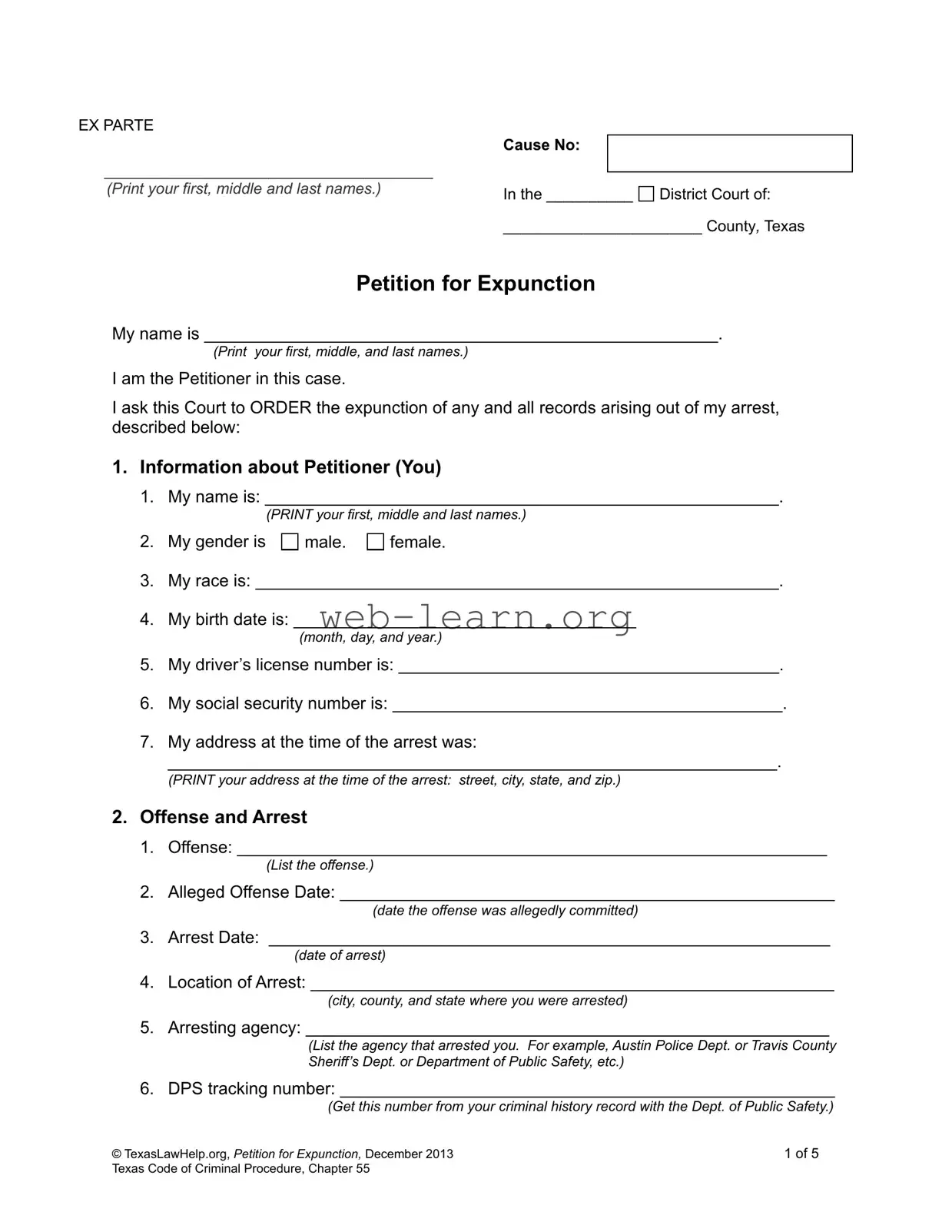
The Petition for Expunction in Texas serves as a formal request to the court for the removal of arrest records under specific circumstances. This form is designed for individuals seeking to clear their criminal history when they meet certain eligibility criteria. The document requires personal information from the petitioner, including their full name, gender, race, birth date, driver's license number, and social security number. Additionally, details about the arrest are necessary, such as the offense charged, the date of the alleged offense, the arrest date, and the arresting agency. The petitioner must also provide information regarding the court and cause numbers associated with the case. Grounds for expunction include scenarios where the petitioner was never charged, had their charges dismissed, was acquitted, received a pardon, or has a recommendation for expunction from the prosecutor. Furthermore, the form requires the petitioner to identify any agencies that may hold records related to their arrest. Finally, the petition concludes with a request for the court to order the return or destruction of records, ensuring that the petitioner can move forward without the burden of a past arrest record.

EX PARTE
|
Cause No: |
|
|
______________________________________ |
|
|
|
|
|
|
|
(Print your first, middle and last names.) |
In the __________ |
District Court of: |
|
|
|||
_______________________ County, Texas
Petition for Expunction
My name is ______________________________________________________.
(Print your first, middle, and last names.)
I am the Petitioner in this case.
I ask this Court to ORDER the expunction of any and all records arising out of my arrest, described below:
1. Information about Petitioner (You)
1. My name is: ______________________________________________________.
(PRINT your first, middle and last names.)
2. My gender is
male.
female.
3.My race is: _______________________________________________________.
4.My birth date is: ____________________________________
(month, day, and year.)
5.My driver’s license number is: ________________________________________.
6.My social security number is: _________________________________________.
7.My address at the time of the arrest was:
________________________________________________________________.
(PRINT your address at the time of the arrest: street, city, state, and zip.)
2.Offense and Arrest
1. Offense: ______________________________________________________________
|
(List the offense.) |
|
2. |
Alleged Offense Date: ____________________________________________________ |
|
|
(date the offense was allegedly committed) |
|
3. |
Arrest Date: ___________________________________________________________ |
|
|
(date of arrest) |
|
4. |
Location of Arrest: _______________________________________________________ |
|
|
(city, county, and state where you were arrested) |
|
5. |
Arresting agency: _______________________________________________________ |
|
|
(List the agency that arrested you. For example, Austin Police Dept. or Travis County |
|
|
Sheriff’s Dept. or Department of Public Safety, etc.) |
|
6. |
DPS tracking number: ____________________________________________________ |
|
|
(Get this number from your criminal history record with the Dept. of Public Safety.) |
|
© TexasLawHelp.org, Petition for Expunction, December 2013 |
1 of 5 |
|
Texas Code of Criminal Procedure, Chapter 55 |
|
|

7.(If you have a court cause number or paid a fine you were probably charged with an offense. Talk to an attorney if you’re not sure.)
(Check one.)
I have not been charged with any offense relating to my arrest. (Skip 8.)
I was charged with an offense relating to my arrest. (Go to 8.)
8.(The official charges related to your arrest may have started in one court, and been assigned a cause number, but later transferred to another court, and assigned a different cause number. You need to list the information about all courts and cause numbers that were assigned to your case.)
My charges were originally filed in __________________________ court, and assigned
the following cause number: ____________________________________.
My charges were finally prosecuted in: (Check one.)
the original court, with the same cause number.
the following court: ______________________________________________, with
the following cause number: __________________________________________.
9. My arrest was not pursuant to a probation revocation warrant. of an arrest that occurs pursuant to a probation revocation warrant.)
3. Grounds for Expunction (Check the box of the ground that applies to your case.)
3a.
Never Charged (You were never charged with any offense relating to your arrest, and you meet at least one of the following conditions.)
I have not been charged for an offense relating to my arrest and:
(Check all that apply.)
I was arrested for a Class C misdemeanor and it has been at least 180 days since the arrest. I have not been charged with a felony arising out of the same transaction for which I was arrested. **(See note below.)
I was arrested for a Class A or B misdemeanor and it has been at least one year since the arrest. I have not been charged with a felony arising out of the same transaction for which I was arrested. **(See note below.)
I was arrested for a felony and It has been at least three years since the arrest. **(See note below.)
The prosecuting attorney has certified that my arrest records and files are not needed for use in any criminal investigation or prosecution, including an investigation or prosecution of another person.
The Statute of Limitations has run completely for all offenses that could be charged from the arrest. This includes any tolling period that may have occurred. (See Article 12 of the Texas Code of Criminal Procedure for a complete list of the Statute if Limitations for all felonies. The Statute of Limitations for all misdemeanors is two years. The Statute of Limitations begins on the date of the alleged offense. Certain conditions may temporarily stop the Statute of Limitations. Ask an attorney to help you determine if the Statute of Limitations has completely run in your case.)
**(If you ask the Court to expunge your arrest records under this ground before the Statute of Limitations has run, the Court will allow the arresting law enforcement agency and prosecutor to keep your arrest records unless you also file a letter from the prosecutor certifying that your arrest records and files are not needed for use in any criminal investigation or prosecution.)
© TexasLawHelp.org, Petition for Expunction, December 2013 |
2 of 5 |
Texas Code of Criminal Procedure, Chapter 55 |
|

3b. Dismissed (Your charges were dismissed, and you meet the following conditions.)
My charges were dismissed or quashed on ___________________________________.
(month, day and year that the charges were dismissed.)
I have attached a copy of the order dismissing or quashing the charges to this Petition.
I have been released, and the charge against me has not resulted in a final conviction, and is no longer pending.
I have not submitted to any kind of court ordered supervision for the offense, unless the offense was a Class C misdemeanor.
I did not intentionally or knowingly abscond (jump bail) from the court’s jurisdiction after being released on bail following this arrest.
My charges were dismissed or quashed:
(Check one.)
because I completed a pretrial intervention program authorized under Section 76.011, Government Code or because I was charged due to mistake, false information, or other similar reason indicating absence of probable cause to believe I committed the offense or because the indictment or information was void.
and prosecution is no longer possible because the Statute of Limitations has run completely for all offenses that could be charged from the arrest. This includes any tolling period that may have occurred. (See Article 12 of the Texas Code of Criminal Procedure for a complete list of the Statute if Limitations for all felonies. The Statute of Limitations for all misdemeanors is two years. The Statute of Limitations begins on the date of the alleged offense. Certain conditions may temporarily stop the Statute of Limitations. Ask an attorney to help you determine if the Statute of Limitations has completely run in your case.)
3c.
Acquitted (You were acquitted of your charges.)
(Check one)
I was acquitted by the trial court. I was not convicted of another offense occurring during this same arrest/alleged criminal episode. No other offense can be charged against me out of this same arrest/ alleged criminal episode. I have attached a copy of the judgment of acquittal to this Petition.
I was acquitted by the Court of Criminal Appeals or a court of appeals and the period for granting a petition for discretionary review has expired. I was not convicted of another offense occurring during this same arrest/alleged criminal episode. No other offense can be charged against me out of this same arrest/ alleged criminal episode. I realize that it is within this Court’s discretion to expunge my arrest record. I am asking this court to expunge my records. I have attached a copy of the judgment of acquittal to this Petition.
3d. Pardoned or Granted Relief Based on Actual Innocence (You were pardoned by the governor or otherwise granted relief by a court based on your actual innocence.)
(Check one.)
I was convicted, but later pardoned. I have attached a copy of the pardon to this Petition.
I was convicted, but later pardoned or otherwise granted relief based on my actual innocence. I have attached a copy of the pardon or court order to this Petition. The
© TexasLawHelp.org, Petition for Expunction, December 2013 |
3 of 5 |
Texas Code of Criminal Procedure, Chapter 55 |
|

pardon or court order clearly shows on its face that it was granted based on my actual innocence.
3e. Prosecutor Recommends Expunction
I have not been tried for the offense for which I was arrested and the prosecutor, authorized to prosecute the offense for which I was arrested, recommends the records of the arrest be expunged.
The prosecuting attorney has recommended that the records of my arrest be expunged.
4. Agencies with Records
I have reason to believe that the following named officials, agencies, and public entities have files or records subject to expunction and should be served with notice of this Petition
(List the NAMES and ADDRESSES of all officials, agencies and public entities that may have files or records of your arrest. You can find examples of agencies that may be included in a Travis County case in the information brochure for expunctions found on www.TexasLawHelp.org .)
(If you aren’t sure which agencies you should list in your petition, consult with an attorney for legal advice. Attach additional sheets if necessary)
© TexasLawHelp.org, Petition for Expunction, December 2013 |
4 of 5 |
Texas Code of Criminal Procedure, Chapter 55 |
|

5. Prayer
I ask the Court to set the case for hearing, and after giving reasonable notice to each official or agency or other entity named in Paragraph 4, order the official, agency or entity to:
1.return all records concerning this arrest to the Court for delivery to me; or if removing the records is not practical, to destroy the records and notify the Court of their destruction, and
2.delete from its public records all index references to the records and files that are subject to the expunction order, and
3.direct any state agency that sent information concerning the arrest to a central federal depository to request the depository to return all records and files subject to the expunction order.
Respectfully submitted,
Petitioner’s signatureDate
_______________________________________________ |
( |
) |
|
||
Petitioner’s name (print) |
|
|
|
Phone number |
|
|
|
|
|
|
|
Mailing address: |
street address |
city |
state |
zip |
|
VERIFICATION
Before me, the undersigned notary, personally appeared the Petitioner named herein, who, having been duly sworn stated:
“I am the Petitioner in this Petition for Expunction. I have read this Petition for Expunction and all fact stated in it are true and correct.”
Do not sign until you are in front of the notary!
Petitioner signs in front of a notary |
Date |
Notary fills out below.
State of Texas, County of
(Print the name of county where this affidavit is notarized.)
Sworn to and subscribed before me, the undersigned authority, on this date:
by _______________________________________________________________________________.
(Print the first and last names of the person who is signing this affidavit.)
(Notary’s seal here)
Notary’s signature
© TexasLawHelp.org, Petition for Expunction, December 2013 |
5 of 5 |
Texas Code of Criminal Procedure, Chapter 55 |
|
| Fact Name | Fact Description |
|---|---|
| Governing Law | The Petition for Expunction in Texas is governed by Chapter 55 of the Texas Code of Criminal Procedure. |
| Eligibility Criteria | Individuals may be eligible for expunction if they were never charged, their charges were dismissed, they were acquitted, or they were pardoned. |
| Petitioner Information | The form requires personal details such as name, gender, race, birth date, driver's license number, and social security number. |
| Offense Details | Petitioners must provide specific information about the offense, including the alleged offense date, arrest date, and arresting agency. |
| Grounds for Expunction | Petitioners must check the applicable ground for expunction, such as never charged or charges dismissed. |
| Supporting Documents | Petitioners may need to attach supporting documents, such as dismissal orders or judgments of acquittal. |
| Notification Requirement | The petition requires notification to agencies that may have records subject to expunction. |
| Hearing Request | The petitioner asks the court to set a hearing and provide notice to relevant agencies regarding the expunction request. |
| Verification | The petitioner must sign the form in front of a notary public to verify the truthfulness of the information provided. |
| Statute of Limitations | Petitioners must be aware of the statute of limitations for their offenses, which varies depending on the type of offense. |
After completing the Petition for Expunction in Texas, you will need to file it with the appropriate court. Make sure to gather all necessary documents and fees required for submission. The court will then review your petition and schedule a hearing.
A Petition for Expunction is a legal request to remove certain arrest records from public view. If you have been arrested but not convicted, or if your charges were dismissed, you may qualify for expunction. This process allows you to clear your name and helps in moving forward without the burden of a criminal record.
Eligibility varies based on your specific circumstances. Generally, you may qualify if:
It’s essential to check the details of your case against these criteria. If unsure, consulting with a legal professional can provide clarity.
Your Petition must contain specific information, including:
Ensure that all information is accurate and complete to avoid delays in the process.
Once you file your Petition, the court will schedule a hearing. You must notify all relevant agencies that hold records about your arrest. After the hearing, if the court grants your request, it will order the agencies to destroy or return the records. This process can take time, so patience is key.
Filling out the Petition for Expunction in Texas can be a daunting task, and many individuals make mistakes that can delay or derail their application. One common error is failing to provide complete and accurate personal information. When the form asks for your name, gender, race, birth date, driver's license number, and social security number, it’s crucial to ensure that all details are correct. Omitting or misspelling any of this information can lead to complications.
Another frequent mistake involves the section detailing the offense and arrest. Many people either forget to include the arresting agency or provide incorrect details about the location of the arrest. This information is vital for the court to process the expunction request. Additionally, individuals sometimes neglect to check whether they were charged with an offense related to their arrest. This oversight can lead to unnecessary delays in the process.
In the section regarding the grounds for expunction, applicants often misinterpret their eligibility. For instance, some may mistakenly believe they qualify for expunction under the "Never Charged" category when they have, in fact, been charged. It's important to thoroughly understand the criteria for each ground listed. Misunderstanding these requirements can lead to a denial of the petition.
Moreover, failing to attach necessary documentation is another pitfall. For example, if your charges were dismissed, you must include a copy of the order dismissing those charges. Without this critical paperwork, the court may not even consider your petition. Similarly, if you were acquitted, you need to provide a copy of the judgment of acquittal.
Another mistake relates to the Statute of Limitations. Many applicants do not verify whether the Statute of Limitations has run for all offenses related to their arrest. If you file for expunction before this period has expired, the court may deny your request. Understanding the nuances of the Statute of Limitations is essential.
People also often overlook the requirement to list all agencies that may have records subject to expunction. This includes not only the arresting agency but also any other public entities that might hold relevant files. Failing to include all necessary agencies can lead to incomplete processing of your petition.
Finally, a common error occurs during the verification process. Applicants sometimes sign the petition before appearing before a notary, which invalidates the document. The verification must be completed in front of the notary to ensure its legitimacy.
By being aware of these common mistakes, individuals can approach the Petition for Expunction with greater confidence and clarity. Taking the time to carefully review each section and ensuring all information is accurate will significantly improve the chances of a successful expunction.
When pursuing the expunction of criminal records in Texas, several documents and forms may be necessary to support your Petition for Expunction. Each of these forms plays a crucial role in ensuring that the process is completed accurately and effectively. Below is a list of commonly used forms alongside the Petition for Expunction.
Collecting and preparing these documents can significantly impact the success of your expunction petition. Each form serves a specific purpose and contributes to a clearer understanding of your case. Being thorough and organized will help facilitate a smoother process as you work towards clearing your record.
When filling out the Petition Expunction Texas form, it is essential to follow specific guidelines to ensure accuracy and completeness. Below is a list of actions to take and avoid during this process.
Not all arrest records are eligible for expunction. In Texas, you can only expunge records if you were never charged, if your charges were dismissed, or if you were acquitted. Each situation has specific criteria that must be met.
The expunction process is not automatic. After you submit your petition, a court hearing will be scheduled. The court will review your case and decide whether to grant the expunction.
There are time limits for filing an expunction petition. Depending on the type of offense, you may need to wait a specific period before you can file. For example, if arrested for a Class C misdemeanor, you must wait at least 180 days.
While it's possible to file on your own, seeking legal advice can be beneficial. An attorney can help ensure that your petition is completed correctly and that you meet all the necessary requirements.
Here are some key takeaways for filling out and using the Petition Expunction Texas form: