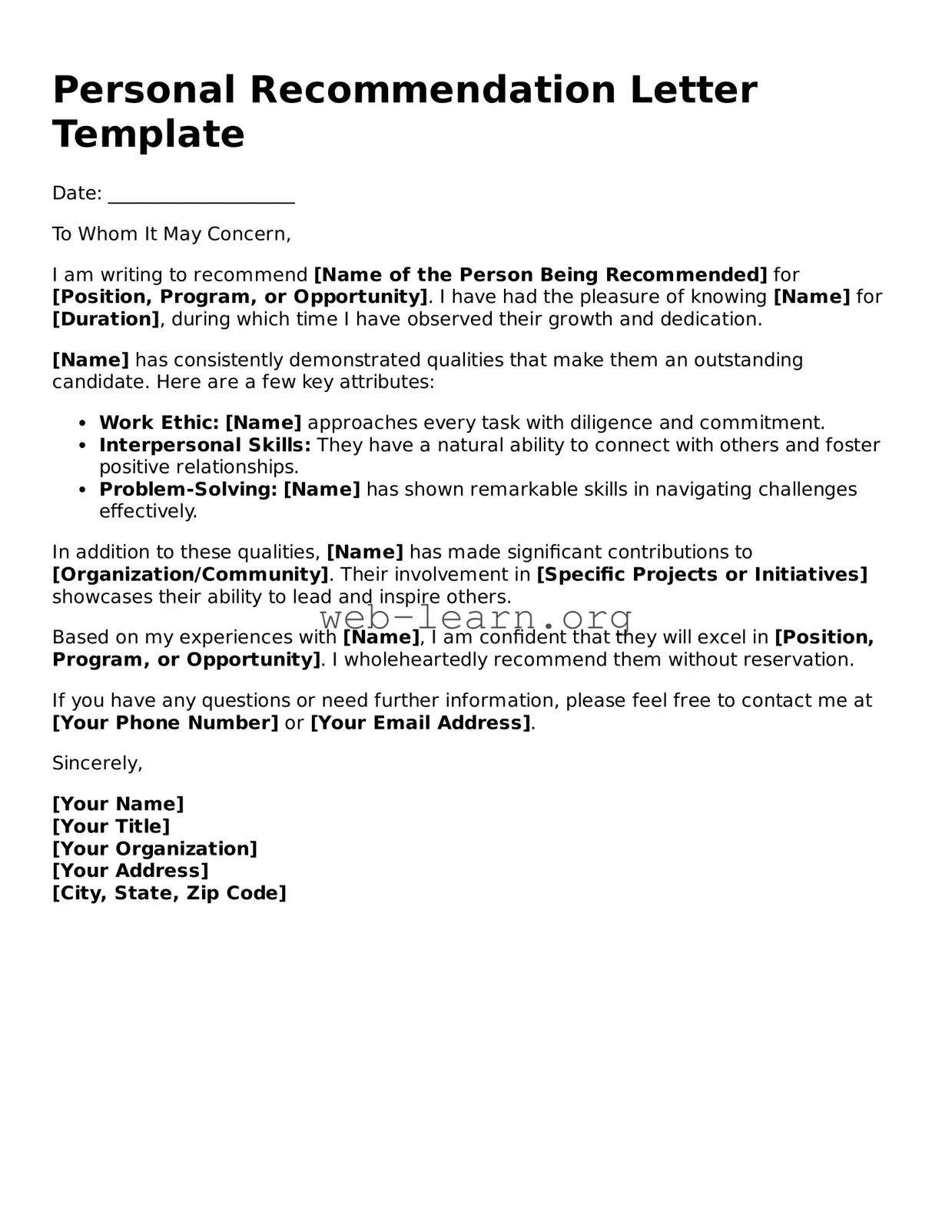
The Personal Recommendation Letter form plays a vital role in various applications, whether for college admissions, job opportunities, or professional endorsements. This form typically requires the recommender to provide insights into the applicant's character, skills, and experiences. It often includes sections for the recommender's contact information, their relationship with the applicant, and specific examples that illustrate the applicant's qualifications and strengths. By outlining the recommender's perspective, the form helps to paint a comprehensive picture of the individual being recommended. Additionally, it may prompt the recommender to discuss the applicant's achievements and potential contributions in a particular field. Overall, the Personal Recommendation Letter form serves as a crucial tool in highlighting an applicant's suitability for their desired path, ensuring that their unique qualities and experiences are effectively communicated to decision-makers.
Personal Recommendation Letter Template
Date: ____________________
To Whom It May Concern,
I am writing to recommend [Name of the Person Being Recommended] for [Position, Program, or Opportunity]. I have had the pleasure of knowing [Name] for [Duration], during which time I have observed their growth and dedication.
[Name] has consistently demonstrated qualities that make them an outstanding candidate. Here are a few key attributes:
In addition to these qualities, [Name] has made significant contributions to [Organization/Community]. Their involvement in [Specific Projects or Initiatives] showcases their ability to lead and inspire others.
Based on my experiences with [Name], I am confident that they will excel in [Position, Program, or Opportunity]. I wholeheartedly recommend them without reservation.
If you have any questions or need further information, please feel free to contact me at [Your Phone Number] or [Your Email Address].
Sincerely,
[Your Name]
[Your Title]
[Your Organization]
[Your Address]
[City, State, Zip Code]
| Fact Name | Description |
|---|---|
| Purpose | A Personal Recommendation Letter is used to provide a reference for an individual, often for job applications, academic admissions, or other opportunities. |
| Format | The letter typically includes the recommender's contact information, a greeting, an introduction, body paragraphs detailing the individual's strengths, and a closing statement. |
| Length | While there is no strict rule, a recommendation letter is usually one page long, consisting of three to four paragraphs. |
| Confidentiality | Some recommendation letters may be confidential, meaning the applicant may not see the letter. This can enhance the letter's credibility. |
| State-Specific Forms | Some states may have specific guidelines or forms for personal recommendations, particularly for professional licensing. Check local regulations for details. |
| Governing Laws | In certain states, laws such as the Fair Credit Reporting Act (FCRA) may apply if the recommendation is used for employment purposes. |
After obtaining the Personal Recommendation Letter form, it’s important to fill it out accurately and completely. This ensures that the recommendation process moves forward smoothly. Follow the steps below to complete the form.
Once the form is completed, ensure it is submitted according to the specified instructions. Double-check for any missing information before sending it off.
A Personal Recommendation Letter is a document that provides a positive endorsement of an individual’s character, skills, and experiences. It is typically written by someone who knows the individual well, such as a teacher, employer, or mentor, and is often used for college applications, job opportunities, or other situations where a personal reference is beneficial.
It is best to choose someone who knows you well and can speak to your strengths and achievements. Ideal candidates include:
The letter should include the following elements:
Typically, a Personal Recommendation Letter should be one page long. It should be concise and focused, ideally consisting of three to five paragraphs that effectively convey the writer's support.
While there is no strict format, a standard business letter format is often used. This includes:
It is advisable to provide the writer with at least two to four weeks to complete the letter. This allows them ample time to reflect on your qualifications and write a thoughtful recommendation.
Yes, it is helpful to provide the writer with a brief overview of your accomplishments, experiences, and the purpose of the letter. This can include your resume, personal statement, or specific points you would like them to address.
Once you receive the Personal Recommendation Letter, review it to ensure it meets your needs. If appropriate, send a thank-you note to the writer, expressing your gratitude for their support and time.
Filling out a Personal Recommendation Letter form can be a daunting task, and many individuals stumble over common pitfalls. One significant mistake is failing to provide specific examples. Instead of merely stating that the person is hardworking or dedicated, it’s essential to illustrate these qualities with real-life instances. This not only adds credibility but also paints a vivid picture for the reader.
Another frequent error is neglecting to tailor the letter to the intended purpose. Each recommendation should reflect the unique qualities of the individual and how they align with the opportunity at hand. A generic letter can come across as insincere and may not resonate with the recipient. Taking the time to customize the content can make a substantial difference.
Many people also overlook the importance of clarity and conciseness. While it’s tempting to elaborate on every positive trait, a recommendation should be focused and to the point. Lengthy letters can lose the reader’s attention. Instead, aim for a well-structured letter that highlights key attributes succinctly.
Another common mistake involves forgetting to proofread. Spelling and grammatical errors can undermine the professionalism of the letter. A recommendation should reflect the writer’s attention to detail. Taking a moment to review the content can prevent these minor issues from detracting from the overall message.
Additionally, some individuals may fail to include their contact information or offer to provide further insights. This omission can leave the recipient without a way to follow up for more information. Including contact details not only shows openness but also demonstrates a commitment to supporting the candidate.
Lastly, it’s crucial to avoid overly vague or ambiguous language. Phrases like “I think” or “maybe” can create uncertainty about the writer’s confidence in the individual’s abilities. Instead, using definitive language can convey strong support and enhance the recommendation’s impact. Clarity in expression is key to making a lasting impression.
A Personal Recommendation Letter is often accompanied by several other forms and documents that help provide a comprehensive view of an individual's qualifications, character, and suitability for a position or opportunity. Below is a list of commonly used documents that may be submitted alongside a Personal Recommendation Letter.
Each of these documents plays a crucial role in the application process. They work together to create a well-rounded picture of the applicant, helping decision-makers assess suitability for the opportunity at hand.
When filling out a Personal Recommendation Letter form, it's important to keep certain best practices in mind. Here’s a straightforward list of what you should and shouldn't do:
Many people have misunderstandings about the Personal Recommendation Letter form. Here are seven common misconceptions, along with clarifications.
While often used for school applications, this form can also be used for job applications, internships, and other opportunities.
Not everyone is qualified to write a strong recommendation. Ideally, the writer should know the applicant well and have relevant experience.
A personal touch can make a recommendation more effective. A conversational tone may resonate better with the reader.
Quality matters more than quantity. A concise, well-written letter can be more impactful than a lengthy one filled with fluff.
Even for less competitive situations, a recommendation letter can provide valuable insights into an applicant's character and skills.
While typed letters are preferred, handwritten notes can also be acceptable, especially if they add a personal touch.
In some cases, it is possible to update or replace a letter if new information comes to light or if the applicant's circumstances change.
When filling out and using the Personal Recommendation Letter form, keep these key takeaways in mind: