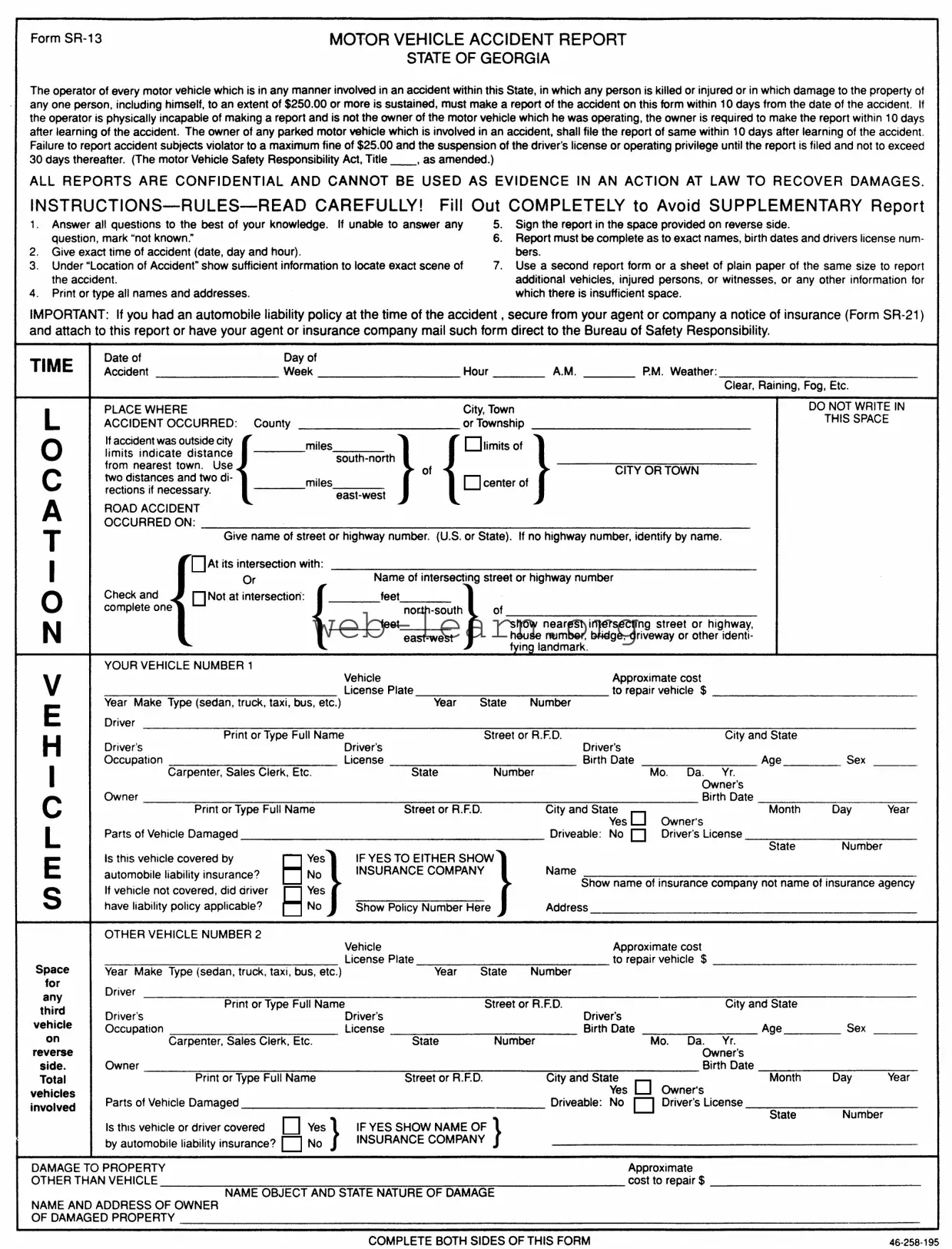
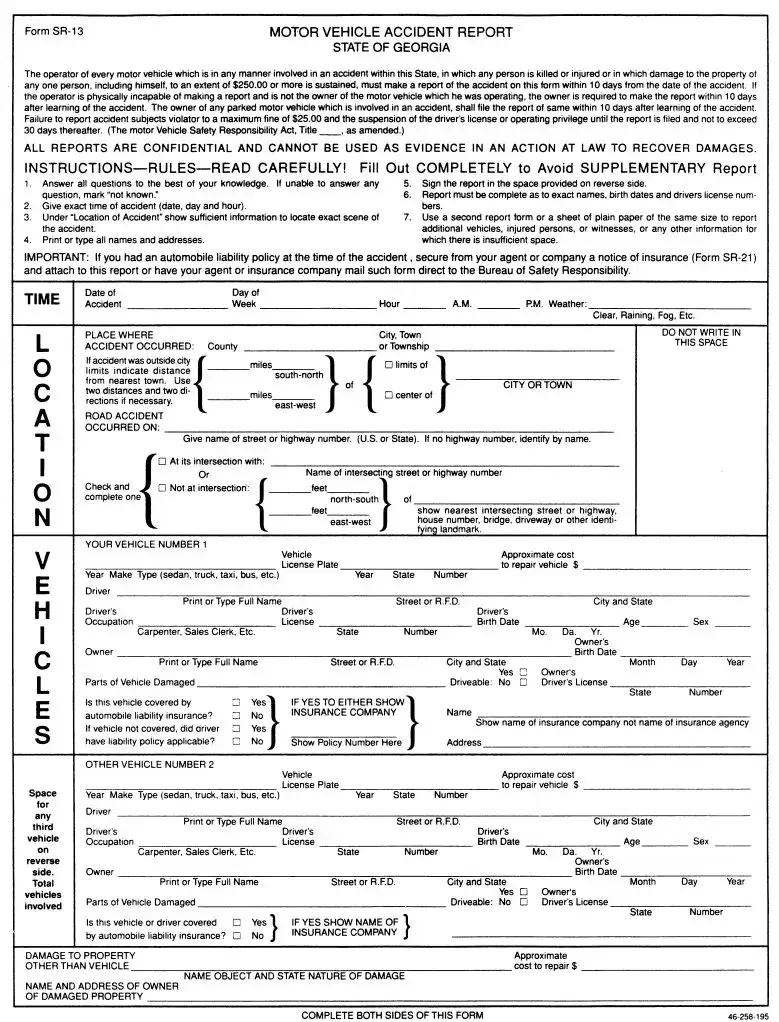
The Personal Accident Report SR 13 GA form is a crucial document for anyone involved in a motor vehicle accident in Georgia. This form must be completed by the operator of any vehicle involved in an accident that results in injury or death, or where property damage exceeds $250. It is essential to file this report within 10 days of the incident to comply with state regulations. If the operator is unable to report due to physical incapacity, the vehicle owner is responsible for submitting the report. This requirement extends to parked vehicles as well, ensuring that all parties involved in an accident are accounted for. Failure to complete and submit the report can lead to fines and potential suspension of driving privileges. The form includes sections for detailed information about the accident, including the time, location, and weather conditions, as well as specifics about the vehicles and individuals involved. It is imperative to answer all questions accurately and completely, as this information is vital for insurance and legal purposes. Additionally, all reports are confidential and cannot be used as evidence in court, which underscores the importance of privacy in these matters. Completing the SR 13 GA form correctly can help streamline the process of addressing the aftermath of an accident, making it easier for all parties to move forward.
| Fact Name | Details |
|---|---|
| Mandatory Reporting | Every motor vehicle operator involved in an accident resulting in injury or property damage of $250 or more must complete the SR-13 form within 10 days. |
| Owner's Responsibility | If the driver cannot report the accident, the vehicle's owner must submit the report within 10 days of learning about the incident. |
| Confidentiality | All reports filed using the SR-13 form are confidential and cannot be used as evidence in legal actions for damages. |
| Penalties for Non-Compliance | Failure to report an accident may result in a fine of up to $25 and possible suspension of the driver's license for up to 30 days. |
| Governing Law | This form is governed by the Motor Vehicle Safety Responsibility Act in Georgia, as outlined in Title 40 of the Official Code of Georgia Annotated (O.C.G.A.). |
Filling out the Personal Accident Report SR 13 Ga form is an important step after an accident. This report needs to be completed within 10 days of the incident. Ensure you have all the necessary information at hand. Below are the steps to help you fill out the form accurately.
After completing the form, ensure that you review all the information for accuracy. Once everything is filled out correctly, submit the report as required.
What is the purpose of the Personal Accident Report SR 13 GA form?
The Personal Accident Report SR 13 GA form is designed to document motor vehicle accidents in the state of Georgia. It is required for any accident that results in injury, death, or property damage exceeding $250. This report must be filed within 10 days of the accident to ensure compliance with state law.
Who is required to file this report?
The operator of any motor vehicle involved in an accident must file the report. If the operator is unable to do so, the vehicle's owner is responsible for submitting the report. Additionally, if a parked vehicle is involved, its owner must also file the report within 10 days of learning about the accident.
What happens if I fail to file the report on time?
Failing to file the report within the specified timeframe can lead to penalties. You may face a maximum fine of $25 and could have your driver’s license suspended until the report is submitted. This suspension can last up to 30 days, emphasizing the importance of timely reporting.
Are the reports confidential?
Yes, all reports filed using the SR 13 GA form are confidential. This means they cannot be used as evidence in any legal action aimed at recovering damages. This confidentiality helps protect the privacy of all parties involved in the accident.
What information do I need to provide on the form?
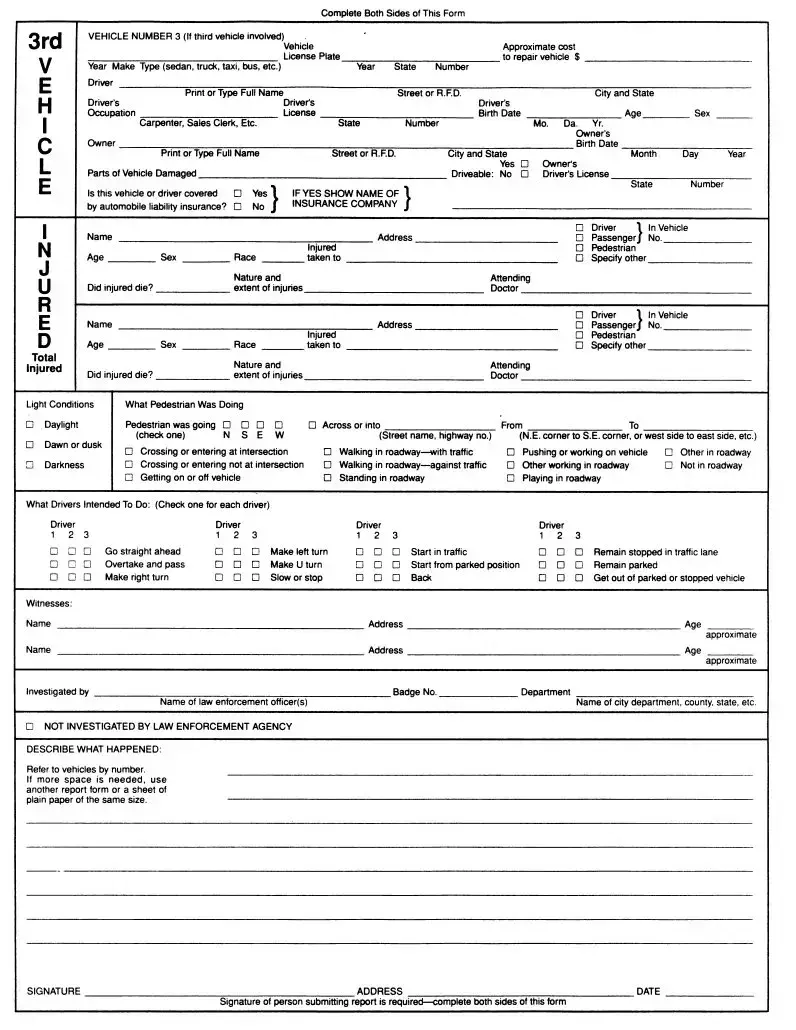
You will need to provide detailed information, including:
What if there is not enough space on the form for all the information?
If you find that there isn’t enough space on the SR 13 GA form, you can use a second report form or a plain sheet of paper of the same size. Just make sure to clearly label and include all necessary details regarding additional vehicles, injured persons, or witnesses.
What should I do if I had an automobile liability policy at the time of the accident?
If you had a liability policy, it’s essential to secure a notice of insurance (Form SR-21) from your insurance agent or company. You can attach this notice to your accident report or have your agent send it directly to the Bureau of Safety Responsibility.
Can I file the report online or do I need to submit a physical form?
As of now, the SR 13 GA form must be completed and submitted in physical form. Ensure that you fill out both sides of the report and sign it before submission. Always check with local authorities for any updates regarding filing options.
When filling out the Personal Accident Report SR-13 GA form, individuals often make several common mistakes that can hinder the accuracy and effectiveness of the report. Awareness of these pitfalls can help ensure that the report is completed correctly and submitted on time.
One frequent error is failing to answer all questions thoroughly. The form requires detailed information about the accident, including the exact time and location. Leaving questions blank or marking them as “not known” without making a reasonable effort to provide accurate information can lead to complications. It is essential to provide as much detail as possible, as this information can be critical in understanding the circumstances of the accident.
Another mistake is neglecting to provide the exact time of the accident. The form requests specific details about the date, day, and hour. Omitting this information can create confusion and may affect the investigation process. Always double-check to ensure that the time is recorded accurately, as it is a key element in establishing the timeline of events.
Additionally, many people forget to sign the report in the designated area. A signature is required to validate the report. Without it, the report may be considered incomplete, leading to delays or potential fines. Always ensure that the report is signed before submission, confirming that the information provided is accurate to the best of your knowledge.
Another common oversight is not providing sufficient information about the accident's location. The form asks for details that can help identify the exact scene, such as street names and landmarks. Vague descriptions can make it difficult for authorities to locate the site of the accident. Providing clear and precise location details is crucial for effective processing of the report.
Lastly, individuals often forget to include information about all vehicles and parties involved in the accident. If there are additional vehicles, injured persons, or witnesses, it's important to use a second report form or a sheet of plain paper to document this information. Failing to do so can lead to incomplete records, which may affect liability determinations and insurance claims.
The Personal Accident Report SR-13 GA form is essential for documenting motor vehicle accidents in Georgia. However, it is often accompanied by other important documents that provide additional information or fulfill specific requirements. Below is a list of four commonly used forms and documents that are frequently associated with the SR-13 GA form.
In summary, while the Personal Accident Report SR-13 GA form is a key document for reporting motor vehicle accidents in Georgia, it is often accompanied by other forms and records that enhance the understanding of the incident. Collecting and submitting these documents can be vital for ensuring a comprehensive and effective response to the accident.
The Personal Accident Report SR 13 GA form is similar to several other documents related to vehicle accidents and personal injury claims. Below is a list of these similar documents and how they relate to the SR 13 form.
When filling out the Personal Accident Report SR-13 GA form, there are important guidelines to follow. Here’s a list of things you should and shouldn't do:
Understanding the Personal Accident Report SR-13 GA form is crucial for anyone involved in a motor vehicle accident in Georgia. However, several misconceptions can lead to confusion about its purpose and requirements. Here are six common misconceptions:
By clarifying these misconceptions, individuals can better navigate the requirements of the Personal Accident Report SR-13 GA form, ensuring compliance and proper documentation following an accident.